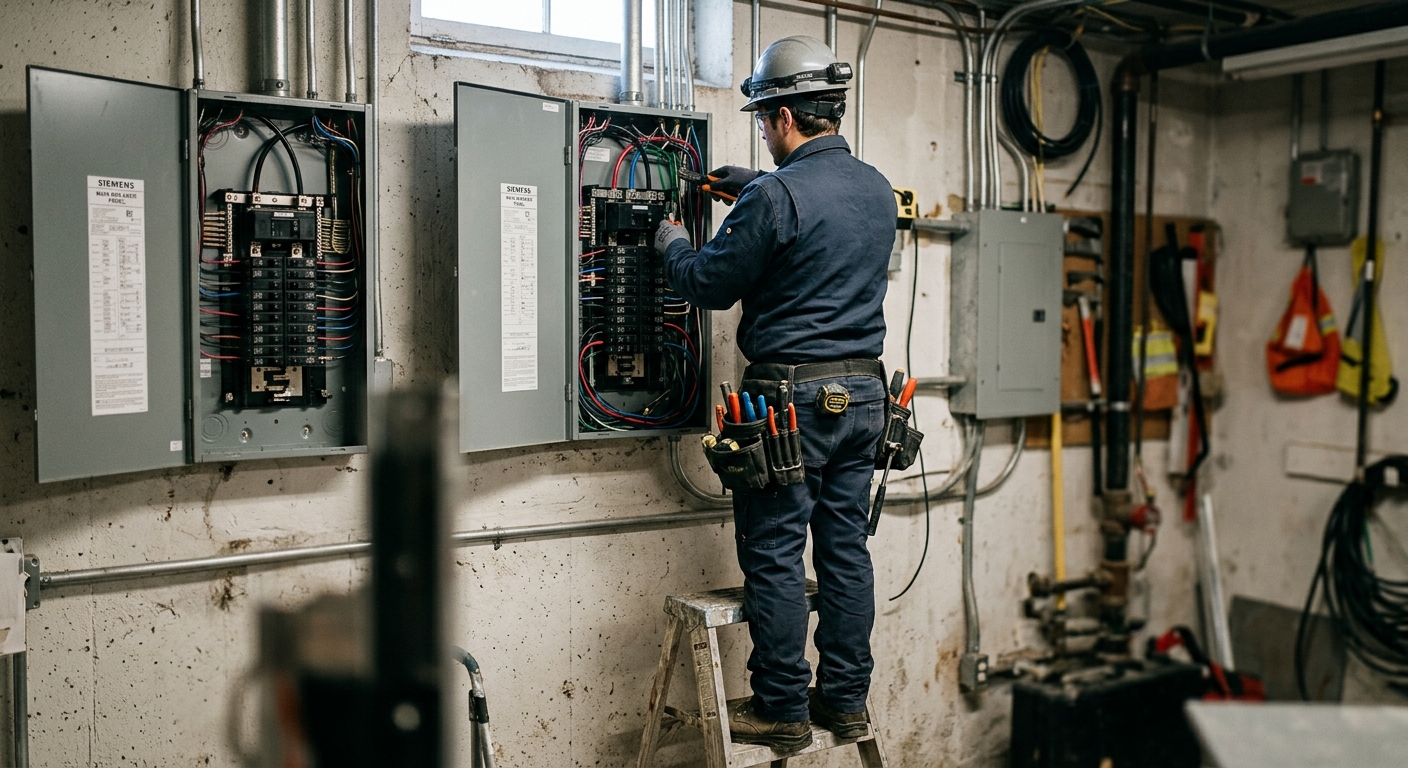
Electrical services and costs in Carstairs
Carstairs homeowners often feel electrical work costs “jump” between quotes, especially in neighbourhoods that include older housing. With just 4,898 people in town (Statistics Canada, 2021 Census) and a strong majority of households owning their homes (1,590 homeowner households, 86.4% of households), many projects are upgrades rather than new construction. A key driver is that 25.8% of homes were built before 1981 (Statistics Canada, 2021 Census)—meaning you’re more likely to run into knob-and-tube wiring, older aluminum branch circuits, and services that were installed for lighter loads than we use today.
In the Calgary region, pricing is shaped by a mix of older stock and acreage-style homes where access, trenching, and load calculations become more involved. Alberta’s heating demand, plus increasing use of air conditioning and heat pumps, pushes panels and branch circuits harder. Labour availability also affects timelines and cost: when EV charger installs and service upgrades surge across Calgary-area communities, contractors have to schedule around permits, inspections, and utility-side work.
In Carstairs, trades typically see extra demand around the older residential pockets near the town core, where homeowners discover wiring issues during renovations, finished basements, or at the same time as they add modern appliances. That’s why many buyers choose a combined approach—service upgrade plus targeted rewiring—to keep the home safe and code-compliant. From there, it’s easier to compare apples-to-apples costs using the table below.
| Service |
Why It's Needed |
Permit Required |
Price Range |
| Panel upgrade — 100A to 200A service |
Modern homes often need more capacity for EV charging, heat pumps, electric stoves, finished basements, and added circuits. |
Yes (major electrical work and service change) |
$2,500–$8,000 |
| EV charger installation (Level 2, 40–50A) |
Dedicated power reduces nuisance breaker trips and supports safe charging for today’s EVs. |
Yes (new circuit/breaker and charger connection) |
$900–$2,500 |
| Knob-and-tube wiring removal and replacement |
Older wiring can be hard to verify and may not meet modern insulation and safety expectations; removal improves reliability and insurability. |
Yes (rewiring and circuit replacement) |
$4,500–$15,000 |
| Aluminum wiring remediation (CO/ALR connectors) |
Aluminum branch circuits require licensed, approved termination methods to reduce overheating and improve long-term connections. |
Yes (alterations to wiring connections/circuits) |
$1,800–$6,500 |
| New dedicated circuit (HVAC, appliance, hot tub) |
Adds capacity and improves safety by preventing overloaded shared circuits for high-draw loads. |
Yes (new circuit work) |
$600–$2,200 |
| Whole-home rewire (older home, full replacement) |
Full replacement is often the safest path when multiple wiring types, lots of circuit failures, and modernization needs overlap. |
Yes (full rewiring and code compliance) |
$8,000–$20,000 |
Prices are estimates only and vary by project scope, site access and material selection.
What affects the price of electrical work in Carstairs
In Carstairs and the wider Calgary region, the same “headline” task can land 30–50% apart between quotes because the scope behind it is rarely identical. Two homeowners might both say “panel upgrade,” but one house has a clear pathway to the service location and straightforward wiring, while the other has inaccessible old wiring, mixed circuit types, and a higher amperage requirement due to EV charging and electric heating.
Housing age is usually the dominant cost driver. Homes built before 1950 are more likely to have knob-and-tube wiring, and while every situation is different, the practical reality is that insurance and risk concerns often push owners toward removal or extensive replacement. Meanwhile, homes built in the 1960s–70s commonly have 60A or 100A panels that were never designed for today’s loads—especially when EV adoption increases and homeowners add heat pumps, induction stoves, and finished basements. Aluminum wiring (commonly seen in builds from about 1965–1976) also tends to add licensed remediation work, typically via approved CO/ALR connectors or targeted replacement.
Concrete examples from this area: (1) If the service panel is in a finished basement with tight stud bays, labour time rises and so does the materials count for cable runs and breakers. (2) If your project involves underground service considerations or utility-side coordination, the permit-to-schedule window can lengthen and pricing can climb. (3) If you’re replacing just the panel and bus, you may stay closer to the lower end of the $2,500–$8,000 band; if you’re also correcting older wiring and adding circuits for modern appliances, the project can drift toward the higher end.
EV charging is another noticeable driver in Alberta right now: Level 2 chargers are commonly installed on dedicated 40A–50A circuits, and that cable/breaker sizing can shift costs by hundreds to over a thousand depending on the panel position and distance. In short, your electrician’s load calculation and the wiring condition determine whether you’re truly in a “panel-only” upgrade or a service plus rewiring project.
| Price Factor |
Why It Matters |
Cost Impact |
| Panel size upgrade — 100A to 200A is the standard minimum today |
Modern homes and added appliances require more capacity for safe load sharing. |
$1,500–$6,000 |
| Wiring type — copper vs. aluminum remediation vs. K&T removal |
Different wiring types require different approved methods and sometimes full circuit replacement. |
$800–$10,000 |
| Number of new circuits — each adds material and labour time |
More circuits means more cable, breakers, and time in panel and attic/basement routing. |
$400–$2,000 |
| Permit + ESA/TSBC inspection fee — mandatory for all major work |
Major work must be permitted and inspected; contractors include admin and coordination. |
$150–$800 |
| Labour rate for licensed electricians — journeyman rates in Calgary-area |
Qualified labour is priced higher when troubleshooting, rewiring, and longer runs are required. |
$600–$3,500 |
| EV charger amperage — 40A vs. 50A circuit affects cable and breaker cost |
Higher amperage can require different breaker/cable sizing and sometimes panel spacing changes. |
$150–$650 |
| Emergency or after-hours premium |
Urgent attendance, shutdowns, and scheduling constraints increase labour and coordination cost. |
$200–$1,200 |
| Load calculation required for service upgrade |
Determines correct service size and avoids repeat work if capacity is underestimated. |
$250–$900 |
Permits & regulations in Alberta
In Alberta, electrical work beyond changing a light bulb must be completed by a licensed electrician. That includes panel upgrades (including 100A to 200A), adding or replacing circuits, rewiring portions of a home, and installing or hardwiring an EV charger. Permits are required for many of these “system changes,” not just because it’s paperwork—because the work has to be verified by inspection to meet the Canadian Electrical Code requirements as adopted in Alberta.
It’s also important to know what typically does not require a permit: swapping a matching, like-for-like receptacle or a properly rated bulb isn’t the same as altering circuits. However, once you’re opening the wall, changing circuit conductors, replacing a breaker, moving wiring, or connecting a new charger/load, you should expect a permit and inspection.
To verify a contractor in Carstairs, start by confirming their Alberta licence details (and that their company is authorized for the scope). Next, request a certificate of insurance showing liability coverage and make sure it’s current. For worker coverage, ask whether they carry WSIB/WCB coverage for their employees and request the relevant clearance documentation. A reputable contractor won’t mind this—it’s normal homeowner due diligence.
Finally, ask how they handle inspection coordination: when the permit will be submitted, what inspections are required, and whether any utility coordination is needed for service work. That coordination is part of legitimate pricing and helps protect you from rework.
When your Carstairs home needs an electrical upgrade
Electrical upgrades in Carstairs are usually about safety and reliability, not aesthetics. Start with the most common warning sign: breakers that trip regularly. Frequent trips often mean an overloaded panel, a circuit wired with the wrong load assumption, or a failing breaker/wiring connection. If it’s happening repeatedly—especially when running the same appliances—plan for a professional assessment.
Next, pay attention to wiring age and type. If knob-and-tube wiring is present, the key concern is not simply “it’s old,” but that insulation conditions and contact points can create higher risk over time; insurers may also decline coverage depending on the situation. Homes built before 1981 (25.8% in Carstairs, per Statistics Canada, 2021 Census) are more likely to have these complications, especially when renovations expose old runs.
Service size matters too. A 60A or 100A panel can become inadequate when you add modern loads such as EV charging, heat pumps, air conditioning, and an electric stove running together. In most of these cases, a 200A upgrade is the standard solution to allow safe circuit additions and future expansion. For aluminum wiring (more common in homes built around the mid-1960s to mid-1970s), remediation is often required; it may not be “immediately dangerous” if maintained, but poor terminations can lead to overheating and failure.
Finally, check for code-compliance gaps: insufficient outlets leading to extension cords everywhere, and missing AFCI/GFCI protection where required. These are not just sale-item issues—electrical safety expectations change, and Alberta homeowners often encounter this during home inspections.
As a dollar example: correcting a few aluminum connections might cost a few thousand dollars, while a full panel/service upgrade plus targeted rewiring can move into the $2,500–$8,000 range and sometimes higher if you’re also expanding circuits for EV and heat. The higher option is justified when you’re preventing repeat service visits and bringing the system up to a modern capacity and protection strategy—especially with Alberta’s ongoing load demands.
| Warning Sign |
What It Means |
Recommended Action |
Urgency |
Price Band |
| Breakers trip frequently |
Possible overload, wiring issues, or failing breakers; often tied to undersized circuits. |
Inspection + load check, then targeted circuit correction or panel assessment |
Immediate / within days |
$600–$3,000 |
| Knob-and-tube wiring present |
Older wiring methods with insulation/contact concerns and higher risk over time. |
Remove and replace affected circuits; consider partial or whole-home rewire |
High priority |
$4,500–$15,000 |
| 60A or 100A panel (inadequate load capacity) |
Capacity limits for today’s appliance mix; can’t support safe additions. |
Service upgrade (commonly to 200A) + load calculation |
High priority |
$2,500–$8,000 |
| Aluminum wiring (pre-1976 construction) |
Needs approved terminations; worn connections can heat up under load. |
CO/ALR connector remediation and/or circuit replacement |
Planned (but don’t delay long) |
$1,800–$6,500 |
| Insufficient outlets — extension cords everywhere |
Improper temporary connections and higher risk of overload/misuse. |
Add receptacles and dedicated circuits for heavy-use areas |
Planned / before it worsens |
$900–$3,500 |
| No AFCI or GFCI protection where required |
Increased shock/fire risk and potential code non-compliance at sale/inspection. |
Upgrade breakers/receptacles to required protection |
Planned / before resale or renovations |
$300–$2,500 |
How to choose a electrical work contractor in Carstairs
Choosing the right electrician in Carstairs starts with verification. Ask for their Alberta licence information and confirm it through the provincial licence registry. Then request a current certificate of insurance (liability coverage) and make sure the coverage is adequate for your type of job—panel upgrades and rewires can involve significant system access. For worker coverage, ask about WSIB/WCB coverage and get the clearance documentation if available.
Next, get 2–3 itemised written quotes. You want a breakdown that separates labour, materials (panel, breakers, cable types), permitting and inspection coordination, and any troubleshooting or load calculation. Avoid “lump sum” quotes with vague scope like “electrical upgrade” unless the scope is clearly attached and measurable.
Read exclusions carefully. Are permits included? Is the inspection fee and test/reporting included? What about disposal of removed wiring, drywall patching, or additional cable required due to inaccessible runs? A fair estimate will call these out up front.
Warranty is often overlooked. Ask for the workmanship warranty length and whether product warranties apply to the exact equipment installed. Also confirm whether any product warranty is transferable to future owners.
For payment, don’t pay more than about 10–15% upfront. Hold back the remainder until the job is complete and inspected. Finally, insist on a start date and estimated completion window in writing—electrical permits and inspection scheduling can affect the timeline, especially during busier periods.
- Licence number and licence status provided before work begins
- Liability insurance certificate current (ask for the expiry date)
- WSIB/WCB coverage confirmation for employees
- Permit responsibility clearly stated (who pulls it and when)
- Inspection coordination included (and which inspections apply)
- Itemised quote: labour + materials + equipment + disposal
- Scope map: which rooms/circuits are included and excluded
- Confirmation of cable/breaker ratings for your loads (EV, heat pump, stove)
- Load calculation included for service upgrades
- Workmanship warranty provided in writing
- Payment schedule with a small upfront deposit and holdback
- Clear timeline for rough-in, final connections, and inspection
Red flags to watch in Carstairs: quotes that don’t mention permits/inspections for panel or rewiring work, reluctance to provide licence/insurance/WSIB documentation, vague “we’ll figure it out later” scope language, insisting on full payment upfront, or promising completion dates without considering permit lead times and inspection availability.
Frequently asked questions — electrical work in Carstairs
How long does a rewiring job take?
In Carstairs, rewiring timelines depend heavily on whether you’re doing targeted circuit replacement or a full-house rewire. A partial rewiring project might take a few days to about a week, especially if cable routes are reasonably accessible in basements and ceilings. Whole-home rewires are commonly stretched over multiple weeks because the work has to be phased: rough-in, circuit testing, insulation and junction box placement, and then final connections and inspection sign-off. The permitting and inspection schedule in Alberta can also affect the calendar, since licensed work usually can’t be “closed out” until inspection is passed. If your home has older wiring types (for example, knob-and-tube), expect more time for careful removal and replacement to meet modern Code expectations.
Why do my breakers keep tripping?
Breakers that trip repeatedly in an Alberta home usually point to overload, a wiring/termination problem, or a breaker nearing end-of-life. In Carstairs, I see this often when homeowners add high-draw loads (space heaters, window AC, basement workshops) to an older panel with limited capacity, or when circuits are shared in a way that wasn’t planned for today’s usage. Another common cause is nuisance tripping from loose connections—heat builds at a connection, the breaker senses abnormal conditions, and it trips. The safest approach is to have the electrician check the load and identify which circuit is faulting, then inspect for wiring defects and correct the root cause. That typically prevents repeat calls and avoids the “try another breaker and hope” cycle.
How do I compare electrical quotes?
To compare quotes in Carstairs (or anywhere in Alberta), insist on itemised scopes instead of only total prices. Make sure each quote includes the same basics: permit application handling, inspection coordination, and whether a load calculation is required for a service upgrade. For panel work, verify whether it’s strictly panel replacement or a full 100A-to-200A service change. For example, a straightforward panel upgrade/service tends to land in the $2,500–$8,000 band, while rewiring steps (like knob-and-tube removal or adding multiple new circuits) can push the total higher because of additional labour and materials. Also check what’s excluded—drywall patching, disposal, or extra cable runs for inaccessible pathways—so you’re not comparing different end results.
How long does a panel upgrade take in Carstairs?
A typical panel upgrade in Carstairs often takes one to two days of electrician time, depending on how accessible the service location is and whether the work is “swap-and-go” or includes routing and circuit reconfiguration. If you’re also doing a broader service upgrade to 200A, adding new breakers, or correcting wiring issues discovered during testing, schedule more time. You also need to account for permit submission and the inspection appointment window in Alberta, which can add days between “rough finish” and final clearance. A reputable contractor will give you a start date and expected inspection timing in writing, and they’ll explain what they’ll test before the inspection. If the contractor can’t answer that clearly, it’s a sign the scope may be underdefined.
What is a GFCI outlet and where is it required in Alberta?
A GFCI (ground-fault circuit interrupter) outlet is designed to quickly shut off power if it detects a ground fault—helping reduce shock risk in areas where moisture is present. In Alberta, GFCI protection is required by the Canadian Electrical Code in specific locations such as kitchens and bathrooms (and generally where water or damp conditions increase hazard), and often for outdoor/garage receptacles depending on setup. If you’re upgrading circuits for safety or planning a renovation, ask your electrician how they’re applying GFCI/AFCI requirements for your rooms. In many Carstairs homes, missing protection shows up during pre-sale inspections or when homeowners add new receptacles and realize the existing wiring doesn’t meet current safety expectations.
How do I know if my Carstairs home has aluminum wiring?
The easiest way to confirm aluminum wiring is through a licensed electrician’s inspection of the panel and visible terminations. Aluminum wiring is common in homes from roughly the mid-1960s through mid-1970s, so if your house is within that era, it’s worth checking sooner—especially if you’re seeing heat marks, discoloured connections, or repeated breaker issues. Your electrician can identify it by conductor marking on the cable jacket and by the way it’s terminated in the panel. If you have older aluminum branch circuits, proper remediation usually involves approved connection methods such as CO/ALR connectors, or replacing circuits where needed. If remediation is required, costs often land in the $1,800–$6,500 range depending on how many terminations are affected and how accessible the runs are.