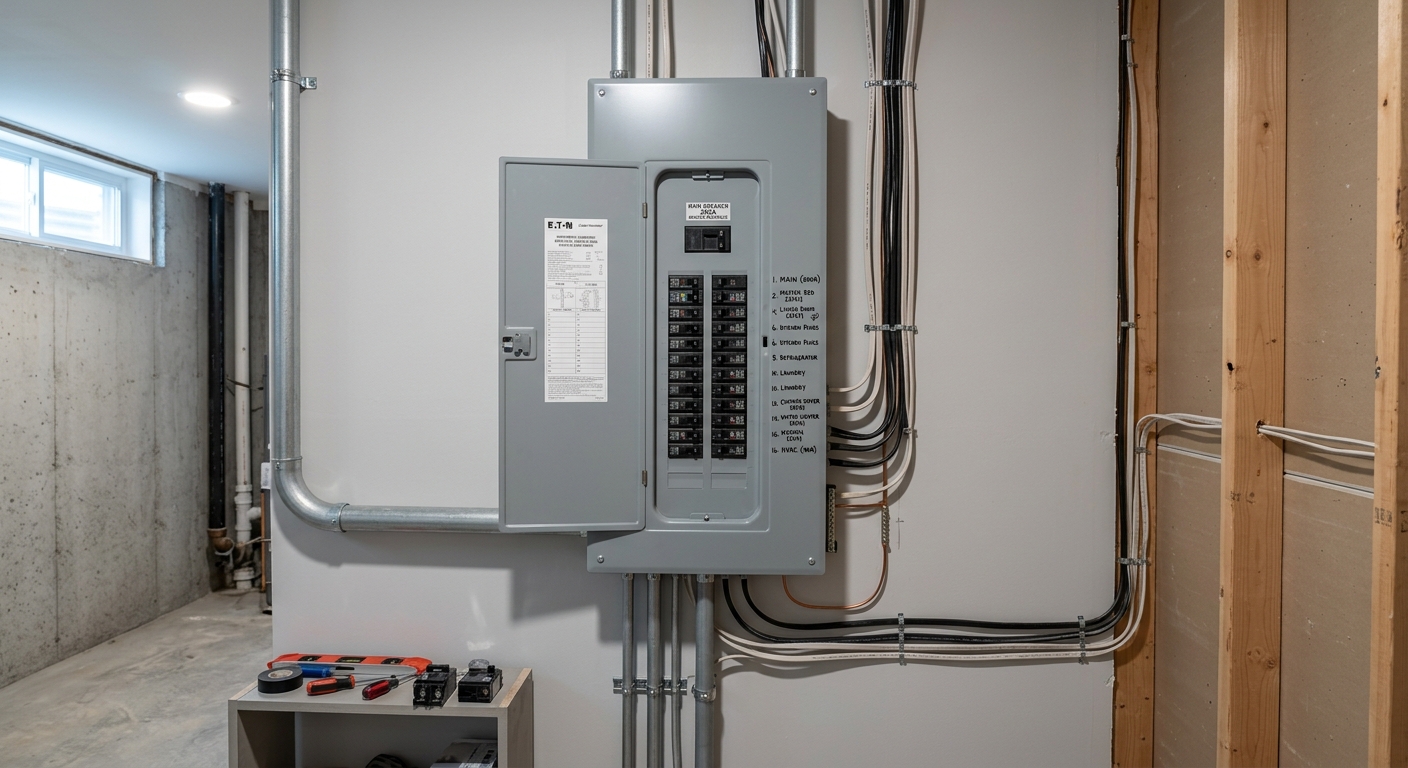
Electrical services and costs in High Prairie
Electrical services in High Prairie often look different from bigger cities because many homes are older, and the work is frequently about bringing wiring and capacity up to today’s Alberta Electrical Code and insurance expectations. In High Prairie, about 56.2% of homes were built before 1981 (Statistics Canada, 2021 Census), which is a common setup for panel capacity upgrades, knob-and-tube removal, and aluminum wiring remediation. Homeowner households are also a majority share (60.3% own), so capacity and safety upgrades are steady as families add load like heat pumps, induction cooking, and EVs.
In the Athabasca–Grande Prairie–Peace River region, winter conditions and the mix of older housing stock plus growth affect electrical pricing in a very practical way: more time goes into troubleshooting, safer access in cold weather, and mobilization when materials and crews have to travel. Resistance heat is also common in northern properties, which increases baseline load and can push marginal panels over their practical limit faster. We also see growing EV adoption, and that drives more service and panel upgrades—often from 100A toward 200A—along with permit applications and load calculations. In High Prairie, service upgrades and wiring remediation are especially in demand around the downtown/core area and surrounding residential streets, where many homes are older and more likely to have dated service equipment.
Below are the most common electrical projects and realistic Alberta-scale price bands to help you compare quotes in High Prairie.
| Service |
Why It's Needed |
Permit Required |
Price Range |
| Panel upgrade — 100A to 200A service |
Adds capacity for modern loads (EV charging, heat pumps, electric ranges) and supports a compliant load calculation. |
Yes (service upgrade/panel change) |
$2,500–$5,000 |
| EV charger installation (Level 2, 40–50A) |
Gives safe, code-compliant charging with the right breaker size and cable sizing for High Prairie’s winter-ready charging. |
Yes (new circuit and EVSE installation) |
$900–$2,500 |
| Knob-and-tube wiring removal and replacement |
Removes dated insulation and improves safety/insurability; replaces with modern wiring methods. |
Yes (rewiring/removal of unsafe/deteriorated wiring) |
$3,000–$12,000 |
| Aluminum wiring remediation (CO/ALR connectors) |
Mitigates CO/ALR connection concerns and improves long-term reliability without immediate full replacement in every case. |
Yes (significant wiring work) |
$3,000–$8,500 |
| New dedicated circuit (HVAC, appliance, hot tub) |
Adds capacity and reduces overheating risk by separating high draw loads from general circuits. |
Yes (new circuits) |
$700–$2,000 |
| Whole-home rewire (older home, full replacement) |
Full replacement for homes with widespread old wiring or inaccessible/unsafe wiring runs. |
Yes (full rewiring) |
$8,000–$20,000 |
Prices are estimates only and vary by project scope, site access and material selection.
What affects the price of electrical work in High Prairie
In High Prairie and the wider Athabasca–Grande Prairie–Peace River region, two contractors can quote the “same” electrical job and still land 30–50% apart. The biggest reason is how much unknowns they uncover during site assessment: panel condition, wiring condition behind walls, distance of runs, grounding quality, and how complicated the route is for new cable. In a smaller market, scheduling and travel also matter—crews may be booked, so mobilization and contingency time can shift the final number.
Housing-stock age is the dominant cost driver. Homes built before 1950 are much more likely to have knob-and-tube wiring, and insulation issues are often a deal-breaker for insurance and a trigger for full or partial replacement rather than a quick repair. Homes from the 1960s–1970s often have older service sizes (commonly 60A or early 100A setups) that don’t comfortably support today’s load—especially when EV charging, heat pump systems, and electric stoves are used at the same time. Aluminum wiring remediation is another common variable; in many older homes it’s addressed with approved CO/ALR connectors, and where connections are deteriorated or the wiring is too compromised, full replacement is the safer (and sometimes more cost-effective long-term) path. EV adoption is also driving a surge in Level 2 charger permits—often pushing customers toward panel upgrades in the $2,500–$5,000 band when a 40–50A circuit must be integrated safely.
Local conditions that raise cost include winter access constraints (cold-weather work, frozen paths, and longer cleanup), long cable routes from panel locations, and service upgrades that require additional utility coordination. Costs can be lower when a home already has a modern panel, good grounding, and accessible wiring pathways. For reference, a straightforward EV charger installation may stay near the $900–$2,500 band when the panel capacity and wiring routes are ready; it rises when cable, conduit, and panel capacity work must be added.
| Price Factor |
Why It Matters |
Cost Impact |
| Panel size upgrade — 100A to 200A is the standard minimum today |
Modern loads often require more breaker space and service capacity for safe operation. |
Typically adds several thousand dollars; commonly aligns with the $2,500–$5,000 band. |
| Wiring type — copper vs. aluminum remediation vs. K&T removal |
Aluminum and knob-and-tube require specific approved methods; K&T often requires replacement. |
Can swing total cost widely; K&T/whole-home rewires tend toward higher bands ($3,000–$12,000+). |
| Number of new circuits — each adds material and labour time |
Every circuit means additional cable, breakers, terminations, testing, and sometimes drilling/conduit. |
Each additional circuit can materially increase labour and materials, even if the panel is already sized. |
| Permit + ESA/TSBC inspection fee — mandatory for all major work |
Permitting and inspection are required for panel/service upgrades, rewiring, and new circuits. |
Non-optional cost; increases total project budget versus “minor” work. |
| Labour rate for licensed electricians — journeyman rates in Athabasca–Grande Prairie–Peace River |
Northern travel, standby time, and lower contractor density affect effective hourly cost. |
Labour intensity can be the difference between a few thousand and a higher four/five-figure total. |
| EV charger amperage — 40A vs. 50A circuit affects cable and breaker cost |
Higher amperage typically means heavier cable and a different breaker configuration. |
Material delta is real; may push a job toward the upper end of the $900–$2,500 band. |
| Emergency or after-hours premium |
Night/urgent callouts require availability and often limit how much prep can be done. |
Can add a noticeable premium versus planned work. |
| Load calculation required for service upgrade |
Service sizing must be justified for the actual connected load (and future additions where relevant). |
May add labour time and sometimes drives changes to panel scope. |
Permits & regulations in Alberta
In Alberta, electrical work beyond changing a light bulb must be performed by a licensed electrician. That includes (but isn’t limited to) panel upgrades, new circuits, rewiring, and service-entrance changes. These projects require a permit and must be inspected before they can be signed off. For permitted electrical work, the inspections are carried out by the provincial electrical safety authority system in Alberta (often referenced as Alberta’s electrical safety framework under the Safety Codes Act).
DIY electrical is heavily restricted. Homeowners should not attempt work that involves panel connections, breaker installation, service equipment, grounding/bonding changes, or anything that would be considered “altering the electrical system” in a way that requires verification and inspection. “Typically does not require a permit” work is limited to things like replacing an existing light fixture with like-for-like parts when the wiring connections remain unchanged and the work does not involve panel/service components—however, in practice, many homeowners still prefer to book an electrician so the connections are verified and the home remains compliant for resale and insurance.
How to verify a contractor in High Prairie, step-by-step: first, confirm the electrician’s licence number through the Alberta licence registry/verification page (use the number shown on the quote/COI). Second, request a certificate of insurance and confirm liability coverage is active for the contract scope. Third, ask for WSIB/WCB coverage documentation (where applicable to their business). Finally, confirm who will pull the permit, schedule inspection, and provide the final inspection clearance paperwork—because major work costs more when it can’t pass inspection the first time.
When your High Prairie home needs an electrical upgrade
When you’re trying to decide whether your High Prairie home needs electrical work, focus on warning signs that point to safety and code compliance—not just things that “look old.”
(1) Breakers that trip regularly: If a breaker trips when you run normal household loads, it often indicates an overloaded circuit, a failing breaker, or wiring that can’t handle the demand. (2) Knob-and-tube wiring: the concern isn’t only age; degraded insulation and contact risks can raise fire and insurance issues. If knob-and-tube is present, plan remediation rather than patching. (3) 60A or 100A service: in a modern home, it’s common to run an EV charger plus heat pump equipment and major appliances. Where capacity is tight, a 200A upgrade is often the clean, code-compliant path. (4) Aluminum wiring (commonly seen in pre-1976 homes): it may not be immediately dangerous if maintained, but it does require licensed remediation using approved CO/ALR methods or replacement where connections are unreliable. (5) Insufficient outlets and “extension-cord everywhere” habits: this is a practical fire risk and often a sign you need new circuits. (6) No AFCI or GFCI protection where required: this becomes a selling and safety issue, and it can surface during inspections and home sales.
Which signs need immediate action versus planning? Frequent tripping and any burning smell/discoloration should be treated as urgent. Knob-and-tube and aluminum wiring issues generally warrant planned upgrades so you can schedule properly and budget—especially in a region where older housing stock is common. For example, if adding an EV charger is pushing you toward capacity changes, spending on a panel/service upgrade in the $2,500–$5,000 range can be justified compared with repeatedly adding circuits that still leave you short on service capacity.
| Warning Sign |
What It Means |
Recommended Action |
Urgency |
| Breakers trip frequently |
Possible overload, failing breaker, loose connections, or undersized circuit design. |
Have an electrician inspect load distribution and circuit condition; identify cause before adding new loads. |
Immediate (schedule asap) |
$250–$1,000 |
| Knob-and-tube wiring present |
Older wiring method with deteriorating insulation risks and insurability concerns. |
Plan removal/replacement of affected sections or whole-home rewire depending on extent. |
Planned (do not ignore) |
$3,000–$12,000 |
| 60A or 100A panel (inadequate load capacity) |
Not enough capacity for today’s combined household loads and future additions (EVs, heat pumps). |
Request a load calculation; consider 100A to 200A service upgrade and panel swap. |
Planned (prioritize if adding EV/major appliances) |
$2,500–$5,000 |
| Aluminum wiring (pre-1976 construction) |
Requires approved remediation of terminations to reduce overheating risk. |
Test connections, then remediate with CO/ALR connectors or replace wiring where needed. |
Planned |
$3,000–$8,500 |
| Insufficient outlets — extension cords everywhere |
Encourages unsafe temporary wiring and overloading of a small number of circuits. |
Add receptacles and, where required, new dedicated circuits for high-use loads. |
Planned (safety issue) |
$700–$2,000 |
| No AFCI or GFCI protection where required |
Higher risk of arc faults and shock; can affect compliance for resale/insurance. |
Upgrade protection devices and update affected circuits to current requirements. |
Planned (before sale or renovation) |
$300–$1,500 |
How to choose a electrical work contractor in High Prairie
Choosing the right contractor matters even more in High Prairie because service upgrades and rewiring often involve permit scheduling, inspection timing, and winter-safe workmanship. Start by verifying Alberta licensing: ask for the contractor’s licence information and confirm it through Alberta’s online licence verification/registry. Next, confirm liability insurance—request the certificate of insurance and check that it covers residential electrical contracting for the stated job scope. Finally, ask for WSIB/WCB coverage documentation (as applicable to their business) and keep it on file.
Get 2–3 itemised written quotes, not lump sums. A good quote breaks out labour hours, materials (panel components, breakers, cable, conduit), testing, permit/inspection handling, and any disposal or removal work. Read the scope carefully: is the permit pull included, and which inspection outcomes are covered if re-inspection is required due to access or correction items? Clarify exclusions like drywall patching, long cable reroutes through inaccessible areas, or any utility coordination required for service work.
Warranty should be in writing. Ask for the workmanship warranty length (commonly 1 year for many residential jobs), plus manufacturer warranties for products. Also ask if any warranty is transferable to a future home buyer. Payment should be staged—never pay more than 10–15% upfront, and hold back until the job is complete and verified. Get a start date and a completion estimate in writing, including how weather can affect timeline.
- Licence number and proof of active insurance provided before work starts.
- Quote includes permit pull and clearly names the inspection process.
- Itemised labour, parts, and testing—no “mystery allowances.”
- Scope specifies whether old panel wiring is fully removed or partially reused.
- Breakers/panel brands and model numbers are listed.
- Testing and commissioning steps are included (continuity, insulation resistance, verification).
- Clear plan for winter-safe access and site protection.
- Disposal/dismantling responsibilities are stated.
- Wall access assumptions are documented (what happens if you find surprises behind drywall).
- Written warranty terms for workmanship and manufacturer product coverage.
- Payment schedule capped with meaningful holdback.
- Respectful scheduling—start date and completion timeline confirmed in writing.
Red flags in High Prairie include: quotes that won’t itemise materials and labour, unclear permit responsibility, refusal to provide licence/insurance/coverage proof, pushing full upfront payment, and vague timelines that don’t mention inspection scheduling or weather-related contingency.
Frequently asked questions — electrical work in High Prairie
Do I need a permit for electrical work in Alberta?
In Alberta, most electrical work beyond simple like-for-like fixture swaps requires permits. In High Prairie, permits are typically required for panel upgrades (like moving from 100A to 200A), new circuits, EV charger installations, rewiring, and any service-entrance changes—because these affect the electrical system and must be inspected to comply with the Alberta Electrical Code and electrical safety requirements. If an electrician is planning work that touches the panel/service, installs new breakers, adds wiring runs, or changes grounding/bonding, assume it needs a permit. When comparing quotes, confirm who pulls the permit, whether inspection fees are included, and that you’ll receive documentation after the inspection clearance.
What are signs of an overloaded electrical panel?
Signs of an overloaded or capacity-limited panel include breakers that trip when you run ordinary loads (not just when you intentionally use high draw appliances together), dimming lights when equipment turns on, and a “too tight” breaker layout where every circuit feels maxed out. In High Prairie—where older homes are common (56.2% built before 1981, Statistics Canada, 2021 Census)—a dated panel can also be the hidden driver behind repeated nuisance trips. If you’re adding an EV charger or modern heating, you may also need a load calculation. If the panel is undersized (often 60A/100A), budgeting for a service upgrade in the $2,500–$5,000 range can be the difference between a safe, code-compliant setup and constant problems.
Can I do my own electrical work in Alberta?
For most electrical work in Alberta, DIY is not permitted; it must be done by a licensed electrician. In High Prairie, that means you generally should not install new circuits, change breakers, open and modify panel wiring, rework grounding, or connect anything involving the service/panel. The allowance for homeowners is narrow—often limited to very minor work like replacing certain fixtures where the wiring connections are unchanged and no permit is triggered—but it’s easy to cross the line without realizing it. If you’re planning work that could affect inspection outcomes or insurance coverage, use a licensed electrician. Ask the contractor whether a permit is required and what documentation you’ll get after inspection.
How long does a rewiring job take?
A whole-home rewire can take weeks, while a targeted wiring replacement can take days depending on the number of rooms, how accessible the wiring paths are, and whether the job includes panel/service updates. In Alberta’s colder months, electricians may also plan more time for safe access and careful installation. A good contractor will do a site assessment and explain what’s accessible, what will need to be fished through, and what surprises could affect timeline (for example, unknown wiring conditions behind walls). If the job includes a panel upgrade along with rewiring, that sequencing is important for inspection readiness. When you request quotes in High Prairie, ask for a written start date, interim milestones, and the time required to schedule and pass inspection.
Why do my breakers keep tripping?
Breakers that keep tripping can be caused by overloaded circuits, worn or failing breakers, loose or overheating connections, or wiring that can’t handle the load (especially in older homes). In High Prairie, homes built before 1981 are more likely to have wiring methods that require careful remediation, and aluminum or knob-and-tube issues can show up as intermittent faults rather than constant failures. The most reliable approach is troubleshooting with proper testing—not guessing—then correcting the cause before adding additional loads. If your plan includes an EV charger or new heat equipment, a panel capacity check can prevent repeated trips. If you’re facing capacity issues, service upgrades commonly fall in the $2,500–$5,000 range; if it’s wiring/connection related, remediation costs may fall into wiring-focused bands depending on scope.
How do I compare electrical quotes?
To compare electrical quotes in High Prairie, start with the scope: make sure each quote addresses the same problem and includes the same items (permit pull, inspection handling, testing, disposal, and any required panel/service changes). Look for itemisation—labour hours, materials, breakers/cable quantities, and what’s included in troubleshooting. Confirm whether you’re being quoted a straight EV charger installation (often in the $900–$2,500 band) versus a charger plus a service/panel capacity upgrade (which usually pushes the budget higher). Check warranty terms for workmanship and products, and verify licensing/insurance/coverage before signing. Finally, request a written timeline and payment schedule with only a small upfront deposit and a holdback until completion.