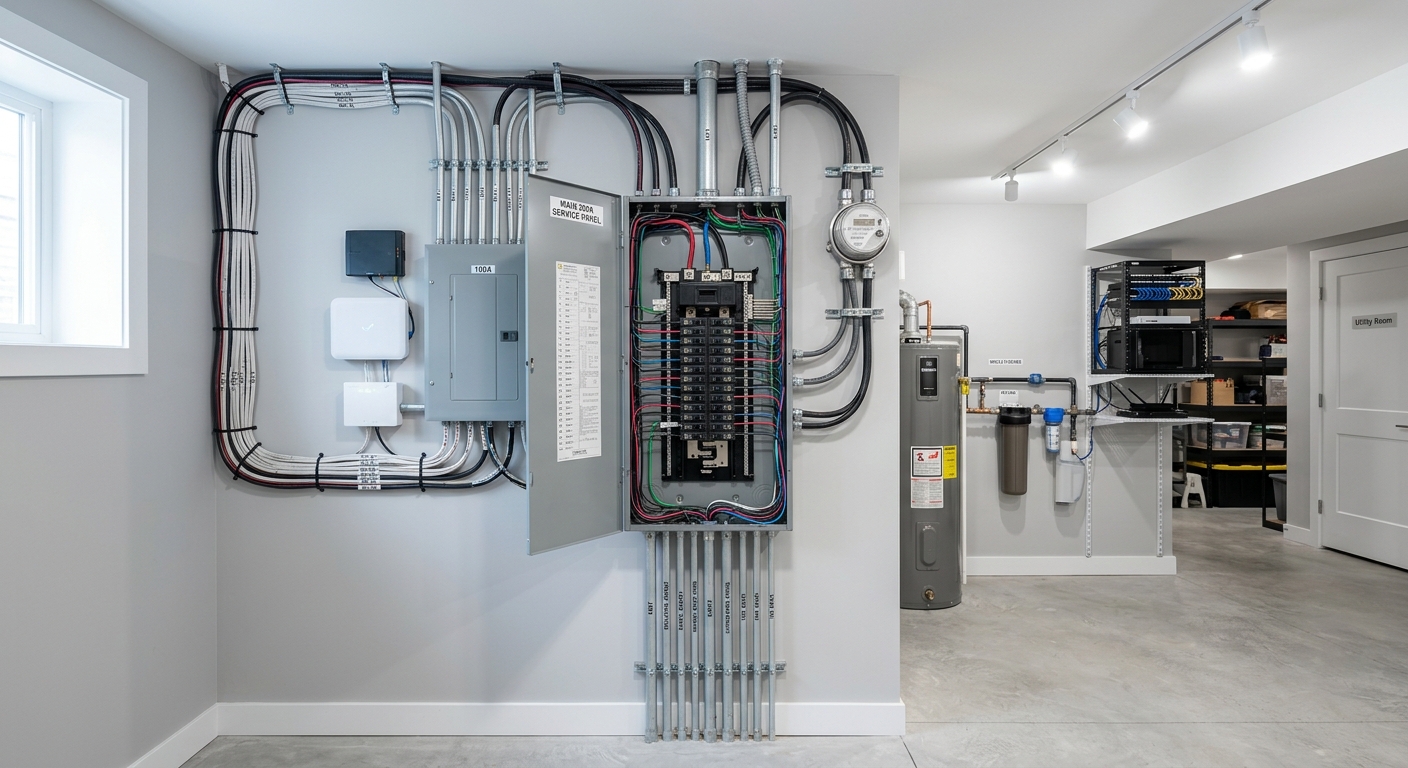
Electrical services and costs in Lacombe
Lacombe homeowners often feel their electrical system “keeping up” has become harder—especially as modern loads move in. With 32.7% of homes built before 1981 (Statistics Canada, 2021 Census), it’s common to see aging panels, worn receptacles, and older wiring that can’t reliably support today’s household demand. That matters in practical terms: Lacombe’s long, cold winters push heat use, while summers bring heavy use of cooling and outdoor plugs. Add in the Red Deer economic region’s steady growth and ongoing renovations, and you’ll see more call-outs for load management, EV readiness, and service upgrades.
Across Red Deer, Red Deer County, Sylvan Lake, Lacombe, and Blackfalds, electricians frequently encounter knob-and-tube wiring, aluminum wiring in mid-century homes, and undersized 100A services. Those are the backbone reasons quotes can vary: it isn’t only the panel swap—it’s the routing of cable, safe separation from older wiring, and the permit scope required before anything is energized. Service access also affects pricing; a basement panel in an older, tight framing layout typically costs more than a modern panel location with clear pathways. In Lacombe, trades are especially busy around the newer infill areas near downtown and the Hwy 2 corridor, where many owners are upgrading before or after adding heat pumps and Level 2 charging.
Below are common cost ranges you can use as a starting point for comparing quotes and planning your budget.
| Service |
Why It's Needed |
Permit Required |
Price Range |
| Panel upgrade — 100A to 200A service |
Modern homes often need more capacity for EV chargers, heat pumps, induction/ranges, and general household growth |
Yes |
$2,850–$6,850 |
| EV charger installation (Level 2, 40–50A) |
Adds a dedicated circuit with proper breaker, cable sizing, and safe disconnecting for daily charging |
Yes |
$900–$2,500 |
| Knob-and-tube wiring removal and replacement |
Older wiring can present insulation/connection concerns and may be declined by insurance without proper upgrades |
Yes |
$4,500–$18,000 |
| Aluminum wiring remediation (CO/ALR connectors) |
Licensed remediation helps ensure terminations are made with approved methods and reduces connection overheating risk |
Yes (scope-dependent) |
$1,800–$6,500 |
| New dedicated circuit (HVAC, appliance, hot tub) |
Dedicated circuits reduce nuisance tripping and support larger loads safely |
Yes |
$650–$3,200 |
| Whole-home rewire (older home, full replacement) |
When multiple rooms, junctions, and receptacles need replacement, a full rewire is often the most reliable long-term fix |
Yes |
$10,000–$28,000 |
Prices are estimates only and vary by project scope, site access and material selection.
What affects the price of electrical work in Lacombe
In Lacombe and the wider Red Deer area, two quotes for the “same” electrical job can differ by 30–50% because the visible work is only part of the cost. The hidden drivers are often service size, how much cable must be rerouted, whether older wiring has to be made safe or replaced, and what the permit inspector expects for the scope of work. Alberta homes built in different decades also create different baseline problems—especially when today’s load demands are compared to older 60A or 100A services.
The age of housing stock is the dominant cost driver. Homes built before 1950 may have knob-and-tube wiring, where insurance and safety expectations increasingly push owners toward removal and replacement rather than partial patching. Homes from the 1960s to 1970s commonly include older panel configurations (often 60A or 100A) that can struggle when you add modern loads like Level 2 EV charging, heat pumps, and higher-demand electric cooking. Aluminum wiring—more frequently seen in homes constructed around 1965–1976—often requires licensed remediation with approved CO/ALR connectors, or in some cases full replacement, to make connections safe and durable.
EV adoption is also changing the labour mix. In the Red Deer region, more owners are applying for permits to add 40A vs. 50A Level 2 circuits, and the circuit amperage can affect breaker cost, conductor size, and cable run requirements. For example, a straightforward 100A to 200A panel upgrade may land in the $2,850–$6,850 band, but if the route must cross older materials, or if load calculation and additional breakers are required, pricing can move toward the upper end. Similarly, wiring work can swing from a targeted remediation toward the higher $4,500–$18,000 band when multiple rooms or circuit paths must be replaced.
In Lacombe specifically, cost can rise when panels are in tight basements with limited access or when exterior service runs need new weatherproof components. Costs may be lower when the panel is already near-future-friendly and conduit/cable pathways are clear, or when the charger location is close enough to avoid long trenching.
| Price Factor |
Why It Matters |
Cost Impact |
| Panel size upgrade — 100A to 200A is the standard minimum today |
Provides headroom for EV charging, heat pumps, and modern kitchen/laundry loads |
Typically shifts you into the service upgrade band (about $2,850–$6,850) |
| Wiring type — copper vs. aluminum remediation vs. K&T removal |
Aluminum and knob-and-tube require approved methods or removal for safety and compliance |
Can increase labour and materials significantly; remediation may be cheaper than full rewire |
| Number of new circuits — each adds material and labour time |
Every added circuit means breakers, conductors, terminations, and time to test |
More circuits often add hundreds to thousands depending on panel position and routing |
| Permit + ESA/TSBC inspection fee — mandatory for all major work |
Permits and inspections are required before energization and keep work compliant |
Usually adds fixed administrative and inspection costs |
| Labour rate for licensed electricians — journeyman rates in Alberta |
Certified labour is priced by time, complexity and risk |
Time-intensive re-routing can noticeably raise total cost |
| EV charger amperage — 40A vs. 50A circuit affects cable and breaker cost |
Higher amperage often needs larger conductors and appropriate breaker selection |
May nudge the project toward the upper portion of the EV band ($900–$2,500) |
| Emergency or after-hours premium |
Urgent scheduling and after-hours labour costs more |
Often adds a noticeable premium to the base price |
| Load calculation required for service upgrade |
Ensures the new service size matches actual and expected connected loads |
Can add scope, testing, and documentation time (usually modest versus full rewire) |
Permits & regulations in Alberta
In Alberta, ALL electrical work beyond changing a light bulb must be done by a licensed electrician, and most “real” upgrades require a permit before work is energized. That includes panel upgrades (for example, replacing a 100A panel with a 200A panel), adding new circuits (including dedicated EV charger circuits), rewiring work, and any service-entrance or meter-base changes. It also covers things like adding/relocating a receptacle in many cases, installing permanent fixtures with wiring changes, and running new cable through walls/ceilings where it affects the circuit layout.
Typical homeowner work that often doesn’t require electrical permits is limited to non-electrical replacement like swapping a bulb or replacing a like-for-like cover/fixture where no wiring is altered. However, because rules and scope can be specific, the safe approach in Lacombe is to ask the contractor what is and isn’t permitted for your exact scope before anyone starts.
To verify a contractor in Lacombe step-by-step: (1) confirm the electrician’s licence status through the provincial registry and ensure the company operating name matches what’s on the quote; (2) request a certificate of insurance and confirm general liability and (where applicable) that coverage is current for the work; (3) ask for WSIB/WCB clearance documentation (or proof of coverage status) before work begins. If you’re hiring for a permit job, insist the electrician provides the permit number/project details and that they’ll handle inspection scheduling. These steps protect you if something goes wrong before the ESA inspection/approval process is complete.
When your Lacombe home needs an electrical upgrade
Knowing the warning signs helps you avoid “cosmetic” electrical problems that can become safety issues in a Red Deer-area winter. In Lacombe, the most important indicators aren’t just age—they’re symptoms of overload, failing connections, or outdated protection that doesn’t keep up with modern demands.
(1) Breakers that trip regularly usually point to overload, bad circuit sizing, or wiring issues. If tripping happens when running heat strips, cooking, or charging a vehicle, treat it as urgent. (2) Knob-and-tube wiring is a key concern because insulation contact and old connection methods can fail over time; it’s not only about how old the home is, but whether the system is maintained and likely to be accepted by insurers. (3) 60A or 100A services can be inadequate when you run an EV charger, heat pump, and electric stove at once; in those situations, a 200A upgrade is commonly the standard solution. (4) Aluminum wiring (often pre-1976 construction) may still operate safely if connections are properly remediated, but it requires licensed remediation rather than handyman “tightening.” (5) Insufficient outlets or extension cords everywhere typically signals a layout problem that can lead to overloading. (6) Missing AFCI/GFCI protection where required can show up during sale or when you add new circuits—then you discover the cost impact of bringing the home up to current requirements.
Climate matters because cold weather increases load patterns (more heating runtime, longer plug-in periods, and heavier reliance on fixed loads). As a dollar example, if you’re currently tripping breakers and you’re paying to add “workaround” plug solutions, that can be less economical than budgeting for a panel upgrade in the $2,850–$6,850 range—especially if a load calculation shows you’re beyond safe capacity. Planned upgrades are better than reactive fixes, but wiring safety issues like knob-and-tube or repeated tripping should be addressed promptly.
| Warning Sign |
What It Means |
Recommended Action |
Urgency |
Price Band |
| Breakers trip frequently |
Possible overload, undersized circuits, or connection/wiring faults |
Professional load assessment; inspect panel and affected circuits; upgrade circuits or service if needed |
Immediate |
$650–$6,850 |
| Knob-and-tube wiring present |
Old wiring method with risks related to insulation and terminations |
Map circuits and plan removal/replacement in phases or whole-home based on scope |
High priority |
$4,500–$18,000 |
| 60A or 100A panel (inadequate load capacity) |
Not enough capacity for modern household loads |
Upgrade to 200A with load calculation and reconfigure breakers as required |
Planned/priority |
$2,850–$6,850 |
| Aluminum wiring (pre-1976 construction) |
Connection methods may need approved remediation for long-term reliability |
Licensed CO/ALR connector remediation or partial replacement where needed |
Planned/priority |
$1,800–$6,500 |
| Insufficient outlets — extension cords everywhere |
Overuse of temporary connections and potential overload risks |
Add receptacles and (if necessary) install dedicated circuits |
Planned |
$650–$3,200 |
| No AFCI or GFCI protection where required |
Safety and compliance gaps that surface during additions/sales |
Upgrade receptacles/breakers as required for current protection standards |
Planned |
$200–$1,500 |
How to choose a electrical work contractor in Lacombe
Choosing the right contractor in Lacombe starts with verification. First, confirm Alberta licensing: ask for the electrician’s licence number (or company licence details) and match it to the provincial registry entry. Second, request a certificate of liability insurance and ensure it covers the scope of your job. Third, confirm WSIB/WCB clearance or proof of coverage status before work begins—don’t accept “we’ll sort it later.”
Next, get 2–3 itemised written quotes. You want a breakdown that clearly separates labour and materials and shows what’s included: the permit pull (or permit handling), cable/conduit, breakers, connectors, disposal, testing and the ESA inspection booking. Avoid lump-sum quotes that don’t specify circuit amperage, breaker type, or cable routing assumptions—those omissions are where change orders appear later.
Look for warranty terms. A workmanship warranty should be clearly stated (often for a defined period), and the product/manufacturer warranty should be provided for things like chargers, breakers, and panels. Also confirm whether warranties are transferable if you sell the home.
On payment scheduling, keep it practical: never pay more than 10–15% upfront, and use a holdback until the job is complete and tested. Finally, demand a start date and completion estimate in writing so weather delays and material lead times are managed openly.
- Licence number and company name match the quote and registry
- Written permit scope (what is being permitted and why)
- Itemised labour and materials (not one blended price)
- Explicit circuit details (40A vs. 50A for EVs, breaker type)
- Testing plan listed (continuity/insulation/functional tests)
- Clean cable routing assumptions (where conduit/cable will run)
- Disposal included? Confirm who removes old breakers/panels/wiring
- Site access notes documented (long runs, trenching, finishing patchwork)
- Workmanship warranty length stated in writing
- Payment schedule capped at 10–15% upfront with holdback
- Insurance certificate and WSIB/WCB clearance provided before work starts
- Timeline with realistic lead times for panels/chargers
Red flags I commonly see with subpar electrical contractors in Lacombe include: refusing to provide licence/insurance details, giving an “all-in” price without permit handling, quoting an EV charger install without confirming 40A vs. 50A circuit requirements, starting work before permits are approved, and offering vague warranty language that doesn’t specify workmanship coverage.
Frequently asked questions — electrical work in Lacombe
How much does a panel upgrade cost in Lacombe?
In Lacombe, a typical 100A to 200A panel upgrade commonly falls in the $2,850–$6,850 range. The spread comes from real job conditions: panel location, how much cable rerouting is required, whether the electrician needs to do a formal load calculation, and how accessible the service area is in an older house. Because 32.7% of local homes were built before 1981 (Statistics Canada, 2021 Census), many projects involve tighter wiring pathways or integration with older components, which can increase labour. If your existing service is undersized and the upgrade includes additional breakers for heat pumps or EV readiness, expect to price closer to the middle-to-upper portion unless everything is straightforward.
Do I need to upgrade to a 200A panel?
You often do if you’re adding modern high-load items. In Alberta homes, 200A is frequently the practical minimum when you install a Level 2 EV charger and run other large loads like electric cooking and heat pumps during winter. If you already have a 60A or 100A service, a load calculation usually shows whether you can safely manage current demands without nuisance tripping or overheating connections. A 200A upgrade is also commonly the cleaner long-term option if your panel is crowded, breakers are near capacity, or you need additional dedicated circuits. If you already have a newer panel with capacity and the wiring is in good condition, you may not need a full upgrade—an electrician can confirm after inspection and load assessment.
How much does an EV charger installation cost in Lacombe?
For a Level 2 charger installation (typically a 40–50A dedicated circuit), budget roughly $900–$2,500 in Lacombe, depending on the circuit amperage and how far the run must go from your panel. The job can cost more when there are longer cable routes, finishing restoration needs, older panel constraints, or when a service/panel upgrade is required to create safe capacity. In older homes common across the Red Deer region, the electrician may have to reconfigure breakers or upgrade the panel before the charger circuit can be installed and permitted. Since EV charging requirements are permit-driven in Alberta, quotes should include circuit details and permit handling, not just the charger mount.
What is knob-and-tube wiring and should I replace it?
Knob-and-tube (K&T) is an older wiring method often found in homes built decades ago. The main concern isn’t just “it’s old”—it’s how insulation and connections perform over time, plus the way K&T can be treated by insurance and safety expectations when you make changes. In Lacombe and surrounding areas, I often see K&T discovered during renovation or panel troubleshooting, and replacement decisions usually depend on how much of the home is affected and whether you’re doing a full circuit upgrade. Partial repairs can sometimes be a short-term fix, but insurers and inspectors may require broader upgrades if K&T circuits are involved. If you’re planning major work (like a panel upgrade or EV charger), replacement is often the more reliable long-term path.
Is aluminum wiring safe in older Lacombe homes?
Aluminum wiring in older Lacombe homes is not automatically “unsafe,” but it does require proper remediation and licensed terminations. The key issue is connection quality and approved connectors (often CO/ALR methods) because aluminum can behave differently at terminations than copper over time. If the wiring was installed and maintained well, it may still function, but if you’re seeing heat damage, loose/bad terminations, or you’re opening junctions to add circuits, you should have it inspected. Many homeowners choose licensed remediation—installing approved connectors and correcting problem terminations—rather than full replacement. The right solution depends on what’s actually present behind panels and devices and what changes you’re planning (new circuits, EV charging, or heat pump integration).
Do I need a permit for electrical work in Alberta?
Yes, for most electrical work beyond very basic like-for-like replacements. In Alberta, major work such as panel upgrades (100A to 200A), rewiring, service-entrance changes, and adding new circuits—including EV charger circuits—requires a permit and must be inspected by the provincial electrical safety authority process before energization. Residential DIY for most tasks is not allowed, even if you think it’s “just moving wires,” because safety requirements and inspection checks apply to the work scope. If you hire an electrician in Lacombe, ask what permit will be filed, confirm the inspection timing, and ensure the permit scope matches the written quote. Always verify the contractor’s Alberta licence and keep the documentation you receive for your records.