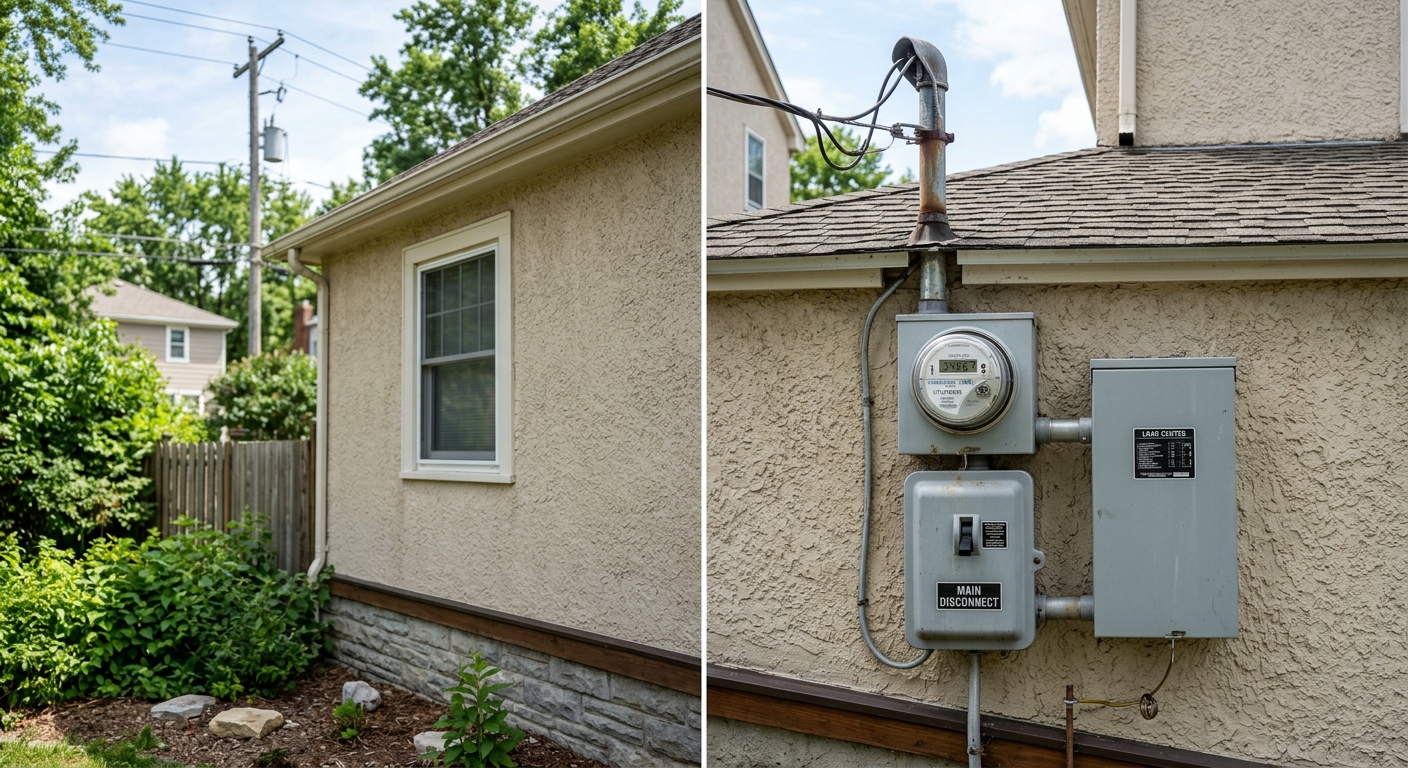
Electrical services and costs in Nakusp
Nakusp homes face a real electrical balancing act: many properties are older, and daily demand rises quickly when you combine electric heat, kitchen appliances, and modern add-ons like Level 2 EV charging. With 62.5% of dwellings built before 1981, a large portion of the housing stock is a prime candidate for panel upgrades and safety-driven updates—especially where knob-and-tube or outdated conductors are present. In a community of 1,589 residents, homeowner-led retrofits also concentrate demand into a smaller contractor base, which can affect scheduling and pricing during peak renovation seasons.
In the Kootenay region, winter conditions matter. Cold snaps and frequent use of electric baseboards and other space-heating systems increase continuous load, so a “works today” panel can become marginal the moment you add an EV charger or a heat pump. Labour costs in BC commonly run in the $80–$150/hour range for licensed electricians, and major work requires permits and inspection, which adds administrative steps but improves safety outcomes. That’s why Kootenay quotes often cluster around panel upgrades (for example, $2,500–$5,500 for service work) and wiring scope (which can range widely depending on access and the wiring type).
In Nakusp, older electrics are especially common in the downtown area and near established residential streets close to the water and hillside lots, where renovations may involve finished basements and tighter crawl or wall access. Use the table below to compare typical service types, what drives the permit requirement, and the most realistic price ranges for the work you’re considering.
| Service |
Why It's Needed |
Permit Required |
Price Range |
| Panel upgrade — 100A to 200A service |
Modern loads (EV charger, electric heat/baseboards, induction cooking, heat pumps) can exceed older service capacity; a 200A upgrade is the standard minimum for many retrofit homes. |
Yes (service change requires permits and inspection) |
$2,500–$5,500 |
| EV charger installation (Level 2, 40–50A) |
BC EV adoption is increasing electrical load; a dedicated circuit improves safety and prevents nuisance tripping. |
Yes (new circuit + charger requires permits/inspection) |
$1,200–$2,800 |
| Knob-and-tube wiring removal and replacement |
K&T systems are outdated and can present fire risk; replacement restores code-compliant wiring methods and safer insulation/terminations. |
Yes (rewiring scope is typically permitted and inspected) |
$3,500–$15,000 |
| Aluminum wiring remediation (CO/ALR connectors) |
If your home uses aluminium conductors, approved remediation (e.g., CO/ALR connectors and torque-checked terminations) reduces overheating risk. |
Yes (major wiring remediation generally requires permit/inspection) |
$3,500–$9,500 |
| New dedicated circuit (HVAC, appliance, hot tub) |
Dedicated breakers and properly sized cable help protect equipment and reduce overloads on existing circuits. |
Typically yes for new circuits (permit + inspection) |
$900–$3,000 |
| Whole-home rewire (older home, full replacement) |
When wiring is mixed, degraded, inaccessible, or unsafe throughout, full replacement is often the most cost-effective long-term solution. |
Yes (full rewiring requires permits and inspection) |
$6,500–$15,000 |
Prices are estimates only and vary by project scope, site access and material selection.
What affects the price of electrical work in Nakusp
In Nakusp and across the wider Kootenay region, homeowners can see quotes for the “same” electrical job vary by 30–50%. The gap usually comes from three things: how much the electrician must open up walls/ceilings to reach wiring, what safety upgrades are triggered by the scope, and whether your existing service and wiring type can be reused or must be replaced. Permits and inspection are mandatory for major work in British Columbia, so contractors can’t shortcut the process—yet the amount of preparatory work behind the permit is where costs diverge.
Housing age is the dominant cost driver. With 62.5% of Nakusp dwellings built before 1981, many homes have older wiring methods and services that were never designed for today’s load profile. Homes built in the mid-20th century may have aluminium wiring, which requires licensed remediation using approved CO/ALR solutions or replacement; similarly, knob-and-tube wiring removal can require substantial labour and material to restore safe pathways. Another common issue is undersized panels—60A or 100A services that were fine decades ago but struggle when you add a Level 2 EV charger and run electric heat consistently during BC winters.
Practical examples from the Kootenay market: (1) If the existing panel is a tight retrofit location with limited access, a panel upgrade in the $2,500–$5,500 band can move upward because cable routing and may-be-required upgrades take longer. (2) If you’re only adding one dedicated circuit, you might stay closer to the lower end of the wiring/circuit ranges; but if the job exposes widespread aluminium or K&T throughout, the project can quickly enter the $3,500–$15,000 territory for significant rewiring. (3) EV chargers can change the math: a 40A versus 50A circuit affects breaker and cable sizing, which influences materials and sometimes prompts a service/load calculation.
| Price Factor |
Why It Matters |
Cost Impact |
| Panel size upgrade — 100A to 200A is the standard minimum today |
More capacity reduces nuisance trips and supports modern appliance and EV demand. |
$2,500–$5,500 |
| Wiring type — copper vs. aluminum remediation vs. K&T removal |
Aluminium remediation requires approved connections and careful torqueing; K&T often can’t be safely “patched.” |
$3,500–$15,000 |
| Number of new circuits — each adds material and labour time |
Every circuit brings breaker, cable, labels, testing, and time to route and terminate. |
$900–$3,000 per circuit (typical) |
| Permit + ESA/TSBC inspection fee — mandatory for all major work |
Major electrical changes must be permitted and inspected, adding administrative steps and required compliance. |
$150–$600 |
| Labour rate for licensed electricians — journeyman rates in {region} |
Complex retrofits and inspection hold times increase billable hours. |
$80–$150/hour |
| EV charger amperage — 40A vs. 50A circuit affects cable and breaker cost |
A higher amperage can require larger cable/conduit and different breaker sizing. |
$1,200–$2,800 |
| Emergency or after-hours premium |
Storm calls and after-hours work often require scheduling adjustments and higher hourly rates. |
$200–$800 add-on (typical) |
| Load calculation required for service upgrade |
Utilities and electrical safety requirements expect a proper assessment to size service and breakers safely. |
$0–$300 (commonly included, sometimes itemised) |
Permits & regulations in British Columbia
In British Columbia, ALL electrical work beyond changing a light bulb must be performed by a licensed electrician. That includes panel upgrades, new circuits, rewiring, generator interconnections, hot tub wiring, and EV charger installations. For most of these jobs, a permit is required before work begins, and the completed work must be inspected and approved by the provincial electrical safety system through Technical Safety BC (and related processes). The key point for homeowners in Nakusp is that DIY is restricted: even if you shut off power at the breaker, the province requires licensed workmanship for essentially all safety-critical electrical alterations.
What typically does NOT require a permit: swapping a like-for-like fixture where the wiring method doesn’t change (for example, replacing a compatible ceiling light with the same type of connection), and minor device replacements only when the installation is truly like-for-like and meets the electrical requirements—your electrician can confirm quickly. However, if you’re adding circuits, changing the service/panel, altering wiring routes, or replacing breakers as part of a service change, expect permit + inspection.
To verify a contractor’s legitimacy in BC, start with the licensed-electrical contractor registry online (check their licence number and whether it’s active). Ask for a current certificate of insurance showing liability coverage, and confirm they have appropriate coverage for workers—often discussed as WSIB/WCB coverage depending on how their business is set up; your goal is to ensure there’s coverage for workplace injuries rather than you assuming risk. Finally, request written proof of insurance and keep all documentation with your quote and contract, including any clearance/inspection paperwork your electrician files.
When your Nakusp home needs an electrical upgrade
Nakusp homes often show electrical stress as soon as winter loads ramp up. Warning signs aren’t just “inconvenient”—they can indicate an overloaded panel, failing connections, or outdated wiring methods that affect both safety and insurance. The most common issue is breakers that trip regularly. That usually means your panel is overloaded, circuits are undersized for what you’re running, or there’s a failing device/connection.
Second, look for knob-and-tube wiring. The concern isn’t only age; older wiring can have insulation that deteriorates and unsafe contact points. If you suspect K&T, treat it as an urgent safety and insurance issue, not a “later” project. Third, a 60A or 100A service is often inadequate for modern load combinations—especially when electric baseboards run alongside an EV charger and heat pumps. In practice, many Nakusp owners end up choosing a 200A upgrade as the standard solution, commonly priced in the $2,500–$5,500 band, depending on the service size and routing.
Fourth, aluminum wiring in pre-1976 construction can be managed, but it requires licensed remediation (for example, approved CO/ALR connectors) rather than handyman fixes. Fifth, insufficient outlets—extension cords everywhere—can become a fire hazard, and it often reveals a bigger code-compliance gap (like missing AFCI/GFCI where required). Finally, missing AFCI/GFCI protection can surface during home sale or inspection and may be required to meet current safety expectations.
As a dollar example: if you’re adding a Level 2 EV charger and your panel is undersized, a “charger-only” quote may look cheaper up front, but the total may still rise if a service upgrade is necessary to meet safety and capacity needs. Getting the load calculation early helps avoid paying for a partial fix that doesn’t hold up to inspections.
| Warning Sign |
What It Means |
Recommended Action |
Urgency |
Price Band |
| Breakers trip frequently |
Potential overload, undersized circuits, failing breaker/device, or unsafe connection. |
Troubleshoot load, inspect panel/breakers, and correct undersized circuits; consider service sizing. |
High (arrange promptly) |
$900–$3,000 |
| Knob-and-tube wiring present |
Outdated wiring method with insulation/contact concerns; often a safety and insurance issue. |
Plan K&T removal and replacement; start with the circuits feeding highest-load areas. |
High (safety-first) |
$3,500–$15,000 |
| 60A or 100A panel (inadequate load capacity) |
Modern loads can exceed capacity; nuisance tripping and unsafe operation become likely. |
Schedule a service upgrade (commonly to 200A) and complete a load calculation. |
High (plan before adding new loads) |
$2,500–$5,500 |
| Aluminum wiring (pre-1976 construction) |
Risk of loose connections/overheating if not properly remediated. |
Licensed remediation with approved CO/ALR connectors or targeted replacement sections. |
Medium to High |
$3,500–$9,500 |
| Insufficient outlets — extension cords everywhere |
Overreliance on temporary wiring increases overheating and trip hazards. |
Add properly rated outlets/circuits and reduce dependence on extension cords. |
Medium |
$900–$3,000 |
| No AFCI or GFCI protection where required |
Higher risk of arc faults/ground-fault hazards and potential compliance failures. |
Upgrade receptacles/breakers as required and match protection to the home’s wiring layout. |
Medium (often time with sale/renovations) |
$250–$3,500 |
How to choose a electrical work contractor in Nakusp
Choosing the right contractor in Nakusp starts with proof. Ask for their active British Columbia electrical licence (and licence number) and verify it using the province’s online registry. Next, request a certificate of insurance showing liability coverage with appropriate limits for residential work. For workers’ coverage, confirm they carry the required workplace coverage so injuries on the job aren’t your responsibility; you can ask what policy they use and request documentation.
Then get 2–3 itemised written quotes. The best quotes break down labour and materials separately (cable/conduit, breakers, panels, charger hardware, misc. fittings), and they explain exclusions clearly. Pay close attention to whether the permit pull and inspection bookings are included in the quoted scope—many homeowners are surprised if that’s left as “client responsibility.” Also confirm disposal/cleanup: removal of old breakers, packaging, and construction debris handling.
Warranty matters too. Ask for the workmanship warranty length and whether it’s transferable to a new owner. Manufacturer warranties on panels/chargers are helpful, but workmanship coverage is what protects you against improper terminations, workmanship failures, or premature component issues.
For payment schedule, avoid large deposits. In practice, keep upfront payments to about 10–15% and hold a portion until the job is complete, inspected, and cleaned up. Finally, require an expected start date and an estimated completion timeline in writing.
- Licence number provided on the quote and verified as active in BC
- Certificate of insurance current at the time of booking
- Confirmation of workers’ coverage for the job
- Itemised labour vs. materials (not a single lump sum)
- Permit pull and inspection included for any panel, rewiring, new circuits, or EV work
- Clear scope: what’s included/excluded (panel relocation, trenching, wall opening, restoration)
- Diagrams or notes showing circuit locations and breaker sizing
- Warranty details in writing (workmanship + product)
- Payment schedule with a small deposit and a holdback until completion
- Estimated start date and completion timeline stated
- Proof of cleanup/disposal responsibility stated
- Safety testing and documentation mentioned (as applicable to the scope)
Red flags in Nakusp include: contractors who won’t provide their BC licence details, quotes that lump “materials” without specifying panel/charger/insulation/cable, promises to do “no permit” work for service changes, vague warranty terms, and requests for large upfront payments that leave you with no leverage once the job starts.
Frequently asked questions — electrical work in Nakusp
How long does a panel upgrade take in Nakusp?
In Nakusp, a typical panel upgrade (like moving from a 100A to a 200A service) often takes about half a day to one full day of on-site labour, depending on access, whether wiring must be re-routed, and how much wall/floor access is needed. If your home has older wiring methods or aluminium conductors, the electrician may need extra time for safe terminations and remediation steps, which can extend the schedule. After rough work, permitting and inspection steps can add calendar time even when the electrical work itself is completed quickly. Pricing commonly falls within the $2,500–$5,500 band for many straightforward service upgrades, but the timeline can stretch if the load calculation or additional cable/conduit work is required.
What is a GFCI outlet and where is it required in British Columbia?
A GFCI (ground-fault circuit interrupter) is a protective device that trips when it detects abnormal current flow to ground—commonly helpful in areas where moisture is present or where there’s a higher shock risk. In British Columbia, GFCI protection requirements are tied to safety expectations in the applicable electrical code and depend on the circuit and location. In everyday terms for Nakusp homeowners: outdoor receptacles, garage receptacles, and wet locations are common places where GFCI protection is required or strongly expected. If you’re renovating or adding receptacles, your electrician will confirm exactly what’s required for your wiring layout. If your quote is strictly for adding a few protected receptacles, work typically fits within the broader $250–$3,500 lighting/fixture-style ranges, but the exact figure depends on whether it’s simple receptacle replacement or requires new circuit wiring and breakers.
How do I know if my Nakusp home has aluminum wiring?
You can’t always tell by sight alone, but there are a few homeowner checks that usually start the right conversation with your Nakusp electrician. First, look for markings on the conductor insulation inside the panel or at device boxes—sometimes labels indicate aluminium. Second, aluminium wiring often has a distinct texture and may be thicker/softer than typical copper conductors. Third, if your home is from the mid-1960s to mid-1970s, aluminium wiring is more likely than in newer construction. Because aluminium wiring must be handled properly, the electrician will typically inspect connection types and check whether remediation is needed using approved CO/ALR methods. If it requires remediation or replacement, costs can land in the $3,500–$9,500 range for many targeted projects, with bigger full-scope issues going higher.
What is the cost of rewiring a house in Nakusp?
Rewiring cost depends heavily on how much of the wiring system is unsafe or outdated, the wiring method (knob-and-tube versus mixed conductors), and how accessible the walls/ceilings are. In Nakusp and the Kootenay region, whole-home rewire projects commonly fall within the broader $3,500–$15,000 range when you’re addressing safety-critical wiring issues, especially if full replacement is required rather than patching. If you’re doing partial rewiring (for example, replacing K&T circuits feeding kitchen/heat loads), the scope may sit closer to the lower band. Labour rates in BC commonly run about $80–$150/hour for licensed electricians, and permits/inspection are part of the safety process for major work. A good contractor will itemise the quote and explain what rooms/circuits are included so you can compare apples-to-apples.
What electrical upgrades are required when selling a home in British Columbia?
British Columbia doesn’t work like “mandatory upgrades list for everyone,” but there are common safety and compliance issues that can come up during a sale. If your home’s electrical system is clearly unsafe, non-compliant, or missing required protections, it may be flagged by inspections or insurers and can become a condition of sale. In older Nakusp homes (many built before 1981), buyers often discover outdated wiring methods, undersized services for modern loads, or missing protection like AFCI/GFCI where required. If your electrical inspection identifies issues tied to current safety expectations, your electrician will recommend upgrades that bring the system into compliance for the parts being altered. For many homes, the “must-do” items are panel capacity and safety corrections; EV-ready changes and additional circuits may be addressed depending on how the home is currently wired and what the buyer requires. Expect panel work and service upgrades to commonly align with $2,500–$5,500 for many service changes.
What is a load calculation and why does my electrician need one?
A load calculation is an electrical assessment that determines whether your service and panel capacity are adequate for your connected devices and planned upgrades. In British Columbia, this is especially important when you’re changing the service/panel size, adding major loads (like EV charging or electric heat additions), or making code-related safety upgrades. For Nakusp homeowners, it matters because electric baseboard systems and other winter-time loads can operate for long periods, and an EV charger adds a dedicated circuit draw (often 40A–50A for Level 2). When a contractor performs a proper load calculation, it helps justify whether a panel upgrade—commonly to 200A—is necessary or whether parts of the system can be safely adapted. This prevents you from paying for a “charger first, upgrade later” path that may fail inspection or cause continued nuisance tripping.