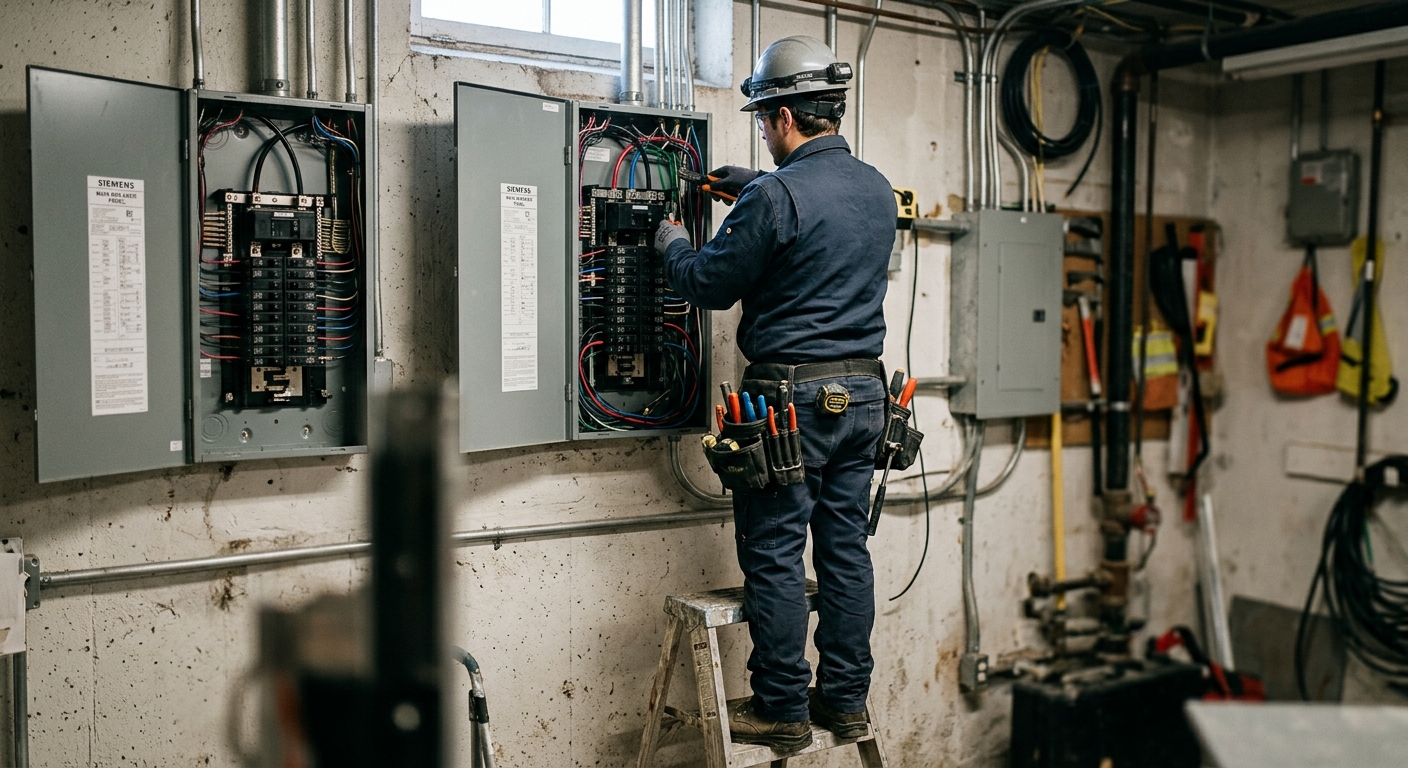
Electrical services and costs in Smithers
Smithers has a distinct electrical-service mix: a lot of older housing stock and a growing number of modern appliances and electric loads. In Nechako, 51.6% of homes were built before 1981, which often means the original wiring and panel equipment were never designed for today’s demand (for example, electric baseboard running alongside a Level 2 EV charger and heat-pump equipment). You’ll also commonly see legacy systems that electricians have to remediate to bring the home up to current Canadian Electrical Code (CEC) safety expectations and insurance requirements.
Cost in the Smithers area is also affected by climate and logistics. Winters can be long and hard in the Bulkley-Nechako region, and service calls and troubleshooting take longer when panels, crawlspaces, and service enclosures are difficult to access in cold weather. Labour availability can be tighter than in larger centres, so electricians may spend additional time on site planning, materials staging, and remediating older wiring before they can restore power safely. The trade is especially busy in neighbourhoods and rural pockets along the Highway 16 corridor where owners frequently add workshops, upgrade heat, and convert older homes for more occupants.
For many homeowners, the “starter” job is a panel and service upgrade—often moving from a 100A service toward 200A—followed by new circuits for EVs, kitchens, or heating. From there, wiring work ranges from targeted replacement to whole-home rewiring depending on what’s found behind walls. Use the estimate table below as a comparison baseline for budgeting in Smithers, British Columbia.
| Service |
Why It's Needed |
Permit Required |
Price Range |
| Panel upgrade — 100A to 200A service |
Improves capacity for modern loads (electric heat, induction stoves, EV charging) and brings the distribution equipment up to current safety requirements. |
Yes (major work) |
$2,500–$6,000 |
| EV charger installation (Level 2, 40–50A) |
Dedicated, code-compliant circuit for safer continuous charging and to prevent overloads on older panels. |
Yes (new circuit/service change if required) |
$1,200–$2,500 |
| Knob-and-tube wiring removal and replacement |
Knob-and-tube increases risk due to age, insulation deterioration, and damage over time; removal is often required for safety and insurability. |
Yes (rewiring) |
$8,000–$18,000 |
| Aluminum wiring remediation (CO/ALR connectors) |
Aluminum conductors require approved connections and workmanship to reduce risk at terminations; sometimes a partial replacement is enough, sometimes full replacement is recommended. |
Yes (significant repairs) |
$8,000–$14,500 |
| New dedicated circuit (HVAC, appliance, hot tub) |
Reduces nuisance tripping and improves safety by giving high-demand equipment a properly sized, protected feeder. |
Yes (new circuit) |
$600–$2,000 |
| Whole-home rewire (older home, full replacement) |
Standard solution when multiple circuits, outlets, and hidden wiring routes are beyond safe condition—common in pre-1981 homes. |
Yes (rewiring) |
$12,000–$25,000 |
Prices are estimates only and vary by project scope, site access and material selection.
What affects the price of electrical work in Smithers
In Smithers and across the Nechako region, it’s common to see quotes for the same type of job differ by 30% to 50% once you include the realities of older homes, inspection requirements, and service-access conditions. The biggest driver is housing age. With 51.6% of dwellings built before 1981, you’re more likely to encounter legacy wiring that triggers remediation (knob-and-tube or older aluminum work) and forces electricians to spend extra time opening walls, verifying cable condition, and replacing components—not just adding a few new breakers.
By comparison, homes built later often still need upgrades for modern load demands, such as EV chargers, heat pumps, and induction cooking. Even when the wiring is in reasonable shape, panels in older homes may be 60A or 100A, which can push a homeowner into a service upgrade. A 100A to 200A panel upgrade typically sits in the $2,500 to $6,000 band, while rewiring projects commonly start around the $8,000 to $18,000 range depending on the number of circuits and whether copper replacement is full or partial.
Local conditions also shift cost in concrete ways. For example: (1) winter access—cold, wet crawlspaces and snow-covered entrances can add labour hours and materials staging time; (2) wiring remediation—aluminum wiring often found in homes from the 1960s to mid-1970s may require approved CO/ALR connectors or selective replacement; (3) EV adoption—Level 2 charger permits and load calculations are increasingly requested, especially where owners want charging plus electric heat running at the same time.
| Price Factor |
Why It Matters |
Cost Impact |
| Panel size upgrade — 100A to 200A is the standard minimum today |
Modern loads exceed older panel capacity, and service equipment may not meet current requirements for safe continuous use. |
Often adds material and labour; commonly $2,500–$6,000 depending on service configuration |
| Wiring type — copper vs. aluminum remediation vs. K&T removal |
Different wiring types require different safety methods and approved component choices. |
Aluminum remediation can push costs toward the $8,000–$14,500 range; K&T removal can fall into $8,000–$18,000+ |
| Number of new circuits — each adds material and labour time |
More circuits means more cable runs, breakers, boxes, and time for testing and labeling. |
Each additional circuit may add roughly $600–$2,000 depending on length and complexity |
| Permit + ESA/TSBC inspection fee — mandatory for all major work |
Permits and inspections are required for panel upgrades, rewiring, new circuits, and EV charger installations. |
Typically increases job total by several hundred dollars and adds administrative time |
| Labour rate for licensed electricians — journeyman rates in {region} |
Licensed labour costs and travel time between communities affect total install time. |
Can shift the same scope by 20% to 35% in remote or time-constrained jobs |
| EV charger amperage — 40A vs. 50A circuit affects cable and breaker cost |
A 50A circuit typically uses larger cable and may require different breaker selection and protection. |
May move the project toward the upper end of $1,200–$2,500 for Level 2 installs |
| Emergency or after-hours premium |
Power-restoration work after storms or urgent shutdowns costs more due to scheduling and priority service. |
Often adds 15%–30% to labour |
| Load calculation required for service upgrade |
For service changes, electricians typically document load to confirm safe capacity for winter heating and EV use. |
Usually adds time (and sometimes minor component changes) but avoids costly rework |
Permits & regulations in British Columbia
In British Columbia, ALL electrical work beyond changing a light bulb must be done by a licensed electrician. That includes panel upgrades (for example, upgrading from 100A to 200A), adding or moving outlets, installing new dedicated circuits, rewiring, and installing EV chargers. If the work changes the fixed wiring, adds circuits, modifies service equipment, or affects protection and grounding, it generally needs a permit and inspection before it can be energized as code-compliant work.
Permits are required for typical homeowner projects like: new circuits for HVAC, hot tubs, or workshops; rewiring when older insulation or wiring types are involved; service upgrades; and Level 2 EV charger installations. Work that often does not require a permit is limited to like-for-like replacements such as swapping a fixture, replacing a ceiling fan (if it’s a straightforward like-for-like install and doesn’t involve new wiring), or changing a switch cover. Even then, the electrician must verify that the existing wiring and boxes are in acceptable condition.
Step-by-step for Smithers homeowners: (1) confirm the electrician’s licence using the provincial registry (Technical Safety BC) and write down the licence details; (2) request a clearance letter or proof of standing and confirm their work includes permits and inspections; (3) ask for a current certificate of liability insurance showing they’re insured for electrical contracting work; (4) confirm workers’ compensation coverage (WSIB/WCB as applicable) so you’re not left responsible if someone is injured on your property; and (5) ensure the quote references permit submission and inspection responsibilities.
When your Smithers home needs an electrical upgrade
In Smithers, electrical upgrades aren’t just “nice to have”—they’re safety-critical, especially because winter heating and longer appliance run-times increase how hard your panel and wiring are working. Here are the main warning signs that point to real electrical work, not cosmetic fixes.
(1) Breakers that trip regularly usually indicate an overloaded circuit, undersized wiring for the load, or a failing breaker. If trips happen when you run common loads (space heating, kettles, laundry, baseboard zones), plan repairs promptly.
(2) Knob-and-tube wiring is a key concern. The issue is the condition of old insulation and terminations, which can be compromised long before any visible fault. If you see knob-and-tube, treat it as a planned replacement/remediation project rather than “wait and see,” and start with an inspection and risk assessment.
(3) A 60A or 100A service often struggles once modern loads are added—especially EV charging plus electric heat and a heat pump. For many homeowners, a 200A upgrade is the standard solution, commonly in the $2,500 to $6,000 band depending on service configuration.
(4) Aluminum wiring (often pre-1976 construction) isn’t automatically dangerous if maintained, but it requires licensed remediation with approved CO/ALR connectors or replacement of affected runs.
(5) Insufficient outlets or extension cords everywhere is a code and safety red flag—extension cords shouldn’t be a permanent substitute for fixed receptacles.
(6) No AFCI or GFCI protection where required can surface during a home sale or inspection and increases risk for arc-fault and ground-fault hazards. In Smithers’ older-stock neighbourhoods, these are common reasons electricians propose a targeted circuit update rather than a full rewire.
In short: frequent trips and compromised wiring demand faster action; missing protection and capacity shortfalls are typically scheduled upgrades to prevent nuisance failures and reduce insurance risk.
| Warning Sign |
What It Means |
Recommended Action |
Urgency |
Price Band |
| Breakers trip frequently |
Possible overload, undersized wiring, faulty breaker, or overheating at terminations. |
Electrical load check, breaker/cable verification, and separation of circuits; may include new dedicated circuit(s). |
High (address soon) |
$600–$2,500+ |
| Knob-and-tube wiring present |
Old insulation and connections may degrade, increasing fire risk and often affecting insurance coverage. |
Inspection and plan for K&T removal/replacement—usually a phased or whole-home approach. |
High (planned but should start) |
$8,000–$18,000 |
| 60A or 100A panel (inadequate load capacity) |
Not enough capacity for winter heating, EV charging, and modern appliances working together. |
Service/panel upgrade (commonly to 200A) and load calculation. |
Medium to High |
$2,500–$6,000 |
| Aluminum wiring (pre-1976 construction) |
Terminations may loosen or overheat without approved connections; risk depends on condition and method. |
Licensed remediation with approved CO/ALR connectors and/or selective conductor replacement. |
Medium |
$8,000–$14,500 |
| Insufficient outlets — extension cords everywhere |
Inadequate receptacle coverage increases trip hazards and overloads flexible cords. |
Add receptacles and dedicated circuits where appropriate; verify grounding and protection. |
Medium |
$600–$2,000 |
| No AFCI or GFCI protection where required |
Protection gaps can fail to detect arcing faults or ground faults, increasing safety risk and resale friction. |
Add AFCI/GFCI protection to affected circuits and upgrade devices as required. |
Planned (unless failures occur) |
$200–$800+ |
How to choose a electrical work contractor in Smithers
Choosing the right contractor in Smithers starts with verification. In British Columbia, confirm the electrician is currently licensed using the provincial licence registry (Technical Safety BC). Ask for a copy of their certificate of insurance (liability) and verify it covers electrical contracting work. Also confirm workers’ compensation coverage (WSIB/WCB as applicable) so you’re protected if an injury occurs on your site. A legitimate contractor won’t hesitate to provide proof and will reference how they handle permits and inspections.
Next, get 2–3 written quotes that are itemised—labour and materials broken out rather than a single lump sum. Ask whether permit fees and inspection scheduling are included, and who pulls the permit (it should be the contractor for permitted work). Clarify what’s excluded: demolition/patching after access, disposal of old wiring, upgrades required by code once walls are open, and any upgrades needed for service configuration.
Warranty matters too. Ask for the workmanship warranty period (typical expectations are a meaningful multi-year coverage) and how manufacturer warranties apply to panels, breakers, and EV charging equipment. Find out whether warranties are transferable if you sell.
For payment, avoid paying more than 10% to 15% upfront. Use a schedule tied to milestones (materials staged, rough-in complete, inspections passed, final energization). Finally, request a start date and completion estimate in writing—winter work can run longer if access is limited, so a realistic schedule protects you.
- Licensed number provided and verifiable via the BC registry
- Certificate of liability insurance supplied before work starts
- Workers’ compensation coverage confirmed
- Permit pull responsibility clearly stated in writing
- Inspection included (and electrician schedules it)
- Itemised quote (labour, materials, breakers, cable, connectors)
- Scope includes what happens when they uncover older wiring (plan for K&T/aluminum)
- Materials choices specified (panel brand/series, breaker type, EV charger model)
- Disposal/cleanup responsibilities defined
- Workmanship warranty length stated
- Payment schedule with ≤ 10–15% upfront and holdback at completion
- Estimated start and finish dates listed
In Smithers, red flags I look for include: vague scopes that don’t mention permits or inspections, quotes that only list a panel price without load calculation discussion, unwillingness to show proof of licence and insurance, pressure to pay a large deposit, and “we’ll fix it later” language when dealing with K&T or aluminum remediation requirements.
Frequently asked questions — electrical work in Smithers
Is aluminum wiring safe in older Smithers homes?
Aluminum wiring can be safe when it has been installed and maintained correctly and when terminations are made with approved methods. In older Smithers homes (many built well before current wiring practices), the concern is typically where aluminum conductors connect at panels, switches, and receptacles. Those connections can oxidize or loosen over time, which is why a licensed electrician may recommend CO/ALR connectors or selective replacement of affected runs rather than ignoring the issue. If you’re considering a service upgrade or adding an EV charger, aluminum remediation becomes even more important because the panel and breaker quality of connections matters for winter loads. If your electrician identifies aluminum problems, remediation can commonly fall in the $8,000–$14,500 range depending on how much of the wiring system needs attention. (Source: Statistics Canada, 2021 Census)
Do I need a permit for electrical work in British Columbia?
In British Columbia, most electrical work beyond simple like-for-like replacements requires permits and inspection. In Smithers, that includes panel upgrades (for example, moving from a 100A service toward 200A), adding new circuits, rewiring, and installing a Level 2 EV charger (40–50A circuits commonly need permits). Permits are required so the work is verified against the Canadian Electrical Code and safety standards before it’s energized. DIY electrical work is prohibited for most tasks, and homeowner exceptions are narrow; even then, permit/inspection requirements still apply for permitted work. Before the electrician starts, ask who will pull the permit and confirm the inspection will occur before final sign-off. This is where reputable contractors differ: they schedule inspections and document the work rather than treating permits like an afterthought.
What are signs of an overloaded electrical panel?
Signs of an overloaded panel in Smithers include breakers that trip when multiple loads run, lights that dim noticeably during appliance startup, and a pattern of nuisance tripping in cold weather when heating runs longer. If you also have a 60A or 100A service, it may not have enough capacity for modern combinations—like EV charging plus electric baseboard heat, a heat pump, and an induction stove. Overload risk is less about “one device” and more about winter run-time and simultaneous loads. A licensed electrician typically performs a load calculation and may recommend a service upgrade. In many Nechako homes, a 100A to 200A panel upgrade is a common fix and often falls in the $2,500–$6,000 band depending on what the service requires and site conditions. (Source: Statistics Canada, 2021 Census)
Can I do my own electrical work in British Columbia?
In British Columbia, homeowners generally cannot do electrical work for anything beyond very limited tasks like changing a light bulb or certain like-for-like fixture swaps. For most electrical modifications—including new outlets, new circuits, panel work, rewiring, and EV charger installations—work must be done by a licensed electrician and generally requires a permit and inspection. Even if you’re comfortable with basic home repairs, the code compliance and safety verification are the key issue, not just wiring connections. In Smithers’ older homes (many built before 1981), wiring condition and protection requirements are often complex, and DIY can create safety hazards and insurance problems. If you want to help, the best “DIY” contribution is often non-electrical prep: clearing access, planning where furniture won’t block receptacles, and coordinating when you’ll have the space ready for rough-in and inspection.
How long does a rewiring job take?
Rewiring timelines vary a lot in Smithers because older housing layouts can hide challenging cable routes, and winter access can add time. For smaller targeted replacements, a day or two is possible; for whole-home rewiring, timelines commonly span multiple days to a few weeks depending on house size, number of circuits, wall access, and whether remediation includes knob-and-tube or aluminum sections. A reputable contractor will walk through your plan and estimate time based on a circuit-by-circuit scope, not just “rough hours.” Also ask about inspection scheduling: permitted work requires inspections before final energization, which can affect the calendar. If your project is in the $8,000–$18,000 band (wiring & rewiring) or higher, budgeting extra time for access, testing, and rework is normal—especially in older homes where hidden conditions are discovered once walls are opened. (Source: Statistics Canada, 2021 Census)
Why do my breakers keep tripping?
Breakers that keep tripping are usually caused by overload, a short or ground fault, loose or failing connections, or a mismatch between the breaker and the wiring method/load it’s carrying. In Smithers, winter heating can push panels harder, so trips may increase during cold months. If tripping happens when you run multiple loads (for example, baseboard heaters plus laundry, kettles, or a space heater), it may indicate undersized capacity or circuit overload that a load calculation and service upgrade can address. If you have older wiring types, the cause can also be termination issues—particularly with aluminum wiring where approved CO/ALR connections may be needed. Knob-and-tube wiring can deteriorate and contribute to faults. If tripping is frequent, treat it as an urgent safety issue and stop using the offending circuits until inspected. A fix may range from a new dedicated circuit to a broader panel/service upgrade depending on the cause.