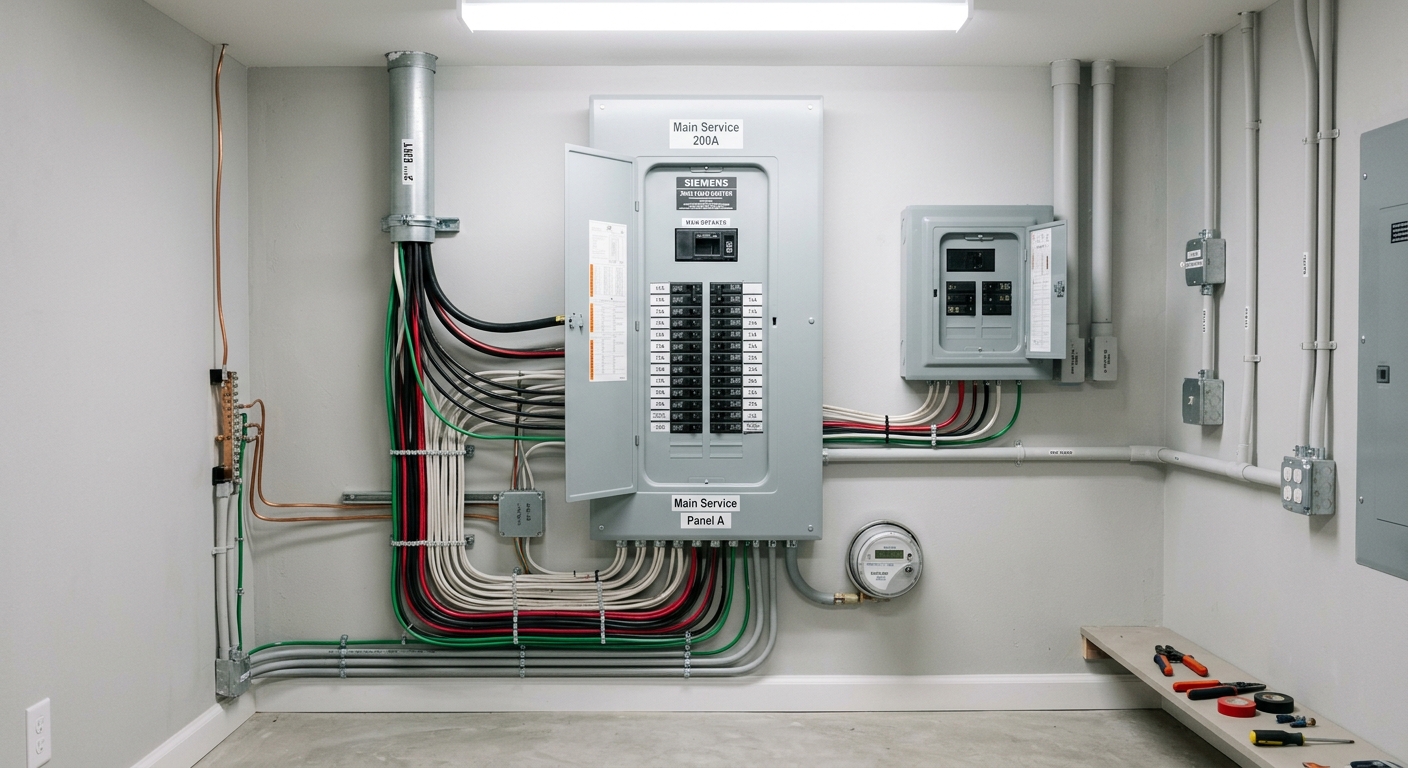
Electrical services and costs in Squamish
Squamish homeowners often start planning electrical work when day-to-day demand catches up with older infrastructure. With 33.8% of homes built before 1981 and many dwellings featuring dated panels, older wiring methods, and limited capacity, it’s common to see projects like panel upgrades, re-wiring, and EV-ready service changes. In fact, homeowner households make up 70.1% of households in Squamish (Statistics Canada, 2021 Census), so contractors frequently deal with long-term owner-driven upgrades rather than short-term tenant changes.
In the Lower Mainland–Southwest, costs are shaped by both housing age and site realities. Squamish winters and shoulder seasons bring heavier use of electric heating and ventilation systems, while ongoing EV adoption is pushing more households toward Level 2 chargers. That combination often means electricians have to plan for additional circuit capacity and fault protection, not just “add a charger.” Labour and permitting can also run higher because access and coordination are more time-intensive when older services, exterior mast locations, or service clearances are involved.
Demand is especially noticeable in areas like Brackendale and Valleycliffe, where many homes are on older electrical services and the electrician’s workload is dominated by capacity upgrades and wiring remediation. If you’re comparing quotes, the simplest way to line up apples-to-apples is to map your needs to typical service lines—then use the ranges below as a starting benchmark before you request itemised proposals.
| Service |
Why It's Needed |
Permit Required |
Price Range |
| Panel upgrade — 100A to 200A service |
Adds capacity for EV charging, electric heating loads, and modern appliance use while meeting today’s safety requirements. |
Yes, typically requires permitting and inspection. |
$1,800 – $4,500 |
| EV charger installation (Level 2, 40–50A) |
Provides faster charging and safer dedicated protection versus extending from existing circuits. |
Yes, new dedicated circuits/connection work require permits. |
$900 – $2,500 |
| Knob-and-tube wiring removal and replacement |
Obsolete wiring method increases fire risk and is often tied to insurance concerns; replacement restores code-compliant safety. |
Yes, rewiring/removal requires permitting and inspection. |
$8,000 – $20,000 |
| Aluminum wiring remediation (CO/ALR connectors) |
Aluminum branch wiring can present connection overheating risks; remediation restores safe terminations where feasible. |
Yes, remediation work is typically permitted and inspected. |
$2,500 – $8,000 |
| New dedicated circuit (HVAC, appliance, hot tub) |
Reduces nuisance trips and supports high-demand equipment with correct wire sizing and protection. |
Yes, generally requires a permit and inspection. |
$1,200 – $3,500 |
| Whole-home rewire (older home, full replacement) |
Addresses widespread aged wiring, inadequate protection (including AFCI/GFCI), and layout changes for modern loads. |
Yes, full rewiring is permitted and inspected. |
$15,000 – $35,000 |
Prices are estimates only and vary by project scope, site access and material selection.
What affects the price of electrical work in Squamish
In the Lower Mainland–Southwest, the same electrical job can land 30% to 50% apart across quotes because electricians price for risk, access, and how much “unknown work” is uncovered—especially in older Squamish homes. It’s not just labour. Permit stages, cable runs through finished spaces, panel/service conditions, and the need for proper load calculations all change the final number. In British Columbia, those permit-and-inspection requirements are mandatory for major work, so the baseline cost is hard to skip.
The dominant cost driver is housing age. Homes built before 1950 can still have knob-and-tube wiring, and insurance concerns and safety upgrades can push projects toward full removal rather than patch repairs. Homes from the 1960s to 1970s often have 60A or 100A panels, which struggle once modern loads show up—think EV chargers (commonly 40–60A circuits), heat pumps, induction stoves, and electric water heating. In many such cases, the budget moves quickly toward a panel upgrade/service change that fits today’s needs, commonly in the $1,800 – $4,500 band for a straightforward upgrade.
Aluminum wiring (often associated with 1965–1976 construction) is another major multiplier because it typically requires licensed remediation with approved connector methods (CO/ALR) or rewiring if conditions aren’t suitable. EV ownership is also increasing permit applications for Level 2 chargers, and the amperage choice matters: a 50A circuit may use slightly different cable and breaker components than a 40A install, affecting both materials and labour.
Concrete Squamish examples: (1) a charger install with an exterior panel location can be faster than one that requires long trenching through finished areas; (2) upgrading a corroded service mast or dealing with cable routing constraints near the entry can add civil/coordination time; (3) homes with older wiring methods frequently trigger a higher wiring-removal scope, which is why wiring projects often fall into the $8,000 – $20,000 band for partial or significant remediation.
| Price Factor |
Why It Matters |
Cost Impact |
| Panel size upgrade — 100A to 200A is the standard minimum today |
Provides capacity for modern loads and proper protective device sizing. |
$1,800 – $4,500 |
| Wiring type — copper vs. aluminum remediation vs. K&T removal |
Different remediation methods and additional disconnect/reconnect work increase labour. |
$2,500 – $20,000 |
| Number of new circuits — each adds material and labour time |
More circuits mean more wiring runs, breakers, testing, and documentation. |
$1,200 – $6,000 |
| Permit + ESA/TSBC inspection fee — mandatory for all major work |
Fees and inspection scheduling are required steps in British Columbia. |
$150 – $800 |
| Labour rate for licensed electricians — journeyman rates in the region |
Rates vary with job complexity, urgency, and contractor overhead. |
$300 – $3,500 |
| EV charger amperage — 40A vs. 50A circuit affects cable and breaker cost |
Higher amperage may require thicker cable, breaker rating changes, and more testing. |
$100 – $600 |
| Emergency or after-hours premium |
Premium rates apply when work must be scheduled around power/occupancy needs. |
$200 – $1,500 |
| Load calculation required for service upgrade |
Proper calculations can confirm whether 200A is sufficient or if additional upgrades are needed. |
$200 – $900 |
Permits & regulations in British Columbia
In British Columbia, electrical work beyond changing a light bulb must be performed by a licensed electrician. Permits are typically required for panel upgrades, service changes, new circuits (including Level 2 EV charger circuits), rewiring, and any work that alters the electrical service equipment or increases load capacity. Work must also be inspected by the electrical safety authority after the permit is issued—through Technical Safety BC or the applicable process administered by the authority having jurisdiction. DIY electrical is effectively prohibited for most tasks, and homeowners are limited to narrow, code-compliant activities that do not involve wiring, connection, or altering protected circuits.
What usually does require a permit: replacing or upgrading a panel or main disconnect, adding dedicated breakers and wiring for appliances/hot tubs, removing knob-and-tube, remediating aluminum wiring, and installing an EV charger where a new circuit or connection is made. What typically does not require a permit: swapping a receptacle faceplate, replacing a non-hardwired bulb/fixture per manufacturer instructions, or basic light maintenance that doesn’t involve opening wiring compartments or modifying circuits.
To verify a contractor in Squamish, I recommend this order: (1) confirm the electrician’s licence online through the BC registry (licence type and status); (2) ask for a current certificate of insurance showing liability coverage and request the name on the COI matches the contractor; (3) confirm workers’ compensation coverage (WSBC/WCB) paperwork—this protects you if a worker is injured. Finally, make sure the quote explicitly says permits will be pulled when required, so the inspection is scheduled and documented for resale and insurance.
When your Squamish home needs an electrical upgrade
Your Squamish home may need electrical work when warning signs point to safety-critical issues—things that won’t be solved by “resetting and forgetting.” First, breakers that trip regularly (especially with only everyday use) often indicate an overloaded panel, undersized or failing circuits, or wiring that can’t handle modern loads. Second, knob-and-tube wiring isn’t just an age problem; the risk is tied to insulation contact and deteriorating conditions, and it’s frequently a trigger for insurance cancellation or required remediation.
Third, consider service size. If your home has a 60A or 100A service, it’s commonly inadequate for today’s combined loads—EV charging, heat pumps or electric furnace supplemental heat, and induction/electric stove usage at the same time. In Squamish’s climate patterns and foggy winter mornings where heating and ventilation run longer, load pressure can be more noticeable. The standard solution is typically moving toward a 200A upgrade, which often aligns with the $1,800 – $4,500 service/panel upgrade band when access is reasonable.
Fourth, aluminum wiring (commonly seen in pre-1976 construction) may not be immediately dangerous if connections have been maintained, but it does require licensed assessment and remediation or replacement of problem sections. Fifth, insufficient outlets and widespread extension cords point to overloaded branch circuits. Finally, missing AFCI/GFCI protection is a code-compliance issue that can surface at resale—often making upgrades urgent from a documentation standpoint.
Immediate action is warranted when you see burning smells, heat damage, buzzing at outlets/breakers, or frequent breaker trips with visible discoloration. Planned upgrades are appropriate when you have older wiring methods, marginal capacity, or safety-protection gaps, especially if you’re planning an EV charger or major appliance upgrades.
| Warning Sign |
What It Means |
Recommended Action |
Urgency |
Price Band |
| Breakers trip frequently |
Can indicate overload, short circuits, failing connections, or undersized circuits. |
Electrical load evaluation, breaker/circuit testing, then add circuits or upgrade service if needed. |
Immediate to planned (depends on damage/heat) |
$1,200 – $4,500 |
| Knob-and-tube wiring present |
Obsolete wiring with insulation breakdown risks and increased safety/insurance concerns. |
Licensed inspection, then phased removal/replacement or targeted rewiring by hazard zone. |
Planned (often with insurance deadlines) |
$8,000 – $20,000 |
| 60A or 100A panel (inadequate load capacity) |
Modern loads can push beyond safe continuous use limits. |
Load calculation and upgrade to 200A service where required. |
Planned (priority if adding EV/major heat) |
$1,800 – $4,500 |
| Aluminum wiring (pre-1976 construction) |
Connection performance may degrade over time without proper approved remediation. |
Licensed assessment and remediation with approved CO/ALR connectors or rewiring. |
Planned (fix before resale/major additions) |
$2,500 – $8,000 |
| Insufficient outlets — extension cords everywhere |
Often leads to overloading and increased risk of overheating at connection points. |
Add new receptacle locations and dedicated circuits as needed. |
Immediate to planned |
$1,200 – $3,500 |
| No AFCI or GFCI protection where required |
Missing safety devices can fail modern shock/fire protection expectations. |
Upgrade affected breakers/receptacles and correct protection where code requires it. |
Planned (more urgent before sale) |
$400 – $2,500 |
How to choose a electrical work contractor in Squamish
Choosing a contractor in Squamish starts with licensing and insurance you can verify. In British Columbia, ensure the electrician is properly licensed and that the company provides a clear certificate of insurance (liability coverage) with the same legal entity named on the quote. Also confirm workers’ compensation coverage (WSBC/WCB) so you’re not exposed if someone is injured on your property. If anything is unclear, ask—reputable contractors will provide documentation promptly.
Next, get 2–3 itemised written quotes with a labour + materials breakdown rather than a single lump sum. A good quote should list the panel/circuit components, cable/conduit runs, labour hours or allowances, testing, disposal/cleanup, and whether a permit is included or will be charged separately. Scope clarity matters: ask what’s excluded (patching drywall, electrical inspection delays, upgrades needed due to hidden knob-and-tube or aluminum terminations, and any required load calculations). For major work, the permit pull and inspection scheduling should be accounted for in the plan.
Warranty should be written and specific: workmanship warranty length, product/manufacturer warranty coverage, and whether it’s transferable if you sell the home. For payment, never pay more than 10% to 15% upfront; hold back the remainder until the job is complete, inspected (where required), and cleaned up. Insist on a start date and estimated completion timeline in writing, because EV charger and service-upgrade scheduling often depends on inspections and utility coordination when a service mast change is needed.
- Licensing and company registration match the quote documents.
- Current certificate of insurance is provided before work starts.
- WSBC/WCB coverage is confirmed (ask for evidence).
- Quote includes permit pull responsibility and inspection steps.
- Itemised parts list (breakers, panel components, chargers, cables).
- Clear scope on wiring routes through finished areas.
- Includes testing, labelling, and final safety checks.
- Disposal/cleanup is stated (dust control, debris haul-away).
- Warranty terms are in writing and cover workmanship.
- Payment schedule: minimal deposit, holdback until completion.
- Scheduling plan includes inspection/utility coordination buffers.
- Communicates how changes will be priced if hidden issues are found.
Red flags I see with electrical contractors in Squamish include: refusing to provide licensing/insurance paperwork, quoting a service upgrade without a load calculation, using “no permit needed” language for panel or circuit additions, giving only a lump sum with no circuit/component details, and asking for large upfront payments before any work or material delivery.
Frequently asked questions — electrical work in Squamish
How much does an EV charger installation cost in Squamish?
In Squamish and the broader Lower Mainland–Southwest, most Level 2 EV charger installs land around $900 – $2,500, assuming you’re adding a dedicated 40–50A circuit and the route to the panel is reasonably accessible. Price changes if your panel needs upgrading first (service capacity) or if the charger location requires long cable runs, conduit through finished spaces, or additional trenching. If your home is older (for example, with 60A or 100A service), the EV request often triggers a load calculation and may push the project toward a panel/service upgrade in the $1,800 – $4,500 band, which is usually the safer way to ensure capacity and correct protection.
What is knob-and-tube wiring and should I replace it?
Knob-and-tube wiring is an older wiring method where cables are run using ceramic knobs and tubes, generally installed long ago and not intended for today’s load profiles. In British Columbia, knob-and-tube is a common target for inspection findings because insulation can become brittle and connections can degrade. Whether you replace it all at once depends on its condition and how much of the home is affected, but many homeowners choose phased removal tied to high-risk areas (kitchens, bedrooms with frequent loads, or sections near service equipment). If you’re planning a panel upgrade, EV charger, or significant circuit additions, it often becomes more practical to remove the obsolete sections than to patch around them. Replacement work typically falls into the broader wiring/remediation bands—commonly $8,000 – $20,000 depending on scope.
Is aluminum wiring safe in older Squamish homes?
Aluminum branch wiring can be safe when it’s in good condition and when terminations are done properly with approved methods. The concern isn’t that aluminum is “always dangerous,” but that certain older connections can overheat over time if they weren’t installed or maintained using the correct approved connector approach. In pre-1976 homes in Squamish, the right next step is a licensed inspection to identify problem terminations and determine whether CO/ALR connector remediation is suitable or whether rewiring is required. If remediation is feasible, many projects price in a remediation range such as $2,500 – $8,000, while full replacement can move into larger wiring budgets when multiple areas must be addressed.
Do I need a permit for electrical work in British Columbia?
In British Columbia, permits are generally required for electrical work that involves new circuits, rewiring, panel/service changes, and any job that alters electrical equipment or increases capacity—this includes Level 2 EV charger circuit installation and most work beyond basic bulb/fixture changes. Work must also pass inspection by the electrical safety authority process administered through Technical Safety BC or the applicable authority having jurisdiction. For homeowners in Squamish, the key is not just “does the electrician say they’ll do it,” but whether the quote clearly states that the permit will be pulled and inspection scheduled. If a contractor tells you a panel upgrade or new dedicated circuit doesn’t need a permit, that’s a serious warning sign and can create problems for insurance and resale.
What are signs of an overloaded electrical panel?
Common signs include breakers that trip frequently, lights dimming when other loads start, warm or discoloured breaker covers/outlets, buzzing from a panel, or the need to run multiple high-demand devices (space heaters, electric furnace supplements, dryers, EV charger) without nuisance tripping. In Squamish, heavier winter heating usage can make overload symptoms show up more clearly. If you’re seeing frequent trips or you plan to add an EV charger, the best practice is a load assessment and often a service capacity review. For many older homes with 60A or 100A service, the standard upgrade approach is a move toward 200A service, which commonly falls into the $1,800 – $4,500 band for straightforward replacements, though the scope can be higher if older wiring methods must be corrected.
Can I do my own electrical work in British Columbia?
In British Columbia, DIY electrical is restricted heavily. For most wiring work—anything involving opening junction boxes, adding circuits, replacing receptacles/switches where wiring connections are disturbed, modifying panels, or installing EV charger circuits—you should use a licensed electrician. The reason is safety and code compliance: permitted work must be inspected, and homeowners typically can’t legally perform the wiring changes that would trigger those inspections. If you want to do some “DIY around the edges,” consider tasks like clearing access, painting after the fact, or replacing an exterior cover once the electrician has completed the connections (as allowed by code). If you have an older Squamish home with knob-and-tube or aluminum wiring, DIY attempts are especially risky because hidden conditions can require licensed remediation before any additional capacity work—like a charger—can be safely completed.