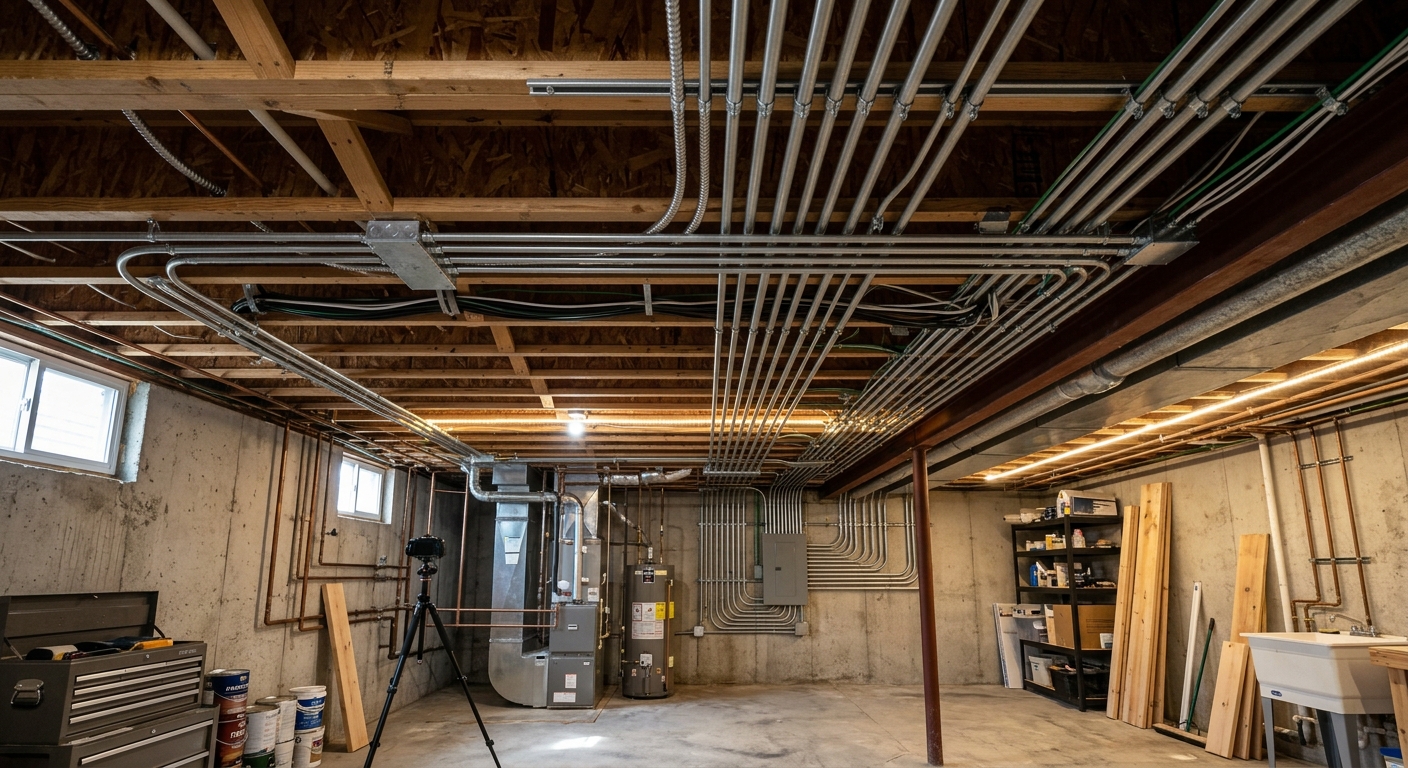
Electrical services and costs in Blake-Jones
Blake-Jones, Ontario is a popular neighbourhood for homeowners upgrading older houses, and electrical pricing here reflects that mix. With a population of 7,727 people (Statistics Canada, 2021 Census), the area sits inside the broader Toronto economic region where labour, inspections, and permit demand are consistently high. Many homes in the surrounding GTA inventory are older—often the same homes that show age-related wiring issues like knob-and-tube or mid-century aluminium branch wiring—so homeowners frequently plan panel and wiring work together rather than piece by piece. In practice, many pre‑1970 and post‑1960 homes end up needing safer capacity for today’s loads (heat pumps, electric ranges, and electronics), and that’s where a 100A-to-200A panel upgrade is common.
Toronto-area market pressure also matters. Contractors are booked more tightly in peak season, and winter conditions can add time to site work because attics, basements, and exterior runs are harder to access when temperatures are low and moisture is common. On top of that, higher infill activity and condo growth increase competition for licensed electricians and skilled labour—one reason the same project can swing noticeably between quotes. In Blake-Jones, demand is especially strong around the older housing pockets near Kingston Road and the surrounding residential streets where renovations and basement finishing are frequent.
Below is a practical comparison of typical services and what drives each price range, so you can benchmark quotes before you book a site visit.
| Service |
Why It's Needed |
Permit Required |
Price Range |
| Panel upgrade — 100A to 200A service |
Provides capacity for modern loads (EV chargers, heat pumps, electric cooking) and improves breaker spacing and safety |
Yes (ESA/permit through local building/inspection process) |
$2,500–$6,000 |
| EV charger installation (Level 2, 40–50A) |
Adds a dedicated charging circuit with correct breaker, wiring size, and safe grounding |
Yes (new circuit/connection) |
$900–$2,500 |
| Knob-and-tube wiring removal and replacement |
Knob-and-tube wiring is obsolete and can present insulation and overheating concerns; replacement restores code-compliant circuits |
Yes (major rewire/remediation) |
$3,000–$15,000 |
| Aluminum wiring remediation (CO/ALR connectors) |
Improves safe terminations and reduces overheating risk where approved connectors are required |
Often yes (inspection/verification of extent) |
$1,800–$6,000 |
| New dedicated circuit (HVAC, appliance, hot tub) |
Ensures proper load handling, avoids nuisance trips, and supports code-required protection |
Yes (new circuit work) |
$600–$3,500 |
| Whole-home rewire (older home, full replacement) |
Restores safety and capacity throughout the home when multiple circuit failures, mixed wiring, and unsafe devices are present |
Yes (major rewire) |
$8,000–$25,000 |
Prices are estimates only and vary by project scope, site access and material selection.
What affects the price of electrical work in Blake-Jones
In Toronto and the wider Ontario market around Blake-Jones, two contractors can quote the “same” electrical job and still be 30% to 50% apart. The difference usually comes down to wiring conditions, electrical service capacity, how much new cabling must be fished, and how extensive the remediation needs to be to meet current Ontario Electrical Code requirements. Age of the housing stock is the dominant cost driver: homes built before 1950 may contain knob-and-tube wiring, and insurance companies often treat it as an unacceptable risk, pushing homeowners toward replacement rather than minor fixes. Homes from the 1960s to 1970s often had 60A or 100A panels—fine for older demand, but inadequate for today’s combination of EV chargers, heat pumps, and electric cooking.
Aluminum wiring is another major driver in the Lake Ontario climate belt where basements and crawl spaces can stay damp. In practice, aluminum branch wiring is commonly seen in builds roughly 1965–1976, and it requires licensed remediation using approved CO/ALR connectors at terminations (or full replacement if wiring is degraded). Meanwhile, EV adoption is accelerating Level 2 charger permit applications, and amperage selection matters: a 40A versus 50A circuit can change breaker and cable sizing, which affects both material cost and how much panel work is needed.
Concrete Blake-Jones examples that swing price: (1) a panel upgrade with service relocation and longer trenching typically lands closer to the higher end of the $2,500–$6,000 range; (2) rewiring a finished basement with insulation-covered ceilings often pushes from the $3,000–$15,000 wiring band toward the upper tiers because labour time rises; (3) if your home already has a spare breaker space and a clear route, a new dedicated circuit can stay near the lower end of typical minor-work pricing.
| Price Factor |
Why It Matters |
Cost Impact |
| Panel size upgrade — 100A to 200A is the standard minimum today |
More capacity reduces nuisance breaker trips and supports modern loads |
Often the biggest single line item; commonly $2,500–$6,000 for standard installs |
| Wiring type — copper vs. aluminum remediation vs. K&T removal |
Aluminum requires CO/ALR-approved terminations; knob-and-tube often requires removal |
Can add thousands; K&T removal commonly sits in the $3,000–$15,000 wiring band |
| Number of new circuits — each adds material and labour time |
New breakers, cabling, and terminations increase time and inspection scope |
Each circuit can change your quote by several hundred dollars or more |
| Permit + ESA/TSBC inspection fee — mandatory for all major work |
Permitted electrical must be inspected; fees are not optional |
Typically in the $200–$500 range depending on scope |
| Labour rate for licensed electricians — journeyman rates in {region} |
Skilled labour time drives the cost, especially for fishing cable and panel work |
Commonly about $90–$120 per hour in the GTA area |
| EV charger amperage — 40A vs. 50A circuit affects cable and breaker cost |
Higher amperage may require larger conductors and additional panel capacity checks |
Can shift you within the $900–$2,500 charger band |
| Emergency or after-hours premium |
Scheduling and overtime increase contractor costs |
Often adds a percentage on labour time |
| Load calculation required for service upgrade |
Determines correct service size and whether 200A is truly needed |
Typically adds a cost but prevents undersizing (and rework) |
Permits & regulations in Ontario
In Ontario, ALL electrical work beyond changing a light bulb must be done by a licensed electrician. For Blake-Jones homeowners, that means anything involving new circuits, panel changes, rewiring, service upgrades, or adding equipment like an EV charger is a permit-and-inspection type of job. A permit is required for common projects such as panel upgrades (for example, 100A to 200A), new dedicated circuits (including HVAC, hot tubs, and appliance circuits), whole-home rewiring, and electrical service work. You should also treat knob-and-tube removal and aluminum remediation as regulated work that will be inspected as part of the permitted scope.
Step-by-step, the easiest way to verify your contractor before they start:
- Check their Ontario licence number with the provincial electrical authority registry (search using the contractor name/licence number).
- Request a certificate of insurance (liability) and confirm it matches the job address and has current coverage.
- Verify WSIB/WCB coverage if applicable for the contractor’s employees; ask for documentation.
- Make sure the quote states that permits and ESA inspection are included for the scope of work.
- Confirm the exact start date, ESA/inspection milestones, and that they will call for inspection before energizing.
Work that typically does not require a permit is limited to “like-for-like” replacements (for example, swapping an existing fixture for a fixture of the same type and wiring method) when no wiring changes are made. If the job touches wiring, breakers, panels, or any new circuit connection, assume a permit is required and plan accordingly.
When your Blake-Jones home needs an electrical upgrade
Electrical upgrades in Blake-Jones aren’t just about convenience—they’re often about preventing overheating, fire risk, and costly sale-time issues. Start with these safety-critical warning signs. (1) Breakers that trip regularly usually point to an overloaded panel, undersized circuits, or loose/aging connections; if it’s happening with normal use, treat it as an urgent safety flag. (2) Knob-and-tube wiring is the key concern for immediate action: the insulation and terminations can degrade, and many insurers won’t cover it, so replacement is commonly needed rather than “band-aid” fixes. (3) A 60A or 100A service can be inadequate for a modern home running an EV charger plus heat pump operation plus electric cooking; in the GTA, a 200A upgrade is the standard solution once load calculations confirm the demand. (4) Aluminum wiring (more common in pre‑1976 homes) isn’t always an instant emergency if it has been maintained and properly terminated, but it must be handled by a licensed electrician for CO/ALR-approved connections or replacement when required. (5) Insufficient outlets—especially when you see extension cords everywhere—signals code-compliance problems and a likely need for additional circuits. (6) Missing AFCI/GFCI where required can become a real issue at home sale or inspection, even if everything “works” today.
Because Ontario winters demand heavy electrical usage (heat pumps, lighting, dehumidifiers), small capacity problems can show up more often during cold months. As a practical example, if a new EV charger circuit would force expensive rework due to a crowded 60A panel, it can be cheaper to upgrade service first: instead of paying for repeated circuit fixes, homeowners often invest closer to the $2,500–$6,000 panel upgrade band to reduce long-term risk and reinstallation costs.
| Warning Sign |
What It Means |
Recommended Action |
Urgency |
Price Band |
| Breakers trip frequently |
Possible overload, undersized circuits, or faulty connections |
Schedule an inspection and load/circuit assessment |
Immediate to planned (depends on frequency) |
$600–$3,500 |
| Knob-and-tube wiring present |
Obsolete wiring with degraded insulation risk |
Plan removal and replacement of affected circuits |
Immediate |
$3,000–$15,000 |
| 60A or 100A panel (inadequate load capacity) |
May not support EV, heat pump, and other modern loads safely |
Run load calculation and consider 200A upgrade |
Planned (before adding major loads) |
$2,500–$6,000 |
| Aluminum wiring (pre-1976 construction) |
Risk relates to termination condition and approved connection methods |
Have terminations evaluated; remediate with CO/ALR connectors or rewire sections |
Planned/seasonal (before sale or major additions) |
$1,800–$6,000 |
| Insufficient outlets — extension cords everywhere |
Overreliance on temporary power increases overheating risk |
Add receptacles and dedicated circuits as needed |
Planned (urgent if cords are warm/scorched) |
$600–$3,500 |
| No AFCI or GFCI protection where required |
Increases shock and arc-fault risk; can be flagged during inspections/sales |
Upgrade protection devices and make circuits code-compliant |
Planned (earlier if selling soon) |
$200–$2,500 |
How to choose a electrical work contractor in Blake-Jones
Choosing the right electrical contractor in Blake-Jones starts with licensing and proof of coverage. First, verify their Ontario electrical licence using the provincial licence registry (ask for the licence number and confirm it in the public database). Next, request a certificate of liability insurance and ensure it’s current and covers electrical work at your address. Finally, ask for WSIB/WCB coverage information if they employ staff—this protects you as the homeowner from certain liability risks.
Then, get 2 to 3 itemised written quotes. You want labour and materials broken out, not just a lump sum. Ask whether the quote includes permit filing, ESA inspection scheduling, and any required documentation. Clarify exclusions up front: will they open and patch drywall/ceilings, is disposal included, and what happens if they discover inaccessible wiring issues once walls are opened? For warranties, ask for the workmanship warranty length (and what it covers), plus the manufacturer warranty on equipment like panels, breakers, and EV chargers. If the equipment warranty is conditional, confirm whether it’s transferable to you.
Payment schedule matters: never pay more than 10% to 15% upfront. Use a holdback until the job is complete and inspection sign-off is done. For timing, insist on a start date and an estimated completion window in writing, including when inspection will occur.
- Ontario licence number provided and verified.
- Liability insurance certificate with your job address on record.
- WSIB/WCB coverage confirmation for the contractor’s workforce.
- Itemised quote: labour hours, materials, and disposal/patching.
- Permit and ESA inspection included for panel, wiring, service, and EV charger work.
- Scope clearly states what is included/excluded (drywall opening/closing, conduit runs, cable fishing).
- Load calculation included when upgrading service or adding major loads.
- Correct parts listed by brand/model (not “equivalent” only).
- Workmanship warranty stated in writing.
- Equipment/manufacturer warranty explained (and whether it transfers).
- Payment schedule capped at 10% to 15% upfront with a holdback after inspection.
- Start date and completion estimate documented.
Red flags in Blake-Jones: they refuse to provide a licence number; they ask for large upfront payments; the quote doesn’t mention permits/ESA inspection; they only offer a phone estimate with no written scope; or they won’t discuss what they’ll do if they find knob-and-tube, aluminum, or hidden damage once walls are opened.
Frequently asked questions — electrical work in Blake-Jones
What is a GFCI outlet and where is it required in Ontario?
A GFCI (Ground-Fault Circuit Interrupter) outlet is designed to shut off power quickly when it detects a ground fault, which helps reduce shock risk. In Ontario, GFCI protection is required in specific locations where moisture increases the chance of a shock hazard—commonly around bathrooms, kitchens (depending on the receptacle location and configuration), garages, basements, outdoors, and near sinks. For Blake-Jones homeowners, this matters most in damp spaces like basements and in winter when meltwater can increase humidity near exterior doors or garage entries. When you’re adding circuits (for example, a basement rec room outlet run) or replacing older receptacles, a licensed electrician will determine which receptacles must be GFCI/AFCI to meet the Ontario Electrical Code and the current inspection expectations.
How do I know if my Blake-Jones home has aluminum wiring?
The most reliable way is an electrician’s inspection at panel terminations and accessible junctions. Visually, aluminum conductors are often identified by “Al” markings on insulation or by the colour/feel of certain older cables, and the panel may show specific lug or connector requirements. In many GTA-area homes built in the mid-1960s through 1970s, aluminum branch wiring was more common, and a proper evaluation will check the condition of terminations and whether CO/ALR-approved connectors were used. If the wiring is aluminum and it’s been improperly terminated or shows signs of overheating, remediation may be required rather than simply replacing outlets. Don’t rely on guessing—during a load calculation or panel upgrade, the electrician typically discovers wiring type and can advise whether CO/ALR connector remediation or a section replacement makes the most sense.
What is the cost of rewiring a house in Blake-Jones?
Rewiring costs vary widely because “rewiring” can mean a targeted circuit replacement or a full whole-home replacement. In Blake-Jones and the broader Toronto region, homeowners typically see wiring work quoted in the $3,000–$15,000 band for substantial rewiring projects depending on access, the number of circuits, and whether walls must be opened. Full whole-home rewire projects are often higher because they involve extensive labour and restoration. If your home has knob-and-tube, the scope usually increases: removing K&T and replacing with modern cable and protection devices is labour-intensive and typically doesn’t stop at a single room. For a benchmark, if you’re also planning to add a major load like an EV charger or heat pump, many homeowners coordinate rewiring with a panel upgrade so they’re not paying twice for repeated circuit modifications.
What electrical upgrades are required when selling a home in Ontario?
Ontario doesn’t usually require you to replace everything just because a home is being sold, but it does require that electrical work be safe, code-compliant, and capable of passing inspection when renovations or permit-required upgrades were done. The practical reality in the Toronto market is that home inspectors and buyers look for obvious code compliance gaps: missing or outdated protection devices (like GFCI/AFCI where required), unsafe wiring conditions, overloaded panels, and systems that can’t support modern loads. If you have knob-and-tube wiring, many insurance or buyer concerns push homeowners toward replacement before closing. If the panel is undersized (for example, older 60A/100A setups), upgrades may not be mandated by law, but they’re often needed for safety and to support modern equipment. A typical electrical panel upgrade for many GTA homes lands around the $2,500–$6,000 range depending on scope and whether any service work is required.
What is a load calculation and why does my electrician need one?
A load calculation is the formal method electricians use to determine whether your electrical service and panel can safely handle your home’s expected demand. In Ontario, when you’re upgrading a service (commonly 100A to 200A) or adding major loads like EV chargers, electric heating, heat pumps, induction stoves, or large appliance circuits, the electrician needs to size the system correctly so it can meet both present and reasonable future demand without overload. In the Toronto area—where older houses often have dated capacity—the load calculation is especially important because it prevents upsizing “just in case,” and it prevents under-sizing that leads to nuisance trips or expensive rework. A proper calculation also helps your permit/inspection process go smoothly because the scope is supported by engineering-style sizing logic.
How do I find a licensed electrician in Blake-Jones?
Start by asking for the contractor’s Ontario electrical licence number and verifying it through the provincial licence registry online. Then request proof of liability insurance and confirm WSIB/WCB coverage if they employ workers—don’t assume it’s automatically included. For your protection, request a written, itemised quote that lists labour and materials separately and clarifies whether permits and ESA inspection are included for panel upgrades, new circuits, rewiring, and EV charger installations. You can also check reviews, but licence/insurance verification comes first. In Blake-Jones, where many homes have older wiring types, choose contractors who routinely handle knob-and-tube removal, aluminum remediation, and load calculations. Finally, make sure the timeline is clear—start date, completion estimate, and when they will call for inspection after the work is installed and before energizing.