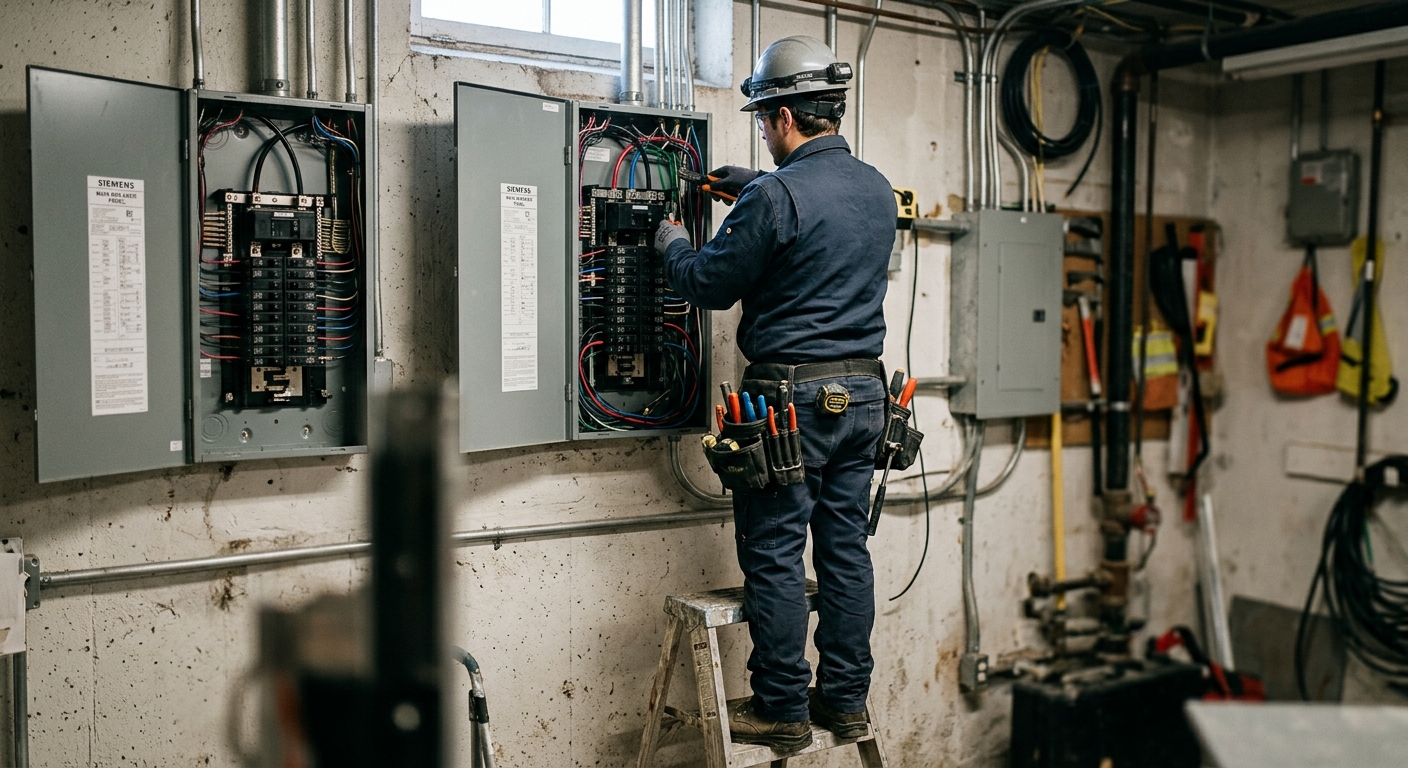
Electrical services and costs in Cochrane
Cochrane homeowners typically see electrical work costs cluster around a few common service upgrades and safety-driven rewires—especially in older housing. With 63.1% of homes built before 1981, many properties were wired for a much lighter electrical lifestyle, so today’s renovations, home offices, and heat upgrades often push panels and wiring past their original capacity. It also matters that Cochrane is a 5,390-person town, meaning fewer electricians serve a wider area, and scheduling can add time for travel, site access, and cold-weather material staging.
In Ontario’s Northeast-facing seasons (long, cold winters with frequent heating demand), peak loads are the rule rather than the exception. Even when most homes run electric baseboard or space heating only part-time, the combination of winter heating plus kitchen loads and laundry can increase nuisance breaker trips—often the first clue your panel or circuits are undersized. As a result, homeowners in areas like Downtown Cochrane and the Hillview area commonly request panel upgrades and new circuits for modern appliances, EV-ready spaces, and basement renovations.
Because of this, you’ll usually get the best value by matching the quote to the real scope (service capacity, wiring type, and the number of new circuits). If your project touches the main service, the pricing typically aligns with service upgrade and wiring/remediation bands used across Ontario for similar workmanship and materials. Compare the typical items below.
| Service |
Why It's Needed |
Permit Required |
Price Range |
| Panel upgrade — 100A to 200A service |
Supports modern loads (EV-ready circuits, heat pumps/electric stoves, more bedrooms/outlets) and reduces nuisance trips |
Yes (permit + ESA inspection) |
$2,500–$6,000 |
| EV charger installation (Level 2, 40–50A) |
Adds a dedicated, safe circuit with proper breaker, wiring method, and protection |
Yes (permit + inspection) |
$1,200–$3,000 |
| Knob-and-tube wiring removal and replacement |
Eliminates aging insulation risks and brings the home up to modern safety expectations |
Yes (permit + inspection) |
$4,000–$20,000 |
| Aluminum wiring remediation (CO/ALR connectors) |
Improves connection integrity where aluminum branch wiring is present and requires approved joining methods |
Yes (permit + inspection) |
$4,000–$12,000 |
| New dedicated circuit (HVAC, appliance, hot tub) |
Prevents overloads and improves reliability for high-demand equipment |
Yes (permit for new circuits) |
$400–$2,500 |
| Whole-home rewire (older home, full replacement) |
When multiple wiring types or extensive K&T/failed components make a full replacement the safest long-term option |
Yes (permit + inspection) |
$12,000–$30,000 |
Prices are estimates only and vary by project scope, site access and material selection.
What affects the price of electrical work in Cochrane
In Cochrane and across Ontario, you can see quotes for the “same” electrical job swing by 30–50% because the real drivers aren’t the headline task—they’re the hidden scope: how hard it is to access wiring routes, what wiring type is present, and whether a load calculation shows your service needs more capacity. That’s especially true when you’re dealing with older homes. With 63.1% of dwellings built before 1981, many projects quickly move from “add a circuit” to “upgrade service and re-route wiring,” which is why costs often land in the panel upgrade / service band of $2,500–$6,000 or expand into the wiring/remediation range depending on conditions.
Housing age dominates because wiring safety and capacity concerns are cumulative. Homes built in the earlier decades may have knob-and-tube wiring or older aluminium branch circuits; insurance and safety expectations increasingly push remediation rather than partial patching. Meanwhile, many homes—particularly from the 1960s through 1970s—started with panels that are often only 60A or 100A. Today’s add-ons (EV chargers, heat pumps, induction stoves, and even multiple hair/footwear appliances in winter) can push demand far higher, making 200A service a standard solution. EV adoption is also a key theme: Level 2 charger installations commonly require a dedicated 40–50A circuit, and the associated permit process adds time and inspection coordination.
Two local examples that commonly raise cost in Cochrane: (1) finishing work already in place—drywall, plaster, or a crowded basement—forces careful routing and more labour; (2) winter access and scheduling—work needs weather-appropriate protection for exterior components and staged materials. Cost can be lower when the panel location is straightforward, the wiring paths are open (unfinished basement), and the upgrade stays within a manageable panel/service footprint rather than triggering a broader rewire.
| Price Factor |
Why It Matters |
Cost Impact |
| Panel size upgrade — 100A to 200A is the standard minimum today |
More space for breakers, proper bus capacity, and room for EV-ready and heating loads |
$2,500–$6,000 |
| Wiring type — copper vs. aluminum remediation vs. K&T removal |
Different safety requirements, approved connection methods (CO/ALR), and more labour for K&T |
$4,000–$20,000 |
| Number of new circuits — each adds material and labour time |
Each circuit requires cable, breaker, wiring method, labeling, and testing |
$400–$2,500 |
| Permit + ESA/TS inspection fee — mandatory for all major work |
Administrative time plus required inspections (and corrections if something is missed) |
$150–$600 |
| Labour rate for licensed electricians — journeyman rates in Ontario/Northeast travel context |
Regional travel time and cold-weather working conditions increase on-site hours |
$1,000–$3,500 |
| EV charger amperage — 40A vs. 50A circuit affects cable and breaker cost |
Higher amperage can require larger conductors and different breaker sizing |
$1,200–$3,000 |
| Emergency or after-hours premium |
Expedited scheduling and increased risk controls for troubleshooting |
$200–$1,200 |
| Load calculation required for service upgrade |
Determines the correct panel/service rating and whether partial upgrades are appropriate |
$300–$800 |
Permits & regulations in Ontario
In Ontario, any electrical work beyond changing a light bulb must be completed by a licensed electrician. That includes panel upgrades, new circuits, rewiring, and service work—so if you’re adding an EV charger, installing new kitchen circuits, replacing a fuse panel, or touching existing wiring, you should expect a permit. Permitted work must also pass inspection by the electrical safety authority: in Ontario, that’s ESA (Electrical Safety Authority). DIY electrical is prohibited for most projects; homeowner “exceptions” are narrow and typically don’t cover circuit changes, panel modifications, or anything that could affect safety or code compliance.
Here’s what typically requires a permit in Ontario: new breaker/circuit additions, panel replacements or 100A-to-200A upgrades, reconfiguring circuits, EV charger installations (including Level 2), and any major wiring changes such as knob-and-tube removal or aluminum remediation that alters connections. Things that typically do not require a permit are like-for-like fixture swaps where no wiring is altered (for example, replacing a ceiling fan/light with an equivalent rated fixture) and simple switch/strap cover changes that don’t involve connecting new circuits—however, you still need the electrician’s judgement on whether the work crosses into “new work” territory.
To verify a contractor for Cochrane work, check three items before approving: (1) licence status using the Ontario public electrical contractor/licence registry; (2) certificate of insurance for liability coverage (ask for the COI copy); and (3) clearance/coverage proof for WSIB/WCB (the electrician/contractor should provide documentation on request). For service upgrades, confirm the electrician will coordinate the ESA permit and inspection steps, and—if the job touches utility service equipment—ask who handles utility coordination and paperwork.
When your Cochrane home needs an electrical upgrade
Electrical upgrades in Cochrane aren’t about “modern style”—they’re about preventing safety issues that surface during winter heavy-use. Start with the obvious warning signs. (1) Breakers that trip frequently often point to an overloaded circuit, a failing breaker, or incorrect load distribution. If it’s happening repeatedly, it’s usually a priority for troubleshooting. (2) Knob-and-tube wiring present is a serious concern: the issue isn’t only age, it’s aging insulation and connection risks that can lead to safety hazards and insurance refusals. If K&T is confirmed, plan replacement, not patching. (3) 60A or 100A service may be inadequate when you add an EV charger, heat pump equipment, and everyday loads like electric stove and laundry. In most cases, moving to 200A is the standard solution. (4) Aluminum wiring (often in pre-1976 construction) can be safe when properly remediated, but it requires a licensed approach—approved connectors (CO/ALR) and correct termination practices—not “DIY tightening.” (5) Insufficient outlets with extension cords everywhere is more than inconvenience; it’s a sign your circuit design and outlet placement don’t match your real usage. (6) No AFCI or GFCI protection where required is a code-compliance and shock/fire risk issue that may also be flagged during sale.
In Northeast Ontario winters, the difference between “works most days” and “fails during cold snaps” can be minutes to hours. For a realistic example, if you’re adding an EV charger and you discover your service is undersized, what starts as a charger install in the $1,200–$3,000 band can expand into a service upgrade in the $2,500–$6,000 band plus any wiring modifications. That higher cost is usually justified because it prevents repeated tripping, failed charging sessions, and the need to open up walls twice.
| Warning Sign |
What It Means |
Recommended Action |
Urgency |
Price Band |
| Breakers trip frequently |
Possible overload, incorrect circuit design, or failing components—often worse in winter heating use |
Troubleshoot load/circuit sizing, add dedicated circuits, repair as needed, consider service review |
Immediate |
$400–$2,500 |
| Knob-and-tube wiring present |
Aging wiring method with insulation/contact risks and increasing insurance concerns |
Plan staged or whole-home removal and replacement based on accessibility and safety scope |
Planned (with scheduling urgency) |
$4,000–$20,000 |
| 60A or 100A panel (inadequate load capacity) |
Modern loads may exceed safe capacity when multiple appliances/heating and EV charging run |
Load calculation, then upgrade to 200A service if indicated |
Planned |
$2,500–$6,000 |
| Aluminum wiring (pre-1976 construction) |
Connection integrity issues can develop; proper remediation is required |
CO/ALR remediation at identified terminations or partial/full replacement depending on condition |
Planned |
$4,000–$12,000 |
| Insufficient outlets — extension cords everywhere |
Risk of overload and tripping when households “make do” during high-use seasons |
Add outlets and dedicated circuits; remove reliance on extension cords |
Planned (address before peak winter) |
$400–$2,500 |
| No AFCI or GFCI protection where required |
Higher risk of shock/fire and potential sale/passing issues |
Add code-required AFCI/GFCI protection; update older device protection where needed |
Planned |
$300–$2,500 |
How to choose a electrical work contractor in Cochrane
Start by confirming the contractor is properly authorized to do the work in Ontario. Ask for their Ontario electrical licence details and verify it using the public licence registry. Next, request a certificate of liability insurance (COI) and confirm the coverage is current. Finally, check WSIB/WCB coverage—legitimate contractors should provide proof or clearance documentation when asked. If they won’t show documentation up front, that’s a major warning sign for homeowners in Cochrane.
Then, get 2–3 itemised written quotes. Look for a breakdown that separates labour and materials (breaker, cable, conduit, panel components, connectors, and disposal). Avoid lump-sum quotes that don’t specify whether permits are included, whether old wiring disposal is included, and what’s excluded (for example, drywall patching, re-termination labour, or utility coordination). A clear scope matters because the cost can jump when accessibility is poor or when additional safety remediation is required.
Warranty should be explicit: workmanship warranty length (how long they’ll return if something fails), product warranties from manufacturers, and whether warranties transfer if you sell the home. For payment, never agree to more than about 10–15% upfront; hold back a portion until the job is complete and inspected. Get a written start date and completion estimate, and ask how they handle ESA inspection scheduling—especially in winter when weather can affect exterior work.
- Licence verified in Ontario (ask for the licence number, then confirm online).
- Current liability insurance COI provided before work begins.
- WSIB/WCB coverage proof or clearance provided on request.
- Itemised quote: labour, materials, permits, and disposal separated.
- Written scope: what’s included and what’s excluded (drilling, patching, rewire extent).
- Permit pull responsibility stated clearly (usually the contractor).
- ESA inspection handled and scheduled with clear responsibilities.
- Expected timeline in writing, including inspection lead time.
- Warranty terms in writing for workmanship and parts.
- Payment schedule with holdback until completion and test/commissioning.
- Clear labeling of new breakers/circuits at the panel.
- Safe work practices: clean jobsite, proper weather protection, and secured materials.
Concrete red flags in Cochrane: (1) no written scope or vague “we’ll upgrade what’s needed” wording with no budget ceiling; (2) refusal to provide licence/insurance/WSIB proof; (3) asking for most payment upfront; (4) skipping permit steps or implying “we can avoid inspection”; and (5) quoting the same price whether the job is a simple EV circuit or a full 200A service upgrade.
Frequently asked questions — electrical work in Cochrane
Do I need to upgrade to a 200A panel?
In many Cochrane homes, a 200A upgrade becomes the right answer when you’re adding modern high-load items. If you already have (or plan soon) an EV charger, heat-pump equipment, an electric stove, and a typical winter load, your 60A or 100A service can be undersized. The safest way to decide is a load calculation done by your licensed electrician, not guesswork. With a large share of homes built before 1981 (Statistics Canada, 2021 Census), older panels may also have limited breaker space and older circuit layouts that complicate expansion. If the calculation shows you need more capacity, panel upgrades commonly land in the $2,500–$6,000 band depending on work complexity, panel location, and wiring accessibility.
How much does an EV charger installation cost in Cochrane?
For a Level 2 EV charger in Cochrane, many installs fall within the $1,200–$3,000 band. That usually covers a dedicated circuit (commonly 40–50A), proper breaker sizing, acceptable wiring method, and the permit/inspection process required by Ontario. Your final price depends on cable run length, whether the panel is nearby, and whether you need upgrades to reach safe capacity. If your home’s service is tight or you discover aluminum/alarming wiring conditions in the route, the job may expand into a service or wiring upgrade. That’s why a good quote starts with an inspection and a clear plan for the charger location, conduit routing, and electrical capacity.
What is knob-and-tube wiring and should I replace it?
Knob-and-tube (K&T) is an older wiring method typically found in pre-1950s to mid-century homes. The concern isn’t simply “it’s old”—it’s that insulation and connection conditions can degrade over time, and the wiring method is not designed for modern load patterns. In Ontario, insurance and safety expectations increasingly push homeowners toward replacement rather than patching. If you’ve confirmed K&T during an inspection, the recommended approach is usually removal and replacement of the affected sections, or a staged plan if access is limited. For many projects, K&T removal and replacement lands in the $4,000–$20,000 range depending on how much wiring is involved and how easy it is to access routes. Your electrician should also address any related circuit updates required for code compliance.
Is aluminum wiring safe in older Cochrane homes?
Aluminum branch wiring can be safe when it’s installed and maintained correctly, but it requires proper connections and remediation where needed. In older Cochrane homes—especially those built in the era when aluminum wiring was more common—the risk often shows up at terminations: loosening over time and oxidation can lead to overheating if not addressed. A licensed electrician can identify problem locations and typically remediates using approved methods such as CO/ALR connectors. Depending on extent, remediation often falls in the $4,000–$12,000 range, while full replacement can be higher. The key in Ontario is that any remediation work that changes wiring connections and affects safety must be permitted and inspected. Don’t rely on “tighten and hope”—use an approved remediation plan.
Do I need a permit for electrical work in Ontario?
Yes—generally, if the work involves anything beyond basic like-for-like fixture replacement, a permit is required and it must be inspected by Ontario’s electrical safety authority (ESA). In Ontario, only licensed electricians can perform the kind of work most homeowners need: panel upgrades, new circuits, rewiring, and EV charger installations all require a permit and an inspection. Homeowner work is limited; DIY for most electrical tasks is prohibited because it can create unsafe conditions you can’t easily verify without testing and inspection. For common projects in Cochrane, expect permits for a 100A-to-200A service upgrade (often $2,500–$6,000), new dedicated circuits, and Level 2 chargers (often $1,200–$3,000). A reputable contractor will include the permit process in the scope and documentation.
What are signs of an overloaded electrical panel?
Frequent breaker trips are the clearest sign—especially when the tripping happens during winter evenings when heating loads are already running. Other indicators include breakers that feel warm, repeated “reset” cycles, flickering lights, burning smells near the panel, and circuits that won’t support what used to work (like running a dryer plus microwave plus space heating). Sometimes the issue is not just capacity; it can be a wiring/circuit design problem, or older wiring that can’t reliably handle current demand. If you’re planning new loads (like an EV charger or additional resistance heating), you should request a load calculation early. When capacity is the issue, moving from 100A to 200A is a standard approach and commonly costs $2,500–$6,000 in Ontario, depending on access and scope. Treat recurring trips as a planned urgent repair—don’t keep resetting indefinitely.