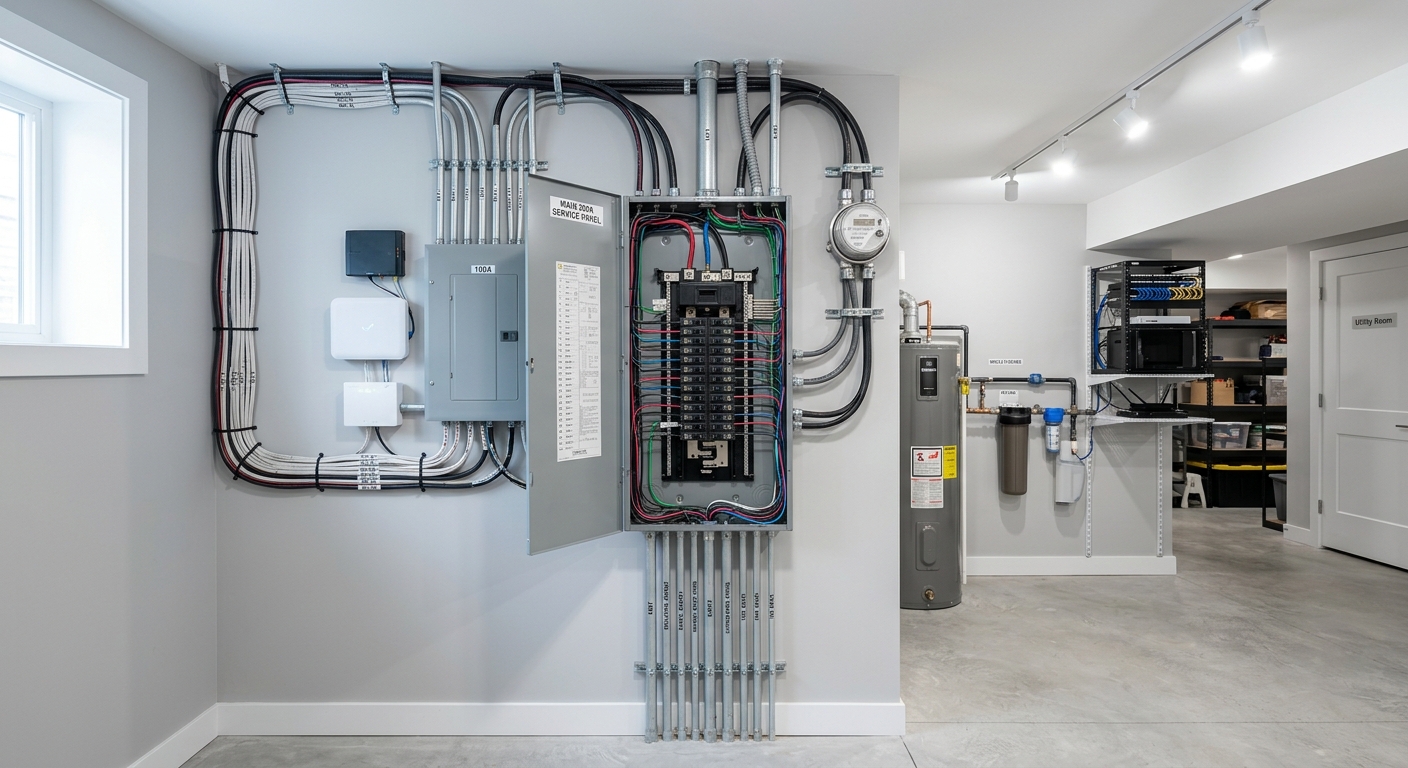
Electrical services and costs in Corso Italia-Davenport
In Corso Italia-Davenport, many homeowners run into electrical work as soon as they modernize: finishes, finished basements, new lighting, and upgrades for today’s appliance loads. This neighbourhood has a mix of older detached homes and newer infill, and that matters because the local housing stock includes a significant older segment—prime candidates for panel upgrades, knob-and-tube removal, and aluminum branch wiring remediation. With Corso Italia-Davenport’s population at 14,133 (Statistics Canada, 2021 Census), there’s enough density to support consistent contractor availability, but demand still spikes in the spring and summer when renovations and heat-pump installs climb.
Toronto’s climate also shapes electrical costs. Winter cold drives higher HVAC and heat-pump runtime, and summers increase air-conditioning and dehumidification loads—meaning panels that were “fine” for 10–15 years can become marginal. At the same time, Toronto’s active renovation and condo-adjacent market increases competition for labour and materials, so quotes can widen between contractors when a job requires service relocation, trenching, or extensive safety remediation.
In practice, many requests in the Davenport area (and around the Corso Italia strip) involve older services and circuit additions for EV charging and basement projects. That’s exactly why it’s common to pair wiring remediation with a 100A-to-200A panel/service upgrade, especially when homeowners add a Level 2 charger and plan to run modern kitchen loads. Use the table below to compare typical services, permitting needs, and cost bands—then we’ll break down what drives price differences job to job.
| Service |
Why It's Needed |
Permit Required |
Price Range |
| Panel upgrade — 100A to 200A service |
Modern load demand (EV charging, heat pumps, induction stoves, electric water/space heating) often exceeds older capacity; improved safety and code compliance. |
Yes (panel/service upgrade) |
$2,500–$6,000 |
| EV charger installation (Level 2, 40–50A) |
Adds a dedicated circuit and properly protected feeder for reliable, code-compliant Level 2 charging. |
Yes (new dedicated circuit/branch and permit) |
$900–$2,2500 |
| Knob-and-tube wiring removal and replacement |
K&T insulation and splices are dated; insurers may limit coverage, and safe terminations/boundaries become critical. |
Yes (rewiring/remediation) |
$3,000–$15,000 |
| Aluminum wiring remediation (CO/ALR connectors) |
Older aluminum branch wiring can overheat at terminations without approved remediation; requires licensed inspection and proper connectors. |
Yes (remediation that changes conductors/terminations) |
$2,000–$8,000 |
| New dedicated circuit (HVAC, appliance, hot tub) |
Supports a high-demand device safely with proper breaker sizing and correct conductor type/route. |
Yes (new circuit) |
$800–$3,500 |
| Whole-home rewire (older home, full replacement) |
Comprehensive upgrade when wiring is unreliable throughout; typically includes panel/service correction and modern protection devices. |
Yes (major rewiring) |
$7,000–$20,000 |
Prices are estimates only and vary by project scope, site access and material selection.
What affects the price of electrical work in Corso Italia-Davenport
Two quotes for the “same” job in Toronto can differ by 30–50% because the hidden variables are rarely identical—especially in Corso Italia-Davenport where older wiring, long cable runs, and mixed electrical systems show up in many pre-renovation homes. The dominant driver is housing age: homes built before 1950 are more likely to have knob-and-tube wiring, and insurance coverage issues often push homeowners toward removal rather than partial fixes. Homes from the 1960s to 1970s often have smaller 60A or 100A panels, which can struggle when you add EV charging, heat pumps, and modern kitchen appliances. Aluminum wiring is also common in the mid-1960s to mid-1970s era, and it requires licensed remediation with approved CO/ALR connectors or full replacement.
In Toronto’s current market, EV adoption is a major load driver, and Level 2 charger permit applications are rising. That impacts pricing because dedicated feeders may require panel upgrades, load calculations, and sometimes service relocation. If your job stays within a straightforward breaker swap and a clean cable route, costs track nearer the lower end of the band; if it needs trenching/long runs, additional protection devices, and comprehensive safety work, costs move toward the upper end—similar to how EV work can sit around $900–$2,500 when panel capacity is already adequate, but can climb when paired with a 200A service plan.
Concrete local examples from Corso Italia-Davenport include: (1) basements finished with older BX/armoured cable routes that need careful tracing, which adds labour; and (2) panel access—if the panel is in a tight utility area near the Davenport side of the house, cable routing and drywall restoration can increase costs. Weather also matters: cold snaps in winter slow outdoor work and can affect material handling for service feeders, so scheduling can shift when permits and inspections are time-sensitive. For service upgrades, the Toronto band is typically $2,500–$6,000 for many 200A projects, with more complex jobs going higher when remediation and access issues pile up.
| Price Factor |
Why It Matters |
Cost Impact |
| Panel size upgrade — 100A to 200A is the standard minimum today |
More capacity for modern loads and safer circuit distribution. |
$1,500–$4,000 |
| Wiring type — copper vs. aluminum remediation vs. K&T removal |
Aluminum and K&T require approved remediation steps and careful terminations. |
$500–$10,000 |
| Number of new circuits — each adds material and labour time |
Each circuit means breaker, wiring, labour time, testing, and documentation. |
$300–$2,500 per circuit |
| Permit + ESA/TSBC inspection fee — mandatory for all major work |
Permitted work must be inspected and documented. |
$200–$500 |
| Labour rate for licensed electricians — journeyman rates in Toronto |
Labour time is the biggest swing factor when wiring is older or access is tight. |
$90–$120 per hour |
| EV charger amperage — 40A vs. 50A circuit affects cable and breaker cost |
Higher amperage can require different conductor sizing, breaker selection, and feeder considerations. |
$150–$1,000 |
| Emergency or after-hours premium |
Scheduling trades around safety calls increases overhead and labour cost. |
$150–$600 |
| Load calculation required for service upgrade |
Code-compliant sizing may require engineering-like calculations and additional checks. |
$150–$800 |
Permits & regulations in Ontario
In Ontario, ALL electrical work beyond changing a light bulb must be performed by a licensed electrician. That includes work like adding or moving outlets, installing dedicated circuits (such as for an EV charger), replacing panels, rewiring portions of a home, and any service upgrade. For Corso Italia-Davenport homeowners, the key point is that major electrical changes are permit-requiring and must pass inspection by the electrical authority for Ontario—through ESA processes.
Typically, you DO need a permit for: panel or service upgrades (including 100A to 200A), new circuits and branch wiring, EV charger installations, rewiring/major alterations (including K&T and aluminum remediation that involves terminations or conductor changes), and most work that changes how the electrical system is configured. You typically do NOT need a permit for “like-for-like” swaps that don’t modify wiring or protection—for example, replacing a working light fixture with an appropriate equivalent fixture or replacing a receptacle with an identical type in the same configuration, provided the job is truly like-for-like and doesn’t involve new wiring, re-routing, or adding circuits.
Step-by-step verification in Ontario (before signing): (1) Ask for the contractor’s Ontario electrical licence information and verify it via the provincial licence registry; (2) Request a current certificate of insurance showing general liability and electrical coverage; (3) Confirm WSIB/WCB clearance or coverage—reputable contractors can provide proof; (4) Ensure the quote states the permit filing and inspection responsibility; and (5) Get the ESA/inspection details in writing with the scope. This protects you during construction delays and ensures the work is documented and safe.
When your Corso Italia-Davenport home needs an electrical upgrade
Electrical upgrades in Corso Italia-Davenport are usually safety-critical—especially in homes with older wiring or limited panel capacity. Start by watching for warning signs, then decide whether you need immediate action or a planned upgrade.
First, breakers that trip regularly (or you feel heat near breakers/fuses) often indicate overloaded circuits, loose connections, or wiring faults. This is an immediate concern: schedule diagnostics right away. Second, knob-and-tube wiring is the big red flag. The issue isn’t just age; it’s insulation deterioration and unsafe junctions/terminations, and many insurers in the Ontario market reduce or deny coverage when K&T is present—so plan removal and replacement rather than living with it.
Third, if you have a 60A or 100A panel, your home can be under-capacity once you add modern loads. In Toronto winters, heat pumps run more, and summers add air conditioning demand; combined with an EV charger and electric stove, an undersized service can lead to nuisance trips or forced “load shedding.” In those cases, a 200A upgrade is usually the standard solution, not a “few more breakers.” Fourth, aluminum wiring (often pre-1976 construction) isn’t always an emergency if it’s in good condition, but it does require licensed remediation with approved methods (commonly CO/ALR connectors) or replacement at problematic terminations. Fifth, insufficient outlets—especially extension cords everywhere—signals planning issues and can mask overloading hazards at the receptacle level. Lastly, missing AFCI/GFCI protection where required is both a safety and code-compliance issue; it can surface during sale or insurance reviews.
For an idea of how choices affect cost: if you’re already planning a panel/service upgrade, bundling a dedicated EV circuit can cost closer to $900–$2,500 for the charger work. If you defer panel upgrades and later discover the service can’t handle it, the charger can become part of a bigger $2,500–$6,000 service upgrade project—so it’s usually cheaper to design the system as one coordinated upgrade.
| Warning Sign |
What It Means |
Recommended Action |
Urgency |
Price Band |
| Breakers trip frequently |
Overload, loose connections, failing components, or undersized/misconfigured circuits. |
Diagnostic inspection first; then correct circuits or upgrade panel capacity if needed. |
Immediate (safety risk) |
$200–$1,500 |
| Knob-and-tube wiring present |
Outdated insulation and splices; elevated fire risk and often an insurance problem. |
Plan removal and rewiring of affected sections or full rewire depending on scope. |
Planned but sooner is better |
$3,000–$15,000 |
| 60A or 100A panel (inadequate load capacity) |
Insufficient capacity for today’s loads (EV charging, heat pumps, electric cooking). |
Load calculation and 100A-to-200A panel/service upgrade. |
Planned soon |
$2,500–$6,000 |
| Aluminum wiring (pre-1976 construction) |
Termination overheating risk without proper remediation. |
Licensed inspection and CO/ALR connector remediation (or replacement if degraded). |
Planned |
$2,000–$8,000 |
| Insufficient outlets — extension cords everywhere |
Increased chance of overloaded receptacles and unsafe temporary wiring. |
Add dedicated circuits/receptacles and correct protection (AFCI/GFCI where required). |
Planned |
$800–$3,500 |
| No AFCI or GFCI protection where required |
Lower safety against arc-fault and shock hazards; potential compliance issues at sale. |
Upgrade protection devices and update affected circuits to code requirements. |
Planned (prioritize before resale) |
$400–$2,000 |
How to choose a electrical work contractor in Corso Italia-Davenport
Choosing the right contractor in Corso Italia-Davenport starts with verifying credentials and asking the right questions. In Ontario, the electrician you hire must be licensed, and the company should carry proper liability insurance. To check licensing, ask for the company’s licence details and verify them using the provincial online licence registry. For liability coverage, request a current certificate of insurance and make sure it lists the jobsite name/address (or at least the insured entity). For WSIB/WCB coverage, reputable contractors provide proof on request—this matters for jobsite safety and worker protection if something goes wrong.
Next, get 2–3 itemized written quotes. You want a breakdown that shows labour hours, materials (breakers, panels, connectors, conduit/cable), testing, and permitting/inspection handling. Avoid quotes that only list one lump sum unless the scope is fully defined. Read scope exclusions carefully: is drywall restoration included, is disposal included, does the price include permit fees, and will they handle ESA inspection booking? For warranty, confirm workmanship warranty length and whether manufacturers’ warranties (like for panels/chargers) are transferable if you sell the home.
For payment, never pay more than 10–15% upfront. Use a holdback tied to completion and final inspection results. Get a timeline and a start/completion estimate in writing, and confirm coordination steps for inspection windows—especially in winter when weather and inspection scheduling can impact readiness.
- Provide licence number(s) and verify Ontario licensing before booking.
- Ask for a certificate of insurance before work starts.
- Confirm WSIB/WCB clearance or coverage in writing.
- Use itemized quotes (labour, materials, testing, permits).
- Confirm permit filing responsibility and ESA inspection scheduling.
- Clarify what’s included for difficult access (attic/basement, exterior service work).
- Request a materials list: panel brand/model, breakers, charger model (if applicable).
- Confirm AFCI/GFCI and any code upgrades included for the affected circuits.
- Ask about disposal/dump fees for removed wiring, panels, and packaging.
- Check warranty terms: workmanship duration and manufacturer warranty transferability.
- Agree on payment milestones with a holdback until final inspection/cleanup.
- Get start date and completion estimate in writing, including re-inspection contingencies.
Red flags in Corso Italia-Davenport: they won’t provide licence/insurance/WSIB proof, the quote isn’t itemized (no permit/inspection or materials listed), they pressure you for large upfront payments, they avoid talking about load calculations for service upgrades, or they suggest “no permit needed” for a panel change or EV charger circuit.
Frequently asked questions — electrical work in Corso Italia-Davenport
How much does an EV charger installation cost in Corso Italia-Davenport?
In Corso Italia-Davenport, most Level 2 home EV charger installs land in the $900–$2,500 band, assuming you have reasonable panel access and capacity. Cost changes quickly if your home needs a service upgrade or additional circuits first—many households in older Toronto-area homes end up doing a coordinated plan because a modern 40–50A EV circuit may exceed older panel capacity. Expect an ESA-permitted job with proper breaker, cable sizing, and testing. If the contractor needs to run longer cable routes, add conduit, or remediate old wiring at terminations, the price can move toward the upper end. Always ask whether the quote includes the permit, inspection handling, and any load calculation.
What is knob-and-tube wiring and should I replace it?
Knob-and-tube (K&T) wiring is an older method that uses porcelain knobs and tubes to route conductors, with junctions and insulation materials that are now considered outdated. In Ontario, K&T is often treated as a safety and risk concern because insulation aging and concealed connections can create unreliable terminations. For Corso Italia-Davenport homeowners, the decision is usually not cosmetic—it can affect insurance acceptance and overall electrical safety. You typically shouldn’t “patch” K&T long-term; instead, plan removal and replacement of the affected circuits or a fuller rewire depending on the condition and scope. Many K&T projects fall in the $3,000–$15,000 band when replacement is substantial, especially if the work includes panel correction and circuit reconfiguration.
Is aluminum wiring safe in older Corso Italia-Davenport homes?
Aluminum wiring can be safe when it’s in good condition and—critically—when terminations are properly remediated. The concern isn’t the presence of aluminum by itself; it’s overheating and increased resistance at connection points when the wiring was installed without today’s approved connection methods. In Corso Italia-Davenport homes built in the 1960s to 1970s, aluminum branch wiring is fairly common, so many homeowners arrange a licensed inspection and then remediation using approved CO/ALR connectors or replacement where needed. If your connectors are loose, damaged, or previously modified incorrectly, the issue becomes more urgent. Remediation projects commonly land around $2,000–$8,000, while full replacement can be higher. Don’t rely on “it still works” as a test—ask for a documented inspection and remediation plan.
Do I need a permit for electrical work in Ontario?
Yes—most electrical work that goes beyond simple like-for-like fixtures requires a permit in Ontario, including in Corso Italia-Davenport. Panel upgrades, service upgrades (for example 100A to 200A), new circuits (including EV charger installations), rewiring, and major alterations all require permitting and must be inspected. In Ontario, permitted work is inspected through ESA processes (Electrical Safety Authority). “No permit” suggestions are a serious red flag if the job changes circuits, wiring paths, breakers, or the electrical service. What’s not usually permit-required is limited like-for-like replacement that does not change the wiring system (for example, replacing a fixture with an equivalent). When in doubt, ask the electrician whether the work triggers a permit and confirm it in writing before starting.
What are signs of an overloaded electrical panel?
Common signs of an overloaded electrical panel include breakers that trip frequently, lights that dim when large loads start (like kettles, microwaves, or HVAC cycling), buzzing from the panel area, and warm or discoloured breaker connections. In Corso Italia-Davenport, overload risk often increases in winter and summer because heating/cooling run times rise. Homes with smaller older panels may also be stressed when you add modern loads like heat pumps, induction cooking, and EV charging. If you suspect overload, treat it as a safety issue—stop using the problem circuit(s) and book a licensed inspection. The fix can range from adding properly designed circuits to a service upgrade; many panel/service upgrades in the GTA tier are around $2,500–$6,000 when moving to a 200A-capacity setup.
Can I do my own electrical work in Ontario?
In Ontario, DIY electrical work is very limited. Beyond simple like-for-like tasks, you generally cannot legally do wiring, panel work, installing new circuits, or any work that requires permits and inspection. For Corso Italia-Davenport homeowners, the practical takeaway is that if the work affects circuits, breakers, wiring methods, or the electrical service, you should hire a licensed electrician. DIY that bypasses licensing and permitting can create safety hazards and can also become a sale/insurance problem later. If you want to do prep work, discuss what’s allowable (for example, clearing access areas or coordinating minor non-electrical demolition) with your licensed contractor ahead of time. Confirm that the electrician is handling permitting, ESA inspection, and provides documentation of the final test results.