Electrical services and costs in Emo
Emo, Ontario has a lot of character homes, and that usually shows up in the electrical. With 54.3% of dwellings built before 1981, many properties have older wiring layouts and service equipment that can’t reliably handle today’s loads. In practice, that often means contractors doing panel upgrades, adding or correcting circuits, and addressing knob-and-tube or aluminum branch wiring before they’ll even sign off on new work. (Statistics Canada, 2021 Census)
In the Northwest, the weather matters too: longer heating seasons and more frequent outages or voltage dips can expose weak connections, aging breakers, and undersized grounding. Labour availability can also swing based on the order book—during busy months (especially when multiple heat-pump and EV projects stack up), the same scope can cost more simply because the crew has to travel and schedule farther blocks in the region.
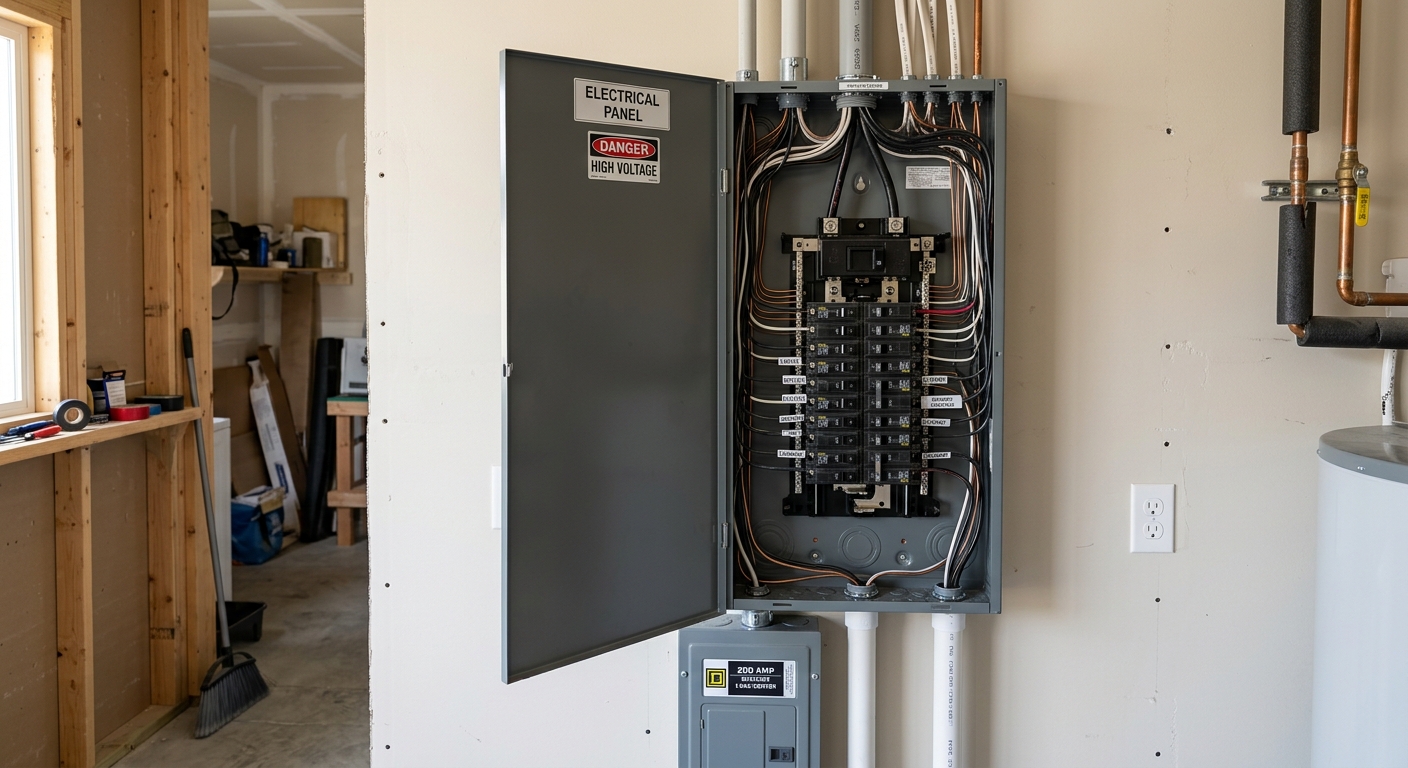
If you live in an area with older, established housing near the commercial core of Emo, you’ll typically see demand spike for service-capacity checks and “make-safe” work before permits. For homeowners adding an EV charger or upgrading to electric heat, the conversation quickly shifts toward a 100A-to-200A service or panel upgrade, plus corrected circuiting so the system can run safely and continuously.
Below is a practical range you’ll see for common jobs in Emo, Ontario—then you can compare your situation to the scope in the rest of this guide.
| Service |
Why It's Needed |
Permit Required |
Price Range |
| Panel upgrade — 100A to 200A service |
Modern loads (electric heat, heat pumps, EV chargers, induction ranges) need higher capacity and updated protection |
Yes (ESA permit + inspection) |
$2,100–$6,900 |
| EV charger installation (Level 2, 40–50A) |
Dedicated circuit for continuous EV charging and safer breaker protection |
Yes (new circuit/service modification) |
$1,000–$2,500 |
| Knob-and-tube wiring removal and replacement |
Legacy wiring has insulation/connector issues; insurance may refuse coverage without remediation |
Yes (major rewiring) |
$4,200–$10,300 |
| Aluminum wiring remediation (CO/ALR connectors) |
Licensed corrections required for poor terminations and compatibility with breakers/devices |
Yes (code-required work) |
$3,850–$7,600 |
| New dedicated circuit (HVAC, appliance, hot tub) |
Separate circuits reduce overload risk and improve safety/compliance |
Yes (new branch circuit) |
$650–$2,400 |
| Whole-home rewire (older home, full replacement) |
When multiple rooms/circuits fail inspection or the layout can’t be safely corrected piecemeal |
Yes (major rewiring) |
$6,000–$10,300 |
Prices are estimates only and vary by project scope, site access and material selection.
What affects the price of electrical work in Emo
In Emo and across Ontario’s Northwest, it’s normal to see quotes for the “same” upgrade differ by 30–50%. The biggest driver is the age and condition of the home—especially because 54.3% of dwellings in the area were built before 1981, and older builds often come with mixed wiring types, older breaker brands, and services that were installed for different electrical habits. (Statistics Canada, 2021 Census)
Knob-and-tube wiring is a good example of why scope changes so fast. If insulation issues are present, an electrician may need to remove and replace sections, not just “add a new outlet.” Homes from the 1960s–70s may have 60A or 100A panels that are inadequate for today’s continuous loads—EV chargers, heat pumps, and electric ranges at the same time—so work can jump from an “add a circuit” job into a panel/service upgrade. Aluminum wiring (commonly from the mid-1960s through the 1970s) also tends to add cost because it requires licensed remediation with approved methods (like CO/ALR connectors) or full replacement where terminations can’t be corrected.
EV adoption is another factor: when homeowners want Level 2 charging, installers often must do a load calculation and may add conductors, breakers, and sometimes service capacity. That’s why you might see a Level 2 charger project sit around the $700–$2,500 band, but climb if it triggers a 100A-to-200A upgrade. In practice, older housing stock plus electric heat can push labour and materials toward the higher end of the $1,400–$7,000 panel/service band.
Two concrete Emo examples: (1) a straightforward breaker swap is usually cheaper, but anything tied to replacing unsafe wiring or expanding a panel gets into permitted, inspected work; (2) long cable runs through older insulation or finishing work already in place can add labour time—so the same circuit length can cost more in older rooms than in newer, open basements.
| Price Factor |
Why It Matters |
Cost Impact |
| Panel size upgrade — 100A to 200A is the standard minimum today |
Service capacity limits whether new loads can run continuously |
$1,400–$7,000 |
| Wiring type — copper vs. aluminum remediation vs. K&T removal |
Remediation methods and replacement scope vary by hazard and inspection results |
$3,850–$10,300 |
| Number of new circuits — each adds material and labour time |
Each circuit requires conductors, terminations, breakers, and often drilling/routing |
$650–$2,400 per circuit typical |
| Permit + ESA/TSBC inspection fee — mandatory for all major work |
Major electrical work must be permitted and inspected before it’s considered safe/complete |
$200–$600 |
| Labour rate for licensed electricians — journeyman rates in Ontario’s Northwest |
Travel, scheduling, and complexity add labour hours |
$120–$200 per hour typical range |
| EV charger amperage — 40A vs. 50A circuit affects cable and breaker cost |
Higher amperage generally needs larger conductors and appropriately rated protection |
$700–$2,500 |
| Emergency or after-hours premium |
Expedited scheduling increases labour cost and sometimes trip charges |
$150–$600 added |
| Load calculation required for service upgrade |
Utilities and permitting often require evidence of adequate capacity for new loads |
$150–$400 |
Permits & regulations in Ontario
In Ontario, all electrical work beyond changing a light bulb must be done by a licensed electrician. That includes panel upgrades, new circuits, rewiring, and service changes—exactly the kinds of jobs that commonly come up in Emo when homeowners add an EV charger, upgrade electric heating, or discover older wiring types during renovations. Permits are typically required for: panel/service upgrades, installing a new breaker/circuit (including Level 2 EV chargers), any rewiring that changes conductors or circuits, and any work that affects the service equipment.
Permitted work must pass inspection by the Electrical Safety Authority (ESA) in Ontario. DIY is restricted: homeowners can do non-electrical tasks (like mounting a fixture or painting a cover), but they can’t install wiring, connect circuits, or make modifications that require permitting and inspection.
To verify a contractor in Emo step-by-step: (1) confirm the electrician’s Ontario licence using the Ontario registry and match the licence name/company to the quote; (2) ask for a clearance letter (or proof) confirming ESA clearance for the specific address after work is complete; (3) request a Certificate of Insurance showing liability coverage; and (4) confirm WSIB coverage where applicable for the contractor’s employees—don’t assume it’s covered. If they can’t provide these documents promptly, that’s a red flag.
When a service change requires utility coordination, your electrician should also explain how they’ll manage the meter/supply scheduling so the inspection and energization aren’t delayed.
When your Emo home needs an electrical upgrade
Not all electrical problems are “cosmetic”—in Emo’s Northwest climate, safety issues show up through repeated faults, failing connections, and undersized services that can’t carry today’s continuous loads. Start with the warning signs that typically matter for immediate safety and insurance risk.
(1) Breakers that trip regularly: if a breaker trips when nothing “big” is running, you may have overloaded circuits, failing breakers, or hot/loose connections. That needs action—often troubleshooting first, then correction. (2) Knob-and-tube wiring: the key concern is deteriorated insulation contact and connection integrity, not just how old it is. It’s commonly a deal-breaker for insurance and can fail inspection, so plan remediation. (3) 60A or 100A service: in a modern Emo household with an EV charger, heat pump(s), and an electric range, you can hit capacity limits—so a 200A upgrade is often the standard solution. (4) Aluminum wiring (pre-1976 construction): it may not be an instant emergency, but it should be evaluated for proper termination and remedied with licensed methods. (5) Insufficient outlets and missing AFCI/GFCI protection: this is a code-compliance issue that can become a problem during sale or inspection, even if it “works” today.
In the real world, the cost difference is often justified. For example, adding a single circuit might sit near the $650–$2,400 range, but if your panel is already full and the wiring is unsafe, the “cheap” option can become double-work—leading to a panel/service upgrade in the $1,400–$7,000 band plus safer circuiting. If your home is from before 1981, it’s worth doing a load-capacity and wiring assessment early so you’re not paying for fixes that won’t pass inspection.
| Warning Sign |
What It Means |
Recommended Action |
Urgency |
Price Band |
| Breakers trip frequently |
Overload, failing breaker, or loose/hot connections |
Troubleshoot load, correct circuits, and inspect terminations |
Immediate to planned (same week if frequent) |
$250–$1,500 |
| Knob-and-tube wiring present |
Older insulation/connectors that can fail safety/inspection |
Remove/replace affected sections and update protection |
Planned upgrade (often required for insurance) |
$4,200–$10,300 |
| 60A or 100A panel (inadequate load capacity) |
Can’t support modern continuous loads reliably |
Upgrade to 200A service/panel with load calculation |
Planned upgrade (before adding major new loads) |
$2,100–$6,900 |
| Aluminum wiring (pre-1976 construction) |
Higher risk at terminations without approved remediation |
Evaluate and remediate with CO/ALR methods or replacement |
Planned upgrade |
$3,850–$7,600 |
| Insufficient outlets — extension cords everywhere |
Overreliance on temporary power and unsafe loading |
Add circuits/outlets and redistribute loads |
Planned upgrade (urgent if cords are constant) |
$650–$2,400 |
| No AFCI or GFCI protection where required |
Higher likelihood of arc-fault/shock hazards and sale-inspection issues |
Add required protection devices and update affected circuits |
Planned upgrade |
$130–$1,200 |
How to choose a electrical work contractor in Emo
Choosing the right electrician in Emo is mostly about documentation, clarity, and inspection readiness. First, verify Ontario licensing: ask for their licence number and confirm it using the Ontario licence registry. Next, confirm liability insurance—request the Certificate of Insurance and make sure it names the correct business entity. For coverage, ask whether they carry WSIB/WCB for their workers; you don’t want to be stuck if a worker is injured on your property. A reputable contractor in Northern Ontario should provide these items without pushing back.
Then get 2–3 itemised written quotes. Avoid “lump sum only” proposals. You want line items that separate labour, materials (breakers, cable, panel hardware), disposal/cleanup, and any required troubleshooting or load calculations. Make sure the scope states whether the electrician will pull the permit, schedule ESA inspection, and handle any utility coordination if the service changes. Also ask what’s excluded (drywall patching, re-insulation, hidden-cable discovery work, or replacing devices like outlets/switches).
Warranty matters: workmanship warranties should be in writing (often covering defects for a period), and you should understand product/manufacturer warranties too. Clarify whether warranty coverage is transferable when you sell your home. Payment should be staged—never more than 10–15% upfront—and you should hold back payment until the job is complete, inspected, and cleaned up.
Finally, request a written timeline: start date, working hours, inspection booking expectations, and estimated completion date.
- Licence number provided and matches the quote/invoice
- Certificate of Insurance available before work begins
- WSIB/WCB clearance confirmed (where applicable)
- Itemised quote: labour vs. materials vs. permits/inspection
- Written scope: what’s included and what’s excluded
- Permit pull responsibility stated clearly
- ESA inspection scheduling included or coordinated
- Load calculation included if service capacity is changing
- Brand/model of panel, breakers, and chargers listed
- Disposal/cleanup included (no surprise hauling bills)
- Workmanship warranty duration stated
- Payment schedule with holdback until inspection/close-out
If you’re comparing contractors in Emo, watch for these red flags: (1) they won’t put the permit/inspection responsibility in writing; (2) they try to collect most of the payment upfront; (3) they dismiss knob-and-tube/aluminum concerns without an assessment; (4) they can’t show insurance/WSIB proof; or (5) the quote is vague (“electrical upgrade”) without listing what equipment is being replaced.
Frequently asked questions — electrical work in Emo
Can I add a subpanel to my Emo home?
Yes, you can add a subpanel in Emo, Ontario, and it’s a common way to manage loads when the main panel is already full—especially in older homes where additional circuits were never planned. Typically, a subpanel install requires a permit and ESA inspection because it involves new branch circuits and usually new feeders/grounding changes. The electrician should plan the feeder size, ensure proper bonding/grounding separation, and confirm the load calculation supports the extra circuits. If your home has a 60A or 100A service and you’re adding modern loads (like heat pumps or an EV charger), the subpanel may be fine—or it may highlight the need for a 100A-to-200A panel/service upgrade.
How much does an electrician cost in Emo?
In Emo, you’ll typically see journeyman labour billed hourly, with travel and minimum call-out time affecting the final number. While exact rates vary by contractor, many quotes land in the practical range of about $120 to $200 per hour for licensed work in Ontario’s Northwest, plus materials and any required permits. The total cost depends heavily on whether you’re doing a straightforward circuit correction or dealing with older wiring—knob-and-tube or aluminum remediation can add hours because the electrician has to make sections safe for inspection. For homeowners, it’s smart to budget separately for permit work and any troubleshooting visit, then expect that projects that cross into panel/service upgrades will shift into the higher bands (for example, panel upgrades often fall into the $1,400–$7,000 range).
How much does a panel upgrade cost in Emo?
Panel upgrade pricing in Emo commonly depends on whether you’re replacing a like-for-like 100A panel or doing a capacity increase. For many Northwest Ontario homes with older services, moving from 100A to 200A is the standard minimum today when you’re adding EV charging, heat pumps, or modern appliances. In this tier, panel/service upgrades are often estimated in the $1,400–$7,000 range, with the typical “all-in” cost closer to the upper half when the wiring, grounding, and service connections need updates for ESA requirements. If your home is built before 1981 (which is common locally), inspectors frequently expect corrections in addition to the panel swap, so a detailed scope matters more than comparing headline numbers.
Do I need to upgrade to a 200A panel?
You might—but it depends on your load calculation and what you plan to add. In Emo and the broader Northwest region, many homes have 60A/100A services that were sized for older heating and cooking patterns. Today’s combo of electric/heat-pump heating, induction or electric ranges, and an EV charger can push capacity quickly, especially with continuous loads. If you’re installing an EV charger (usually Level 2 at 40–50A) and you already run electric heat and major appliances, a 200A upgrade is often the safest, most future-proof solution. Your electrician should perform (or document) a load calculation as part of the service change decision. If you only need one small circuit and your existing panel has space and adequate capacity, you may not need 200A right away.
How much does an EV charger installation cost in Emo?
For Emo, Level 2 EV charger installation typically falls into the $700–$2,500 range depending on amperage (40A vs. 50A), wire distance from the panel, and whether your service needs updating. If your main panel is near capacity or your service equipment is older, the quote can increase because the electrician may need a new breaker, upgraded conductors, and sometimes a 100A-to-200A panel/service upgrade. Because EV charging is continuous load, ESA-permitted dedicated circuiting is the norm—not a “shared outlet” approach. If you’re considering an EV charger soon, ask for an early assessment; it can prevent paying for a charger install twice if a capacity upgrade is required for safe operation and inspection.
What is knob-and-tube wiring and should I replace it?
Knob-and-tube wiring is an older wiring method commonly found in pre-modern homes. In Emo, where a large share of housing stock is older, it can still show up during renovations. The concern isn’t just age—it’s the way insulation ages and how connections/closures perform over time. For safety and insurance reasons, knob-and-tube often fails inspection or can lead to insurance cancellation if you can’t demonstrate safe, code-compliant conditions. In most cases, electricians recommend replacement or removal of affected runs, especially if you plan to add new circuits, upgrade a panel, or do major electrical work. Whether you replace all or part depends on inspection findings, how much of the home’s wiring is affected, and what ESA requires for the permitted scope. If knob-and-tube is present, schedule an assessment before you spend money on new outlets or a panel change.