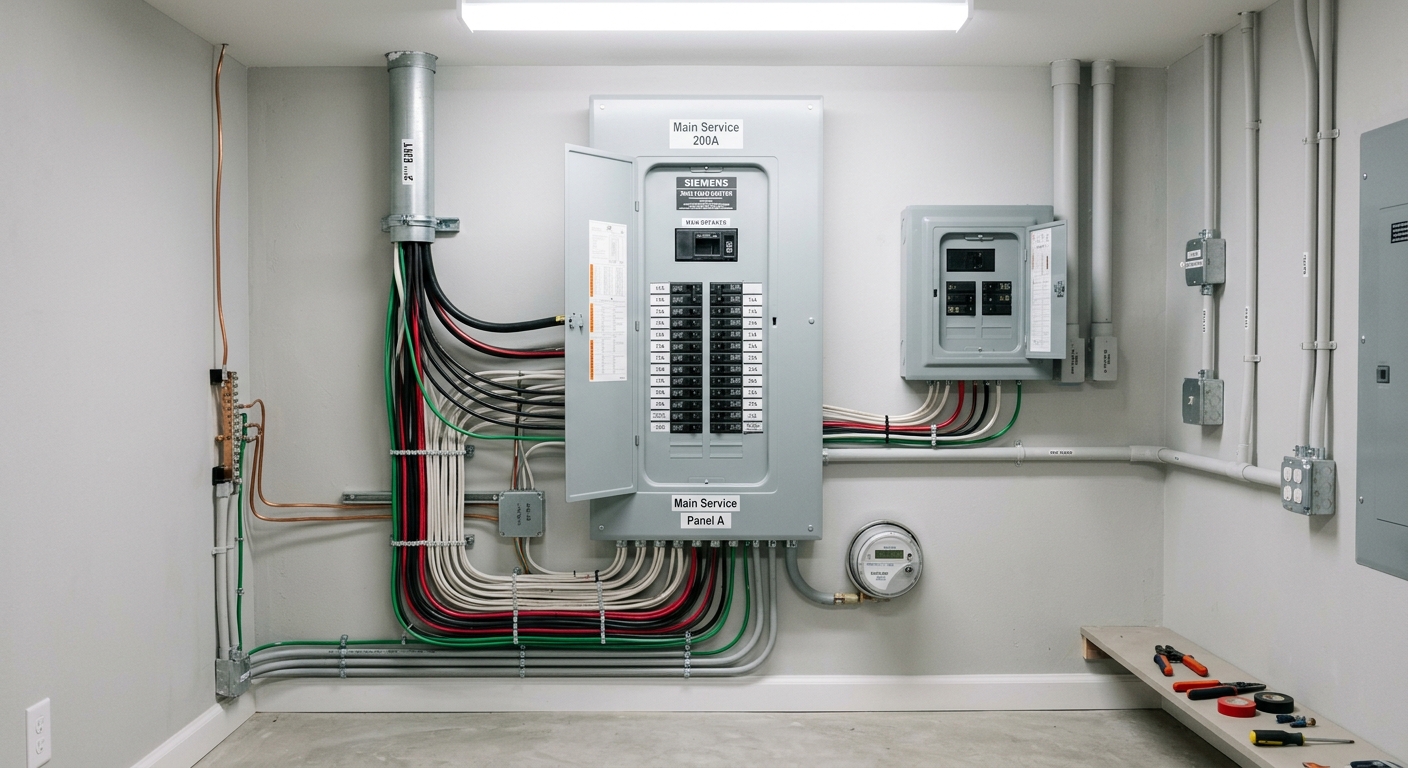
Electrical services and costs in St. Thomas
In St. Thomas, electrical upgrades are a common part of maintaining and modernizing older homes. With 57.7% of dwellings built before 1981 (Statistics Canada, 2021 Census), many properties in the city’s older neighbourhood pockets are prime candidates for panel changes, knob-and-tube removal, and aluminum wiring remediation—work that’s needed for safety, comfort, and future insurability. St. Thomas also has a large base of homeowner households (67.8% of households own), which tends to translate into higher rates of “whole-home” upgrades rather than short, stop-gap repairs.
London’s economic region has an active residential contracting market, but pricing is still shaped by demand and project complexity. The region’s cold winters (and more frequent use of supplemental electric heat and heated water systems) can expose marginal service capacity. As EV adoption increases, electricians are seeing more Level 2 charger permit applications, and that drives higher labour planning and load-calculation work for service upgrades. In areas such as West Elgin and near the downtown core, older housing stock and steady renovation activity often mean more competition for electricians—helpful for availability, but it can also keep pricing from dropping too far.
Because most bids depend on scope—how much rewiring, how much panel work, and whether there’s aluminum or knob-and-tube involved—use the table below as a realistic starting point for comparing quotes in St. Thomas.
| Service |
Why It's Needed |
Permit Required |
Price Range |
| Panel upgrade — 100A to 200A service |
Meets modern load demands (EV chargers, heat pumps/resistance heating, cooking loads) and improves safety |
Yes (ESA permit + inspection in Ontario) |
$2,500–$4,500 |
| EV charger installation (Level 2, 40–50A) |
Dedicated charging circuit reduces wear on existing circuits and supports convenient overnight charging |
Yes (new circuit + charger requires permits/inspection) |
$1,200–$2,400 |
| Knob-and-tube wiring removal and replacement |
Eliminates aging insulation concerns and supports code-compliant, insurable wiring |
Yes (rewiring scope requires permits + inspection) |
$9,000–$18,500 |
| Aluminum wiring remediation (CO/ALR connectors) |
Corrects terminations so connections are rated for aluminum conductors (or replaces affected runs) |
Yes (major wiring alteration requires permits/inspection) |
$3,200–$10,000 |
| New dedicated circuit (HVAC, appliance, hot tub) |
Adds capacity and reduces nuisance trips and overloaded branch circuits |
Typically yes (new circuit) + ESA inspection |
$1,000–$2,800 |
| Whole-home rewire (older home, full replacement) |
Brings the home to modern wiring standards and supports safety/insurance and resale expectations |
Yes (comprehensive rewiring requires permits/inspection) |
$15,000–$28,000 |
Prices are estimates only and vary by project scope, site access and material selection.
What affects the price of electrical work in St. Thomas
In St. Thomas and across the London region, two homeowners can receive bids for the “same” electrical outcome that differ by 30% to 50%. The usual reasons aren’t just contractor overhead—they’re scope details: the condition of existing wiring, how much panelwork is required, how many circuits must be added, and whether a full load calculation changes the service size. Ontario’s enforcement through ESA permits/inspections also means the electrical plan must be correct up front, which can increase the cost of jobs that are discovered to be more complex after opening walls.
Housing age is the dominant cost driver here. With 57.7% of homes built before 1981 (Statistics Canada, 2021 Census), it’s common to encounter knob-and-tube or older wiring systems. Homes from the 1960s to 1970s often have 60A or 100A panels that are inadequate for today’s loads—especially when EV chargers, heat pumps, and electric stoves operate during peak winter evenings. Aluminum branch wiring (commonly seen in homes built roughly in the mid-1960s to mid-1970s window) requires licensed remediation using approved CO/ALR connectors, or in some cases replacement. In today’s market, EV adoption is also increasing demand for Level 2 charger installs, so the cost isn’t just the charger—it’s the permit, the dedicated breaker/cable sizing, and sometimes the service upgrade.
Two local examples show how costs swing. If an electrician can reuse accessible conduit runs from a previous renovation, the wiring portion can land closer to the lower band of $8,000–$22,000. If walls are closed, wiring routes are hidden, or there are multiple panel upgrades and rewiring phases, whole-home work can push toward the upper end, and panel/service work typically sits around $2,200–$4,800 for a straightforward upgrade. Climate also matters: winter peak loads make load calculations more critical, so “oversubscribed” setups are more likely to trigger a required 200A solution to keep the system safe.
| Price Factor |
Why It Matters |
Cost Impact |
| Panel size upgrade — 100A to 200A is the standard minimum today |
More headroom for modern loads and safer circuit management |
Often adds roughly $2,500–$4,500 depending on materials and grounding corrections |
| Wiring type — copper vs. aluminum remediation vs. K&T removal |
Aluminum needs approved termination methods; knob-and-tube removal is labour intensive |
Remediation might range $3,200–$10,000; K&T removal can escalate to $9,000–$18,500+ |
| Number of new circuits — each adds material and labour time |
Dedicated circuits reduce nuisance tripping and support code compliance |
Each circuit commonly adds ~$800–$2,000+ depending on distance and cable type |
| Permit + ESA/TSBC inspection fee — mandatory for all major work |
Work must be designed and inspected to Ontario electrical safety requirements |
Increases total project cost, but prevents rework and failed inspections |
| Labour rate for licensed electricians — journeyman rates in London–St. Thomas area |
Complexity (service relocation, finished basements, drywall patching) changes labour hours |
Labour can swing total pricing by several thousand dollars on the same scope |
| EV charger amperage — 40A vs. 50A circuit affects cable and breaker cost |
Higher amperage often requires larger conductor and breaker components |
Typical charger installs can differ by ~$200–$600+ based on parts and run length |
| Emergency or after-hours premium |
Urgent schedules cost more and can require additional staffing |
May add 15%–30% to labour for urgent callouts |
| Load calculation required for service upgrade |
Confirms required service size based on intended usage and heating type |
Can add assessment/planning time; may also prevent an undersized panel |
Permits & regulations in Ontario
In Ontario, ALL electrical work beyond changing a light bulb must be performed by a licensed electrician. That includes panel upgrades, adding or replacing breakers, installing new outlets/circuits, rewiring portions of a home, and anything involving service equipment or EV charger connections. In St. Thomas, permits are required for the kinds of work that change how the system is protected and sized—so major rewiring, service upgrades, and new dedicated circuits generally require an ESA permit and inspection (Electrical Safety Authority in Ontario). You should expect that the electrician will also submit and coordinate the required documentation so the inspection happens before the work is finalized.
What typically does NOT require a permit: purely cosmetic lighting changes where you’re swapping like-for-like fixtures that are already installed and you’re not modifying wiring, boxes, or protection devices. However, if the job involves opening junction boxes, changing circuit wiring, or altering protected conductors, treat it as permitted work. DIY electrical is restricted—homeowner exceptions are narrow and still require permits/inspection for most safety-critical changes.
To verify a contractor, start by checking the electrician/company licence status through the Ontario licence registry (use the provincial online search). Next, request a certificate of insurance for liability coverage and confirm whether they carry WSIB/WCB coverage for workers. Finally, ask for a written clearance letter for past work if they reference prior insurance documents. These steps protect you if something fails inspection or if there’s an incident on-site.
When your St. Thomas home needs an electrical upgrade
Electrical upgrades aren’t just about convenience—they’re about preventing overheating, nuisance faults, and insurance problems in a home that’s under pressure. Here are common warning signs in St. Thomas that point to safety-critical electrical issues.
(1) Breakers that trip regularly: this often indicates overloaded circuits, faulty breakers, or wiring that can’t handle sustained demand. If trips happen with normal daily use, plan an upgrade quickly. (2) Knob-and-tube wiring: the concern is the condition and insulation integrity, plus compatibility with modern loads. If you see K&T, it’s usually a priority replacement rather than a “wait and see,” especially because older wiring can create insurability challenges. (3) 60A or 100A service: with today’s peak winter loads and rising EV adoption, 60A/100A panels can struggle when an EV charger runs while heat pumps, electric cooking, and other loads are active. In many cases, a 200A upgrade is the standard solution. (4) Aluminum wiring (commonly seen in many pre-1976 homes): it may still function, but it requires licensed remediation with approved connectors or replacement of affected terminations. (5) Insufficient outlets and extension cords everywhere: that’s not cosmetic—it’s a sign circuits are being stressed. (6) Missing AFCI/GFCI protection where required: this becomes a code-compliance risk and can surface at sale or inspection.
St. Thomas climate matters because cold weather increases sustained heating and water-heating demand, which amplifies load calculation requirements. For example, if a 100A panel is upgraded only with “a single new circuit” for an EV charger, you might spend around $1,000–$2,800 for that circuit but still be forced into a $2,200–$4,800 service upgrade later. Doing the right capacity plan upfront typically costs less than repeating labour after failed load margins.
| Warning Sign |
What It Means |
Recommended Action |
Urgency |
Price Band |
| Breakers trip frequently |
Overloaded circuits, failing breakers, or undersized/incorrect wiring for current load |
Electrical load review + circuit troubleshooting; add dedicated circuits if needed |
Immediate to planned upgrade (depends on frequency) |
$1,200–$4,500 |
| Knob-and-tube wiring present |
Aging insulation and connection methods not suited to modern electrical demand |
Plan knob-and-tube removal/replacement in phases or full rewire |
Planned upgrade (often prioritized) |
$9,000–$18,500 |
| 60A or 100A panel (inadequate load capacity) |
Not enough headroom for EV, modern kitchen loads, and winter heating use |
Service upgrade to 200A with proper load calculation |
Planned upgrade (recommended before adding EV/heavy loads) |
$2,200–$4,800 |
| Aluminum wiring (pre-1976 construction) |
Connection heating risk without CO/ALR-compatible remediation |
Licensed remediation with approved connectors or targeted replacement |
Planned upgrade (not usually “emergency,” unless damaged/overheated) |
$3,200–$10,000 |
| Insufficient outlets — extension cords everywhere |
Increased load on limited circuits; higher chance of overheating |
Add outlets and create new dedicated circuits where needed |
Immediate to planned upgrade |
$1,000–$2,800 |
| No AFCI or GFCI protection where required |
Higher risk of arc-fault hazards and shock protection gaps |
Add/update protection devices and bring affected circuits up to code |
Planned upgrade (priority before sale) |
$300–$3,500 |
How to choose a electrical work contractor in St. Thomas
Choosing the right electrician in St. Thomas starts with verification. Confirm Ontario licensing for the individual or company and request proof of liability insurance. Then ask whether they carry WSIB/WCB coverage for their workers (and get documentation). If a contractor can’t provide clear insurance/coverage proof, that’s a serious risk for you and for anyone working in your home.
Next, get 2–3 itemised written quotes. You want a breakdown that shows labour hours, materials (breakers, panel equipment, cable, connectors), disposal/cleanup, and permit handling. Avoid “lump sum” bids that don’t specify what’s included. The scope matters: ask if the ESA permit pull is included, whether grounding corrections are included if they’re discovered during work, and whether patching/drywall restoration is part of the plan. Also clarify what’s excluded (for example, chasing concealed wiring in finished walls, or replacing damaged drywall beyond a set area).
Warranty should be clear. Ask for workmanship warranty length and what happens if components fail—confirm product/manufacturer warranties and whether they’re transferable to you. For payment schedule, never pay more than 10% to 15% upfront; keep a holdback until inspection passes and the job is complete. Finally, get a realistic timeline in writing: start date, inspection timing, and completion estimate—winter conditions in Ontario can affect scheduling, but a professional should still provide a firm plan.
- Verify Ontario licence status using the provincial online registry
- Request certificate of insurance (liability) naming you/home address if available
- Confirm WSIB/WCB clearance or coverage documentation
- Get 2–3 itemised quotes (labour + materials + permits clearly listed)
- Ask exactly what triggers extra charges (finished walls, service relocation, panel brand changes)
- Confirm permit pull responsibility and inspection scheduling included
- Clarify disposal: old panel, wiring debris, packaging/unused materials
- Confirm grounding/bonding upgrades are included if deficiencies are found
- Ask about AFCI/GFCI requirements for the circuits being added
- Request workmanship warranty terms in writing
- Use a payment schedule with a holdback until the ESA sign-off is complete
- Get job start and completion dates in writing
In St. Thomas, watch for these red flags: quotes that don’t mention permits/inspection steps, no licence/insurance proof on request, vague scopes that don’t list materials or breaker/panel details, promises to “skip the permit to save money,” and payment demands that exceed 10%–15% upfront.
Frequently asked questions — electrical work in St. Thomas
What are signs of an overloaded electrical panel?
Signs in St. Thomas that your panel may be overloaded include frequent breaker trips during normal activities (not just during a single appliance startup), dimming lights when large loads start (like ovens, dryers, or space heaters), and overheating smells near the panel or breaker area. You may also notice that adding “one more thing” (a hot tub circuit, an EV charger, or a new microwave) causes problems because there’s not enough spare capacity. In many older homes—especially those built when 60A or 100A panels were common—EV charging plus winter heating can push the system to its limits. A proper load calculation for a service upgrade is usually the deciding factor. If you’re planning a service improvement, typical panel upgrade pricing sits around $2,200–$4,800 for a straightforward 100A to 200A replacement, depending on site conditions.
Can I do my own electrical work in Ontario?
In Ontario, DIY electrical is heavily restricted. Beyond minor like-for-like changes such as replacing an existing light bulb or an identical fixture where you’re not modifying wiring, outlets, boxes, or protection devices, most electrical work must be done by a licensed electrician. Panel changes, new circuits, EV charger installations, rewiring, and service upgrades require permits and ESA inspection. Even when homeowners ask to “help out,” the licensed electrician must still take responsibility for the safety-critical portions and the inspection outcome. If you’re in St. Thomas and thinking about doing part of the work yourself, the safer approach is to discuss your plan with the electrician before you start—especially because some “pre-work” (like moving panels or opening walls to run wiring) can still change what the permit needs to cover. For anything beyond minor replacements, plan on hiring a licensed pro.
How long does a rewiring job take?
Whole-home rewiring timelines in St. Thomas vary widely based on wiring access (finished vs. open walls), whether you’re replacing knob-and-tube, and how many stories the home has. A targeted room or circuit replacement can take a day or two for labour, but a whole-home rewire often takes multiple days to a few weeks because it involves coordinated rough-in, fixture/outlet installation, and inspection readiness. Ontario permitting and inspection scheduling with the ESA also affects timing—work may pause for inspection windows. In homes built before 1981 (Statistics Canada, 2021 Census), it’s common to encounter hidden condition issues once walls are opened, which can extend timelines. If you’re budgeting, a full replacement can fall in the broader wiring band (often $8,000–$22,000 for many residential scenarios, and higher for full homes). Ask your contractor for a day-by-day plan that includes inspection timing, not just a total “weeks” estimate.
Why do my breakers keep tripping?
Breakers that keep tripping in St. Thomas are usually a sign of either overload (too many loads on one circuit), a failing breaker, a wiring connection issue, or a circuit that’s not sized appropriately for what you’re using. Cold weather can worsen the issue because winter heating devices and water heaters raise continuous load. Nuisance tripping can also happen when older wiring types (or poor terminations) can’t handle current safely—especially in homes with aluminum wiring or aging connections. If the trips happen only with one appliance, the appliance or its circuit may be faulty. If trips occur across multiple activities, you likely have a broader capacity or circuit layout problem. The best next step is troubleshooting plus a load review. Depending on findings, costs can range from diagnosis and targeted circuit corrections to service-level changes; a panel upgrade to 200A is often the pathway when undersized capacity is the root cause (commonly $2,200–$4,800 for typical upgrades).
How do I compare electrical quotes?
To compare quotes in St. Thomas, insist on itemised proposals that separate labour and materials and clearly state what’s included for permits and inspection. Look for: the exact work scope (panel model/equipment, breaker sizes, circuits listed), whether ESA permit pull and inspection fees are included, and how the contractor handles surprises (like grounding corrections or additional wiring remediation needed once walls are opened). A good quote also references a load calculation where service capacity is involved. Avoid choosing based only on the lowest number—two contractors might price the “panel change” differently if one includes grounding and interior corrections while the other excludes them. If you’re comparing an EV charger install, ensure the quote specifies whether it’s a 40A or 50A circuit and whether a service upgrade is included or priced separately. For reference, many straightforward panel upgrades for 100A to 200A land in the $2,200–$4,800 range, while Level 2 charger installs commonly sit near $900–$2,500 depending on circuit work and permit scope.
How long does a panel upgrade take in St. Thomas?
A 100A to 200A panel upgrade in St. Thomas typically takes a few hours of active electrical work, but the total project timeline depends on permit processing and scheduling for inspection. Many homeowners experience the changeout day as half-day to full-day work when service equipment is straightforward and grounding/inlet corrections are minimal. If the job requires more extensive interior modifications—like relocating the panel, correcting wiring routes, addressing aluminum terminations found during removal, or updating grounding/bonding—the work can extend to multiple days. Winter weather can also affect scheduling around access and drying times if exterior work and repairs are needed. Your contractor should provide a written timeline that includes: permit approval, the planned changeout, and ESA inspection scheduling. Pricing for a typical 100A to 200A upgrade often sits in the $2,200–$4,800 band for straightforward installations, but time and total cost can increase if extensive service relocation or rewiring corrections are uncovered.