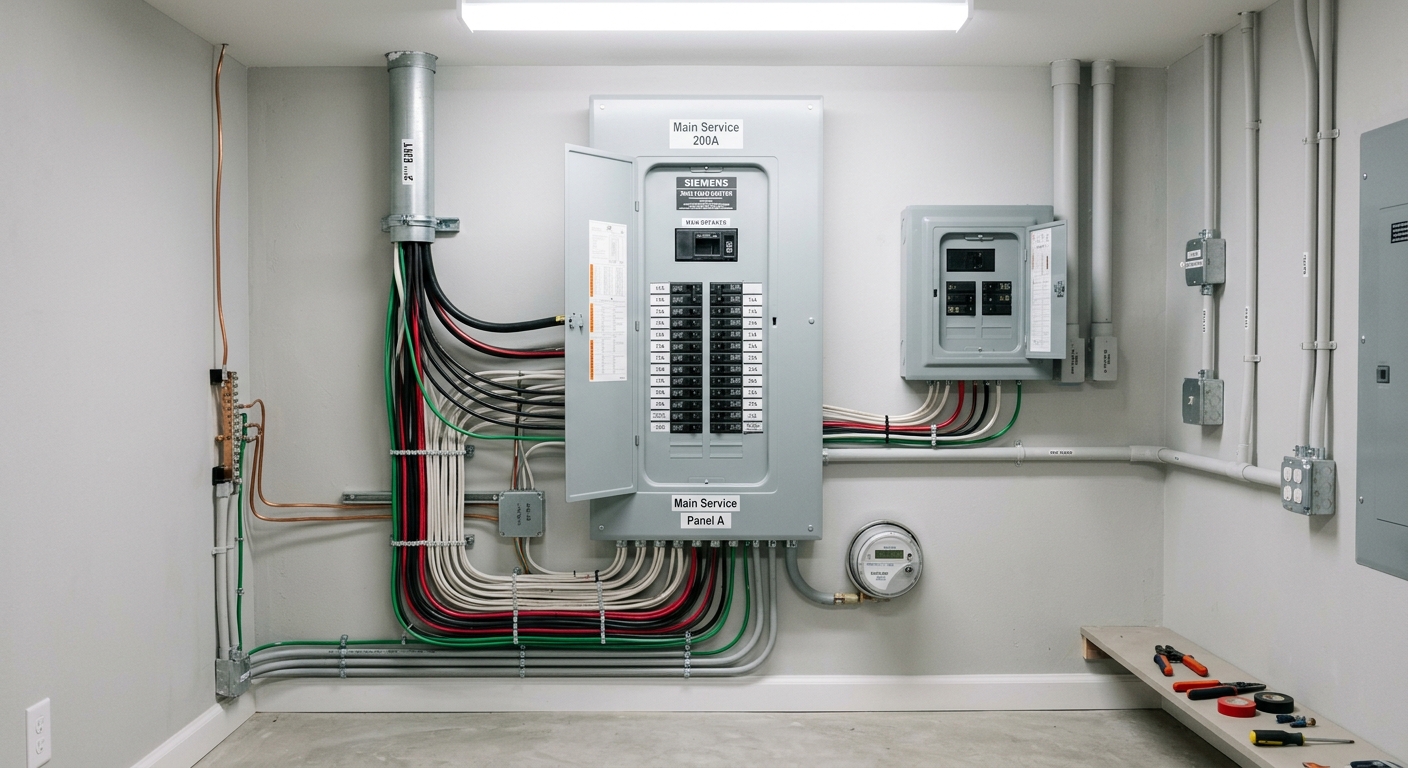
Electrical services and costs in Toronto
Toronto’s electrical market is busy and pricing reflects the mix of older wiring stock and ongoing upgrades for today’s loads. With 58.1% of homes in the broader profile built before 1981, it’s common to see knob-and-tube or mid-century aluminum branch wiring when homeowners add a finished basement, a rental unit, heat pumps, or electric heating. Also, Toronto has a large homeowner base—602,925 homeowner households (51.9% of households own) in the 2021 Census—so service calls often turn into multi-trade electrical scopes rather than “quick fixes.” (Statistics Canada, 2021 Census)
Cost is further shaped by Toronto’s climate and its demand patterns. Cold winters drive higher continuous loads (heating, ventilation, sometimes hot water systems), while long outages during storms are a priority concern for many households—so workmanship, testing, and inspection readiness matter. At the same time, dense neighbourhoods such as Roncesvalles and nearby west-end blocks often mean tighter access, older basements, and longer time spent on safe wiring pathways, which can raise labour time even when the job looks straightforward. Availability of licensed crews can also tighten schedules in peak seasons.
Below is a practical comparison of common Toronto projects so you can see where permit requirements, electrical complexity, and materials typically land before you request itemised quotes.
| Service |
Why It's Needed |
Permit Required |
Price Range |
| Panel upgrade — 100A to 200A service |
Modern homes often need capacity for EV chargers, heat pumps, and additional kitchen/laundry circuits; older panels can be undersized or lack safe breaker space and protection. |
Yes (major work) |
$2,500–$6,000 |
| EV charger installation (Level 2, 40–50A) |
Supports faster charging at home with a dedicated circuit, correct breaker sizing, and weather-rated installation—especially important in wet/salt-exposed Toronto winters. |
Yes (new circuit/charger) |
$900–$2,500 |
| Knob-and-tube wiring removal and replacement |
K&T wiring uses older insulation and wiring methods; homeowners usually upgrade for safety, insurability, and the ability to support current electrical loads. |
Yes (rewiring/remediation) |
$3,000–$15,000 |
| Aluminum wiring remediation (CO/ALR connectors) |
Removes/addresses oxidation at terminations and reduces overheating risk where aluminium branch wiring exists; may be a partial fix or a step before full rewiring. |
Yes (repair/remediation) |
$3,000–$9,500 |
| New dedicated circuit (HVAC, appliance, hot tub) |
Adds safe capacity for a specific high-use load, reducing nuisance trips and preventing overloaded extension cords or shared circuits. |
Yes (new circuit) |
$900–$3,500 |
| Whole-home rewire (older home, full replacement) |
Needed when multiple circuits, outlets, and connection points are aged, mixed wiring types exist, or the home requires code-compliant AFCI/GFCI protection and modern layout. |
Yes (full rewiring) |
$8,000–$22,000 |
Prices are estimates only and vary by project scope, site access and material selection.
What affects the price of electrical work in Toronto
In Toronto and the broader Ontario market, the same electrical job can land 30–50% apart because contractors price for risk, accessibility, and how much existing wiring can be safely reused. The dominant driver is the age and condition of the housing stock. In neighbourhoods where many homes pre-date modern wiring standards, you’ll often see knob-and-tube in older portions and inadequate capacity in mid-century builds. For example, homes with dated wiring can require full or partial rewiring rather than “add-a-circuit” work, and Toronto insurance can refuse coverage when older wiring types remain.
Another major driver is panel size. In 1960s–70s homes—when aluminum branch wiring was more common—homeowners frequently have 60A or 100A service that can’t comfortably handle today’s loads such as an EV charger, heat pumps, induction ranges, and dryer/laundry use. That’s why many projects pair wiring work with a service upgrade. As a realistic planning range, a 100A-to-200A panel upgrade commonly falls around $2,500–$6,000, while more involved rewiring scopes often start around $3,000–$15,000 depending on how much of the home needs replacement.
Concrete Toronto examples that raise cost include: (1) hard-to-route cable through finished basements and small joist bays—labour time increases; (2) aluminum remediation requiring approved CO/ALR connectors and careful re-termination; and (3) older meter/main areas with limited space or missing grounding components that must be corrected before inspection. Costs can be lower when the existing panel has adequate breaker space, when the wiring paths are open and accessible, and when the work can be done in a single contiguous layout rather than staged repairs.
| Price Factor |
Why It Matters |
Cost Impact |
| Panel size upgrade — 100A to 200A is the standard minimum today |
More capacity for EVs, heat pumps, and modern appliances; often requires new breakers and updated grounding/bonding details. |
Often the difference between a small job and a large service upgrade budget (roughly $2,500–$6,000 typical band) |
| Wiring type — copper vs. aluminum remediation vs. K&T removal |
Different materials and older connection methods require specialized, code-acceptable remediation or replacement. |
Can move the job into the $3,000–$15,000 rewiring/remediation band depending on extent |
| Number of new circuits — each adds material and labour time |
Each circuit needs conductors, breakers, outlets/devices, testing, and coordination. |
Multiple circuits can push the total from “single task” to a panel + wiring plan |
| Permit + ESA/TSBC inspection fee — mandatory for all major work |
Major work must be permitted and inspected; fees depend on scope. |
Typically adds a mandatory cost that contractors must include (commonly $200–$500 range for many projects) |
| Labour rate for licensed electricians — journeyman rates in Toronto area |
Toronto labour is high due to demand and skilled workforce requirements. |
Regional billing commonly around $90–$120 per hour, so labour time heavily affects total cost |
| EV charger amperage — 40A vs. 50A circuit affects cable and breaker cost |
Higher amperage typically means larger conductors, breaker rating changes, and more careful load planning. |
Can shift EV charger installation toward the upper $900–$2,500 range |
| Emergency or after-hours premium |
Urgent call-outs reduce scheduling flexibility and often require additional crew planning. |
Often increases the total beyond the normal band for the same scope |
| Load calculation required for service upgrade |
Ensures the service size supports modern loads; may require additional design/testing steps. |
Can add labour time but helps avoid expensive “rework” if the service size is insufficient |
Permits & regulations in Ontario
In Ontario, virtually all electrical work beyond changing a light bulb must be done by a licensed electrician, and permits are required for major projects—panel upgrades, new circuits (including Level 2 EV charger circuits), rewiring, and service upgrades. In the GTA, any permitted work must be inspected by the province’s electrical safety authority (ESA in Ontario). DIY is restricted: homeowners generally can’t legally “wire it themselves” for permitted work, even if they follow instructions, because the work must be installed, tested, and signed off by a licensed contractor.
Typical examples that do require a permit include: replacing a breaker panel, adding a dedicated 240V circuit, installing a new EV charger, replacing/adding receptacles as part of a new circuit, and full or partial rewiring of a room or home. Work that often does not require a permit is limited and may include swapping a like-for-like device under a licensed scope (for example, replacing a single receptacle) depending on what else is changed—if you’re unsure, ask your electrician to confirm before work starts.
Step-by-step verification in Toronto: (1) check the electrician/contractor licence using the Ontario licence registry (ensure the company and individuals are properly listed); (2) request a certificate of insurance that shows liability coverage appropriate to the work; (3) confirm WSIB/WCB coverage (or an acceptable exemption if applicable); (4) insist on a written scope that states permit pulling responsibility and inspection scheduling; and (5) keep the paperwork for warranty support and ESA inspection records.
When your Toronto home needs an electrical upgrade
In Toronto, warning signs usually show up when older wiring can’t handle today’s load profile, not just when something “looks old.” Start with the safety-critical symptoms. First, breakers that trip regularly often mean an overloaded circuit, a failing breaker, or a panel that doesn’t have the capacity for modern appliance use. Second, knob-and-tube wiring is a key concern: the issue is less about age alone and more about older insulation, connection points, and how insurance and inspection requirements treat it.
Third, pay attention to service size. If you still have a 60A or 100A panel, it may be inadequate once you add an EV charger, a heat pump system, or other electrified loads running simultaneously—Toronto winters also push continuous demand. In many cases, the standard solution is upgrading to a 200A service so you can add circuits safely. Fourth, aluminum wiring found in many homes constructed roughly from the mid-1960s through the mid-1970s may not be immediately dangerous if maintained, but it does require licensed remediation where connections are suspect, typically using approved methods such as CO/ALR connectors. Fifth, insufficient outlets—extension cords everywhere—tends to indicate a planning and code-compliance gap that can worsen overheating risks.
Finally, no AFCI or GFCI protection where required is often the issue that surfaces at home sale or renovation. If you’re seeing frequent trips or knob-and-tube, treat it as more urgent (safety and insurability). If you’re mainly dealing with limited outlets or missing protection, plan a staged upgrade.
For budgeting: upgrading from a lower-capacity service to a 200A system often moves into the $2,500–$6,000 panel upgrade band, but if knob-and-tube or extensive wiring replacement is required, totals can move into the larger $3,000–$15,000 wiring/remediation range—so it’s usually worth getting an electrician to assess before you purchase devices or sign a charger contract.
| Warning Sign |
What It Means |
Recommended Action |
Urgency |
Price Band |
| Breakers trip frequently |
Often indicates overloaded circuits, undersized breakers/cabling, or failing components—can also point to hidden faults. |
Schedule troubleshooting and a load/circuit review; consider adding dedicated circuits. |
Immediate to short-term |
$900–$3,500 |
| Knob-and-tube wiring present |
Older insulation/connection methods are not well-suited to modern loads; insurance may restrict or deny coverage. |
Plan K&T removal and replacement of affected circuits/zones. |
Immediate to planned |
$3,000–$15,000 |
| 60A or 100A panel (inadequate load capacity) |
Not enough headroom for EV charging, heat pumps, and electrified appliances—can lead to chronic overloads. |
Request a load calculation and plan a service upgrade to 200A if required. |
Planned (before adding major loads) |
$2,500–$6,000 |
| Aluminum wiring (pre-1976 construction) |
Connections and terminations can oxidize and overheat if not handled with approved remediation methods. |
Have licensed remediation performed (CO/ALR connector strategy or replacement where necessary). |
Planned (schedule promptly) |
$3,000–$9,500 |
| Insufficient outlets — extension cords everywhere |
Creates a safety risk and often signals that circuits/outlet spacing aren’t code-compliant for how you use the home. |
Add receptacles and/or dedicated circuits to remove reliance on extension cords. |
Planned |
$900–$3,500 |
| No AFCI or GFCI protection where required |
Increases risk of shock and certain arc-fault conditions; can become a selling/renovation compliance issue. |
Add/upgrade GFCI/AFCI protection as required for the circuits affected. |
Planned (do before sale/renovation) |
$200–$5,000 |
How to choose a electrical work contractor in Toronto
Choosing the right contractor matters in Toronto because older wiring, dense access, and ESA inspection scheduling can turn a small job into a larger one quickly. Start by verifying the contractor’s Ontario electrical licence and that they carry liability insurance. Ask for a certificate of insurance before work begins and confirm WSIB/WCB coverage—if they can’t provide proof, treat it as a red flag. For licence verification, use the Ontario licence registry to confirm the specific company or electrician is listed and eligible to perform the type of work being quoted.
Next, get 2–3 itemised written quotes. An itemised quote should break down labour hours, materials (cable, breakers, outlets/chargers), and any testing/inspection steps rather than only giving a lump sum. Carefully read the scope: is permit pulling included, who schedules ESA inspection, and is disposal of old materials included (especially in rewiring jobs)? Clarify what’s excluded—restoration of drywall, painting, landscaping, or concrete patching—so you don’t get surprise change orders after the wiring is in.
On warranty, request a workmanship warranty length and confirm whether product warranties apply to parts supplied. Also ask if the warranty is transferable to a new homeowner (important in resale situations). For payment, avoid paying the full amount up front—keep deposits typically under 10–15% and hold back a portion until completion/testing is confirmed. Finally, require a written timeline with a start date and realistic completion estimate, plus a plan if the ESA inspection can’t be booked immediately.
- Confirm Ontario licence number and that it matches the contractor’s legal name.
- Request liability insurance and confirm coverage limits are appropriate for residential work.
- Verify WSIB/WCB coverage (or acceptable exemption documentation).
- Insist on a written scope of work and who pulls the permit.
- Ask for an ESA inspection schedule expectation and who attends the inspection.
- Get an itemised quote (labour, materials, testing, and service connection details).
- Clarify exclusions: drywall repairs, patching, restoration, and any panel access costs.
- Confirm disposal/recycling of removed breakers/wiring is included.
- Ask if a load calculation is included for service upgrades.
- Confirm AFCI/GFCI strategy for bedroom/kitchen/bath circuits where applicable.
- Review warranty: workmanship duration and how to claim it.
- Set a payment schedule with a holdback until final testing and cleanup are complete.
Red flags in Toronto include: vague scopes without permit responsibility, “cash-only” arrangements or no insurance paperwork, promises of “no inspection required,” pressure for large upfront deposits, and quotes that don’t address existing wiring conditions (especially if knob-and-tube or aluminum is mentioned).
Frequently asked questions — electrical work in Toronto
How much does an electrician cost in Toronto?
In Toronto, licensed electrical contractors commonly bill around $90–$120 per hour for journeyman-level labour, and your total depends on troubleshooting time, how accessible the wiring paths are, and how much existing work needs correction to pass ESA inspection. For smaller tasks like adding a dedicated circuit, you may see totals in the roughly $900–$3,500 range depending on wire runs, outlet/breaker requirements, and whether panel space is available. If the job uncovers hidden issues in older wiring—something that’s common in Toronto homes built before the 1980-era modernization—your estimate may rise because remediation or rework becomes necessary. (Statistics Canada, 2021 Census)
How much does a panel upgrade cost in Toronto?
Panel upgrades in the GTA typically fall in the $2,500–$6,000 range for many common 100A-to-200A installations. Your price can land higher if the job requires service relocation, trenching, substantial remediation to bring grounding/bonding up to code, or if the panel location has limited access in a finished basement or tight mechanical area. For homes with older wiring types, electricians often recommend pairing the service upgrade with wiring corrections so the whole installation is consistent and inspection-ready. If you’re adding major new loads such as heat pumps and an EV charger, the service upgrade cost can be justified because it reduces the risk of repeated circuit overloads later.
Do I need to upgrade to a 200A panel?
You don’t always need 200A, but in Toronto it’s a common planning target because many households are adding electrified loads. If you have a 60A or 100A panel and you’re planning an EV charger (Level 2), heat pumps, or electric cooking/heating, a load calculation is the right first step. That calculation determines whether your current service has enough capacity and breaker space, and whether you can safely add new circuits without constantly tripping breakers. In many real Toronto situations, a move to 200A is the standard minimum solution because it provides headroom and supports modern protection requirements. If your existing panel is in decent shape and the load calculation shows capacity, you may be able to add circuits without upgrading—confirm in writing.
How much does an EV charger installation cost in Toronto?
For a typical Level 2 home charger installation with a 40–50A circuit, Toronto pricing is commonly around $900–$2,500. The range depends on cable routing distance, whether you need to add a new breaker/circuit in the panel, charger location (garage vs. exterior wall), and whether the service/panel has enough capacity. If you must upgrade from 100A to 200A to support the new EV load, then you’re effectively budgeting for both the charger and a service/panel plan (often landing in the $2,500–$6,000 band for the panel portion). Toronto’s wet, freeze-thaw winters also mean weather-rated installation details matter for outdoor mounts and conduit sealing.
What is knob-and-tube wiring and should I replace it?
Knob-and-tube (K&T) wiring is an older wiring method that can still be found in parts of Toronto homes, especially in older neighbourhoods. The main concern isn’t just age—it’s the older insulation and connection practices, which can be difficult to maintain safely with today’s load levels. Many insurers either reduce coverage or decline claims if K&T remains in use, and K&T may also complicate adding new circuits because of how the wiring is routed and protected. Whether you must fully replace everything depends on what’s in the home and what’s being added, but if you’re planning renovations, adding an EV charger, or experiencing frequent breaker issues, replacement or staged removal is often the safer path. Discuss a targeted plan with your electrician and confirm permitting/inspection requirements.
Is aluminum wiring safe in older Toronto homes?
Aluminum wiring can be safe when properly installed and maintained, but older aluminum branch wiring in Toronto homes (especially those built in the mid-1960s to mid-1970s window) often needs licensed remediation—mainly at termination points—because oxidation and connection quality can lead to overheating over time. That’s why many projects involve approved CO/ALR connector remediation or, in some cases, full replacement of certain circuits. If your home has aluminum wiring, you should not rely on “it still works” as a safety standard; have an electrician assess terminations and connections and discuss whether your risk is localized or systemic. In budgeting terms, remediation commonly sits in the $3,000–$9,500 range depending on how many circuits and junctions require correction.