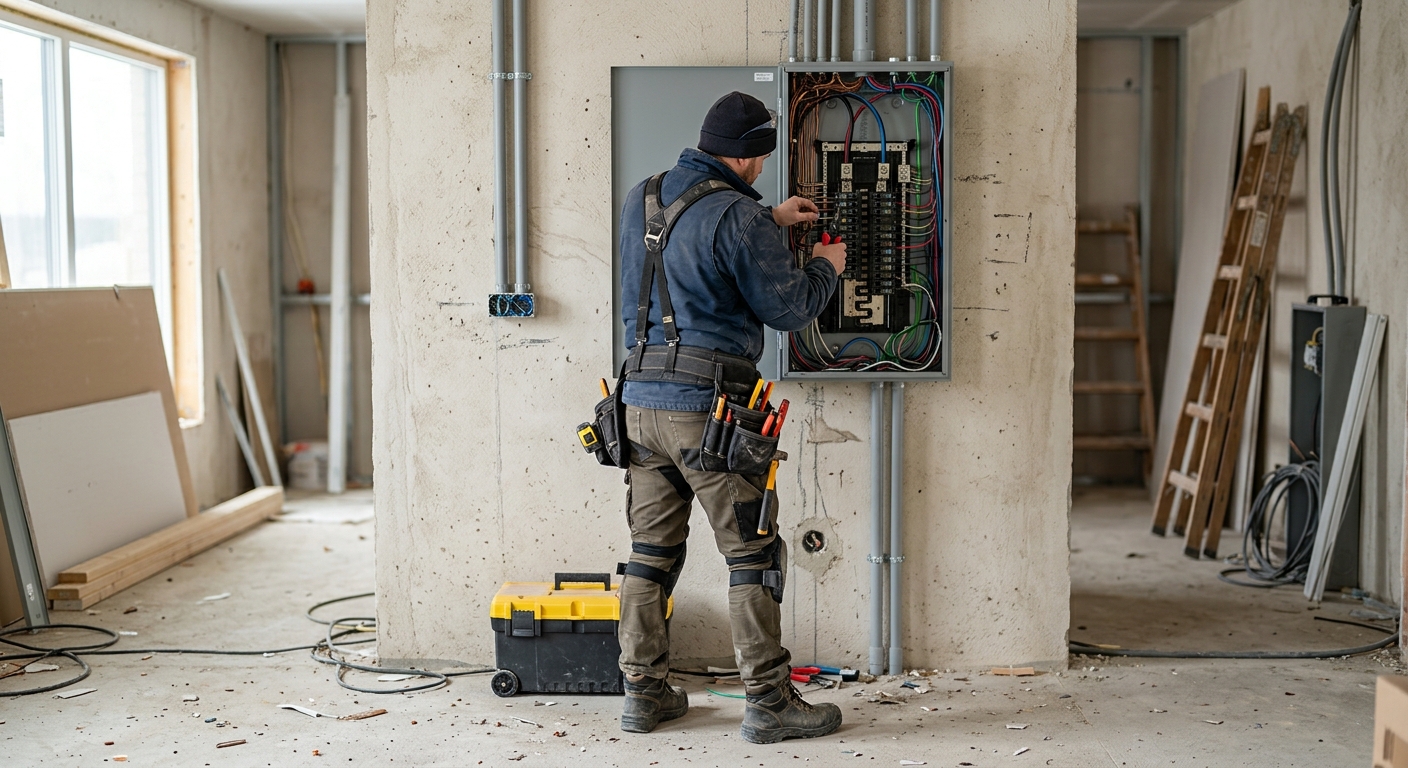
Electrical services and costs in Trinity-Bellwoods
Trinity-Bellwoods is a lively mix of older, character neighbourhood housing and newer infill, and that blend shows up directly in electrical service calls. With a local population of 16,556 (Statistics Canada, 2021 Census), there’s constant demand for safe upgrades—especially because many properties in the Toronto core were built long enough ago that wiring, service size, and protection devices often lag behind today’s loads. In practice, it’s common to see pre‑1970 homes with knob-and-tube wiring and/or mid‑century aluminum branch wiring, both of which can struggle with modern appliance, A/C, EV charger, and electronics loads.
Toronto’s market conditions also matter for pricing. Contractor availability is generally good, but dense streets, limited parking, and frequent second‑unit conversions increase on‑site time for material runs, panel access, and inspection scheduling. Summer heat can push A/C and ventilation circuits harder, while winter heating demand adds stress to aging panels that were originally designed for lighter loads. That’s why many Trinity-Bellwoods projects are built around a coordinated package: a panel upgrade paired with targeted rewiring and new dedicated circuits. In areas around Queen Street West and the Trinity-Bellwoods Park corridor, electricians are especially busy with service upgrades tied to basement finishing and home-sale compliance updates.
Below is a practical comparison of common electrical services and what typically drives permitting and cost in the GTA, leading into a side-by-side estimate table.
| Service |
Why It's Needed |
Permit Required |
Price Range |
| Panel upgrade — 100A to 200A service |
Supports modern loads such as EV charging, heat pumps, electric cooking, and multiple circuits without overheating or nuisance tripping. |
Yes (permit + inspection) |
$2,500 – $6,000 |
| EV charger installation (Level 2, 40–50A) |
Adds safe, code-compliant charging with the right breaker, conductor size, and load considerations. |
Yes (permit + inspection) |
$900 – $2,500 |
| Knob-and-tube wiring removal and replacement |
Older insulation and connection methods are no longer appropriate for today’s loads; replacement reduces fire risk and insurance issues. |
Yes (permit + inspection) |
$3,000 – $15,000 |
| Aluminum wiring remediation (CO/ALR connectors) |
Improves connection integrity where aluminum branch wiring is present, often requiring approved remediation or replacement sections. |
Yes (permit + inspection) |
$1,500 – $7,500 |
| New dedicated circuit (HVAC, appliance, hot tub) |
Prevents overload and provides proper protection for high-demand equipment. |
Yes (permit + inspection) |
$600 – $3,000 |
| Whole-home rewire (older home, full replacement) |
Replaces obsolete wiring across the home to bring the electrical system up to current safety and code expectations. |
Yes (permit + inspection) |
$6,000 – $18,000 |
Prices are estimates only and vary by project scope, site access and material selection.
What affects the price of electrical work in Trinity-Bellwoods
In Trinity-Bellwoods and the broader Toronto economic region, it’s not unusual to see quotes for the “same” job land 30–50% apart. The main reason is that identical-sounding scopes often hide different wiring conditions, panel capacity, and finished-space access. Toronto’s dense housing stock means contractors frequently encounter unexpected obstacles—older cable routes behind plaster, partially upgraded subpanels, or inaccessible crawlspaces—so labour time and materials can change quickly. Even a straightforward panel upgrade can swing in price depending on whether service relocation, extensive breaker/panel work, or significant remediation is required.
Housing age is the dominant cost driver. In many older homes, knob-and-tube systems can trigger additional removal work for safe termination and inspection, and some homeowners also face insurance refusal on outdated wiring types. Homes from the 1960s–70s may have 60A or 100A panels that are inadequate for modern demand, especially once you add an EV charger, heat pump equipment, and electric stove loads. Aluminum wiring—common from roughly 1965–1976—often requires licensed remediation using approved CO/ALR connectors or full replacement for affected runs. In parallel, EV adoption is increasing Level 2 charger permit applications; a 40A versus 50A circuit affects conductor and breaker costs, and the available panel capacity affects whether a service upgrade is also needed.
For example, if your home can take a 200A panel without major service relocation, you’re often in the panel-upgrade band of about $2,500 – $6,000. If the job requires longer cable routes, trenching, or significant knob-and-tube removal to pass inspection, totals can climb toward the upper $3,000 – $15,000 wiring/remediation band. Weather matters too: summer A/C and winter heating can expose marginal connections faster, turning “planned” work into urgent troubleshooting—another driver of final cost.
| Price Factor |
Why It Matters |
Cost Impact |
| Panel size upgrade — 100A to 200A is the standard minimum today |
Modern homes often require more capacity for EV charging, heat pumps, and cooking. |
Typically moves the project into the $2,500 – $6,000 range |
| Wiring type — copper vs. aluminum remediation vs. K&T removal |
Aluminum and knob-and-tube usually require approved remediation or replacement for safe terminations. |
Can push costs from the lower hundreds up to $3,000 – $15,000 depending on extent |
| Number of new circuits — each adds material and labour time |
Every added circuit requires conductors, breakers, box work, and testing. |
Commonly adds noticeable cost; each circuit may cost several hundred to over a thousand |
| Permit + ESA/TSBC inspection fee — mandatory for all major work |
Permitted electrical work must be inspected and documented. |
Usually a few hundred dollars depending on scope |
| Labour rate for licensed electricians — journeyman rates in {region} |
Toronto-area rates reflect skilled labour demand and project complexity. |
Often around 90–120 per hour, so time overruns matter |
| EV charger amperage — 40A vs. 50A circuit affects cable and breaker cost |
Higher amperage generally requires larger conductors and compatible breaker components. |
Can shift EV installs within the $900 – $2,500 band |
| Emergency or after-hours premium |
Callouts, troubleshooting, and scheduling add overhead. |
Can add a substantial hourly premium compared with regular hours |
| Load calculation required for service upgrade |
Determines whether 100A/150A/200A is appropriate and avoids future overload. |
May add some cost, but can prevent under-sizing and rework |
Permits & regulations in Ontario
In Ontario (including Trinity-Bellwoods), electrical work beyond changing a light bulb must be done by a licensed electrician. Permits are required for major changes such as panel upgrades, new circuits (including EV chargers), rewiring, and service upgrades. Permitted work must pass inspection by the Electrical Safety Authority (ESA) or your local building department process, and the inspector verifies that the installation complies with the Ontario Electrical Code and relevant safety rules.
Typical work that generally requires a permit includes: installing or replacing a breaker panel, running new circuits to feed outlets or appliances, adding circuits for hot tubs/saunas, installing Level 2 EV charging equipment, relocating wiring in a way that changes circuit routing or conductors, and undertaking whole-home or partial rewires. Work that typically does not require a permit is limited—common examples include replacing a simple light fixture with an identical, pre-approved model and swapping like-for-like devices under the narrow “replacement” pathway. If there’s any doubt, assume a permit is needed and ask the electrician to confirm it in writing.
To verify a contractor in Trinity-Bellwoods, start with the Ontario public licence registry for the individual or company, and confirm the licence is active. Ask for a certificate of insurance (general liability and, where applicable, contractor liability) and confirm they carry WSIB/WCB coverage for their workers. Finally, request documentation of the permit/ESA inspection plan—reputable contractors will include permit handling and inspection scheduling in the proposal.
When your Trinity-Bellwoods home needs an electrical upgrade
In Trinity-Bellwoods, the warning signs that you need electrical work are usually safety-critical, not just “old house” inconveniences. First, breakers that trip frequently—especially when you run the same set of devices—often point to an overloaded panel, undersized circuits, or failing connections. Second, knob-and-tube wiring is a major concern: the issue isn’t only age, it’s the compromised insulation and wiring practices that can raise risk and complicate insurance coverage. Third, a 60A or 100A panel may be inadequate for a modern household trying to run an EV charger plus heat pump equipment and an electric range at the same time; in those cases, a 200A upgrade is commonly the standard solution. Fourth, aluminum wiring in pre-1976 construction is not always “immediately dangerous” when properly maintained, but it does require licensed remediation (often with CO/ALR connectors or replacement of affected sections). Fifth, insufficient outlets and reliance on extension cords usually signals you’re missing required circuit capacity—while also increasing overheating risk. Finally, missing AFCI/GFCI protection where required is a code compliance issue that can surface during home sales and inspections.
Act immediately if you smell burning, see discoloured outlets or panels, experience repeated tripping at random times (not just during heavy appliance use), or notice sparking/hot covers. Plan an upgrade when breakers trip only after new loads are added, when you find knob-and-tube, or when you’re preparing for EV charging.
Price context helps: if upgrading to EV-ready service moves you from a 60A/100A panel into the $2,500 – $6,000 panel-upgrade band, that cost is usually justified because it prevents expensive rework—like adding circuits that still can’t safely support future loads. By contrast, if you need limited wiring fixes only, you may avoid full rewire costs that can fall into the larger $3,000 – $15,000 wiring/remediation range.
| Warning Sign |
What It Means |
Recommended Action |
Urgency |
Price Band |
| Breakers trip frequently |
Possible overload, failing breaker, or arcing/loose connections. |
Troubleshoot load patterns, inspect panel connections, add circuits or upgrade service if required. |
Immediate to planned (depends on pattern) |
$600 – $3,000 |
| Knob-and-tube wiring present |
Older wiring practices with aging insulation; often linked to insurance and safety concerns. |
Quote removal/replacement for affected areas and plan for code-compliant circuits. |
Planned to immediate depending on condition |
$3,000 – $15,000 |
| 60A or 100A panel (inadequate load capacity) |
Modern loads exceed capacity; may cause voltage drop and nuisance tripping. |
Perform load calculation and upgrade to 200A where warranted. |
Planned (especially before EV/heat pump upgrades) |
$2,500 – $6,000 |
| Aluminum wiring (pre-1976 construction) |
Connections may loosen over time; requires approved remediation. |
Inspect connections, remediate with CO/ALR connectors or replace unsafe sections. |
Planned |
$1,500 – $7,500 |
| Insufficient outlets — extension cords everywhere |
Indicates circuit capacity and placement issues; increases overheating risk. |
Add grounded outlets and new dedicated circuits for high-use areas. |
Planned (safety improvement soon) |
$600 – $3,000 |
| No AFCI or GFCI protection where required |
Higher risk and non-compliance that can affect inspections and resale. |
Upgrade receptacles/breakers and correct protection gaps. |
Planned |
$200 – $2,000 |
How to choose a electrical work contractor in Trinity-Bellwoods
Choosing the right contractor matters as much as the price, especially in Trinity-Bellwoods where older wiring conditions are common. Start by verifying Ontario licensing: ask for the licence number and confirm it through the Ontario licence registry for both the company and the individual who will be doing supervisory work. Next, request proof of liability insurance and confirm they carry WSIB/WCB coverage for their workers—don’t assume; get the certificate. If they can’t provide documentation promptly, that’s a major red flag.
Get 2–3 itemised written quotes (labour + materials breakdown), not a lump-sum estimate that hides assumptions. Make sure the scope is detailed: what’s included for panel work, cable runs, breaker selections, testing, and inspection scheduling. Ask whether the permit pull and ESA inspection are included, and confirm whether disposal/demolition is part of the quote if any wiring removal is needed. Warranty is also important—ask for workmanship warranty length and whether manufacturers’ warranties apply to parts supplied.
For payment, avoid large upfront payments; a common safe approach is keeping deposits around 10–15% and holding back until the job is complete and tested. Get a start date and a realistic completion estimate in writing, including contingency time for inspection scheduling.
- Provide their Ontario licence number and confirm it on the public registry.
- Supply a current certificate of insurance (liability) before work starts.
- Show WSIB/WCB coverage proof for workers on site.
- Give 2–3 itemised quotes with labour hours, materials, and allowance items.
- Confirm whether the ESA/permit process is included or billed separately.
- State exactly what components are included (panel brand/model, breaker types, charger specs).
- Clarify exclusions (patching drywall, removing old wiring, disposal, re-inspection costs).
- Request a load calculation for service upgrades when EV/heat pump loads are planned.
- Ask about AFCI/GFCI requirements and which devices will be installed.
- Confirm testing and documentation (labels on circuits, test results where applicable).
- Get the workmanship warranty in writing and confirm whether it transfers if you sell.
- Use a payment schedule that limits upfront payment and includes a holdback for completion.
Concrete red flags to watch for in Trinity-Bellwoods: they refuse to provide their licence/insurance/WSIB proof; they quote a panel upgrade without discussing load calculation or whether service relocation is needed; they lump “wiring” costs without indicating whether knob-and-tube or aluminum remediation is included; they won’t include permit/inspection responsibilities; and they ask for most payment upfront before any testing or labelling is done.
Frequently asked questions — electrical work in Trinity-Bellwoods
Why do my breakers keep tripping?
Breaker trips in Trinity-Bellwoods usually come down to overload, a failing breaker, or a connection issue. If the breaker trips only when you run certain items (like the dryer, microwave, or A/C), it often indicates a circuit that’s carrying more than it was designed for. If it trips unpredictably, it can point to loose terminations, damaged wiring insulation, or arcing—especially in older homes with aging wiring. If you have a 60A/100A panel, the issue can also be load capacity: modern habits (and EV charger planning) can push the panel beyond safe margin. A licensed electrician can map your loads, inspect the panel and breakers, and determine whether you need new dedicated circuits or a $2,500 – $6,000 style panel upgrade.
How do I compare electrical quotes?
When comparing quotes in Ontario (including Trinity-Bellwoods), don’t focus only on the total—compare what’s actually included. Ask for an itemised breakdown: labour hours, materials, permits/inspection handling, testing, and any remediation. For example, one quote for EV charging might assume you already have adequate panel capacity, while another includes a load calculation and a panel upgrade. Similarly, a “wiring” quote can range drastically depending on whether knob-and-tube removal is included versus limited replacement of specific runs. Also confirm whether disposal, drywall patching, and re-inspection are included. In the GTA, labour time and site access can change total cost significantly, so the best quotes show assumptions clearly and align with Ontario Electrical Code and ESA inspection requirements.
How long does a panel upgrade take in Trinity-Bellwoods?
Typical panel upgrades in Trinity-Bellwoods are often completed in about one full working day, but the real timeline depends on prep work, parts availability, and inspection scheduling. If your job is straightforward (for example, replacing a failing panel and upgrading to a 200A system), most of the day is wiring terminations, new breakers, labeling, and safety testing. If the scope includes service relocation, significant cable work, or remediation for knob-and-tube/aluminum sections, expect more time and potentially extra days for access and inspection readiness. Permitted work still needs ESA inspection, so completion can be delayed by inspection booking times. Your electrician should provide a start date, estimated inspection date window, and what you need to ensure beforehand (access to the service area, clear working space, and power-off coordination).
What is a GFCI outlet and where is it required in Ontario?
A GFCI (Ground-Fault Circuit Interrupter) outlet is designed to trip quickly if it senses a ground-fault condition, which can happen when electricity leaks through water or an unintended path. In Ontario, GFCI protection is required for receptacles in specific locations such as areas that are more likely to get wet (for example, bathrooms, kitchens in certain configurations, garages, and outdoor receptacles) and for other defined scenarios under the Ontario Electrical Code. The exact requirements depend on the location and how the circuit is configured, so a licensed electrician will confirm what applies to your Trinity-Bellwoods home. If you’re updating outlets, it’s also a good time to check for proper AFCI protection where required, since missing protection can show up during sale inspections.
How do I know if my Trinity-Bellwoods home has aluminum wiring?
In Trinity-Bellwoods, aluminum wiring is commonly found in homes from the mid‑century era (often associated with certain construction periods). The practical way to confirm is to look at the conductor markings at accessible junction points (for example, at the panel or in junction boxes, if accessible). Aluminum conductors typically have markings and require compatible termination methods. However, the safest approach is an electrician inspection: they can identify conductor type, evaluate condition and connection integrity, and test/verify whether remediation is needed. If you have aluminum branch wiring, remediation may involve approved CO/ALR connectors and careful re-termination, or replacement of specific sections if connections are unsafe. Because incorrect connections can create heat and risk, don’t rely on guessing—have it inspected before you add loads like EV charging or new high-demand kitchen appliances.
What is the cost of rewiring a house in Trinity-Bellwoods?
Rewiring cost in Trinity-Bellwoods varies widely because “rewire” can mean anything from targeted replacement of obsolete sections to a full whole-home replacement. If the home needs knob-and-tube removal and replacement across multiple rooms, or if there are extensive aluminum wiring issues, projects often fall into the broader $3,000 – $15,000 wiring/remediation range, and whole-home rewires can go higher depending on access, finishes, and how much wall/ceiling opening is required. If your main goal is to support EV charging and modern loads, you may first do a panel upgrade in the $2,500 – $6,000 band and then selectively rewire problem areas to reduce cost. A licensed electrician can assess your existing wiring routes, identify unsafe sections, and give a clearer scope so you can plan around permits, ESA inspection, and realistic material/access constraints in the Toronto area.