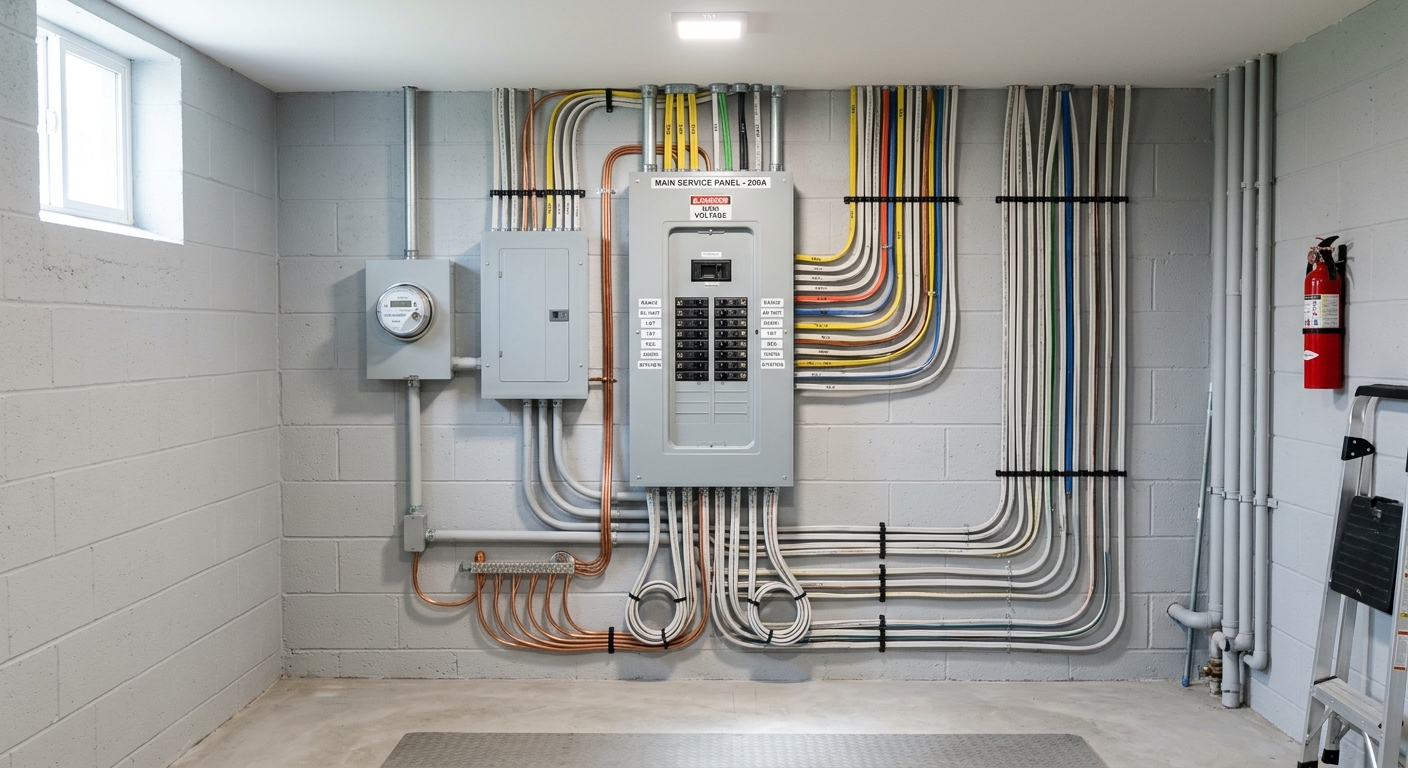
Electrical services and costs in Altadore
Altadore is a great example of Calgary’s “mix” neighbourhood: many homes are older, but the area keeps modernising fast. In a community of about 7,290 people (Statistics Canada, 2021 Census), you’ll commonly see electrical upgrades as owners add heat pumps, finished basements, induction ranges, and—more and more—Level 2 EV chargers. If your house is pre-1980, it’s often a prime candidate for panel upgrades, knob-and-tube removal, or aluminum branch-circuit fixes, because those wiring methods were never designed for today’s load expectations.
Calgary pricing also reflects site and climate realities. In winter, even minor troubleshooting takes longer because crews are working in colder, less comfortable crawlspaces and garages, and service-access issues (snow cover, thaw/freeze conditions, and overhead versus underground service) can affect labour time. Market demand in established pockets of Altadore—especially along busier corridors with older service runs—means scheduling can be tighter when multiple neighbours are upgrading at once.
In practical terms, normal panel replacement or service upgrade work often falls in the low-to-mid thousands, while whole-home rewiring and wiring remediation tend to run higher when the scope includes multiple rooms, drywall access, or a full code-compliance overhaul. EV chargers are usually priced as a separate line item because permits, load calculations, and dedicated breakers are standard. Use the comparison table below to estimate where your project is likely to land in the Altadore market.
| Service |
Why It's Needed |
Permit Required |
Price Range |
| Panel upgrade — 100A to 200A service |
Modern homes often exceed 100A capacity with EV chargers, heat pumps, electric ranges, and basement development; 200A is the standard minimum for safer load handling. |
Yes (panel/service upgrade is permitted and inspected) |
$2,500–$8,000 |
| EV charger installation (Level 2, 40–50A) |
Dedicated circuit and proper protection to charge safely and meet code requirements; reduces nuisance breaker trips and improves compatibility. |
Yes (new circuit/charger installation is permitted) |
$900–$2,500 |
| Knob-and-tube wiring removal and replacement |
Older insulation and connection methods can present safety and insurance-risk issues; replacement restores reliable grounding and modern cable systems. |
Yes (rewiring/removal work is permitted) |
$6,500–$15,000 |
| Aluminum wiring remediation (CO/ALR connectors) |
Aluminum branch circuits (commonly found in homes from the mid-1960s to mid-1970s) need approved connectors or partial replacement to address long-term terminations. |
Yes (major wiring remediation typically requires a permit) |
$4,000–$10,000 |
| New dedicated circuit (HVAC, appliance, hot tub) |
Creates a properly sized, protected path for high-demand equipment and avoids overloaded shared circuits. |
Yes (new circuits are permitted) |
$900–$3,500 |
| Whole-home rewire (older home, full replacement) |
When multiple legacy systems are unsafe or non-compliant, full replacement brings the home up to current code with safe breakers, grounding, and wiring routes. |
Yes (full rewiring is permitted and inspected) |
$10,000–$25,000 |
Prices are estimates only and vary by project scope, site access and material selection.
What affects the price of electrical work in Altadore
In Altadore and across Calgary, two quotes for the “same” electrical job can easily differ by 30–50% because scope details change: how far wiring must be run, whether the existing panel has spare capacity, whether ESA/Technical Safety inspections require additional corrections, and whether utility-side service work becomes involved. Labour and material costs in Alberta move together with contractor availability, so timelines can influence pricing during peak season.
Housing age is the dominant driver. Pre-1950 homes often include knob-and-tube wiring, which pushes costs upward because electricians must remove or isolate unsafe sections, re-route circuits, and bring the system up to modern standards. Homes built in the 1960s–1970s frequently have 60A or 100A panels that were never designed for today’s loads; adding EV chargers and heat pumps can turn a “minor” upgrade into a service upgrade. Aluminum wiring (commonly seen in homes from roughly 1965–1976) typically requires licensed remediation using approved CO/ALR connectors—or sometimes full replacement—especially at terminations where long-term performance is a concern. On top of that, EV adoption in the Calgary area is driving a surge in Level 2 charger permits, and many homes need load calculations to justify breaker sizing and circuit capacity.
Two local examples that often raise costs in Altadore: (1) overhead service locations where route changes are tricky, increasing labour time, and (2) finished basements where cable runs require careful access and patching. Costs can be lower if your panel already has space and you can run shorter cable paths for a new dedicated circuit; in those cases, EV work can land closer to the $900–$2,500 band instead of triggering a $2,500–$8,000 panel upgrade.
| Price Factor |
Why It Matters |
Cost Impact |
| Panel size upgrade — 100A to 200A is the standard minimum today |
More capacity and breaker spaces for modern loads (EVs, heat pumps, electric appliances). |
$2,500–$8,000 typical band depending on access and scope |
| Wiring type — copper vs. aluminum remediation vs. K&T removal |
Aluminum and knob-and-tube require approved methods and extra replacement/remediation labour. |
$4,000–$15,000 depending on extent |
| Number of new circuits — each adds material and labour time |
Each circuit means breakers, cable, terminations, and often additional panel modifications. |
Often adds $900–$3,500 per dedicated circuit in typical cases |
| Permit + ESA/TSBC inspection fee — mandatory for all major work |
Permits/inspections protect safety and are required for service upgrades, rewiring, and new circuits. |
Typically built into overall pricing; can shift totals by hundreds to low thousands |
| Labour rate for licensed electricians — journeyman rates in Calgary area |
Alberta’s labour rates drive the base cost for diagnostics, cable runs, and panel modifications. |
Higher when troubleshooting extends due to hidden wiring routes |
| EV charger amperage — 40A vs. 50A circuit affects cable and breaker cost |
Higher amperage can require heavier cable and specific breaker components. |
Can shift you within $900–$2,500, depending on service capacity and wiring distance |
| Emergency or after-hours premium |
Urgent scheduling and after-hours mobilization increases crew and overhead costs. |
Often adds a noticeable premium over standard weekday pricing |
| Load calculation required for service upgrade |
Proper sizing may require calculations and sometimes additional upgrades if the service is undersized. |
May move the project into the higher end of the $2,500–$8,000 band |
Permits & regulations in Alberta
In Alberta, electrical work beyond changing a light bulb must be completed by a licensed electrician. For homeowners in Altadore, that means panel upgrades, new circuits (including EV charger installations), rewiring, and service upgrades require permits. Permitted work is then inspected by the provincial electrical safety authority (commonly referenced through the Technical Safety environment in Alberta), and you should expect the electrician to coordinate the permit and inspection process as part of the job.
What typically does require a permit: replacing a breaker or receptacle when it’s part of a circuit modification, adding outlets/switches as new branch circuits, installing or upgrading a panel, upgrading service size (100A to 200A), removing knob-and-tube wiring, remediating aluminum terminations, and installing dedicated equipment circuits (hot tubs, HVAC, EV chargers). What typically does not require a permit: replacing a working fixture with an identical one, swapping in a like-for-like lamp or bulb, or simple non-electrical cosmetic work—provided no wiring, circuit routing, or device rating changes are involved.
To verify a contractor, start with Alberta’s public licence registry search for their licence status and electrical category. Next, request a clearance letter or proof of coverage requirements as applicable, then check their certificate of insurance for liability coverage and confirm workers’ compensation coverage (WSIB/WCB). Only proceed once you’ve received the electrician’s paperwork for the permitted scope, so the inspection record is tied to the correct work.
When your Altadore home needs an electrical upgrade
If you’re in Altadore, electrical “warning signs” are usually about safety and capacity—not convenience. First, breakers that trip regularly are a common symptom of an overloaded panel or undersized circuits. Second, knob-and-tube wiring is the standout concern: the issue is insulation contact and connection reliability, and insurers may cancel coverage if it remains in service. Third, a 60A or 100A panel can be inadequate for a modern Calgary household with an EV charger, heat pump, and electric stove operating at the same time; in those cases, a 200A upgrade is the standard solution to prevent nuisance trips and to create space for modern breakers.
Fourth, aluminum wiring (often seen in pre-1976 construction) isn’t always “immediately dangerous” if connections have been maintained, but it requires licensed remediation—typically at terminations with approved CO/ALR methods or targeted replacement. Fifth, insufficient outlets and extension-cord living is a code and fire-risk problem; it often correlates with limited circuit capacity and missing protection. Finally, no AFCI/GFCI protection where required can surface during a home sale or inspection, especially in renovated basements.
Urgency matters in Alberta’s climate. If you’re experiencing repeated trips, scorch marks, buzzing at outlets, or flickering when high-demand appliances run, treat it as urgent and stop using the affected circuits. If you have knob-and-tube or an undersized service, plan soon—don’t wait for failure. For example, if an EV charger would force a service upgrade, the difference can be justified: adding a Level 2 charger alone may fall in the $900–$2,500 band, but if your existing panel is at capacity, you may move into the $2,500–$8,000 panel upgrade band for safer long-term capacity.
| Warning Sign |
What It Means |
Recommended Action |
Urgency |
Price Band |
| Breakers trip frequently |
Possible overload, failing breaker, or circuits feeding too many loads. |
Call for a load check and panel/circuit diagnostic; add capacity or re-circuit as needed. |
Immediate to urgent (stop using the affected circuits) |
$900–$3,500 (often diagnostic + dedicated circuit option) |
| Knob-and-tube wiring present |
Legacy wiring with aging insulation and connection risks; common insurance concern. |
Schedule removal/replacement and update circuits to modern cable and grounding. |
Urgent (safety + insurance risk) |
$6,500–$15,000 |
| 60A or 100A panel (inadequate load capacity) |
Modern loads can exceed service capacity; nuisance trips and limited breaker space. |
Perform load calculation and upgrade to 200A if required; add EV-ready breakers. |
Planned upgrade (sooner if adding EV/heat) |
$2,500–$8,000 |
| Aluminum wiring (pre-1976 construction) |
Terminations may require remediation for reliable long-term performance. |
Have licensed remediation with approved CO/ALR connectors or partial replacement. |
Planned upgrade (after inspection) |
$4,000–$10,000 |
| Insufficient outlets — extension cords everywhere |
Overextension and risk from temporary connections; likely missing circuits. |
Add circuits/outlets safely; relocate loads to proper receptacles. |
Planned upgrade (address before busy seasons) |
$900–$3,500 |
| No AFCI or GFCI protection where required |
Reduced shock and arcing protection; can fail code compliance during sale/renovations. |
Upgrade breakers/receptacles to meet current code requirements. |
Planned upgrade (especially if selling/renovating) |
$200–$2,500 |
How to choose a electrical work contractor in Altadore
Choosing the right contractor matters as much as the price in Altadore, because electrical fixes often need repeatable, code-compliant workmanship. Start by verifying the electrician’s Alberta licence status via the provincial licence registry, then ask for their certificate of insurance and evidence of workers’ compensation coverage (WSIB/WCB). If they can’t provide documentation promptly, that’s a major red flag.
Next, request 2–3 itemised written quotes. The best quotes break labour and materials separately and specify what’s included: panel parts, breakers, cable type and length allowances, permit pulling, and inspection coordination. Look for exclusions (for example, drywall repair, trenching/hydrovac for service runs, or relocating fixtures) so you don’t get surprise change orders. For warranty, confirm the workmanship warranty length and whether it’s transferrable if you sell your home; also check the manufacturer warranty on the panel, breakers, EV charger, and any auxiliary components.
Payment terms should be reasonable. For most jobs, never pay more than 10–15% upfront; hold back part of the balance until the final inspection and cleanup are complete. Ask for a start date and an estimated completion timeline in writing—winter scheduling can affect timelines, but a reputable contractor still provides a clear plan. If you’re upgrading from 100A to 200A or doing EV work, insist on load calculation and permit handling as part of the scope.
- Licence number on the quote and confirmed on Alberta’s public registry.
- Proof of liability insurance (request the COI) before work starts.
- Confirmation of WSIB/WCB coverage for the crew assigned to your job.
- Itemised quote: labour, parts, cable, breakers, and any allowance amounts.
- Clear scope: what’s included versus excluded (drywall repair, disposal, patching).
- Permit pull included for panel/service upgrades, new circuits, and EV chargers.
- Inspection coordination included (who books it and when).
- Workmanship warranty stated in writing, with length and coverage details.
- Manufacturer warranty details for panels/breakers/charger equipment.
- Payment schedule with limited upfront deposit (10–15%) and holdback until completion.
- Timeline estimate with start and completion dates, plus contingency for weather.
- Photo documentation of before/after connections and panel labelling.
Red flags I see in the Altadore market include: contractors who won’t put permits/inspection responsibilities in writing, quotes that are only “lump sum” with no cable/bracket/breaker details, asking for large upfront payments, refusing to provide insurance/licence numbers, and promising “DIY-style” timelines without accounting for inspection scheduling.
Frequently asked questions — electrical work in Altadore
How much does an EV charger installation cost in Altadore?
In Altadore, a typical Level 2 EV charger installation (often a 40–50A circuit) commonly lands in the $900–$2,500 band when your panel has adequate capacity and the cable run isn’t excessive. If your current 100A panel is already near capacity, you may need a load calculation and possibly a panel upgrade, which can shift the project into the $2,500–$8,000 range. In Calgary’s winter conditions, electricians also plan for faster, cleaner routing and safe termination—so the price reflects time and access, not just parts. A licensed contractor should pull the permit, add the correct breaker and protection, and ensure the installation passes inspection under Alberta’s electrical safety requirements.
What is knob-and-tube wiring and should I replace it?
Knob-and-tube (K&T) wiring is an older wiring system where conductors are routed through porcelain knobs and tubes, with insulation that ages over time. The key issue is safety and connection reliability—especially as insulation materials become brittle and contacts loosen—rather than “it still works.” In Altadore, homeowners often discover K&T during basement renovations, attic inspections, or when insurance questions come up. Because insurance concerns and code expectations have tightened, many electricians recommend removal or replacement of K&T sections that remain in active service. Depending on how much of the home is affected, rewiring/removal can fall in the $6,500–$15,000 range or higher when the scope includes multiple rooms and new circuit runs.
Is aluminum wiring safe in older Altadore homes?
Aluminum wiring is not automatically “unsafe,” but it does require careful handling—especially at terminations where long-term performance depends on proper connectors and workmanship. In many Altadore homes built around the mid-1960s to mid-1970s, aluminium branch circuits were installed with methods that today typically need remediation. A licensed electrician can inspect for known termination problems and then recommend CO/ALR-approved remediation or targeted replacement. If you’re seeing heat discoloration, loose connections, or frequent issues at outlets or junctions, remediation becomes more urgent. For typical remediation projects, homeowners often see costs in the $4,000–$10,000 range depending on how widespread the aluminium wiring is. The main goal is reliable connections that will pass inspection and hold up through Calgary temperature swings.
Do I need a permit for electrical work in Alberta?
Yes—most electrical work beyond basic bulb/fixture changes requires a permit in Alberta, including in Altadore. Panel upgrades (like upgrading from 100A to 200A), new circuits (including dedicated outlets and EV charger installations), rewiring, and service upgrades typically require permits and inspection before the work can be signed off. DIY electrical is broadly restricted in Alberta, and exceptions are narrow; even when permitted to do limited tasks, you still need the permitted scope handled correctly. A good licensed electrician will pull the permit, coordinate the inspection, and ensure the installation is compliant with the Canadian Electrical Code as adopted in Alberta. Before hiring, ask what permits they will file, who will book the inspection, and whether you’ll receive proof of permit/inspection paperwork.
What are signs of an overloaded electrical panel?
Common signs of an overloaded panel include breakers that trip regularly, dimming lights when appliances start, recurring “nuisance trips,” and warm or discoloured breaker/fuse areas (a stop-using-now condition if you notice it). In Altadore, these symptoms are often triggered by modern load additions—EV chargers, heat pumps, induction stoves, and basement development—on older 60A or 100A services. If your panel is undersized, the safer long-term fix is usually a service upgrade: many homeowners move into the $2,500–$8,000 band for a 100A to 200A upgrade, especially when load calculations confirm capacity issues. If trips are happening, don’t just reset breakers—have the circuits inspected and load-tested.
Can I do my own electrical work in Alberta?
In Alberta (including Altadore), you generally can’t do your own electrical work for most tasks if you want it to be legal and insurable. Beyond basic, non-electrical activities or changing a working light bulb, electrical work must be done by a licensed electrician—particularly for anything that involves permits, circuit changes, panel/service work, or new wiring. The homeowner exceptions are narrow, and even when a homeowner performs limited tasks, the work still typically requires permits/inspection depending on what was altered. If you’re considering DIY to save money, it often backfires due to permit delays or failed inspections, and you may lose the protection of a workmanship warranty. The safest path is to hire a licensed electrician for the permitted scope and ask them to provide an itemised plan before any drywall access or material purchases.