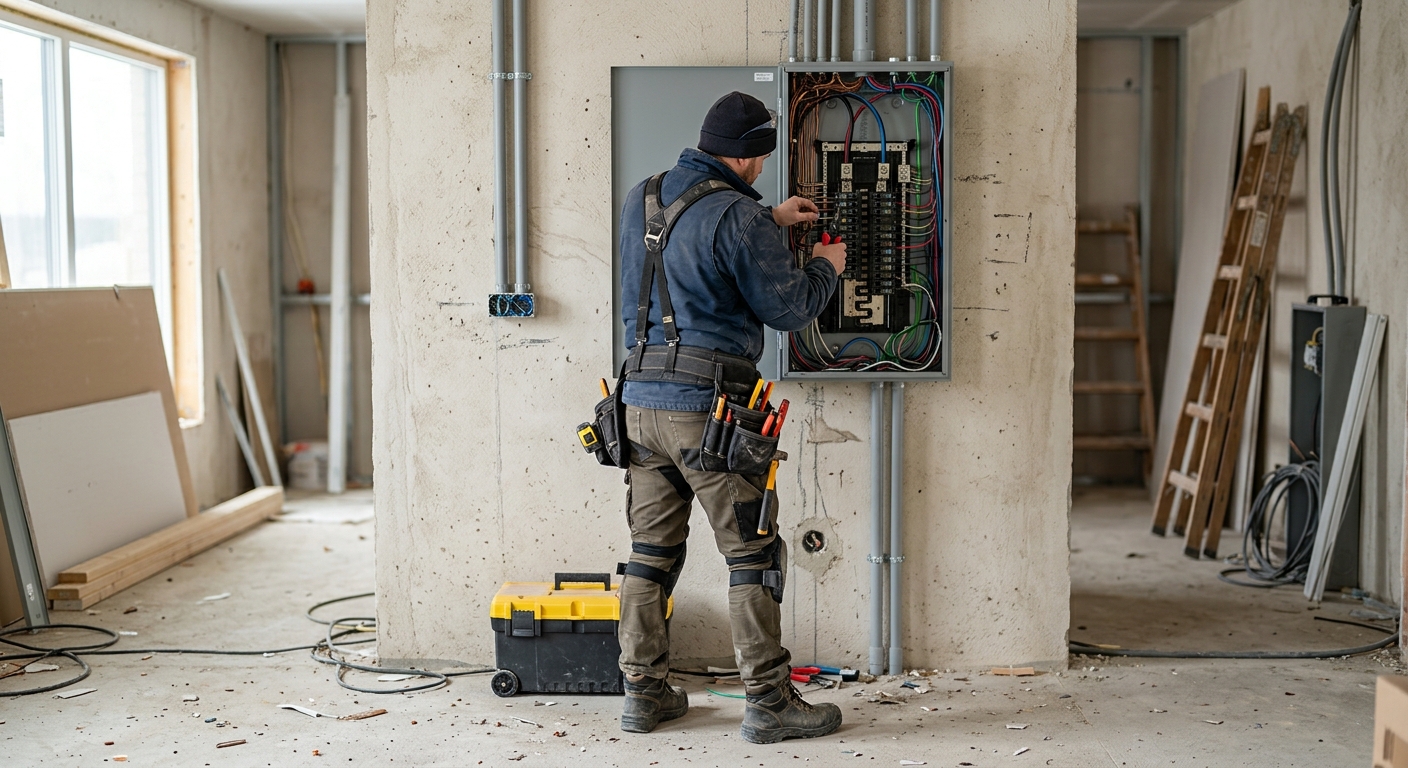
Electrical services and costs in Whitehorn
Whitehorn, Alberta is a great place to live, but the electrical system in many older Calgary-area homes can’t keep up with modern loads. With a growing population of 11,085 people in 2021 (Statistics Canada, 2021 Census), more households are finishing basements, adding heat pumps, and increasing day-to-day electrical use. In this part of the Calgary economic region, neighbourhoods with pre-1980 construction are especially likely to still have knob-and-tube wiring or aluminum branch circuits, and those are prime candidates for partial or full rewiring. Even when wiring is “working,” older 60A or 100A services were often never designed for today’s combination of EV charging, electric cooking, finished basement entertainment systems, and higher air-conditioning demand during hotter stretches.
Calgary’s market conditions also affect pricing. When more households pursue panel upgrades and service sizing (commonly 100A to 200A, and sometimes beyond), electricians and materials can become busier during peak seasons, and site conditions vary—overhead vs. underground utility feeds, trenching needs, and indoor access in older basements. In Whitehorn, the trade is particularly in demand around the more mature sections near Calgary’s established commercial corridors and the transition areas where older homes sit beside newer subdivisions—exactly where utilities and service entrances get upgraded to match current electrical loads.
To help you compare options, the table below summarizes common electrical services, why they’re needed, whether a permit is required, and realistic price bands for Whitehorn.
| Service |
Why It's Needed |
Permit Required |
Price Range |
| Panel upgrade — 100A to 200A service |
Adds capacity for EV charging, heat pumps, and modern appliances; improves safety and code compliance for load management. |
Yes |
$2,500–$8,000 |
| EV charger installation (Level 2, 40–50A) |
Supports daily charging with an appropriately sized breaker, wiring, and grounding/bonding. |
Yes |
$900–$2,500 |
| Knob-and-tube wiring removal and replacement |
Replaces aging insulation and junction practices that can be unsafe and often problematic for insurance coverage. |
Yes |
$4,000–$15,000 |
| Aluminum wiring remediation (CO/ALR connectors) |
Improves connection quality in older aluminum branch circuits to reduce overheating risk. |
Yes (for remediation and modifications) |
$2,500–$7,500 |
| New dedicated circuit (HVAC, appliance, hot tub) |
Stops nuisance tripping and supports large loads safely by adding the right wire size and breaker protection. |
Yes (new circuits) |
$900–$3,500 |
| Whole-home rewire (older home, full replacement) |
Upgrades safety, capacity, and protection (including modern AFCI/GFCI requirements where applicable) across the entire home. |
Yes |
$10,000–$25,000 |
Prices are estimates only and vary by project scope, site access and material selection.
What affects the price of electrical work in Whitehorn
Homeowners often ask why two quotes for the “same” job can be 30–50% apart across Calgary and Alberta. The short answer is that scope details change the work—wire runs, panel location, service entrance type, wiring condition, and how much of the existing system must be made code-compliant. A service upgrade that looks straightforward on paper can become more involved if the utility feed is underground, if trenching or hydrovac is required, or if older wiring needs extensive remediation to safely integrate with a new panel.
In Whitehorn, the age of the housing stock is typically the dominant cost driver. Many pre-1950 homes in older Calgary-area pockets may include knob-and-tube systems, and older knob-and-tube is a common trigger for increased inspection attention and insurance friction—so contractors plan for more junctions, more splicing, and sometimes partial tear-out to do the work properly. Meanwhile, homes from the 1960s–1970s frequently have panels in the 60A or 100A range and may include aluminum wiring; that combination is where load calculations, breaker space constraints, and certified CO/ALR connector remediation come into play. EV adoption is also a real driver—Level 2 charger permit applications are trending because homeowners want 40A–50A circuits that don’t overload the panel.
Concrete local examples: adding one dedicated circuit for an appliance might fall near the mid-range of the new-circuit band, while converting that same load plan into a 100A-to-200A service upgrade can move the project toward the low-to-mid thousands because the panel, breakers, and often feeder/service components change. Also, a simple EV charger can stay closer to the $900–$2,500 band when the panel is accessible, but the price climbs if cable routing requires long runs through finished basements or if the service capacity needs adjustment near the upper end of the $2,500–$8,000 panel upgrade/service range.
| Price Factor |
Why It Matters |
Cost Impact |
| Panel size upgrade — 100A to 200A is the standard minimum today |
Provides breaker space and service capacity for modern devices and heating loads. |
$2,500–$8,000 |
| Wiring type — copper vs. aluminum remediation vs. K&T removal |
Aluminum and knob-and-tube require specific licensed methods, approved parts, and often more labour. |
$2,500–$15,000 |
| Number of new circuits — each adds material and labour time |
More circuits mean more cable, breakers, terminations, and testing. |
$900–$3,500 per circuit (typical) |
| Permit + ESA/TSBC inspection fee — mandatory for all major work |
Major electrical modifications require permit coordination and inspection before energization. |
$200–$800 typical add-on |
| Labour rate for licensed electricians — journeyman rates in Calgary area |
Time on-site is the biggest variable; complicated access increases labour hours. |
$1,500–$6,000 labour component (project-dependent) |
| EV charger amperage — 40A vs. 50A circuit affects cable and breaker cost |
Higher amperage can require larger conductors and breaker sizing. |
$100–$600 difference (typical) |
| Emergency or after-hours premium |
Scheduling urgency often pushes work into overtime, changing crew availability. |
$250–$1,200 |
| Load calculation required for service upgrade |
Confirms whether 200A is enough or if additional work is needed to meet code and safe operation. |
$150–$600 (varies by scope) |
Permits & regulations in Alberta
In Alberta, ALL electrical work beyond changing a light bulb must be done by a licensed electrician. That includes panel upgrades (like 100A to 200A), rewiring work, adding new circuits (including EV chargers), and any service-entrance related modifications. Permits are also required for most of the work homeowners think of as “small but meaningful,” such as running a new dedicated circuit for an appliance, hot tub, or HVAC equipment—because it changes the electrical system’s protection and conductor loading. All permitted work must pass inspection by Alberta’s electrical safety authority (ESA), administered under provincial requirements.
What homeowners can typically do without a permit is limited. You can usually replace a like-for-like fixture where the wiring connection method doesn’t change, and you can do non-electrical prep like clearing access, but you should not attempt wiring changes, breaker swaps, adding receptacles, or connecting a charging unit. DIY electrical is heavily restricted; the practical risk is not just safety—improper work can be rejected at inspection and may affect insurance coverage.
To verify a contractor for a Whitehorn job, start with Alberta’s online licence registry and confirm their electrical contractor licence number matches the person/company on the quote. Next, request a certificate of insurance showing liability coverage and ensure they have WSIB/WCB coverage if applicable to your project. Finally, ask for a clearance/inspection plan (or job permit reference) and confirm they will coordinate the permit pull and inspection timing. If they won’t show licence details or insurance paperwork, treat that as a red flag and move on.
When your Whitehorn home needs an electrical upgrade
Warning signs in Whitehorn aren’t just about convenience—they’re about safety, code compliance, and avoiding costly failures during Alberta’s temperature swings. First, breakers that trip regularly can mean an overloaded panel, undersized circuits, or failing connections; if it happens more than occasionally, plan for an assessment rather than resetting and forgetting. Second, knob-and-tube wiring isn’t only an “age” issue—the concern is the integrity of insulation contact points and junctions, which can create overheating risk. If you have knob-and-tube, treat it as a priority upgrade, especially if you’re shopping for insurance or a home sale inspection.
Third, 60A or 100A service is a common limitation for modern Calgary-area homes. When you add an EV charger, heat pump, and high-demand appliances (like an electric stove) in the same household, a 200A upgrade is often the standard solution to give breathing room. Fourth, aluminum wiring in pre-1976 construction may not be an immediate emergency, but it typically requires licensed remediation using approved methods (like CO/ALR connector work) or replacement—especially at terminations. Fifth, insufficient outlets leading to extension cords everywhere is a practical hazard that often points to missing circuits or overloaded receptacles. Lastly, no AFCI or GFCI protection where required can become a code-compliance issue—showing up during sale or inspection and affecting safety.
Urgency: frequent tripping and visible burning/heat at outlets or panels are immediate. Knob-and-tube and aluminum issues are urgent-to-plan quickly. Service capacity and missing protection are often planned upgrades, but they should be scheduled before adding new loads. As an example, a dedicated circuit for an EV charger may land closer to $900–$2,500, but if your panel is already constrained, the difference is justified—because a panel upgrade/service sizing toward $2,500–$8,000 can prevent future overloads and avoid repeated service interruptions.
| Warning Sign |
What It Means |
Recommended Action |
Urgency |
Price Band |
| Breakers trip frequently |
Overload, failing connections, or circuits not sized for present-day loads. |
Electrical load assessment and targeted circuit corrections; may include panel evaluation. |
Immediate-to-plan |
$900–$3,500 |
| Knob-and-tube wiring present |
Older insulation and junction methods can create risk and insurance/inspection complications. |
Remove and replace affected circuits or plan a staged rewire. |
Priority |
$4,000–$15,000 |
| 60A or 100A panel (inadequate load capacity) |
Limited breaker space and service capacity for EV charging and modern appliances. |
100A to 200A service upgrade and proper load calculation. |
Plan soon |
$2,500–$8,000 |
| Aluminum wiring (pre-1976 construction) |
Terminations may overheat without approved connector methods. |
Licensed remediation with CO/ALR connectors or replacement of problem segments. |
Plan soon |
$2,500–$7,500 |
| Insufficient outlets — extension cords everywhere |
Outlets/circuits are too limited; increased risk from overloaded cords. |
Add receptacles and/or dedicated circuits for major appliances. |
Plan soon |
$900–$3,500 |
| No AFCI or GFCI protection where required |
Higher shock/fire risk and potential failure during sale/inspection. |
Update protection devices and address circuit compliance gaps. |
Planned upgrade |
$200–$2,500 |
How to choose a electrical work contractor in Whitehorn
Choosing the right electrician matters in Whitehorn because many projects involve permits, inspection coordination, and sometimes remediation of older wiring types. Start by confirming the contractor’s Alberta licence details using the provincial licence registry, and ask for their certificate of insurance showing liability coverage. Also verify WSIB/WCB coverage where applicable—electricians who are properly insured and properly registered reduce your risk if something unexpected happens during the job.
Get 2–3 itemised written quotes. Ask for a breakdown of labour and materials (for example: panel model, breakers, cable type/size, connectors, disposal, and testing), not just a single lump sum. Read the scope carefully: what’s included for permit pull and inspection scheduling? Is disposal/haul-away included for removed panel components, old wiring, or damaged materials? If the work might require additional corrections once the electrician opens walls, ask how changes are handled and capped.
For warranty, ask about workmanship coverage length (commonly stated as a period after completion), what manufacturer warranties apply to breakers/panels/charging equipment, and whether warranties are transferable if you sell. On payment schedule, don’t pay more than about 10–15% upfront; hold back the remainder until the job is completed and inspected where required. Finally, insist on a start date and a realistic completion timeline in writing.
- Licence number and scope match (service upgrade vs. new circuit vs. EV charger)
- Certificate of insurance and WSIB/WCB confirmation provided before work starts
- Permit pull included in the quote (and who coordinates inspection)
- Itemised parts list: panel, breakers, cable, connectors, and charger components
- Workmanship warranty stated in writing
- Clear exclusions: what won’t be done unless you approve a change order
- Jobsite protection and cleanup plan (especially in finished basements)
- Testing and commissioning steps included (megger/testing, functional checks)
- Confirmation of cable routing plan and any drilling/patching allowances
- EV charger: confirm amperage (40A vs. 50A) and compatible mounting/installation
- Emergency contact and after-hours policy in case of inspection delays
- Payment schedule with a holdback until completion and inspection
In Whitehorn, the most common contractor red flags are: they refuse to provide their Alberta licence number; they won’t list permit/inspection coordination in the quote; they want most of the payment upfront; they treat a “panel upgrade” as a simple breaker swap; or they quote EV charging without confirming panel capacity and required circuit sizing.
Frequently asked questions — electrical work in Whitehorn
How much does an EV charger installation cost in Whitehorn?
In Whitehorn, a typical Level 2 EV charger installation (about 40A–50A) commonly falls in the $900–$2,500 band, assuming the panel is accessible and the circuit design fits your service capacity. Pricing varies if you need a dedicated circuit run through finished areas, if your panel has limited breaker space, or if your electrician determines you need a service/panel upgrade to safely support the load. In Calgary’s market, EV charger permits are increasingly common, so labour and scheduling can also influence the final number. If you’re pairing an EV charger with a 100A-to-200A upgrade, that panel/service work is usually in the $2,500–$8,000 range and may prevent future overloads.
What is knob-and-tube wiring and should I replace it?
Knob-and-tube (K&T) wiring is an older wiring method with conductors routed through ceramic insulators (“knobs”) and supported using “tubes” at crossings and junctions. The concern isn’t only age—it’s that insulation contact and junction practices can deteriorate over time, and that can raise safety risk. In Alberta, K&T typically requires licensed, code-compliant replacement when you’re addressing circuits, adding loads, or making substantial changes. If you plan a panel upgrade or you’re trying to improve insurability and inspection outcomes, staged K&T removal is often the practical route. The cost commonly lands in the $4,000–$15,000 range depending on how many circuits and how much wall opening is needed. If you sell soon, replacing at least the problematic areas can reduce delays during home inspections.
Is aluminum wiring safe in older Whitehorn homes?
Aluminum wiring can be safe when it’s in good condition and the terminations are handled correctly. The key issue in many older Calgary-area homes (especially those built in the 1965–1976 period) is that aluminum branch-circuit connections can overheat over time if the wiring was not properly joined or if connections weren’t maintained. That’s why licensed remediation with approved methods (for example, CO/ALR connectors where applicable) is often recommended rather than guessing. If the aluminum wiring is intact and connections are addressed, you may not need a full rewire; remediation work commonly falls in the $2,500–$7,500 range. If the problem is widespread or connections are deteriorated, a fuller replacement may be required, especially when you’re also adding modern loads like EV charging and heat pumps.
Do I need a permit for electrical work in Alberta?
Yes—most electrical work that changes the system requires a permit in Alberta, including panel upgrades (like 100A to 200A), new circuits, rewiring, service entrance modifications, and EV charger installations. In Whitehorn, the electrician typically pulls the permit and coordinates inspection so the work meets the Canadian Electrical Code as adopted in Alberta. Minor fixture swaps may not require a permit if it’s truly like-for-like and doesn’t involve wiring changes, but adding outlets, replacing breakers as part of upgrades, or connecting new equipment generally does. The permitted work must be inspected and passed before you can energize and rely on it. Always confirm the licence and ask your contractor to show how permits and inspections are handled in the quote; legitimate contractors build this into their scheduling and pricing.
What are signs of an overloaded electrical panel?
An overloaded electrical panel often shows up as breakers that trip frequently, flickering lights when large appliances run, burning odours or heat near the panel, and repeated nuisance trips when you run multiple devices at once. In Whitehorn homes with older 60A or 100A service, the risk increases when new loads are added—like an EV charger, electric stove, or basement appliances—without confirming capacity. Another sign is limited breaker space forcing “makeshift” shared circuits. If the panel is undersized or crowded, a 200A upgrade is commonly the standard solution; pricing for panel/service upgrades in this region typically sits in the $2,500–$8,000 band, depending on whether utility-side work is involved and how accessible the service entrance is. A licensed electrician can confirm this with proper load calculations and inspection.
Can I do my own electrical work in Alberta?
In Alberta, most electrical work must be done by a licensed electrician. DIY is prohibited for most tasks that impact wiring, breakers, panels, or connections—this includes installing or connecting EV chargers, adding circuits, rewiring, and performing panel or service upgrades. Homeowners may be able to do limited tasks that don’t involve electrical wiring changes (for example, swapping certain like-for-like fixtures), but you should not treat that as permission to run cables, modify circuits, or make electrical connections. If the work is permitted, it must be inspected, and the electrician is responsible for code compliance. If you’re considering upgrades in Whitehorn—like an EV charger typically in the $900–$2,500 band or a panel upgrade in the $2,500–$8,000 band—plan on hiring a licensed contractor to avoid safety risks and inspection issues.