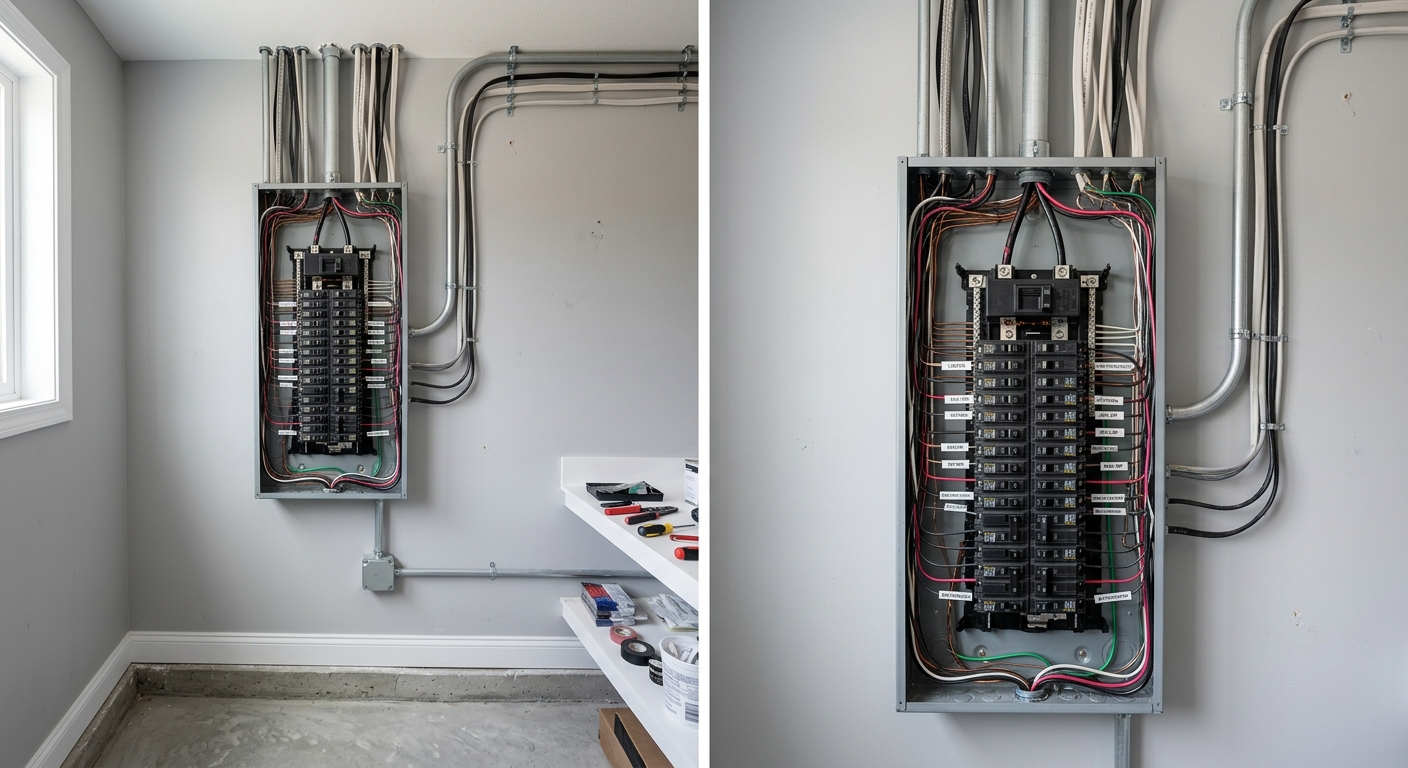
Electrical services and costs in Canmore
Electrical services in Canmore often start with the same reality: many homes here were built well before today’s power-hungry lifestyle. In fact, about 11.6% of local homes were built before 1981, and those older structures are frequently prime candidates for panel upgrades, knob-and-tube removal, and aluminum wiring remediation. At the same time, Canmore’s homeowner market is strong—owner-occupied households make up 66.2% of households (Statistics Canada, 2021 Census)—so upgrades are commonly tied to renovations, insurance requirements, and longer-term plans like EV charging.
In the Banff–Jasper–Rocky Mountain House region, pricing is shaped by older housing stock plus challenging terrain and winter working conditions. When contractors need to manage rock-heavy yards, long cable runs, or utility coordination for transformer/service changes, labour time and site prep rise. EV adoption and electric-heat-heavy homes also push demand for 100A-to-200A panel upgrades and additional circuits, especially in established neighbourhoods such as Canmore’s Three Sisters / Promontory area, where upgrades often come bundled with garage/shop builds and home energy improvements.
Because the electrical system is the backbone for everything else, most projects begin with an assessment and—when required—a load calculation. From there, the work typically falls into a few common service tiers, reflected in the comparison table below.
| Service |
Why It's Needed |
Permit Required |
Price Range |
| Panel upgrade — 100A to 200A service |
Add capacity for modern loads (EV chargers, heat pumps/electric ranges, induction, garages) and meet code safety requirements |
Yes (service/panel work) |
$3,500–$12,000 |
| EV charger installation (Level 2, 40–50A) |
Dedicated, code-compliant circuit reduces nuisance trips and supports daily charging reliably |
Yes (new circuit/charger installation) |
$1,200–$3,500 |
| Knob-and-tube wiring removal and replacement |
Replace ageing wiring with modern insulated cable to reduce risk and meet insurer/code expectations |
Yes (rewiring/alterations) |
$6,000–$25,000 |
| Aluminum wiring remediation (CO/ALR connectors) |
Aluminum branch wiring often needs approved pigtailing/connectors or replacement to address overheating risk |
Yes (required for major wiring changes/remediation) |
$3,000–$15,000 |
| New dedicated circuit (HVAC, appliance, hot tub) |
Dedicated capacity for high-wattage equipment improves safety and performance (fewer trips, better reliability) |
Yes (new circuit) |
$800–$3,500 |
| Whole-home rewire (older home, full replacement) |
Full replacement when multiple wiring types exist or when the safe option is complete modernization |
Yes (major wiring work) |
$12,000–$40,000 |
Prices are estimates only and vary by project scope, site access and material selection.
What affects the price of electrical work in Canmore
If you receive two quotes for what sounds like the “same” electrical job in Canmore, it’s normal to see a 30–50% difference across the Banff–Jasper–Rocky Mountain House region and Alberta. That spread is mostly driven by hidden scope: the real condition of the wiring, the routing difficulty through insulated or unfinished walls, and whether the project requires a service/load upgrade versus adding circuitry only. Labour and permit requirements are fixed realities, but site conditions and electrical complexity vary a lot—especially in Canmore’s older properties and hillside lots.
Housing age is the dominant cost driver here. Homes built before 1950 may still have older wiring practices that insurance companies increasingly scrutinize, and homes in the 1960s–70s era often used 60A or 100A panels that don’t comfortably handle today’s combined loads (EV chargers, heat pumps, induction stoves, and electric hot tubs). Aluminum wiring was also common in some periods, and CO/ALR-approved remediation must be done by licensed electricians—or the safer choice may be full replacement. EV adoption in the region continues to increase permit applications for Level 2 charging, and a 40A charger circuit can sometimes be simpler than a 50A run depending on the required cable, breaker, and available panel space.
Concrete Canmore examples: a panel upgrade in a cramped basement with short cable runs may land closer to the lower end of the panel/service range, while the same upgrade on a rocky access lot can push costs toward the upper end once trenching, longer conduit runs, and additional labour time are included. Meanwhile, if your home already has modern circuit wiring and spare breaker spaces, a new dedicated circuit may stay closer to the lighting & fixtures and smaller-circuit pricing; if you need remediation plus a load calculation and service work, you’re typically looking at a multi-thousand dollar shift.
| Price Factor |
Why It Matters |
Cost Impact |
| Panel size upgrade — 100A to 200A is the standard minimum today |
More capacity for modern appliances, EV charging, and heat electrification |
Often adds thousands; typically aligns with the service/panel band of $3,500–$12,000 |
| Wiring type — copper vs. aluminum remediation vs. K&T removal |
Different materials, connector methods, and replacement scope |
Can swing from “pigtailing” to full rewiring; commonly $6,000–$25,000 for K&T removal/remediation-heavy work |
| Number of new circuits — each adds material and labour time |
Each circuit needs cable, breakers, devices, and often AFCI/GFCI where required |
More circuits increases labour hours and device/material totals (often hundreds per circuit plus routing impacts) |
| Permit + ESA/TSBC inspection fee — mandatory for all major work |
Major electrical alterations must be permitted and inspected |
Adds a non-trivial but fixed portion to the overall quote |
| Labour rate for licensed electricians — journeyman rates in Banff–Jasper–Rocky Mountain House region |
Higher travel/setup time and winter readiness work increases labour cost |
Labour is the biggest controllable line item; site difficulty often expands hours |
| EV charger amperage — 40A vs. 50A circuit affects cable and breaker cost |
Higher amperage may require larger cable and breakers and can affect load balance |
Differences of several hundred to over $1,000 depending on panel/service capacity and run length; typical EV band is $1,200–$3,500 |
| Emergency or after-hours premium |
Scheduling risk and overtime/priority dispatch |
Usually increases total by a service call premium (often noticeable within the first few hundred dollars and beyond) |
| Load calculation required for service upgrade |
Confirms the correct service size and branch layout for safety and code |
May add assessment time; can prevent oversizing or costly rework |
Permits & regulations in Alberta
In Alberta, all electrical work beyond changing a light bulb must be performed by a licensed electrician. Permits are required for panel upgrades/service upgrades, new circuits (including EV charger installations), rewiring, and other major modifications that alter the electrical system. Any permitted work must pass inspection by the electrical safety authority operating in Alberta. DIY electrical is prohibited for most work; homeowner exemptions are narrow and typically do not cover tasks like adding breakers, altering panels, or changing wiring that affects safety.
What requires a permit commonly includes: adding or relocating circuits, upgrading a breaker/panel, installing new outlets where wiring must be run, and removing/replacing older wiring types. What typically does not require a permit includes: swapping an existing lamp, replacing a like-for-like fixture if the wiring method is untouched and you’re not changing circuits or circuits’ capacity (still confirm with your electrician to avoid assumptions).
To verify your contractor for Canmore work, start by checking their Alberta licence status through the provincial online resources, then request a certificate of insurance showing liability coverage. Ask for evidence of WSIB/WCB coverage (if applicable to their workers) and keep copies with your paperwork. Finally, confirm they will pull the permit, schedule inspection, and coordinate any utility-side requirements if the upgrade touches the service equipment.
When your Canmore home needs an electrical upgrade
Electrical upgrades in Canmore aren’t just “nice to have”—they’re often about preventing faults that become more likely in cold weather and through high-use seasons. Here are key warning signs that point to safety-critical issues rather than cosmetic fixes. First, breakers that trip frequently usually signal an overloaded panel or undersized/incorrectly connected circuit. Second, knob-and-tube wiring is a standout concern: the risk is not only age, but insulation condition and contact points that can contribute to overheating; it’s also a common insurance stumbling block. Third, if you have a 60A or 100A panel, it can be inadequate for modern combined loads—especially when you add an EV charger, heat pump supplements, and an electric range in the same household routine. In most cases, a 200A upgrade becomes the standard solution rather than trying to “patch” with additional circuits. Fourth, aluminum wiring (pre-1976 construction) may not be instantly dangerous if maintained, but it generally needs licensed remediation (often with approved CO/ALR connectors) to manage connection integrity. Fifth, insufficient outlets and lots of extension cords can be a code and safety compliance issue. Finally, no AFCI/GFCI protection where required can surface during sales and inspections, even if nothing “feels” wrong day to day.
Urgency matters: frequent tripping and any active signs of overheating (burn marks, hot panels, buzzing) warrant prompt attention. Planned upgrades—like panel capacity improvements for EV readiness—can often be scheduled, but should be based on a load calculation to avoid buying the wrong “fix.” For example, adding a dedicated EV circuit may fit the EV charger band of $1,200–$3,500, but if your panel is already close to capacity, the justified cost jump may involve a panel/service upgrade—often in the $3,500–$12,000 range—so the charger and the rest of your home can operate safely together.
| Warning Sign |
What It Means |
Recommended Action |
Urgency |
Price Band |
| Breakers trip frequently |
Likely overload, incorrect circuit sizing, or failing components |
Inspection + diagnosis, then circuit or panel corrections |
High |
$800–$3,500 |
| Knob-and-tube wiring present |
Older wiring methods with elevated risk and insurance/code concerns |
Targeted removal/replacement; consider broader rewiring if widespread |
High |
$6,000–$25,000 |
| 60A or 100A panel (inadequate load capacity) |
Not enough headroom for EVs and modern electrified loads |
Load calculation and likely 200A upgrade |
Medium to High |
$3,500–$12,000 |
| Aluminum wiring (pre-1976 construction) |
Connections may overheat without proper remediation |
CO/ALR connector remediation or replacement of affected runs |
Medium to High |
$3,000–$15,000 |
| Insufficient outlets — extension cords everywhere |
Improper temporary wiring and hidden overload risks |
Add new receptacle circuits and correct spacing/placement |
Medium |
$800–$3,500 |
| No AFCI or GFCI protection where required |
Shock and arc-fault risk not addressed to current safety expectations |
Upgrade protective devices and update affected circuits |
Medium |
$300–$3,000 |
How to choose a electrical work contractor in Canmore
Choosing a contractor in Canmore comes down to verifying licensing, insurance, and process—because electrical work is both regulated and safety-critical. First, confirm the electrician is licensed in Alberta and ask for their licence number or proof from the provincial registry. Second, request liability insurance documentation (certificate of insurance is usually provided immediately). Third, verify WSIB/WCB coverage for their workers if applicable—don’t rely on verbal assurances. These checks are especially important for service upgrades and rewiring, where the job often includes permit coordination, inspection scheduling, and longer site time in winter conditions.
Next, get 2–3 itemised written quotes rather than one lump sum. You want a breakdown showing labour hours, materials (cable, breakers, connectors, devices), and any allowance for access and disposal. Ask whether permit pulling is included and whether inspection fees and materials disposal/haul-away are covered. Carefully read exclusions: for example, some quotes may exclude trenching, utility coordination costs, drywall restoration, or additional circuit requirements discovered during the assessment.
Warranty matters for workmanship—ask how long they stand behind installation, and whether the product warranty is manufacturer-backed and transferable. For payment scheduling, avoid paying more than 10–15% upfront; hold back the remainder until the job is complete and inspected. Finally, get a written timeline with a start date and an estimated completion window.
- Licence verification in Alberta before any work starts
- Certificate of insurance and clear liability limits
- WSIB/WCB coverage confirmation where applicable
- Itemised quote with labour, parts, permits, and allowances clearly listed
- Ask who pulls the permit and who pays inspection fees
- Confirm if disposal/haul-away of old panels/wiring is included
- Request a load calculation for service upgrades when needed
- Written schedule: start date and expected completion
- Photo documentation before/after for older wiring situations
- Workmanship warranty details in writing
- Adequate protection of floors/walls and dust control plan
- Transparent change-order process if scope expands (e.g., discovery of old wiring types)
Red flags I commonly see with electrical contractors in Canmore include: quotes that won’t commit to permit handling, refusal to provide licence/insurance documentation, “lump sum only” pricing without a breakdown, vague warranties, and pressure to pay most of the job cost upfront before any inspection or rough-in is complete.
Frequently asked questions — electrical work in Canmore
What electrical upgrades are required when selling a home in Alberta?
In Alberta, there isn’t a single “one-size-fits-all” list that applies to every sale, but electrical safety and code compliance are still central. Many upgrades are triggered by deficiencies found during inspection or by buyer/lender requirements. Common items we see in Canmore include updating missing protective devices (like GFCI/AFCI where required), correcting unsafe wiring methods, and ensuring the panel and circuits are properly protected and labelled. If you have older wiring (including knob-and-tube) or aluminum branch wiring without proper remediation, the safety and insurer expectations often push owners toward remediation or replacement. If your service is undersized for modern loads, a panel upgrade is frequently the practical outcome for a safer electrical system. Costs vary widely—an EV-ready panel/service upgrade often falls in the $3,500–$12,000 range, while smaller compliance device updates may be closer to a few hundred to a few thousand depending on the circuit count.
What is a load calculation and why does my electrician need one?
A load calculation is a formal method electricians use to estimate how much electricity your home will require based on what’s installed (and sometimes what you plan to add), then determine whether your panel/service size is appropriate. In Canmore, this is especially important because many homes—particularly older ones—were built with smaller services than modern electrification demands. If you’re adding an EV charger, upgrading heating, or increasing kitchen/laundry loads, the existing panel may be too close to capacity, which can lead to nuisance tripping or unsafe operation. A load calculation supports correct breaker and cable selection and helps justify a service upgrade rather than guessing. If you’re already planning a 100A to 200A upgrade, having the calculation done upfront is typically part of doing the job right, and it can save money by avoiding rework and preventing “oversize” surprises.
How do I find a licensed electrician in Canmore?
Start by confirming licensing through the provincial Alberta registry resources (use the electrician’s name/licence details). Then ask the contractor for a certificate of insurance showing liability coverage and confirmation of WSIB/WCB coverage where applicable to their workers. For Canmore projects—panel upgrades, EV charger installs, and any rewiring—don’t proceed until you’ve confirmed they will pull the appropriate permit and schedule the required inspection. A good contractor will be straightforward about their licence number, permit responsibility, and inspection process. You can also ask for a brief list of similar local jobs in the Banff–Jasper–Rocky Mountain House region, because terrain and winter scheduling can affect how work is staged. When comparing quotes, look for itemised scopes rather than vague estimates—especially if you’re facing a service upgrade that typically lands in the $3,500–$12,000 band.
Can I add a subpanel to my Canmore home?
In many Canmore homes, adding a subpanel is possible and sometimes the best approach—especially if the main panel is full, you have a detached garage/shop, or you’re adding circuits during renovations. However, it must be designed for your actual service capacity and existing wiring condition. A subpanel typically requires permit approval because it involves adding or extending branch circuits and modifying the distribution layout. If your home has older wiring methods (like knob-and-tube) or aluminum wiring issues, the electrician may recommend remediation first or plan the subpanel expansion to avoid unsafe connection points. Often, subpanels are used alongside a load calculation to ensure the system is sized correctly before adding an EV charger or new heat equipment. The overall cost depends on whether a service upgrade is also required—EV charging alone is commonly in the $1,200–$3,500 range, but service/panel changes can shift the total to the $3,500–$12,000 band.
How much does an electrician cost in Canmore?
Electrician pricing in Canmore is usually structured around the scope (labour hours, materials, permits/inspection, and site difficulty), not a simple hourly rate. For many common jobs, you’ll see typical project bands: EV charger installs in the $1,200–$3,500 range, and panel/service upgrades often landing in the $3,500–$12,000 range when upgrading from 100A to 200A. If your home requires knob-and-tube removal or heavier rewiring, costs can rise into the $6,000–$25,000 band depending on how much wiring is affected and how much wall access is needed. In Canmore, cold-weather scheduling and difficult access (rocky lots, long runs, older basements) can increase labour time. Always ask for an itemised quote that clearly states what’s included—permits, inspection scheduling, and any utility coordination—so you can compare apples to apples.
How much does a panel upgrade cost in Canmore?
For Canmore homeowners, a panel upgrade cost most commonly depends on whether you’re moving from a 100A service to a 200A service, how complicated the wiring condition is, and how much coordination is needed for service equipment. In the Banff–Jasper–Rocky Mountain House region, a typical 100A to 200A panel/service upgrade is often estimated in the $3,500–$12,000 range. Homes built before 1981 are a higher-likelihood category for additional work (for example, older wiring types that may need remediation alongside the panel), which can push the project toward the higher end. If you’re adding EV charging, heat electrification, or multiple new circuits, a load calculation helps confirm the correct size—preventing a cheaper fix that can still leave you capacity short.