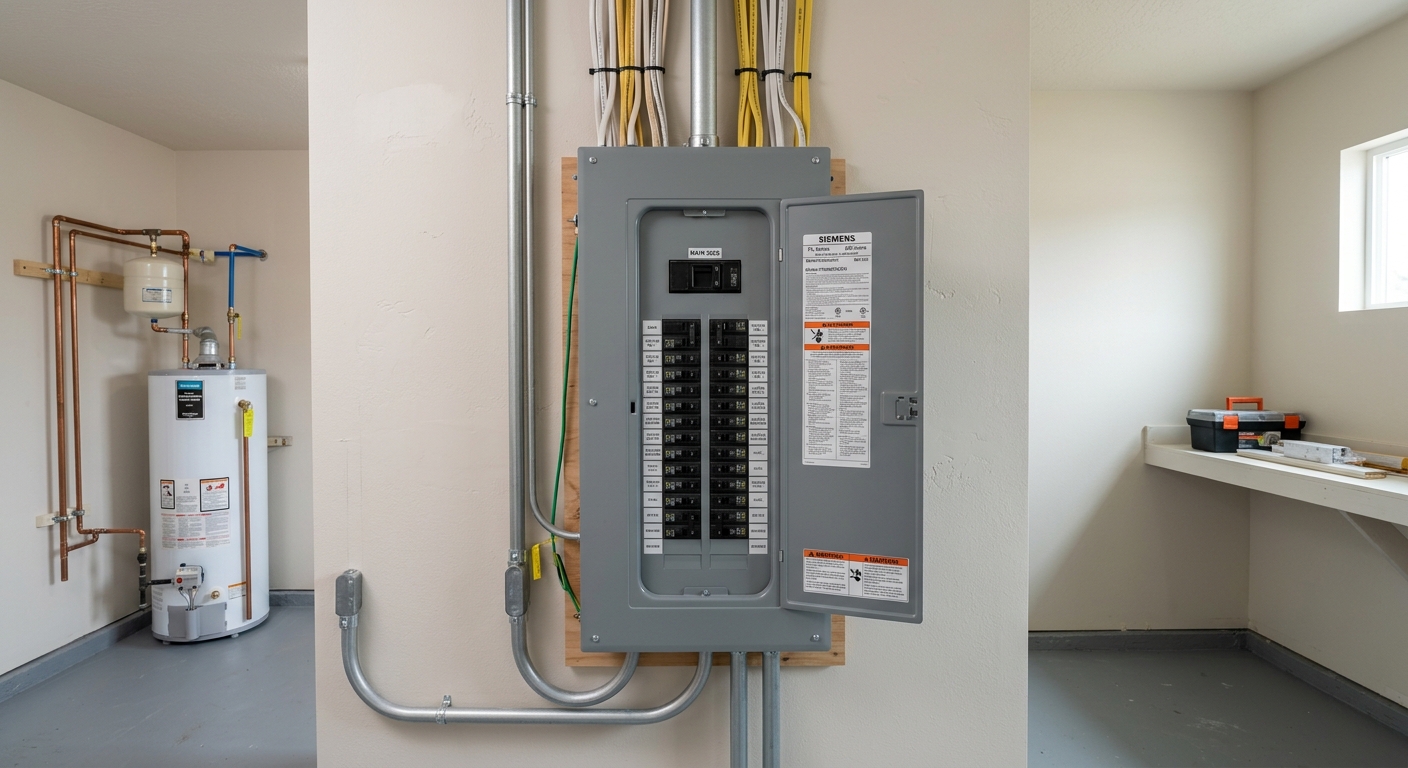
Electrical services and costs in Claresholm
In Claresholm, electrical upgrades are a common part of home maintenance—especially because so many properties were built well before today’s electrical demands. With 61.4% of homes built before 1981, it’s not unusual to find older wiring methods that were never designed for EV charging, electric cooking, heat pumps, or today’s higher-draw appliances. The homeowner base is also substantial (1,310 homeowner households, 76.6% of households own), which supports steady availability of licensed trades, but it can still mean scheduling pressure during peak permit-inspection weeks.
The Lethbridge–Medicine Hat economic region has a mix of legacy electrical systems and newer suburban builds, so electricians frequently modernize older panels and unsafe wiring. In colder stretches, space-heating loads can rise, and that pushes undersized services (for example 60A or older 100A panels) closer to their limits. At the same time, EV charger installations have become a frequent reason for load calculations and service upgrades, and that tends to increase both labour and permit coordination time.
Where demand is especially visible around town, you’ll often see calls for upgrades near the older residential pockets along Main Street and established areas closer to the school and downtown services. Those homes are commonly in the “workhorse” category: not always failing, but needing safer breaker configurations, updated protection, and sometimes a full or partial rewire.
Below is a practical comparison of the services Claresholm homeowners most often request, along with whether a permit is typically required and the expected price band.
| Service |
Why It's Needed |
Permit Required |
Price Range |
| Panel upgrade — 100A to 200A service |
Modern load demand for EV chargers, electric ranges, and heat pumps; improves safety and reduces nuisance trips. |
Yes (service upgrade/panel change) |
$2,800–$4,900 |
| EV charger installation (Level 2, 40–50A) |
Provides proper dedicated power with correct breaker and conductor sizing; supports future charging needs. |
Yes (new branch circuit and/or panel work) |
$1,400–$2,450 |
| Knob-and-tube wiring removal and replacement |
Older insulation/contact points can be unsafe and insurance coverage may be declined; brings wiring up to current requirements. |
Yes (rewiring) |
$4,000–$10,000 |
| Aluminum wiring remediation (CO/ALR connectors) |
Aluminium branch wiring requires approved remediation to reduce overheating risk at terminations. |
Yes (hazardous/wiring changes) |
$3,500–$7,500 |
| New dedicated circuit (HVAC, appliance, hot tub) |
Dedicated circuits prevent overloading shared wiring and supports code-compliant protection. |
Yes (new circuit) |
$1,200–$3,800 |
| Whole-home rewire (older home, full replacement) |
Complete replacement when wiring is widespread, undersized, or combined with service/panel limitations. |
Yes (full rewiring) |
$7,500–$14,500 |
Prices are estimates only and vary by project scope, site access and material selection.
What affects the price of electrical work in Claresholm
In Claresholm and across the Lethbridge–Medicine Hat region, it’s common to see quotes for the “same” electrical job differ by 30–50%. The reasons usually come down to how much of the existing system must be made safe, what’s required to pass inspection, and the time it takes to open walls/ceilings. Labour in the region is often a dominant cost driver, commonly in the $80–$130/hour range for licensed electricians, and that labour is multiplied when older wiring is found to be more extensive than expected.
The age of the housing stock is the dominant cost driver. In homes built before 1950, knob-and-tube wiring may be present, and insurance companies increasingly require it to be addressed. Homes from the 1960s–70s often have 60A or 100A panels that are inadequate for today’s load profile—especially when adding EV chargers, heat pumps, and high-draw cooking. Aluminum wiring is also a factor in many homes from roughly 1965–1976, and it typically requires licensed remediation using approved CO/ALR connectors or replacement. Meanwhile, EV adoption is driving more Level 2 permit applications and load calculations, which adds cost even before any trenching or cable runs begin.
Concrete examples from Claresholm: (1) A “simple” panel upgrade can shift from a straightforward 100A-to-200A change into a higher band if the feeder conductors or grounding system need updating to suit today’s installation standards. (2) If an EV charger location requires a longer conduit run or panel relocation for workable terminations, the project can move closer to the upper end of the $1,400–$2,450 EV charger band. On the other hand, some upgrades stay near the lower end when the existing service is accessible and the wiring path is short—saving labour and materials.
| Price Factor |
Why It Matters |
Cost Impact |
| Panel size upgrade — 100A to 200A is the standard minimum today |
Requires new panel, breakers, load calculation, and often feeder/ground updates. |
$2,800–$4,900 |
| Wiring type — copper vs. aluminum remediation vs. K&T removal |
Aluminum and knob-and-tube systems require additional safety steps, approvals, and labour. |
$3,500–$10,000 |
| Number of new circuits — each adds material and labour time |
Each circuit means breakers, cable/conduit, boxes, testing and labour hours. |
$1,200–$3,800 |
| Permit + ESA/TSBC inspection fee — mandatory for all major work |
Major electrical work is not considered complete until it’s inspected. |
$200–$800 |
| Labour rate for licensed electricians — journeyman rates in Lethbridge–Medicine Hat |
Older systems increase time for troubleshooting, routing, and safe terminations. |
$80–$130/hour |
| EV charger amperage — 40A vs. 50A circuit affects cable and breaker cost |
Higher amperage can increase conductor sizing and breaker cost, plus more planning. |
$1,400–$2,450 |
| Emergency or after-hours premium |
Scheduling urgency adds overhead and may require expedited inspection coordination. |
$150–$600 |
| Load calculation required for service upgrade |
Determines correct service size and breaker arrangement to satisfy inspection. |
$250–$700 |
Permits & regulations in Alberta
In Alberta, electrical work beyond changing a light bulb must be done by a licensed electrician. Permits are required for panel upgrades, new circuits (including EV chargers), rewiring, and service upgrades, because these changes affect the safety of the electrical system. All permitted work must pass inspection by the provincial electrical safety authority (in Alberta, inspections are administered under the Safety Codes framework through accredited agencies such as ESA-related administration).
DIY electrical is generally prohibited for most work. Homeowners can usually handle low-voltage tasks that are outside the scope of wiring in a typical dwelling—however, anything involving the panel, breakers, conductor terminations, junctioning, or new branch circuits requires a permit and a licensed electrician. In practice, changing a receptacle or switch is not considered “minor” when it involves verifying wiring conditions, proper grounding, and compliance with required protection (like GFCI/AFCI where applicable).
Here’s how to verify a contractor in Claresholm step-by-step. First, confirm the electrician’s licence and registration through the provincial registry maintained for the Safety Codes framework. Second, request a certificate of insurance showing liability coverage (ask for the effective dates) and ensure the company provides documentation in writing. Third, confirm WSIB/WCB clearance (or appropriate coverage for the business) before work starts. Finally, insist on a permit number and inspection schedule plan in your estimate—if a contractor won’t discuss permits, that’s a major warning sign.
When your Claresholm home needs an electrical upgrade
Some electrical problems are cosmetic, but in Claresholm you should treat certain warning signs as safety-critical—especially given the mix of older housing stock. Start with breakers that trip regularly: frequent nuisance trips usually indicate an overloaded panel, undersized circuits, loose connections, or failing breakers. If trips happen during normal loads (not a one-time event), plan action soon; if there’s heat, burning odours, or sparking, treat it as urgent.
Knob-and-tube wiring is another big one. The concern is the original insulation and connection points (not just the age). If you see it in an attic, basement, or junction area, it should be assessed and typically replaced with modern cable.
Then look at the service size. If your home has a 60A or 100A panel, it may be inadequate for today’s combined loads—particularly with an EV charger, heat pump, and electric stove running in parallel. The practical solution is often a 200A upgrade, which aligns with today’s load expectations and simplifies future expansion. In that case, spending on the panel upgrade can be justified: for example, moving from a $2,800–$4,900 panel upgrade to attempting “cheap fixes” (like adding a couple of circuits without addressing service capacity) can lead to repeated breaker trips and extra labour later.
Aluminum wiring from pre-1976 construction is not always an emergency, but it does require licensed remediation or replacement to ensure safe terminations. Finally, insufficient outlets and missing AFCI/GFCI protection can show up during a home sale or inspection; it’s often worth upgrading because it improves both safety and marketability.
| Warning Sign |
What It Means |
Recommended Action |
Urgency |
Price Band |
| Breakers trip frequently |
Possible overload, failing breaker, or unsafe wiring conditions. |
Troubleshoot load and fix/replace undersized circuits; consider service assessment. |
Planned soon (urgent if burning/heat) |
$1,200–$4,900 |
| Knob-and-tube wiring present |
Older wiring system with deteriorating insulation/contact concerns. |
Inspection and staged removal/replacement (often partial-to-whole depending on extent). |
Urgent to schedule |
$4,000–$10,000 |
| 60A or 100A panel (inadequate load capacity) |
May not support modern loads safely, especially in winter heating seasons and with EVs. |
Load calculation and upgrade to 200A; update feeders/grounding if needed. |
Planned upgrade |
$2,800–$4,900 |
| Aluminum wiring (pre-1976 construction) |
Requires approved remediation to reduce overheating at terminations. |
CO/ALR connector remediation or conductor replacement where required. |
Planned soon |
$3,500–$7,500 |
| Insufficient outlets — extension cords everywhere |
Overreliance on temporary connections and overloaded receptacles. |
Add circuits and receptacles; improve placement and protection. |
Planned |
$1,200–$3,800 |
| No AFCI or GFCI protection where required |
Code compliance and shock/fire-risk concern. |
Upgrade protection devices on affected circuits and update receptacles as needed. |
Planned (or required for sale) |
$150–$1,800 |
How to choose a electrical work contractor in Claresholm
Choosing the right contractor matters in Claresholm because older wiring discoveries can quickly change scope. Start by verifying the contractor’s Alberta licensing: ask for the licence number and confirm it using Alberta’s online licence registry. Next, check liability insurance by requesting a current certificate of insurance—make sure it lists the correct legal entity and covers the type of work being performed. Finally, confirm WSIB/WCB coverage (or the appropriate clearance documentation) before work starts; don’t rely on verbal assurances.
Then get 2–3 itemised written quotes—not just lump sums. The best quotes break out labour hours, materials, disposal/cleanup, and whether permit pulling and inspection coordination are included. Scope clarity is key: ask what’s excluded (for example, drywall repair, cable fishing through finished walls, trenching for EV conduit, or bringing grounding up to current requirements). Warranty terms should be explicit: workmanship warranty length, product/manufacturer warranty coverage, and whether warranties transfer if you sell the home.
Payment schedule should be conservative. Avoid paying more than 10–15% upfront; use a holdback until the job is complete and inspected. Ask for a start date and a completion estimate in writing, including inspection timing—because permitting and inspections can affect the schedule even when labour is available.
- Confirm Alberta licence number and business registration before signing
- Request a certificate of insurance with the correct company name and dates
- Verify WSIB/WCB coverage or clearance documentation
- Get itemised quotes (labour, materials, permits, disposal, testing)
- Ask if permit pulling is included and who schedules inspection
- Confirm whether drywall patching/painting is included or excluded
- Ask for an EV charger quote that specifies amperage (40A vs 50A) and wiring path
- Ensure the quote states whether old wiring is removed to a defined scope
- Request a load calculation plan for service upgrades
- Verify warranty: workmanship period and product warranty documentation
- Use a payment schedule with a holdback until inspection passes
- Require start date, duration estimate, and permit/inspection timeline in writing
In Claresholm, watch for red flags like: (1) a contractor who won’t discuss permits and inspection responsibility, (2) “flat-rate” quotes with no breakdown when older wiring may change scope, (3) promises to do panel/service work without clear licensing proof, (4) refusing to put warranty terms in writing, and (5) asking for large upfront deposits beyond 10–15%.
Frequently asked questions — electrical work in Claresholm
How much does an EV charger installation cost in Claresholm?
In Claresholm, a typical Level 2 EV charger install (often a 40–50A circuit with a new breaker and proper wiring) is commonly budgeted in the $1,400–$2,450 range, depending on cable length, conduit routing, and whether your panel can accept the additional load. If you’re already near service capacity, you may also need a load calculation and possibly a service upgrade—panel upgrades in the $2,800–$4,900 band can become part of the EV plan. Alberta permitting and inspection requirements also influence the schedule and total cost, so factor permit coordination into your timeline. Homes built before 1981 may have older panel setups or wiring conditions that affect how smoothly installation proceeds.
What is knob-and-tube wiring and should I replace it?
Knob-and-tube wiring is an older wiring method used in many older homes, and it’s still sometimes found in attics, basements, and wall cavities. The key safety concern isn’t only age—it’s how the wiring components and insulation/contact points behave over time. In practical terms, it’s often harder to inspect and safer to remove or replace during modernization. In Claresholm and across Alberta, you’ll generally need a licensed electrician and permits for rewiring, and any permitted work must pass inspection. If knob-and-tube is present, I usually recommend scheduling an assessment promptly—especially because insurance coverage can be affected in some cases. Replacement scope can be partial or whole-home depending on how widespread it is.
Is aluminum wiring safe in older Claresholm homes?
Aluminum branch wiring can be safe when it’s properly installed and maintained, but it often requires licensed remediation because terminations can overheat if connections aren’t handled with approved methods. In older Claresholm homes—many of which date back to the pre-1981 period—aluminum wiring remediation is frequently done using approved CO/ALR connectors, or by replacing conductors in affected areas. Whether it’s “immediately dangerous” depends on condition, termination quality, and evidence of overheating, but remediation is usually a wise planned upgrade, especially before a sale or major renovation. Budget-wise, many remediation projects land in the $3,500–$7,500 range, with whole rewire work costing more if the wiring is extensive.
Do I need a permit for electrical work in Alberta?
Yes—most electrical work in Alberta that changes circuits, wiring, panels, or adds new power requires a permit and inspection through the Safety Codes framework. In Claresholm, that typically includes panel upgrades (like 100A to 200A), new circuits (including EV charger installations), rewiring projects, and service-related changes. Minor work is where expectations can get confusing, but if it involves the panel/breakers, new branch circuits, or altering wiring pathways, assume a permit is required and use a licensed electrician. A good contractor will include permit pulling and inspection coordination as part of the scope. Before hiring, verify the electrician’s Alberta licence through the provincial registry and ask for proof of insurance and WSIB/WCB clearance.
What are signs of an overloaded electrical panel?
Signs of an overloaded panel include breakers that trip frequently, lights dimming during normal use, a burning smell near outlets or the panel, warm or discoloured breaker handles, and repeated GFCI/AFCI nuisance trips that don’t resolve after basic troubleshooting. In many Claresholm homes built before 1981, the service may have been sized for older lifestyles, and modern loads—like EV chargers, heat pumps, and electric stoves—can push the system closer to its limits. When troubleshooting shows capacity issues, the standard solution is often a load calculation and a service upgrade to 200A. That’s commonly budgeted in the $2,800–$4,900 band, depending on whether feeder/grounding updates are required.
Can I do my own electrical work in Alberta?
For most work, no. In Alberta, electrical work beyond very limited “non-structural” tasks must be performed by a licensed electrician, and permitted projects must be inspected. If you try to do work yourself that falls under permitting requirements—like adding circuits, working on a panel, or installing an EV charger—you may be forced to undo the work and re-permit, which increases cost and delays. In Claresholm, the safe path is to hire a licensed electrician for anything that affects breakers, wiring, or protection devices. If you want to prepare, you can often handle practical pre-work like clearing access or planning locations, but the actual electrical connections and commissioning should be done by the licensed contractor and backed by warranty.