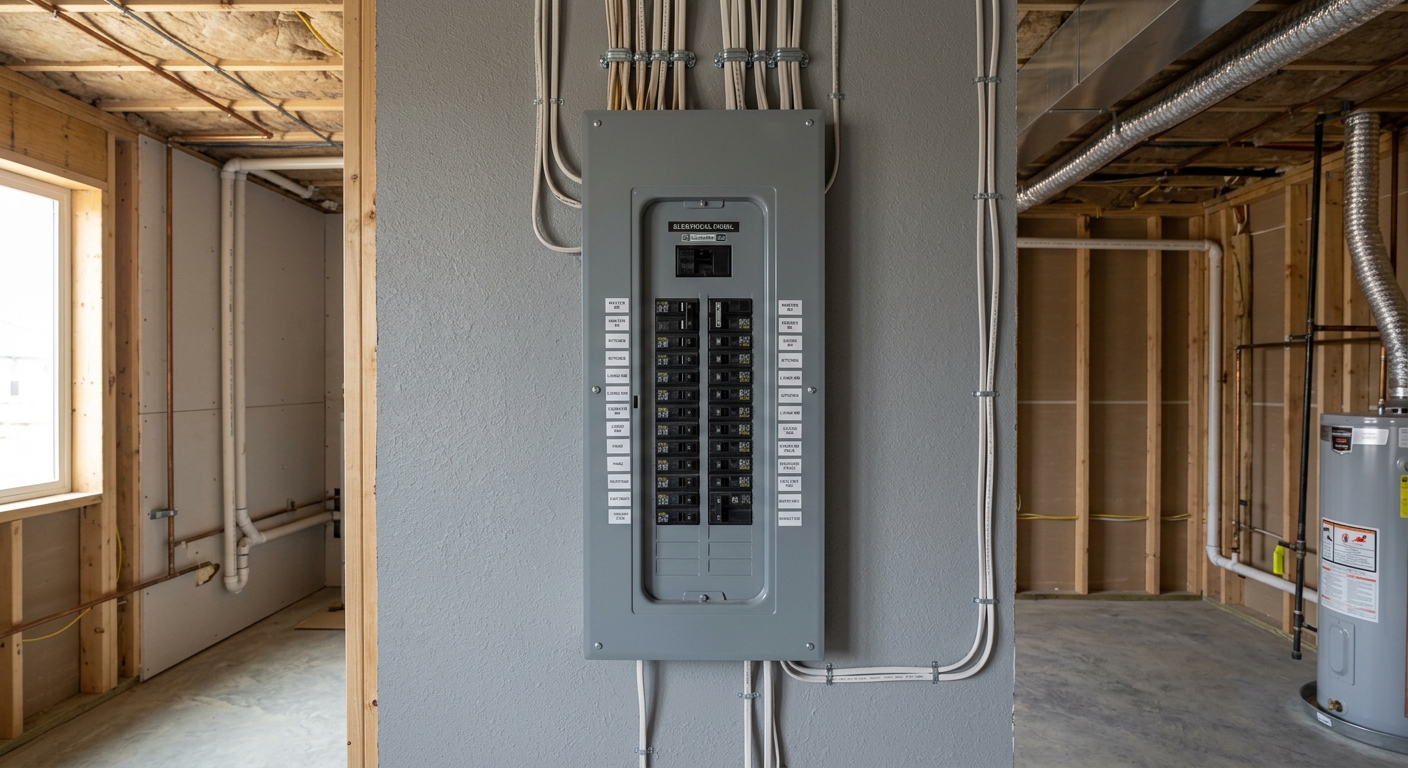
Electrical services and costs in Burquitlam
Burquitlam homeowners often run into the same electrical reality: the neighbourhood’s older housing stock and growing electrification (EVs and modern heating) put pressure on aging panels and branch circuits. With a Burquitlam population of 14,896 (Statistics Canada, 2021 Census), the area also has enough turnover and multi-unit activity that electrical contractors stay busy—especially around Burnaby/New Westminster commuting corridors and the pockets of older homes closer to the South Fraser Way side. Many homes in the Lower Mainland–Southwest region were built long before today’s typical load profile, so the “starter” service problems commonly start with either an undersized panel (60A or 100A) or wiring methods that no longer meet modern safety expectations.
Lower Mainland–Southwest pricing is shaped by dense urban access, permitting/inspection steps, and the fact that many houses require more than a like-for-like fix. In practice, that often means replacing knob-and-tube wiring and remediating aluminum branch circuits, then upgrading services from 60–100A to modern 200A so you can add circuits for EV chargers and high-demand appliances. On top of that, British Columbia’s wet winters and temperature swings drive demand for heating-related electrical work, and EV ownership has accelerated Level 2 charger installations—projects that frequently trigger a panel or full service change to maintain capacity and comply with fault-current requirements.
Because of those drivers, it’s smart to compare quotes using consistent scope. The table below shows typical cost bands for the most common Burquitlam jobs, so you can line up apples-to-apples before you book an inspection.
| Service |
Why It's Needed |
Permit Required |
Price Range |
| Panel upgrade — 100A to 200A service |
Modern load demands (EV charger, electric range, heat pumps) typically require more breaker space and higher service capacity to stay within safe limits. |
Yes (service equipment alteration requires permit and inspection in BC) |
$1,800 – $4,500 |
| EV charger installation (Level 2, 40–50A) |
Adds a dedicated charging circuit; depending on your panel capacity, it may require a new breaker space and sometimes a service/panel upgrade. |
Yes (new circuit and breaker installation) |
$900 – $2,500 |
| Knob-and-tube wiring removal and replacement |
Knob-and-tube presents insulation and connection risks; many insurers and buyers require it to be removed and replaced with code-compliant wiring. |
Yes (rewiring requires permit and inspection) |
$8,000 – $20,000 |
| Aluminum wiring remediation (CO/ALR connectors) |
Older aluminum branch wiring (commonly from the mid-1960s to mid-1970s) may require approved connector methods or targeted replacement at terminations and affected runs. |
Yes (wiring alterations require permit and inspection) |
$8,000 – $20,000 |
| New dedicated circuit (HVAC, appliance, hot tub) |
Dedicated capacity improves safety and performance and reduces nuisance trips/voltage issues; often paired with panel space checks. |
Yes (new circuit work typically requires permit) |
$1,000 – $3,200 |
| Whole-home rewire (older home, full replacement) |
When multiple rooms and circuits need replacement, a full rewire reduces future “patchwork” risk and speeds up resale/insurance compliance. |
Yes (rewiring requires permit and inspection) |
$8,000 – $20,000 |
Prices are estimates only and vary by project scope, site access and material selection.
What affects the price of electrical work in Burquitlam
In Burquitlam and across Lower Mainland–Southwest, two quotes for the “same” electrical job can differ by 30–50% because scope details change what’s underneath the walls: wire condition, panel condition, trenching/route length, and how many circuits must be added to make the system compliant. British Columbia projects also include mandatory permitting and inspections, plus scheduling constraints when multiple trades are coordinating around service equipment and utility involvement.
For most homeowners, the dominant cost driver is the age and wiring method of the housing stock. Older homes (especially those with knob-and-tube wiring) often need more labour to safely remove and replace wiring than people expect—partly because you can’t just “cap and move on” when insulation and connection methods don’t meet modern safety expectations. Homes from the 1960s–70s may have 60A or 100A panels that are inadequate for today’s loads, and many households now add EV charging and heavy appliances that increase demand. Aluminum wiring, common in homes built roughly between 1965 and 1976, requires licensed remediation using approved CO/ALR connectors or targeted replacement of affected sections; if remediation isn’t practical in the layout, the job moves toward a larger rewire scope. The result is that a job that starts as a panel upgrade can legitimately expand, and that’s where cost variance comes from.
Local examples in Burquitlam: (1) a Level 2 charger (40–50A) may stay in the $900 – $2,500 band if you have spare breaker positions and capacity, but it can jump into a higher-cost service plan if your panel is crowded or your total load calculation shows overload risk. (2) older branch wiring in inaccessible ceiling spaces or tight interior routes often pushes wiring work toward the $8,000 – $20,000 band because labour time is higher and materials counts rise. (3) wet-season access can slow down exterior mast conduit and trench routing around driveways and landscaping, affecting schedule and labour.
| Price Factor |
Why It Matters |
Cost Impact |
| Panel size upgrade — 100A to 200A is the standard minimum today |
More capacity and breaker space reduce the need for load-shaving and enable EV + modern appliances safely. |
$1,800 – $4,500 |
| Wiring type — copper vs. aluminum remediation vs. K&T removal |
Aluminum terminations need approved methods; knob-and-tube removal requires careful, complete replacement practices. |
Can swing by $3,000 – $10,000 depending on how much is affected |
| Number of new circuits — each adds material and labour time |
Each circuit requires conductors, breakers, boxes, and testing; more runs also mean more labour. |
Typical incremental effect: $300 – $1,200 per added circuit |
| Permit + ESA/TSBC inspection fee — mandatory for all major work |
Permits and inspection stages are required for panel/service work and new circuits and must be booked into schedules. |
Often $150 – $600 depending on scope |
| Labour rate for licensed electricians — journeyman rates in Lower Mainland–Southwest |
Urban labour and coordination costs are higher in the Lower Mainland, especially with tight access and multi-step work. |
Labour typically drives 40%–70% of total for larger scopes |
| EV charger amperage — 40A vs. 50A circuit affects cable and breaker cost |
Higher amperage generally means larger conductors/breaker and sometimes different routing constraints. |
Can add $150 – $450 |
| Emergency or after-hours premium |
Urgent troubleshooting, after-hours access, and risk management increase labour rates and scheduling costs. |
Often $250 – $1,000 extra |
| Load calculation required for service upgrade |
If the load calculation doesn’t support your intended add-ons, your upgrade may need to change size or scope. |
Often adds $200 – $500 for engineering/calculation time |
Permits & regulations in British Columbia
In British Columbia, ALL electrical work beyond changing a light bulb must be completed by a licensed electrician. That includes panel upgrades, new circuits (including EV chargers), rewiring, and service equipment changes. In other words, if your job touches the panel, adds wiring, replaces wiring methods, or alters service capacity, you should expect permits and inspection requirements under the BC Electrical Code and the Safety Standards Act, administered through Technical Safety BC (or the local authority having jurisdiction where applicable). DIY electrical is prohibited for most work; homeowner “exceptions” are narrow and still require permits and inspection for work that changes circuits, equipment, or wiring methods.
What does typically require a permit: panel/service replacement or modification, adding a new breaker/circuit, rewiring rooms, installing a Level 2 EV charger, and any work involving aluminum/K&T wiring removal or reconnection. What usually does not require a permit: replacing a like-for-like lamp, replacing a receptacle faceplate, or swapping a cord-and-plug appliance where no wiring inside the walls or panel is altered. Still, if you’re unsure, ask your electrician to confirm permit scope before work starts.
To verify a contractor in Burquitlam step-by-step: first, check the electrician/company licence status using the appropriate provincial registry (licence verification is essential). Next, request a certificate of liability insurance that lists you as an additional insured if possible, and confirm clearance/coverage documents are current. Finally, verify WSBC coverage (WorkSafeBC) information for the company before the first day of work—your quote paperwork should include evidence. A reputable contractor will provide all of this without pushing back.
When your Burquitlam home needs an electrical upgrade
Electrical upgrades in Burquitlam are usually prompted by safety issues—not aesthetics. The most common warning signs are (1) breakers that trip regularly; this often points to an overloaded panel, failing breakers, or circuits that were never designed for today’s load (think electric baseboard + kitchen loads + EV charging). If trips happen repeatedly, treat it as urgent because it can lead to damaged wiring and heat at connections. (2) Knob-and-tube wiring: the key concern is not just “age,” but the insulation condition and connection methods. If you have knob-and-tube, many homeowners plan for removal during insurance-driven timelines or before a sale. (3) A 60A or 100A service is often inadequate for a modern home simultaneously running an EV charger, heat pump/electric backup heating, and high-demand appliances; a 200A upgrade is the standard solution to regain safe capacity and breaker space. (4) Aluminum wiring (pre-1976 construction) is not automatically dangerous if maintained, but it does require licensed remediation to reduce risk at terminations. (5) Insufficient outlets and lack of required AFCI/GFCI protection can become a code and safety issue that surfaces during resale inspections and renovation scopes.
BC’s wet, windy winters can also make problem connections more noticeable because outdoor-rated equipment and exterior paths experience more moisture exposure. If you’re seeing frequent tripping or scorching/discolouration at receptacles, that’s an immediate action item. If it’s a “patchwork” situation—like knob-and-tube plus a crowded panel—you’re often looking at a planned upgrade path where costs can be justified by insurance and long-term safety.
For example, if you’re adding an EV charger and your panel is undersized, the difference between staying at a basic charger install and moving to a service upgrade can be justified. A Level 2 charger might land in the $900 – $2,500 range when capacity is available; but if load calculations require a panel/service change, you’re often looking at $1,800 – $4,500 for a 100A to 200A service upgrade to make everything work safely and comply.
| Warning Sign |
What It Means |
Recommended Action |
Urgency |
Price Band |
| Breakers trip frequently |
Possible overload, poor connections, or inadequate circuit design for current household loads. |
Troubleshoot load, inspect panel/breakers, perform corrective load balancing; consider service/panel capacity review. |
Immediate to urgent |
$1,000 – $4,500 |
| Knob-and-tube wiring present |
Old wiring methods with insulation/connection risks and frequent insurance and resale objections. |
Plan for removal and full or targeted replacement to code. |
Planned upgrade (safety + insurance), not “wait and see” |
$8,000 – $20,000 |
| 60A or 100A panel (inadequate load capacity) |
Not enough capacity and breaker space for EV charging, modern cooking, and heating loads. |
Load calculation and upgrade to 200A as the typical standard minimum. |
Urgent for any major add-on (EV/major appliances) |
$1,800 – $4,500 |
| Aluminum wiring (pre-1976 construction) |
Requires approved remediation to address connection quality and safety at terminations. |
Inspection and CO/ALR connector remediation or partial replacement where needed. |
Planned upgrade (schedule-friendly) but get it assessed |
$8,000 – $20,000 |
| Insufficient outlets — extension cords everywhere |
Overreliance on temporary power increases overheating risk and can indicate missing code-compliant receptacles. |
Add receptacles and/or new circuits; address GFCI/AFCI needs where required. |
Planned upgrade |
$1,000 – $3,200 |
| No AFCI or GFCI protection where required |
Higher shock/arc-fault risk and potential code compliance problems during sale or renovation. |
Add compliant protection devices and correct circuit wiring. |
Planned upgrade, sooner if selling/renovating |
$800 – $2,500 |
How to choose a electrical work contractor in Burquitlam
Choosing the right contractor in Burquitlam starts with verifying British Columbia licensing and coverage. First, confirm the electrician/company is properly licensed—use the provincial registry (ask them for their licence number and company name). Second, request proof of liability insurance (a current certificate) and verify it matches the company doing the work. Third, confirm WorkSafeBC (WSBC) coverage: employers and contractors working on your property should be registered and insured so you’re not left holding the risk if someone is injured. A legitimate contractor will provide documentation up front.
Next, get 2–3 itemised written quotes that break out labour and materials, not just a single lump sum. Scope clarity matters: ask whether the permit is included, whether Technical Safety BC/inspection fees are covered, and whether waste/disposal and material staging are included. For wiring and service upgrades, also ask what route/material choices are assumed (for example, conduit routing length and drywall patching limitations). A good quote will list assumptions and exclusions clearly.
Warranty is another selection point. Require a workmanship warranty in writing and confirm the length (often longer for larger service work). Also note manufacturer warranties for breakers, panels, EV hardware and whether warranties are transferable if you sell the home. On payment schedule, never pay more than 10–15% upfront; hold back a meaningful portion until the job is complete and tested/inspected. Finally, demand a written timeline with start date and realistic completion estimate, including inspection booking time.
- Licence number and company name shown on the quote
- Proof of liability insurance (current date) provided before starting
- WorkSafeBC coverage confirmed
- Permit/inspection responsibilities stated in writing
- Itemised labour vs. materials line items
- Clear scope boundaries: what rooms/circuits are included
- Load calculation noted when upgrading service capacity
- Equipment brand/model listed (panel type, breakers, EV charger specs)
- Disposal/dust control and drywall patching assumptions explained
- Workmanship warranty length and start date stated
- Payment schedule with ≤10–15% upfront and progress holdback
- Written timeline including inspection and re-attendance if needed
Red flags I see too often in Burquitlam: “we don’t need permits for that,” quotes that aren’t itemised, refusal to show licence/insurance/WSBC proof, vague timelines with no inspection allowance, and payment requests of large deposits before any rough-in or testing is completed.
Frequently asked questions — electrical work in Burquitlam
Do I need to upgrade to a 200A panel?
If you’re in Burquitlam and planning major electrical additions—most commonly a Level 2 EV charger, heat pump/electric backup heating changes, induction cooking, or heavy appliance upgrades—a 200A service is often the practical standard minimum. Whether you “need” it comes down to a load calculation: your current circuit count, breaker space, and total demand compared to what the panel/service can safely support. If your home is currently 60A or 100A, many households find the margin is too tight once modern loads stack together, especially if you also have aging wiring that limits how confidently you can add new circuits. A service upgrade is typically priced in the $1,800 – $4,500 range, but the exact scope changes if BC Hydro involvement or service/mast work is required.
How much does an EV charger installation cost in Burquitlam?
For Burquitlam homeowners, Level 2 EV charger installs commonly fall in the $900 – $2,500 range when you already have spare breaker capacity and a straightforward cable/conduit route. The price moves up when you need a new circuit with additional labour for routing, trenching, or when your panel is at capacity and a panel/service upgrade is required. In Lower Mainland–Southwest, permitting and inspection are mandatory for new EV circuits, and scheduling can add time during busy periods. Also, charger amperage matters: a 40A circuit can cost less than 50A because cable and breaker components may be sized differently. Ask your electrician for a load/capacity check so you can budget accurately from day one.
What is knob-and-tube wiring and should I replace it?
Knob-and-tube (K&T) wiring is an older wiring method where conductors are routed and supported using porcelain knobs and tubes, typically seen in older homes. The concern in British Columbia isn’t just “how old it is,” but how the insulation ages and how connections behave over time—especially after renovations. Many insurers and buyers become nervous when K&T remains, and it can complicate future repairs because adding new circuits to a mixed system can be more difficult and less predictable. In most Burquitlam situations, the safest route is to replace K&T with modern code-compliant wiring, either room-by-room or as a whole-home rewire depending on condition and access. Large replacement scopes often align with the $8,000 – $20,000 band.
Is aluminum wiring safe in older Burquitlam homes?
Aluminum wiring isn’t automatically “unsafe,” but it does require special attention at connections. In many Lower Mainland homes built during the mid-1960s to mid-1970s, aluminum branch circuits used connector methods that may not be ideal by today’s standards. Over time, connection quality and heat cycling can increase risk if terminations aren’t made using approved practices. In Burquitlam, the usual approach is an electrician inspection followed by licensed remediation—often using approved CO/ALR connectors at affected points—or targeted replacement where remediation isn’t feasible. If you’re also planning an EV charger or adding circuits, resolving aluminum terminations early can prevent capacity and safety issues later. Remediation or broader rewiring can often fall in the $8,000 – $20,000 range depending on how extensive it is.
Do I need a permit for electrical work in British Columbia?
In British Columbia, most electrical work beyond simple like-for-like changes must be permitted and inspected. For Burquitlam homeowners, permits are expected for panel upgrades/service changes, any new circuits (including EV chargers), rewiring, and work that alters wiring methods or adds equipment. The permitted work must be inspected by the electrical safety authority under the provincial framework (commonly through Technical Safety BC or the local authority having jurisdiction). DIY electrical is restricted—homeowners generally cannot perform work that requires a permit, and even when certain minor tasks are allowed, the moment you change circuits or equipment, you’re in licensed territory. If a contractor tells you “no permit needed,” that’s a serious warning sign—insurance and resale can be impacted if work isn’t inspected.
What are signs of an overloaded electrical panel?
Common signs in Burquitlam include breakers that trip repeatedly, warm or discoloured receptacles/switches, lights that dim when appliances start, and a panel that feels “crowded” with improvised extensions or multiple high-load devices on the same circuit. If you plan for EV charging or modern cooking and you already experience nuisance trips, your panel may be undersized or your circuits may be improperly balanced. Aging wiring can also make overload symptoms worse by increasing connection resistance. Another indicator is insufficient spare breaker space, which forces you into unsafe workarounds instead of proper dedicated circuits. If you suspect overload, the right next step is a load calculation and an inspection. When the solution is a service upgrade, a 100A to 200A panel upgrade is typically in the $1,800 – $4,500 band.