Electrical services and costs in Gibsons
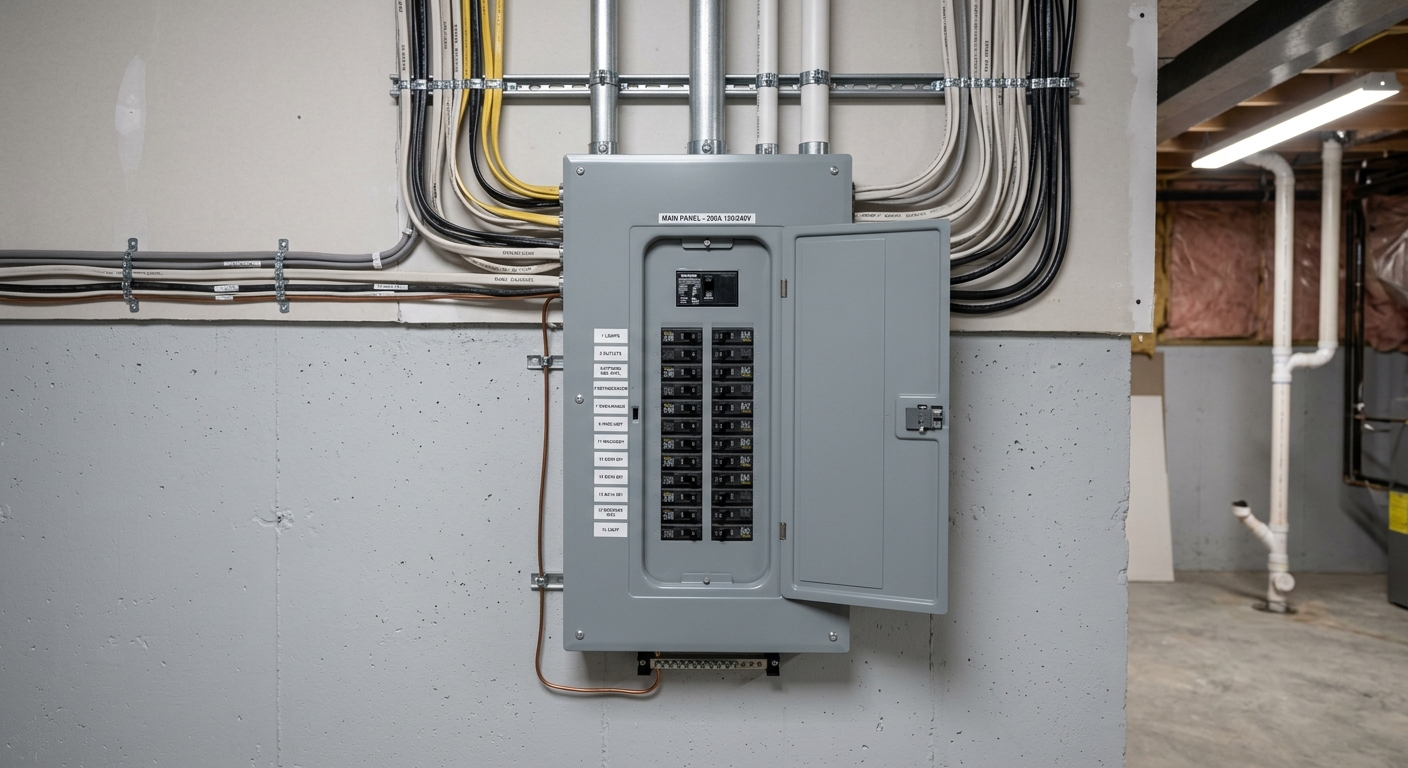
In Gibsons, electrical projects are often driven by the mix of older housing stock and today’s higher-power lifestyle. With 37.3% of homes built before 1981, many properties are prime candidates for panel work, obsolete wiring removal, and safety upgrades before renovations or during insurance renewals. That timing matters in a place like Gibsons—many single-detached homes are older, and the electrical system may not have been designed for modern loads such as electric vehicle (EV) charging and electric heat. (Source: Statistics Canada, 2021 Census)
Lower Mainland–Southwest market conditions also shape costs. Trades availability can be tighter during peak permitting and inspection windows, and older neighbourhoods around Upper Gibsons and Pratt Road often involve slower access (driveway lengths, overhead service runs, and landscaping obstacles). In the same region, it’s common to replace knob-and-tube and aluminum branch circuits, then upgrade services from 60–100A to modern 200A so the panel can safely handle EV charging plus heating and kitchen loads.
Weather plays a role too. Coastal conditions and frequent storms increase the likelihood of maintenance items (loose terminations, moisture-related issues in older splices, and nuisance faults) being discovered during service calls. As EV adoption accelerates, you’ll also see a surge in Level 2 charger permit applications, which often triggers circuit upgrades or, in older homes, a panel or service capacity review. The result: the same end goal—“more power”—can land in different price tiers depending on what the electrician finds. Use the table below as a practical comparison for typical Gibsons service ranges.
| Service |
Why It's Needed |
Permit Required |
Price Range |
| Panel upgrade — 100A to 200A service |
Adds safe capacity for today’s loads (EV charging, electric heat, modern kitchen appliances) and improves fault-current protection. |
Yes (service equipment and panel changes require permits and inspection) |
$1,800–$4,500 |
| EV charger installation (Level 2, 40–50A) |
Provides faster home charging with code-compliant breakers and wiring suited to the charger’s demand. |
Yes (new dedicated circuit and charger connections) |
$900–$2,500 |
| Knob-and-tube wiring removal and replacement |
Obsolete wiring method often cannot meet modern safety expectations; replacement reduces fire risk and insurance/resale friction. |
Yes (rewiring and circuit alterations) |
$8,000–$20,000 |
| Aluminum wiring remediation (CO/ALR connectors) |
Approved connectors and verified terminations address oxidation and connection reliability for aluminum branch circuits. |
Yes (altering/repairing wiring and terminations) |
$1,800–$6,500 |
| New dedicated circuit (HVAC, appliance, hot tub) |
Dedicated feed improves performance and safety for high-load equipment and reduces nuisance trips. |
Yes (new circuits typically require permits and inspection) |
$1,200–$3,800 |
| Whole-home rewire (older home, full replacement) |
When multiple circuit types and wiring methods are mixed, full replacement standardizes safety and future-proofs loads. |
Yes (major rewiring requires permits and inspection) |
$12,000–$28,000 |
Prices are estimates only and vary by project scope, site access and material selection.
What affects the price of electrical work in Gibsons
Across Lower Mainland–Southwest and across British Columbia overall, the same electrical request can swing 30–50% depending on what’s hidden behind walls and what capacity work is triggered. The dominant cost driver is the age of the housing stock. In many Gibsons homes built before 1950, you may find knob-and-tube wiring that insurance companies increasingly scrutinize, which pushes projects toward removal rather than patch repairs. Homes from the 1960s–70s often have smaller 60A or 100A panels; those can be inadequate for today’s simultaneous loads—think EV chargers, heat pumps, and induction cooking.
Aluminum wiring is another major factor. In homes from about the mid-1960s through the 1970s, aluminum branch circuits may require licensed remediation using approved CO/ALR connectors—or sometimes full replacement if condition is poor. At the same time, EV adoption is increasing the number of Level 2 charger permit applications, and that can change the design: a 40A circuit versus a 50A circuit affects cable sizing and breaker selection, and may force a panel upgrade if the service is already near capacity.
Concrete examples in Gibsons: (1) If you’re adding a hot tub circuit to a home with a 60A service, the job may stay in the $1,800–$4,500 panel/service band because the electrician must address capacity first. (2) If your wiring mix includes knob-and-tube plus aluminum splices, expect rewiring to move toward the $8,000–$20,000 range rather than a simple circuit add, because each obsolete method must be brought up to code properly.
| Price Factor |
Why It Matters |
Cost Impact |
| Panel size upgrade — 100A to 200A is the standard minimum today |
Determines how much additional load you can safely run without repeated trips and overload. |
$1,800–$4,500 |
| Wiring type — copper vs. aluminum remediation vs. K&T removal |
Obsolete or corrosion-prone wiring methods increase labour and material needs. |
$1,800–$20,000 |
| Number of new circuits — each adds material and labour time |
Every circuit requires conductors, breakers, termination work, and often wall/route labour. |
$1,200–$6,000+ |
| Permit + ESA/TSBC inspection fee — mandatory for all major work |
Inspections are required for panel changes, new circuits, and rewiring; scheduling affects labour flow. |
$150–$600 |
| Labour rate for licensed electricians — journeyman rates in region |
Older homes often need longer tracing, testing, and careful terminations. |
$900–$4,000 |
| EV charger amperage — 40A vs. 50A circuit affects cable and breaker cost |
Higher amperage can require heavier cable and a different breaker setup. |
$100–$600 |
| Emergency or after-hours premium |
Storm-related callouts and urgent diagnostics cost more due to scheduling and overtime. |
$200–$800 |
| Load calculation required for service upgrade |
Verifies capacity needs to justify service/panel changes safely under code. |
$200–$600 |
Permits & regulations in British Columbia
In British Columbia, ALL electrical work beyond changing a light bulb must be performed by a licensed electrician. That includes panel upgrades, new circuits, EV charger installations (since they require dedicated wiring and breakers), rewiring work, and any service change. Permits are also required for most of the “hidden” work homeowners often forget to budget for—new branch circuits, modifications to existing circuits, and replacement of major equipment. Once the work is complete, the permitted electrical work must pass inspection by the provincial electrical safety authority, which in BC is administered through Technical Safety BC. (For the exact inspection process on your permit, your electrician will arrange the submission and inspection booking.)
What typically doesn’t require a permit: simple fixture swaps that don’t alter wiring methods or change connections beyond what the existing box supports (for example, replacing a matched light fixture with the same wiring arrangement). What does require a permit: anything involving breakers, panel/service equipment, concealed wiring runs, knob-and-tube removal, aluminum remediation work that changes terminations, and any new dedicated circuit.
To verify a contractor in Gibsons, ask for (1) proof of BC electrical licence/registration (commonly checked online through the provincial registry), (2) a current certificate of insurance (liability) naming you as additional insured where appropriate, and (3) confirmation of WSIB coverage (and/or applicable coverage where required). You should also receive a clearance letter or documentation tied to the work and permit, and keep it for resale or insurance. Never start major work until you’ve verified these items in writing.
When your Gibsons home needs an electrical upgrade
If you live in Gibsons, the signs your electrical system needs attention are usually about safety and capacity—not style. Start with breakers that trip regularly. That’s often a sign your panel or circuits are overloaded or that there’s a failing connection. Next, knob-and-tube wiring is a key concern in older homes: it’s not just “because it’s old.” The issue is insulation condition and modern connection reliability, and it can create insurance and compliance problems when you sell or renew.
Then check your service size. If you’re on a 60A or 100A panel, you may feel it immediately when you add EV charging or run electric heat and large appliances at the same time. In that situation, a 200A upgrade is the standard solution because it gives you safer headroom and cleaner fault protection. Aluminum wiring in pre-1976 construction is another common finding. It’s not automatically an emergency if it’s been maintained, but it should be evaluated by a licensed electrician and often remediated using approved CO/ALR connectors or replacement where terminations are compromised.
Finally, insufficient outlets (extension cords everywhere) and missing AFCI/GFCI protection can surface as a code-compliance issue during inspections at resale. Coastal conditions in the Lower Mainland–Southwest can also accelerate deterioration in older concealed splices, so planned upgrades can be justified sooner rather than later.
For example, if you’re offered two paths—adding a single EV circuit versus upgrading service capacity—the upgrade may cost more up front, but it prevents repeated nuisance trips and can reduce future rework. A typical panel/service upgrade sits in the $1,800–$4,500 band, and it can be the difference between a straightforward install and a larger multi-day project when capacity is insufficient.
| Warning Sign |
What It Means |
Recommended Action |
Urgency |
Price Band |
| Breakers trip frequently |
Often indicates overload, nuisance tripping, or connections not operating reliably under load. |
Have an electrician test circuits and check load; consider panel capacity review. |
Planned soon |
$900–$3,800 |
| Knob-and-tube wiring present |
Obsolete method with safety/insurance and connection reliability concerns. |
Plan removal and replacement of affected circuits; consider whole-home approach if widespread. |
Planned immediately |
$8,000–$20,000 |
| 60A or 100A panel (inadequate load capacity) |
May not support modern simultaneous loads and EV charging without frequent issues. |
Upgrade to 200A service/panel with a load calculation. |
High priority |
$1,800–$4,500 |
| Aluminum wiring (pre-1976 construction) |
Can develop connection issues unless terminations are done correctly and maintained. |
Inspect and remediate with approved CO/ALR connectors or replace wiring where needed. |
Planned soon |
$1,800–$6,500 |
| Insufficient outlets — extension cords everywhere |
Improper temporary powering increases risk and can overload circuits. |
Add receptacles and, where required, add dedicated circuits for heavy-use devices. |
Planned |
$1,200–$3,800 |
| No AFCI or GFCI protection where required |
Higher shock/fire risk and potential code issues during inspections and resale. |
Upgrade protection devices and update affected circuits to comply. |
Planned |
$200–$800 |
How to choose a electrical work contractor in Gibsons
Choosing a contractor in Gibsons starts with verification. First, confirm the electrician is properly licensed in British Columbia; ask for their licence number and double-check via the provincial online registry. Next, request proof of liability insurance and ensure it’s current and appropriate for the job scale. For coverage, confirm WSIB/WCB status as applicable (your contractor should be able to provide documentation on request). If they hesitate or only provide verbal assurances, that’s a warning sign.
Get 2–3 itemised written quotes. The best quotes separate labour from materials and list major components (panel model, breakers, EV charger make/model if applicable, cable type, disposal, and any testing). Avoid “lump sum only” pricing for major work like a service change or knob-and-tube removal, because the scope often expands after opening walls.
Read the scope carefully: does the permit application and inspection scheduling get pulled into the price, or billed separately? Is debris/disposal included, and are there protections for flooring and landscaping? Ask about warranty: workmanship warranty length, manufacturer warranty coverage, and whether any product warranty transfers if you sell your home. For payment scheduling, never pay more than 10–15% upfront; hold back remaining funds until the job is complete, inspected (where required), and cleaned up.
Finally, insist on a timeline in writing—start date, expected milestones, and estimated completion. In the Lower Mainland–Southwest, inspection availability can affect schedule, so having realistic dates protects you from avoidable delays.
- Licence number and BC registration confirmed before work starts
- Certificate of liability insurance provided and current
- WSIB/WCB coverage confirmation documentation where applicable
- Permit handling clearly stated (included vs separate)
- Itemised quote (labour, materials, testing, disposal)
- Scope exclusions listed (what’s not included)
- Expected inspection process and responsibility explained
- Workmanship warranty stated in writing
- Manufacturer warranty details and whether it transfers
- Payment schedule capped at 10–15% upfront; holdback plan
- Start date and completion estimate in writing
- Client communication plan for discoveries behind walls
In Gibsons, red flags include: (1) quoting a panel/service upgrade without confirming the home’s existing wiring condition and capacity requirements; (2) refusing to provide permit/inspection details for major work; (3) asking for large deposits (more than 10–15%); (4) offering only lump-sum pricing without an itemised scope; and (5) dismissing aluminum or knob-and-tube concerns without an inspection and proper remediation plan.
Frequently asked questions — electrical work in Gibsons
How much does an electrician cost in Gibsons?
In Gibsons, your electrician’s “cost” is usually made up of labour time plus materials plus any permit/inspection fees. For many common jobs, you’ll typically see project pricing land in ranges like $900–$2,500 for EV-related add-ons or smaller dedicated circuit work, while larger capacity and safety projects move higher—often around the $1,800–$4,500 band for panel or service upgrades. Because 37.3% of homes were built before 1981, older wiring conditions can add tracing time, extra testing, and sometimes rewiring or remediation. (Statistics Canada, 2021 Census) Permits are mandatory for major work, and inspection scheduling can affect labour flow across the Lower Mainland–Southwest.
How much does a panel upgrade cost in Gibsons?
A panel upgrade in Gibsons typically means moving from an older service size (like 100A) to a modern setup that can safely handle current loads, often to 200A minimum. In the Lower Mainland–Southwest, a typical panel/service upgrade estimate sits in the $1,800–$4,500 range, depending on whether additional work is required (service mast adjustments, breaker changes, grounding updates, or load calculations). Older homes—especially those with mixed wiring methods—may require extra time to ensure connections are done correctly and compatible with modern equipment. Permits and inspection are part of the process for service/panel changes in British Columbia through the province’s safety system.
Do I need to upgrade to a 200A panel?
You might, but the decision should be based on a load calculation and what you’re adding. In Gibsons, 200A is commonly the standard solution when you’re planning Level 2 EV charging, adding heat-pump loads, or dealing with existing undersized services (many older homes are on 60–100A). If your panel is already near capacity, upgrading to 200A can prevent repeated breaker trips and reduce the odds of future rework. That said, if your current service has capacity and the wiring is in good condition, your electrician may be able to add a properly designed dedicated circuit instead. In practice, many EV and heat-related upgrades end up requiring a service review because safe fault-current compliance depends on the whole system, not just the new breaker.
How much does an EV charger installation cost in Gibsons?
For a Level 2 EV charger installation in Gibsons, typical pricing falls in the $900–$2,500 range. The range reflects charger type, the amperage of the dedicated circuit (often 40A or 50A), the cable run length, trenching/wall access complexity, and whether your panel has spare capacity. Many homeowners discover that the charger requires not just a new circuit, but also a panel/service capacity check; that’s where costs can rise toward the $1,800–$4,500 band if a service upgrade is needed. All permitted electrical work for EV chargers requires inspection in British Columbia, so your quote should include the permit process and testing.
What is knob-and-tube wiring and should I replace it?
Knob-and-tube (K&T) wiring is an older wiring method commonly found in homes from the early-to-mid 20th century. The main issue isn’t just age; it’s that the original insulation and routing methods don’t match modern installation expectations, and the system is harder to verify for safe performance when walls are opened or when new loads are added. In Gibsons and across British Columbia, K&T also causes headaches for insurance and resale because insurers and inspectors may not accept it as-is. If you have it, replacement is often the safest long-term approach—especially if you’re adding new circuits or upgrading your service. The cost can be substantial because it usually becomes a rewiring project, often in the $8,000–$20,000 band depending on how widespread it is and what must be replaced.
Is aluminum wiring safe in older Gibsons homes?
Aluminum wiring can be safe when it has been properly installed and maintained, but it requires careful handling. In many older Gibsons homes (particularly those built in the aluminum-wiring era), the concern is connection reliability over time—oxidation at terminations and improper devices can create heat and reduce safety margins. If your home has aluminum branch circuits, a licensed electrician should inspect terminations and assess whether remediation is needed. Often, approved CO/ALR connectors and properly executed repairs can address the issue without full replacement, with typical remediation budgets in the $1,800–$6,500 range depending on the scope. If you’re upgrading to EV charging or a new panel, aluminum evaluation becomes even more important because every new connection must be compatible with modern code requirements in British Columbia.