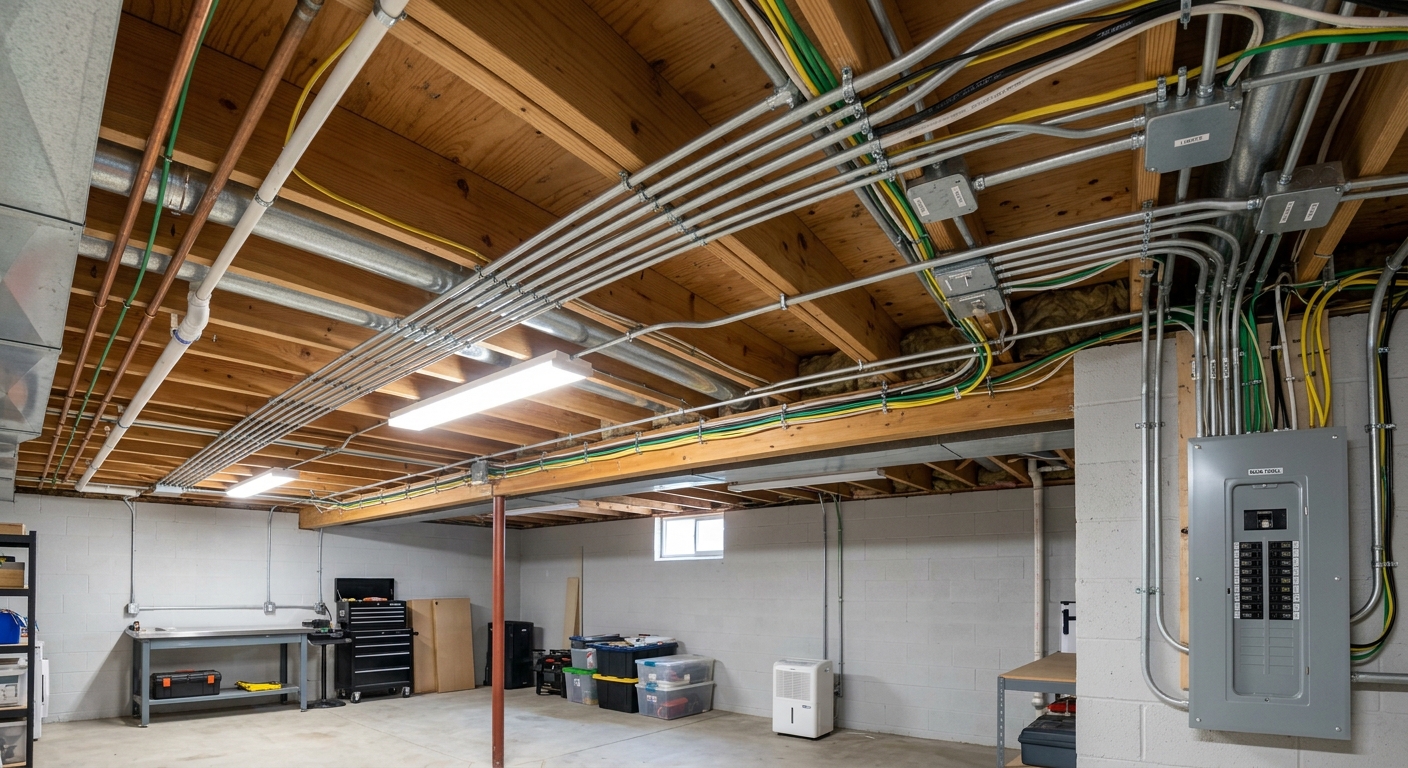
Electrical services and costs in Mission
Electrical services in Mission, British Columbia are shaped by the reality that many homes were built long before today’s load demands. In Mission’s Lower Mainland–Southwest area, 42.4% of homes were built before 1981, which often means older panels, dated wiring types, and service sizes that need modernization for modern kitchens, laundry, heat, and EV charging. Mission’s housing mix also leans heavily toward single-detached homes (64.7% of dwellings), so upgrades are commonly whole-home in scope rather than limited to a single room.
Costs in Mission are also influenced by how Lower Mainland–Southwest work is scheduled and accessed. Tight neighbourhood layouts and frequent driveway constraints around areas like Albion–Mission Junction can slow truck access, increase time on site, and raise labour costs compared with more open rural servicing. On top of that, many homeowners in this region rely on electric baseboard or electric furnace heat, which increases steady winter demand and makes older 60–100A services struggle—especially when you add a Level 2 EV charger. In practice, that’s why panel upgrade and service work is often required alongside EV installations.
Where you see the biggest quote differences is when contractors have to remove knob-and-tube wiring, remediate aluminum branch circuits, or perform a full load calculation before sizing a new 200A service. If you’re planning an EV charger, an electrical upgrade is usually the safest first step to avoid repeated breaker trips, nuisance outages, or a rushed change later. Use the table below to compare common electrical projects and what typically triggers permits and inspection time.
| Service |
Why It's Needed |
Permit Required |
Price Range |
| Panel upgrade — 100A to 200A service |
Add capacity for EV charging, electric heat demand, and modern kitchen loads; brings equipment up to current safety requirements. |
Yes (service equipment change + inspection) |
$1,800 – $4,500 |
| EV charger installation (Level 2, 40–50A) |
Provides faster charging while remaining within circuit/breaker limits; often triggers load calculation and sometimes a service/panel upgrade. |
Yes (new dedicated circuit + charger work) |
$900 – $2,500 |
| Knob-and-tube wiring removal and replacement |
Knob-and-tube is obsolete and can fail insurance/safety requirements; replacement reduces risk from aged insulation and improper connections. |
Yes (major wiring alteration + inspection) |
$8,000 – $20,000 |
| Aluminum wiring remediation (CO/ALR connectors) |
Aluminum branch circuits require approved connection methods to reduce overheating and improve reliability. |
Yes (wiring modification + inspection) |
$8,000 – $20,000 |
| New dedicated circuit (HVAC, appliance, hot tub) |
Prevents overload on existing circuits and supports equipment that needs stable power. |
Yes (new circuit + inspection) |
$1,200 – $3,900 |
| Whole-home rewire (older home, full replacement) |
Addresses multiple circuits, safety-critical routing, and overall code compliance for today’s loads and protection requirements. |
Yes (full rewiring + inspection) |
$14,000 – $28,000 |
Prices are estimates only and vary by project scope, site access and material selection.
What affects the price of electrical work in Mission
In the Lower Mainland–Southwest, homeowners often see the same electrical job priced 30–50% differently depending on the contractor’s approach, the permitting pathway, and what’s found once the walls or panel are opened. That spread shows up across British Columbia because costs depend on local labour availability, inspection sequencing, and how much “hidden work” exists in older homes. Mission’s homeowner base is also large enough that electricians can be booked out during peak renovation months, which can add urgency labour premiums for time-sensitive installs.
The dominant cost driver is housing age. In Mission, a meaningful share of homes were built before 1981, and those properties frequently contain knob-and-tube wiring and/or undersized 60–100A panels. Homes with knob-and-tube often require removal plus replacement to meet safe modern connection standards, and insurance requirements can push this sooner rather than later. Homes built in the 1960s–70s commonly have 60A or 100A services and sometimes aluminum branch wiring; today’s typical electrified loads—EV chargers (40–60A circuits), heat pumps or electric furnaces, and high-demand appliances—can push panels beyond what a basic upgrade can solve. Aluminum wiring remediation with approved CO/ALR connectors or full replacement is labour-intensive but often less disruptive than a full rewire, depending on how widespread the aluminum runs are.
Concrete examples: (1) If an EV charger install needs a panel upgrade, you’ll usually move from the EV charger band (about $900 – $2,500) into the service upgrade band (about $1,800 – $4,500), plus wiring labour. (2) If a job is constrained by tight access in older neighbourhoods like areas near Mission Junction, labour time and material handling increase. (3) A load calculation that reveals insufficient capacity can change breaker and feeder sizing, which impacts both materials and inspection requirements.
| Price Factor |
Why It Matters |
Cost Impact |
| Panel size upgrade — 100A to 200A is the standard minimum today |
Ensures enough capacity for EV charging and winter heating loads without nuisance trips. |
Often adds major cost; commonly falls in the $1,800 – $4,500 band |
| Wiring type — copper vs. aluminum remediation vs. K&T removal |
Aluminum and knob-and-tube are more time-consuming and require approved methods or replacement. |
Can shift you toward $8,000 – $20,000 depending on scope |
| Number of new circuits — each adds material and labour time |
New circuits require cable, breakers, testing, and often additional rough-in work. |
Extra circuits can add hundreds to thousands based on run length and finish access |
| Permit + ESA/TSBC inspection fee — mandatory for all major work |
Permits ensure the work meets code and is safe; inspections verify compliance. |
Increases overall total even when labour is straightforward |
| Labour rate for licensed electricians — journeyman rates in {region} |
Rates reflect complexity, experience, and local demand across Lower Mainland–Southwest. |
Higher demand windows can push bids toward the top end of bands |
| EV charger amperage — 40A vs. 50A circuit affects cable and breaker cost |
Higher amperage can require heavier cable and breakers, plus a revised load plan. |
Often nudges the EV install toward the upper end of $900 – $2,500 |
| Emergency or after-hours premium |
Scheduling outside normal hours increases crew costs and reduces material flexibility. |
Can add a noticeable premium for urgent safety fixes |
| Load calculation required for service upgrade |
Determines correct service size and breaker arrangement before approval. |
Can add professional time and affects final equipment/material selection |
Permits & regulations in British Columbia
In British Columbia, all electrical work beyond changing a light bulb must be completed by a licensed electrician. That includes panel upgrades, adding new circuits, rewiring, and installing or modifying service equipment (including anything required for an EV charger circuit). Permits are required for these types of work because it must meet the BC Electrical Code and pass inspection by the provincial electrical safety authority (commonly Technical Safety BC). DIY electrical is prohibited for most work; homeowner exceptions are narrow and still typically require permits and inspections for the work that’s permitted.
What typically does require a permit in Mission includes: replacing a breaker, adding or moving outlets (new circuits), installing a dedicated circuit for an appliance/hot tub, rewiring sections of a home, and upgrading service/panels. What typically does not require a permit is usually limited to like-for-like replacements that do not alter circuits—such as swapping a fixture with an identical, pre-existing connection or replacing a clearly identified lamp or receptacle faceplate, assuming the receptacle itself is not being rewired or relocated.
To verify your contractor in Mission: (1) Check the electrician/company licence in the BC public registry for the correct licence class and company authorization. (2) Request a certificate of insurance and confirm liability coverage limits; ask whether it includes work at residential premises. (3) Ask for WSBC/WCB clearance documentation where applicable. (4) Ensure the permit will be pulled under the electrician’s profile and that the plan includes inspection scheduling. Don’t proceed if any of these items are missing.
When your Mission home needs an electrical upgrade
Mission homeowners usually notice electrical problems in everyday ways, but the warning signs can point to safety-critical issues rather than simple “wear and tear.” First, breakers that trip frequently—especially when using space heaters, hair dryers, an oven, or charging an EV—often means an overloaded circuit or an outdated panel/circuit layout. Second, knob-and-tube wiring is the red flag: the concern isn’t only age; it’s the deteriorating insulation and connections that can fail under stress and can raise insurance and safety issues.
Third, pay attention to whether you’re on a 60A or 100A service. In Mission’s Lower Mainland–Southwest climate and typical household setup, it’s common to run more continuous electrical load in winter (electric baseboard or electric furnace heat), then add modern demand like Level 2 EV charging and high-efficiency induction cooking. If you’re trying to run all of that at once, a 200A upgrade is often the standard, future-proof solution. Fourth, aluminum wiring (more common in pre-1976 construction) isn’t automatically “dangerous” if maintained, but it requires licensed remediation using approved CO/ALR connectors or replacement where necessary. Fifth, insufficient outlets and missing protection (no AFCI/GFCI where required) can become a code-compliance and resale issue—often visible during an inspection at home sale.
Which needs immediate action versus planned upgrade? If you see heat damage, burning odours, frequent nuisance trips, or arcing at a panel, treat it as urgent. If the issue is capacity or aging protection, schedule a planned upgrade so you can coordinate permits and, if needed, utility timelines. For example, choosing a panel upgrade within the $1,800 – $4,500 service band can prevent costly repeat visits later when an EV charger installation (often $900 – $2,500) otherwise can’t be safely accommodated on an undersized service.
| Warning Sign |
What It Means |
Recommended Action |
Urgency |
Price Band |
| Breakers trip frequently |
Possible overload, undersized circuits, failing breakers, or unsafe load distribution on an older panel. |
Licensed troubleshooting, load assessment, and correction (often new circuits or panel/service capacity review). |
Urgent to schedule |
$1,200 – $4,500 |
| Knob-and-tube wiring present |
Obsolete wiring method with aged insulation and unsafe connection practices. |
K&T removal and replacement plan; prioritize circuits feeding critical loads and EV/heat circuits. |
Safety-critical—schedule promptly |
$8,000 – $20,000 |
| 60A or 100A panel (inadequate load capacity) |
Not enough capacity for today’s simultaneous loads in an electrified home. |
Load calculation and upgrade to 200A service where required. |
Planned upgrade (sooner if you have EV plans) |
$1,800 – $4,500 |
| Aluminum wiring (pre-1976 construction) |
Higher risk of overheating at terminations if not properly remediated with approved methods. |
CO/ALR connector remediation or targeted replacement; confirm with testing and inspection. |
Planned upgrade |
$8,000 – $20,000 |
| Insufficient outlets — extension cords everywhere |
Improper temporary power use increases trip/overload risk and can hide circuit capacity problems. |
Add outlets and (if necessary) new dedicated circuits for high-demand appliances. |
Schedule |
$1,200 – $3,900 |
| No AFCI or GFCI protection where required |
Lack of modern protection increases risk from damaged cords/wiring and shock hazards. |
Update receptacles/breakers to meet required protection and improve safety. |
Planned upgrade |
$200 – $800 |
How to choose a electrical work contractor in Mission
Choosing the right electrical contractor in Mission starts with verification. First, confirm British Columbia licensing for the electrician/company: the licence should match the scope you’re hiring for (service equipment changes and rewiring require appropriate qualifications). Next, request proof of liability insurance (certificate of insurance) and make sure the coverage is valid for work at your address. For coverage related to work crews, ask for WSBC/WCB documentation and keep a copy for your records.
Then get 2–3 itemised written quotes—not just a lump sum. A good quote lists labour, materials, and major components (for example, the breaker and panel/service equipment allowances, cable quantities, and any connector parts for CO/ALR remediation). Make sure the scope clarifies what’s excluded: drywall patching, permit pull responsibility, disposal of old breakers/wiring, and whether site restoration is included or billed separately. Confirm whether permit fees and inspection scheduling are included in the estimate or billed as add-ons.
Warranty matters. Ask for a workmanship warranty length and whether product warranties transfer to you for installed components. Payment should be structured responsibly: don’t pay more than 10–15% upfront, and hold back a portion until completion and final inspection (when applicable). Finally, request a written timeline with the estimated start date and completion window, especially if utility coordination or a service mast is involved.
- Licence verified in BC public registry before signing
- Certificate of insurance provided and current
- WSBC/WCB clearance or documentation requested
- Quote is itemised (labour + materials), not one total
- Permit pull responsibility stated clearly
- Inspection scheduling included (or explicitly excluded)
- Scope notes what happens to removed wiring/equipment (disposal included?)
- Restoration details noted (patching, painting, wall access)
- Warranty on workmanship stated in writing
- Product/manufacturer warranty coverage explained
- Payment schedule uses a small deposit (10–15% max)
- Start date and completion estimate in writing
Red flags in Mission: (1) “No permit needed” claims for panel/service changes or new circuits, (2) refusal to provide licence/insurance documentation, (3) vague scopes like “fix the wiring” without load calculations or circuit plans, (4) asking for large upfront payments (over 20%) without a detailed contract, and (5) quoting only “materials allowance” without stating what exact components are included.
Frequently asked questions — electrical work in Mission
Can I do my own electrical work in British Columbia?
In British Columbia, most electrical work beyond very limited, like-for-like replacements must be done by a licensed electrician. That means jobs such as installing a new breaker, adding a new outlet circuit, rewiring portions of a home, or upgrading service/panel equipment generally require a permit and a licensed contractor. In Mission, where many homes were built before 1981, homeowners sometimes want to “tackle the wiring” to save money, but knob-and-tube removal, aluminum remediation, and any service change are not DIY-friendly because they must be inspected and meet code requirements under the provincial electrical safety framework (commonly overseen by Technical Safety BC). A safe rule of thumb: if the work changes circuits, connections, or equipment, assume you need a permit and a licensed electrician.
How long does a rewiring job take?
The timeline for a rewiring job depends on how much of the home needs replacement, access conditions, and whether the work is a partial replacement (targeted circuits) or a whole-home rewire. In a Mission detached home with older wiring, a partial rewiring might be completed in several days to a couple of weeks, while a full rewire often takes longer because crews must open walls/ceilings, run new cable, label and test circuits, and coordinate inspections. Permit and inspection scheduling under British Columbia requirements can add a few extra days. If you’re also upgrading to a modern service (for capacity for EV charging and winter heat demand), that coordination can extend the schedule. When planning around renovation timelines, ask your electrician for a written start/completion estimate and the inspection dates or expected inspection windows.
Why do my breakers keep tripping?
Breakers that trip repeatedly usually indicate either overload, a faulted circuit/device, or an outdated setup that can’t handle today’s loads. In Mission’s Lower Mainland–Southwest market, many homes run higher continuous demand in winter due to electric baseboard or electric furnace heat, and then add other loads like an EV Level 2 charger or modern kitchen appliances. If you’re on an older 60A or 100A service, the load may exceed what the panel layout can safely accommodate, even if each individual appliance seems “reasonable.” Trips can also happen from bad terminations, especially in aluminum wiring circuits common in pre-1976 construction. Treat frequent trips as more than nuisance: plan a licensed troubleshooting visit. Depending on findings, you may need a service upgrade (often in the $1,800 – $4,500 band) or targeted circuit corrections.
How do I compare electrical quotes?
To compare electrical quotes in Mission, ask for itemised labour and materials breakdowns rather than lump sums. Check whether each quote includes the same scope items: permit pull, inspection scheduling, testing, disposal of removed wiring or old breakers, and any required restoration. Confirm whether each contractor performed or included a load calculation for service upgrades—this is critical when EV charging and winter heating loads are part of your plan. Quotes can vary by 30–50% across the Lower Mainland–Southwest because crews price hidden conditions differently, especially in older homes (Mission has a substantial share built before 1981). Also verify what price band each job is matching: a panel/service upgrade is typically around $1,800 – $4,500, while wiring replacement can land in the $8,000 – $20,000 range. If two bids don’t match scope details, they’re not truly comparable.
How long does a panel upgrade take in Mission?
A panel upgrade timeline is usually shorter than rewiring but depends on the existing service condition, access, and inspection scheduling. In many detached homes in Mission, the core electrical work can take a day or two, while inspections and permit processing can extend the overall project window. If your installation also includes a service change that requires coordination with BC Hydro (for example, mast or service equipment updates), expect additional scheduling time. Weather can affect access and safe working conditions, and older homes may require extra time for safe termination of conductors or remediation of problematic wiring sections. If your panel upgrade is part of a larger plan—like adding a Level 2 charger (often in the $900 – $2,500 band)—your electrician should explain the sequence so you don’t end up with extra labour re-running circuits. Ask for a written schedule including inspection day expectations.
What is a GFCI outlet and where is it required in British Columbia?
A GFCI (Ground-Fault Circuit Interrupter) outlet is designed to quickly shut off power when it detects an imbalance between hot and neutral—helping reduce shock risk, especially in damp areas. In British Columbia, GFCI protection is required in specific locations under the electrical code, commonly including bathrooms, garages (in many cases), kitchens (where applicable to the circuit layout), basements depending on configuration, and outdoor or wet-area receptacles. Mission homes frequently have older outlet layouts, so it’s not unusual to discover missing or outdated protection during renovations or sale inspections. A typical “add GFCI” upgrade can be modest compared with a service change, often aligning with the $200 – $800 lighting/fixture-type band only if it’s limited to receptacle and breaker work; broader wiring corrections may push the project higher. A licensed electrician should check your existing circuit type and confirm exactly which receptacles/circuits require GFCI in your home.