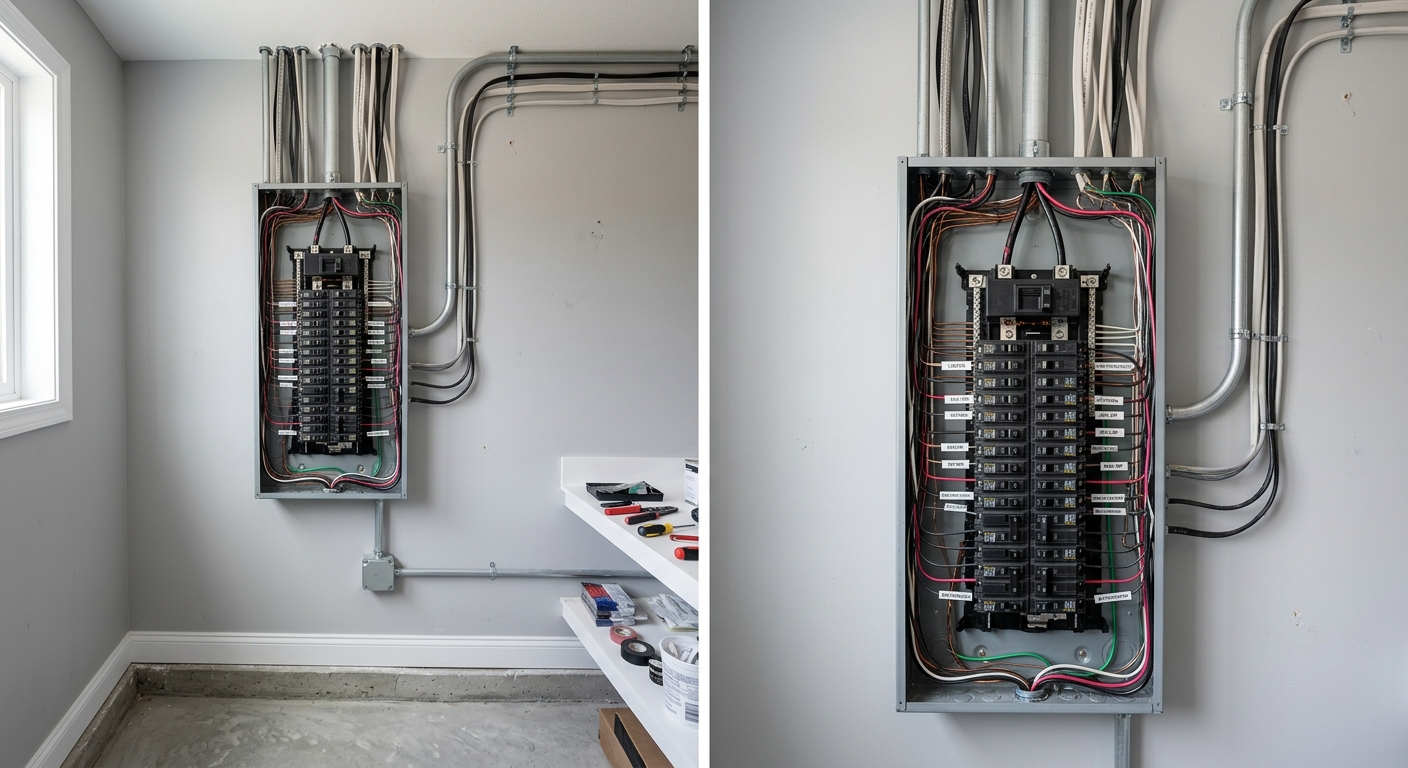
Electrical services and costs in Coldstream
Electrical work in Coldstream can swing widely in price because the area has a broad mix of housing ages. With 45.2% of homes built before 1981, many properties are prime candidates for panel upgrades, knob-and-tube removal, and aluminum-wiring remediation—work that’s more labour-intensive than straightforward upgrades. Coldstream’s roughly 11,171 residents live across 3,675 homeowner households, and most upgrades are driven by growing home loads rather than new construction. (Statistics Canada, 2021 Census)
In the Thompson–Okanagan, costs are also shaped by how often electricians have to travel between communities and schedule around permits and inspections. Winter in the Coldstream area can be cold enough that electric heat is a real base load, and that increases how quickly a 60A or 100A service becomes capacity-limited. Demand is especially noticeable around the older, established pockets near the village core and along the routes feeding commuter areas, where homeowners often modernize for EVs, heat pumps, hot tubs, and home-office loads. When load calculations show the need for more capacity, service work commonly becomes part of the “bundled” electrical plan, along with additional circuits and safety upgrades.
Below is a practical price comparison of the most common services homeowners request in Coldstream, so you can line up your scope with realistic budgeting before you get quotes.
| Service |
Why It's Needed |
Permit Required |
Price Range |
| Panel upgrade — 100A to 200A service |
Modern homes often need more capacity for EV chargers, heat pumps, kitchen loads, and electric heating run times. |
Yes (service/panel work) |
$2,500 – $6,000 |
| EV charger installation (Level 2, 40–50A) |
Adds a dedicated 240V circuit with the right breaker, wiring, and protection for reliable overnight charging. |
Yes (new circuit/EV equipment) |
$1,200 – $3,500 |
| Knob-and-tube wiring removal and replacement |
Older wiring can have brittle insulation and poor termination reliability; replacement brings the home to modern safety expectations. |
Yes (rewiring) |
$8,000 – $20,000 |
| Aluminum wiring remediation (CO/ALR connectors) |
Improves connections on CO/ALR terminations; sometimes the “best” fix is targeted remediation rather than full replacement. |
Often (rework to circuits/connections) |
$8,000 – $20,000 |
| New dedicated circuit (HVAC, appliance, hot tub) |
Reduces nuisance trips and supports higher continuous loads with the correct conductor size and protection. |
Yes (new circuit) |
$700 – $2,500 |
| Whole-home rewire (older home, full replacement) |
Needed when multiple wiring types, widespread K&T segments, or code-level deficiencies exist throughout the home. |
Yes (extensive rewiring) |
$12,000 – $30,000 |
Prices are estimates only and vary by project scope, site access and material selection.
What affects the price of electrical work in Coldstream
In Coldstream and across the broader Thompson–Okanagan, you can see the same basic electrical request quoted 30–50% differently depending on how much the electrician has to uncover and correct once they open walls, check existing wiring types, and run load calculations. That spread is common in British Columbia because permitting, inspection scheduling, and the practical need to coordinate travel time and labour availability across a wide region can add cost even when the “surface” job looks similar. Homes here are frequently older (and often retrofitted), which means the electrician’s time is spent diagnosing and bringing the installation up to modern safety expectations—not just swapping parts.
Housing stock age is usually the dominant driver. If you have wiring from before the widespread shift to modern standards, insurance and safety considerations often push owners toward knob-and-tube removal and full replacement in higher-risk areas. Homes from the 1960s–70s sometimes have 60A or 100A panels that were never sized for today’s combined loads; adding an EV charger and upgrading cooking or heating can tip the balance quickly. Aluminum wiring—more common in homes built roughly between 1965 and 1976—requires licensed remediation using approved CO/ALR connectors or, in some cases, a circuit-by-circuit replacement approach. Meanwhile, EV adoption is driving a surge in Level 2 charger permit applications, and that typically increases quote variability because service capacity may need review alongside the new circuit.
Concrete Coldstream examples: if your panel is a crowded 100A board with outdated breakers, a panel upgrade and circuit rework may move the job from a “simple breaker add” to a larger service plan. If your charger location requires trenching or long cable runs, an EV install may land closer to the upper end of the $1,200 – $3,500 band. Conversely, if you already have a safe, spare breaker space and a clear cable route, the job can stay near the lower range of typical wiring add-ons. These are also the reasons service upgrades that align with a $2,500 – $6,000 panel/service band can end up being the cost-effective option versus repeated smaller repairs.
| Price Factor |
Why It Matters |
Cost Impact |
| Panel size upgrade — 100A to 200A is the standard minimum today |
Insufficient capacity leads to oversized loads, nuisance trips, and safety concerns. |
Often adds major scope and brings you into the $2,500 – $6,000 range for service/panel work. |
| Wiring type — copper vs. aluminum remediation vs. K&T removal |
Different wiring types require different approved methods and additional inspection notes. |
Can shift a job from “targeted remediation” into full rewiring budgets (commonly $8,000 – $20,000). |
| Number of new circuits — each adds material and labour time |
Each circuit requires conductors, breakers, labelling, testing, and often new wall work. |
More circuits pushes material and labour higher; it also affects how quickly your panel becomes “fully allocated.” |
| Permit + ESA/TSBC inspection fee — mandatory for all major work |
Permits and inspections are required for service/panel work, new circuits, and rewiring. |
Typically adds a meaningful fixed cost on top of labour; you should see it itemized in the quote. |
| Labour rate for licensed electricians — journeyman rates in Thompson–Okanagan |
Licensed time is the real cost driver when openings, troubleshooting, and compliance testing are involved. |
Regional mid-range pricing plus travel can raise the total even when material costs are modest. |
| EV charger amperage — 40A vs. 50A circuit affects cable and breaker cost |
Higher amperage typically means larger conductors and may affect breaker and equipment costs. |
Can move an install toward the upper end of $1,200 – $3,500. |
| Emergency or after-hours premium |
Scheduling and after-hours labour are more expensive and sometimes require additional crew time. |
Often the fastest way to add 25%+ to labour. |
| Load calculation required for service upgrade |
Modern load needs are verified using calculations; panel upgrades aren’t “guesswork.” |
May add a small design/engineering line item but prevents rework and failed capacity assumptions. |
Permits & regulations in British Columbia
In British Columbia, ALL electrical work beyond changing a light bulb must be done by a licensed electrician. That includes panel upgrades, new circuits (for example, a garage outlet or an EV charger circuit), rewiring, and service upgrades. Permits are required for major work, and the completed work must pass inspection by the provincial electrical safety authority—Technical Safety BC. Homeowners still play an important role, but the practical rule is: DIY electrical is prohibited for most work, and the homeowner exceptions are narrow and do not typically cover service/panel work or branch-circuit additions.
What commonly requires a permit in BC: panel/service replacement or upgrades, adding dedicated circuits for appliances/hot tubs/EV chargers, any rewiring where circuit conductors are replaced, and work that affects safety devices (breakers, GFCI/AFCI protection where required, bonding/grounding). What typically does not require a permit: swapping a like-for-like LED bulb or receptacle cover that you’re not altering wiring for (still must be safe and de-energized; follow manufacturer instructions).
Step-by-step, here’s how a Coldstream homeowner can verify your contractor before work starts: (1) Confirm the electrician’s licence/registration via the provincial online registry (request the licence number and check it matches). (2) Ask for a certificate of insurance showing liability coverage and request it be current. (3) Ask about coverage for workplace injury—WSBC/WCB coverage is important for labour on site; don’t accept a vague “we’re insured.” (4) Make sure the permit is pulled under the electrician/company doing the work, and request the inspection documentation on completion.
When your Coldstream home needs an electrical upgrade
Electrical upgrades in Coldstream are often triggered by safety symptoms, not by aesthetics. Start with the warning signs that point to overloaded systems or wiring that can’t support today’s usage. If breakers trip regularly—especially when multiple appliances run—that’s frequently a sign of an overloaded panel, undersized wiring for the load, or a failing breaker situation that needs correction. Another high-priority concern is knob-and-tube wiring; the issue isn’t only “age,” but deteriorating insulation and contact reliability. In many older Thompson–Okanagan homes (and with 45.2% of Coldstream housing built before 1981), K&T is more than a nuisance—it’s a safety and risk-management problem that can surface during inspections and insurance conversations.
Service capacity is another common driver. A 60A or 100A panel may be adequate decades ago, but it can become insufficient once you add an EV charger, heat pump(s), an induction range, and electric heat during cold spells. In those cases, a 200A upgrade is usually the standard long-term solution because it restores room for modern breakers and proper future planning. Aluminum wiring in pre-1976 construction can be safe when connections are properly maintained, but it still needs licensed remediation—using approved connector methods—and careful testing. Finally, insufficient outlets (extension cords everywhere) and missing AFCI/GFCI protection are real code-compliance and safety red flags that often become visible at home sale or during renovation.
For urgency: breakers tripping and knob-and-tube present are typically “planned but prompt” (and sometimes urgent if there’s burning smell or arcing). Service capacity problems and missing protection are “planned upgrade” items that should be scheduled before you add more load. As a dollar example, investing in a panel upgrade that lands in the $2,500 – $6,000 band can be more cost-effective than repeatedly adding “patch” circuits that later force rewiring work or require a service change anyway.
| Warning Sign |
What It Means |
Recommended Action |
Urgency |
Price Band |
| Breakers trip frequently |
Often indicates overload, weak connections, incorrect breaker/circuit sizing, or issues with specific loads. |
Arrange a load assessment and inspect panel/breakers and affected circuits. |
Often immediate (schedule as soon as possible) |
$700 – $2,500 |
| Knob-and-tube wiring present |
Higher risk due to aging insulation and connection reliability concerns. |
Plan removal/replacement in affected areas or full rewire depending on extent. |
Planned but prompt |
$8,000 – $20,000 |
| 60A or 100A panel (inadequate load capacity) |
Capacity limits become obvious as you add EV charging and modern appliances/heat. |
Run load calculation and consider 200A service upgrade. |
Planned upgrade (before adding more load) |
$2,500 – $6,000 |
| Aluminum wiring (pre-1976 construction) |
Connections may loosen or oxidize over time; requires approved remediation methods. |
Have licensed remediation done using CO/ALR connectors and testing. |
Planned (but don’t ignore) |
$8,000 – $20,000 |
| Insufficient outlets — extension cords everywhere |
Increases risk of overloading and trip hazards; often a sign of circuit allocation issues. |
Add properly rated outlets/circuits and address load distribution. |
Planned |
$700 – $2,500 |
| No AFCI or GFCI protection where required |
Safety protection gaps can create shock/fire risk and can complicate resale/renovations. |
Upgrade receptacles/breakers to add required protection for the relevant areas. |
Planned |
$300 – $3,000 |
How to choose a electrical work contractor in Coldstream
Choosing the right contractor matters because electrical quotes aren’t just about materials—they’re about compliance, diagnostics, and how cleanly the job is documented for inspection. Start by verifying British Columbia licensing: ask for the licence number and confirm it through the provincial online registry. Next, request liability insurance documentation—ideally a certificate of insurance—and verify it covers residential work and remains current for the project dates. Finally, confirm workplace injury coverage (WSBC/WCB). A reputable Coldstream electrician will provide these without hesitation and will explain that permits and inspections are part of the work, not an add-on after the fact.
Get 2–3 itemised written quotes instead of a single lump sum. You want a line-by-line breakdown of labour and materials (breakers, cable, panel components, protection devices like GFCI/AFCI where needed) and a clear scope stating what’s included. Make sure you understand whether the permit is pulled by the electrician, whether TSBC inspection fees are included, and who handles disposal and drywall rework limitations (most electrical companies don’t patch drywall unless stated). Warranty matters too: ask for a workmanship warranty length and whether product warranties transfer to you (for example, panel and EV charger equipment warranties). For payment, never pay more than 10–15% upfront—hold back the remainder until the job is complete and tested. Also get a start date and completion estimate in writing, because service upgrades and EV installs can be delayed by inspection scheduling.
- Verify BC licence number matches the company name on the quote.
- Confirm liability insurance certificate is current and project-specific.
- Ask for WSBC/WCB coverage evidence for the crew.
- Get 2–3 itemised quotes (labour + materials), not lump sums.
- Confirm permit pull responsibility and whether inspection fees are included.
- Ensure load calculation is included if upgrading service size.
- Check whether disposal of old breakers/panel components is included.
- Clarify what areas may require access (attics, crawlspaces, panel location).
- Ask how they handle aluminum wiring areas (connector method vs replacement).
- Confirm testing and documentation (labels, photos, test results) will be provided.
- Confirm workmanship warranty duration and exclusions in writing.
- Use a payment schedule with a holdback until inspection passes.
Red flags in Coldstream include: refusing to provide licence/insurance details, quoting without a site visit (especially for K&T/aluminum work), using vague scopes like “electrical as needed,” promising “no permit required” for service/panel or EV charger work, and asking for large deposits (more than 10–15%) before any real work begins.
Frequently asked questions — electrical work in Coldstream
How much does an electrician cost in Coldstream?
In Coldstream, an electrician’s cost is usually driven by the amount of licensed labour time, how much wall/panel access is needed, and whether the work involves permits and inspection milestones. For straightforward additions (like a small number of outlets or a dedicated circuit), quotes often land in the mid-range of common residential electrical pricing; but service/panel and wiring-type work can be substantially higher because it includes troubleshooting, compliance testing, and sometimes panel/service changes. If your project is headed toward a panel/service upgrade, you’ll often budget within the $2,500 – $6,000 band for typical service/panel upgrades. For context, Coldstream’s older housing mix—where many homes were built before major modern standards—means contractors frequently spend more time verifying wiring types and capacity than they would in newer-only neighbourhoods. (Statistics Canada, 2021 Census)
How much does a panel upgrade cost in Coldstream?
A panel upgrade price in Coldstream commonly depends on whether it’s a like-for-like replacement or a true service increase (most often 100A to 200A), plus the complexity of the existing wiring and panel location. In the Thompson–Okanagan, many homeowners need this because modern loads are bigger than what older services were sized for—EV chargers, heat pumps, electric ranges, and electric baseboard/heating demand during cold months. Typical budgeting for service and panel work is often in the $2,500 – $6,000 range. If your job also includes additional circuits or extensive wiring remediation, the total project cost can move above that range because it becomes a larger electrical scope, not just a panel swap.
Do I need to upgrade to a 200A panel?
You may need a 200A upgrade if your load calculation shows your existing panel/service can’t accommodate modern usage with proper safety margins—especially when you plan for an EV charger and higher-demand appliances. In Coldstream, where many homes were built before 1981, it’s common to find 60A or 100A equipment originally sized for a different era of energy use. A 200A service also gives room for future additions, which reduces the chance of repeated “band-aid” work. Practically, an electrician should run a proper load calculation before recommending the change. If the calculation supports it, then 200A is usually the standard solution and aligns with budgeting in the $2,500 – $6,000 band for typical service/panel upgrades. If you only add a small circuit, you might not need 200A—this is why load testing matters.
How much does an EV charger installation cost in Coldstream?
Level 2 EV charger installation in Coldstream typically costs within the $1,200 – $3,500 band, depending on the amperage (often a 40–50A circuit), how far the wiring must run, and whether your panel/service has spare capacity. If your current service is marginal—common in older homes—your charger install may need to be paired with a panel upgrade to meet modern load requirements and avoid nuisance trips. That’s why you’ll sometimes see quotes that include both EV work and service/panel work, since permits and inspection requirements apply to both. Climate also plays a role indirectly: winter charging behaviour and simultaneous household loads can be higher during cold spells, making correct circuit sizing and protection more important than people expect.
What is knob-and-tube wiring and should I replace it?
Knob-and-tube (K&T) wiring is an older wiring method typically found in homes from earlier decades. The concern isn’t just that it’s old; it’s that insulation and connections can deteriorate, making the system less reliable and potentially increasing risk. In Coldstream and across British Columbia, K&T is treated more conservatively because modern electrical safety expectations require reliable insulation conditions and secure connections, and it can trigger insurance complications during underwriting. Whether you need full replacement depends on the extent of K&T, which circuits it serves, and what’s been modified over time. Many homeowners choose replacement because it’s the safest long-term path, and it also supports modern safety devices. When K&T removal becomes part of a bigger rewiring scope, projects often fall into the $8,000 – $20,000 range, depending on how much wiring must be replaced.
Is aluminum wiring safe in older Coldstream homes?
Aluminum wiring can be safe when it’s properly installed and when connections are remediated using approved methods. The issue historically is not that aluminum “must always fail,” but that connections can oxidize or loosen over time if they’re not made with the correct compatible devices and techniques. In Coldstream’s older housing stock (with a large share built before newer electrical standards became common), aluminum wiring remediation is a frequent request. A licensed electrician will inspect terminations, check condition, and determine whether CO/ALR connector remediation is appropriate circuit-by-circuit, or whether replacement is needed in higher-risk areas. If remediation is recommended, it should be done with the correct connectors and verified by testing. Depending on scope, remediation can move into the $8,000 – $20,000 range, especially when multiple circuits or combination wiring types are present.