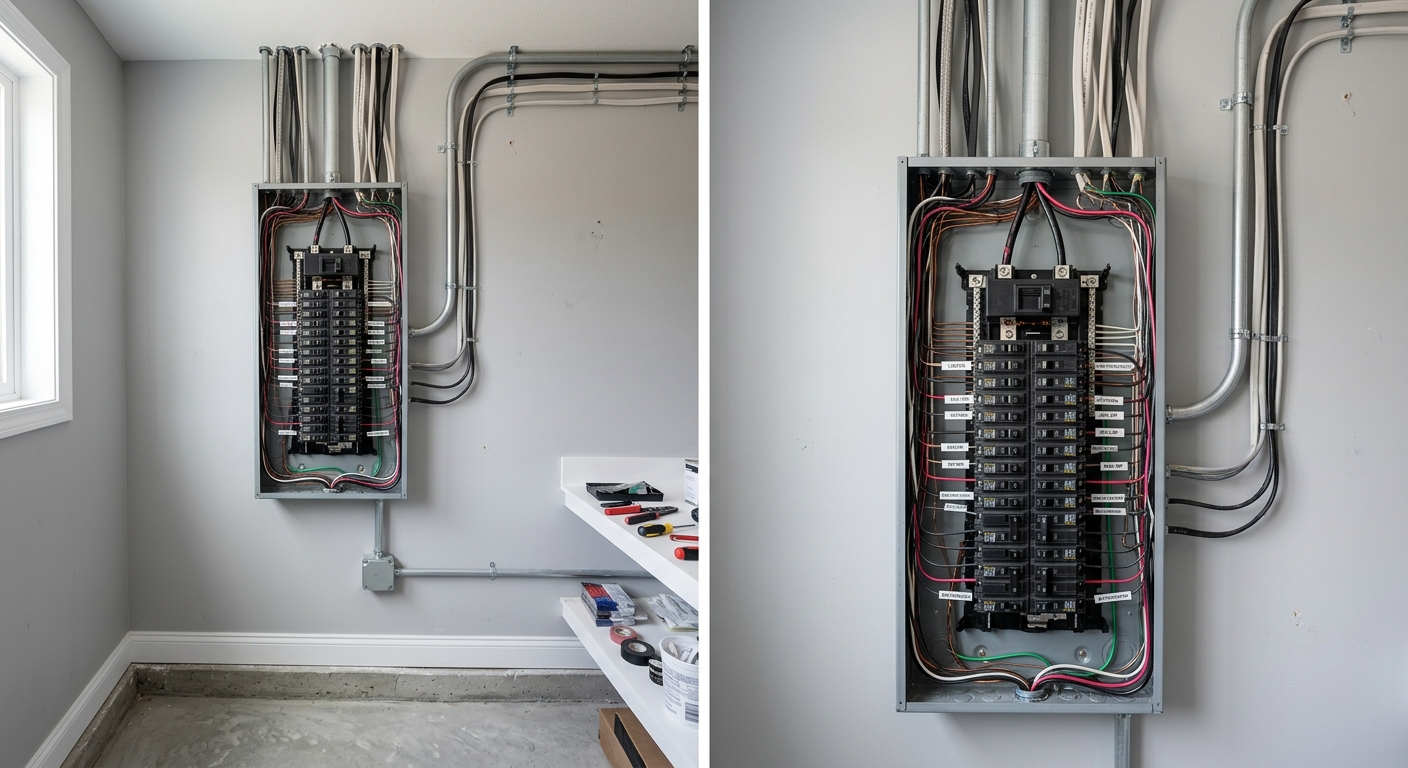
Electrical services and costs in Renfrew-Collingwood
Electrical services in Renfrew-Collingwood, British Columbia typically cost more than homeowners expect once you factor in permitting, older wiring upgrades, and service-capacity changes. With a population of 51,530 (Statistics Canada, 2021 Census), the area draws working electricians to neighbourhoods where older housing stock is common—especially around the Collingwood (north) and Renfrew (east) corridor, where many properties were wired for lighting-and-appliances decades ago. In many Lower Mainland–Southwest homes, electrical work centres on replacing knob-and-tube or addressing aluminium branch circuits, and a large share of older residences require moving from undersized services (often 60–100A) to modern 200A.
The Lower Mainland–Southwest market also shapes pricing because labour demand is higher in the region’s busier streets and tighter access conditions, and scheduling with BC Hydro may add coordination time when a mast/service change is needed. BC’s wet winters and frequent freeze-thaw in some lots can also reveal insulation and connection issues sooner, which pushes contractors toward more complete corrective work instead of quick fixes. EV charging is another cost driver: Level 2 chargers frequently require a dedicated breaker/circuit and, in under-capacity panels, they trigger a panel or full-service upgrade to remain compliant and safe.
Contractors price projects differently based on how much hidden wiring remediation is required and how complex the load calculation is. Use the table below to compare typical scopes and ranges for common Renfrew-Collingwood upgrades before you book inspections and site visits.
| Service |
Why It's Needed |
Permit Required |
Price Range |
| Panel upgrade — 100A to 200A service |
Modern household loads (heat, cooking, EV charging) often exceed older panel/service capacity and need fault-current compliance |
Yes (service and panel work) |
$1,800 – $4,500 |
| EV charger installation (Level 2, 40–50A) |
Dedicated circuit and proper protection for Level 2 charging; may require panel capacity upgrade |
Yes (new circuit and breaker work) |
$900 – $2,500 |
| Knob-and-tube wiring removal and replacement |
Obsolete wiring methods can present insulation and connection risks and are commonly removed for safety and insurance |
Yes (major wiring alteration) |
$8,000 – $20,000 |
| Aluminum wiring remediation (CO/ALR connectors) |
Homes built with aluminium branch wiring often need approved connector/circuit remediation for safe terminations |
Yes (alteration/remediation) |
$8,000 – $20,000 |
| New dedicated circuit (HVAC, appliance, hot tub) |
Adds capacity and reduces nuisance trips by separating high-load appliances from general outlets/lights |
Yes (new circuit) |
$1,500 – $4,000 |
| Whole-home rewire (older home, full replacement) |
Most complete solution when multiple rooms/circuits are obsolete, unsafe, or undersized for today’s load profile |
Yes (rewiring) |
$8,000 – $20,000 |
Prices are estimates only and vary by project scope, site access and material selection.
What affects the price of electrical work in Renfrew-Collingwood
In Renfrew-Collingwood and the broader Lower Mainland–Southwest, quotes for the same electrical job can swing by 30–50% depending on what’s discovered once power is opened up, and how much work is required to meet today’s BC Electrical Code expectations. In practical terms, the age of the local housing stock is the dominant cost driver: many older homes have wiring methods that don’t align with modern safety requirements. For example, homes built before 1950 may contain knob-and-tube wiring that insurance companies increasingly question, while 1960s–70s homes often have 60A or 100A panels that struggle when you add EV charging, heat pumps, and electric cooking.
Aluminum wiring is also a key factor. Aluminium branch circuits (common in homes built about 1965–1976) typically require licensed remediation using approved CO/ALR connectors or, in some cases, replacement—work that’s labour-intensive because terminations must be corrected circuit-by-circuit. EV ownership is accelerating permit demand for Level 2 chargers, and that often means electricians must complete load calculations and sometimes coordinate panel/service changes to maintain capacity. If your panel upgrade is needed, you’re commonly in the $1,800 – $4,500 band, but a wiring-heavy job can move into the $8,000 – $20,000 range.
Two local examples in this market: (1) tight lots and older service routing in established neighbourhoods can add time to access and to route new cable safely; (2) houses with known EV plans frequently require earlier panel capacity checks, which can raise the upfront estimate but prevent expensive rework later. With BC’s damp season, contractors also tend to price more complete repairs when they find moisture-affected connections or damaged insulation surfaces.
| Price Factor |
Why It Matters |
Cost Impact |
| Panel size upgrade — 100A to 200A is the standard minimum today |
More capacity and better protection coordination for modern loads |
Often increases total by roughly $1,800 – $4,500 depending on access and utility coordination |
| Wiring type — copper vs. aluminum remediation vs. K&T removal |
Obsolete or aluminium terminations require approved methods and more troubleshooting time |
Can move from minor repairs to $8,000 – $20,000 if extensive replacement is needed |
| Number of new circuits — each adds material and labour time |
New breakers, cables, boxes, and testing increase work scope |
Typical per-circuit adds up quickly; commonly several hundred to a few thousand dollars each |
| Permit + ESA/TSBC inspection fee — mandatory for all major work |
Permits and inspection stages are required under BC’s safety framework |
Adds administrative cost and scheduling time even before labour starts |
| Labour rate for licensed electricians — journeyman rates in Lower Mainland–Southwest |
Regional labour demand and travel/access time affect hourly cost |
Can explain a meaningful portion of the 30–50% quote spread |
| EV charger amperage — 40A vs. 50A circuit affects cable and breaker cost |
Higher amperage can require larger cable and breaker components |
Often shifts charger installs upward within the $900 – $2,500 band |
| Emergency or after-hours premium |
After-hours scheduling and faster turnaround increase overhead |
Commonly adds a premium on labour and mobilization |
| Load calculation required for service upgrade |
Determines whether 200A is truly required or if another configuration is feasible |
Shortens rework risk; can add upfront time but prevent costly “redo” later |
Permits & regulations in British Columbia
In British Columbia, electrical work beyond changing a light bulb must be carried out by a licensed electrician. Permits are typically required for panel upgrades, new circuits (including dedicated EV charger circuits), rewiring, and service equipment changes. Any permitted work must pass inspection by the provincial electrical safety authority—Technical Safety BC—before it can be considered completed for safety and compliance.
DIY electrical is prohibited for most work. Homeowners may change certain low-risk items only within narrow limits, but anything involving panel work, new wiring, replacement of breakers, or modifications to service equipment generally requires a licensed electrician and the associated permits and inspections. If you’re planning to remove knob-and-tube, remediate aluminium wiring, or add AFCI/GFCI protection, assume you’ll be in permit-and-inspection territory.
For a Renfrew-Collingwood project, verify the contractor’s British Columbia licence before work starts. Start with the electrician/contractor’s details on the official registry for tradespeople, then ask for a current certificate of insurance (liability) and confirmation of coverage for workers (WSIB/WCB). Request the paperwork before the first invoice, and keep copies for your records—especially important if you’ll finance, insure, or sell the home soon after the upgrade.
Finally, confirm that the permit will be pulled for your exact scope (service change, panel replacement, new circuit, charger installation) and that the electrician will book and coordinate the required inspection steps.
When your Renfrew-Collingwood home needs an electrical upgrade
If you live in Renfrew-Collingwood, it’s wise to treat some electrical issues as safety-critical—not cosmetic. (1) Breakers that trip regularly usually mean an overloaded panel, undersized circuits, or problems in a specific circuit. (2) Knob-and-tube wiring is the key concern: the issue isn’t just “how old it is,” but that worn insulation and contact points can create high resistance and fire risk, and it can complicate insurance acceptance. (3) A 60A or 100A service may be inadequate for a modern load pattern—especially when you run an EV charger plus electric cooking and heat (or even a mix of heat pumps and electric backup). In these cases, a 200A upgrade is the common safe path.
(4) Aluminum wiring (often pre-1976 construction) isn’t automatically an emergency every day, but it does require licensed remediation because safe terminations and connectors (CO/ALR) matter. (5) Insufficient outlets—extension cords everywhere—points to capacity and code-compliance gaps that can become serious when high-draw appliances are used on overloaded strips. (6) No AFCI or GFCI protection where required can surface during home sale or inspections, and it’s a practical reason to upgrade rather than patch.
In wet BC seasons, marginal connections and older wiring methods can show symptoms earlier, so you may notice issues during colder, damp stretches. For a real cost comparison: upgrading from a smaller service to a 200A panel often falls in the $1,800 – $4,500 range, but repeating nuisance-tripping “repairs” without addressing capacity may cost more over time and still leave you short on safe headroom for an EV.
| Warning Sign |
What It Means |
Recommended Action |
Urgency |
Price Band |
| Breakers trip frequently |
Possible overloading, faulty breaker/circuit, or wiring that can’t handle present loads |
Call for load/circuit testing; consider dedicated circuits and/or panel/service evaluation |
Immediate (schedule quickly) |
$900 – $4,500 |
| Knob-and-tube wiring present |
Obsolete wiring method with insulation/contact risks and insurance/resale complications |
Plan removal and replacement during a rewire or targeted circuit replacement |
High (plan soon) |
$8,000 – $20,000 |
| 60A or 100A panel (inadequate load capacity) |
May not support EV charging and modern appliances safely |
Request a load calculation and plan a service/panel upgrade |
Medium to high |
$1,800 – $4,500 |
| Aluminum wiring (pre-1976 construction) |
Requires licensed remediation for safe connections and terminations |
CO/ALR connector remediation or replacement of affected runs |
High (plan remediation) |
$8,000 – $20,000 |
| Insufficient outlets — extension cords everywhere |
Indicates code-compliance gaps and increased fire risk when overloading power bars |
Add outlets and dedicated circuits for high-load areas |
Medium |
$1,500 – $4,000 |
| No AFCI or GFCI protection where required |
Higher risk in arc-fault and shock scenarios; can block sale/inspection acceptance |
Upgrade protection devices to match required locations |
Planned upgrade |
$200 – $2,500 |
How to choose a electrical work contractor in Renfrew-Collingwood
Choosing the right electrical contractor in Renfrew-Collingwood starts with verification. In British Columbia, confirm the contractor and/or electrician is properly licensed (use the official provincial registry), then ask for a certificate of insurance showing liability coverage. Also request confirmation of workers’ coverage (WSIB/WCB) and keep it in your project file. These checks matter because a service or rewire can involve hidden damage, permit timelines, and inspections—your risk should not shift to you.
Get 2–3 written, itemised quotes—not a single lump sum. Your quote should show labour and materials separately (for example: panel/service components, breakers/cables, grounding/bonding, charger parts, and any required testing). Read the scope carefully: ask what’s excluded (for instance drywall patching, disposal of old equipment, cutting/drilling allowances, or trenching if a cable route needs it). Confirm whether the permit pull and inspection scheduling are included, and whether any BC Hydro coordination is required for a service change.
Warranty is another differentiator. Ask for the workmanship warranty length (how long the contractor stands behind the install) and whether it’s transferable if you sell the home. For payment, avoid paying more than 10–15% upfront; use a holdback until the job is complete and inspected. Finally, ask for a start date and a realistic completion estimate in writing, since material lead times and inspection bookings can affect schedules in the Lower Mainland–Southwest.
- Licensed status confirmed in the BC trade registry before any work begins
- Current liability insurance certificate provided
- WSIB/WCB coverage confirmation for workers on site
- Itemised quote: labour vs. materials, not just a total price
- Permit pull and inspection handling explicitly stated
- Defined scope: what’s included/excluded for cable routing, boxes, and patching
- Disposal/restoration details (old breakers, panel components, debris)
- Workmanship warranty duration and terms in writing
- Product/manufacturer warranty information for panels, breakers, and chargers
- Payment schedule capped at 10–15% deposit with a holdback
- Clear timeline with start date and target completion date
- Written plan for load calculation when upgrading service capacity
Red flags in Renfrew-Collingwood include: refusing to provide licence/insurance documentation, quoting without a load calculation for service upgrades, using unapproved connectors for aluminium remediation, “no permit needed” claims for panels/new circuits, and asking for large upfront payments (well above 10–15%) without a signed scope and schedule.
Frequently asked questions — electrical work in Renfrew-Collingwood
What are signs of an overloaded electrical panel?
In Renfrew-Collingwood, common signs of an overloaded electrical panel include breakers tripping when you run multiple high-load items at once (like an electric stove plus space heating and a hair dryer), lights dimming during heavy appliance use, and a noticeable pattern of trips on specific circuits rather than a single sporadic fault. Older homes with limited capacity—often 60A or 100A—are particularly vulnerable when EV charging and modern cooking are added. Another indicator is frequent “temporary” extensions or power bars because outlets are too limited, which encourages higher continuous loads. If you’re seeing nuisance trips, don’t just reset breakers repeatedly; ask for a load calculation and circuit testing. Depending on findings, upgrading toward a 200A service typically falls in the $1,800 – $4,500 band.
Can I do my own electrical work in British Columbia?
In British Columbia, you generally cannot do your own electrical work for anything beyond very limited, low-risk homeowner tasks (and even then, only within narrow rules). For panel work, new circuits, rewiring, EV charger installation, service equipment changes, and any work that requires permits and inspection, a licensed electrician must perform the work. This matters for safety and for insurance/resale documentation—especially in older Renfrew-Collingwood housing where knob-and-tube removal or aluminium remediation may be involved. A typical example is a Level 2 EV charger: it’s almost always a permit-required new circuit and must be inspected. For homeowners, the practical route is to hire a licensed electrician, ask them to pull the permit, and ensure the inspection is booked under the BC process administered through Technical Safety BC.
How long does a rewiring job take?
Rewiring timelines in Renfrew-Collingwood vary mainly with how much of the home needs replacement, how many circuits are being upgraded, and whether walls must be opened extensively. Targeted circuit replacement may take a few days to a week, while whole-home rewires often take several weeks. Factors that change the schedule include access challenges in older construction, how quickly materials arrive, and inspection booking times under BC requirements. If knob-and-tube is present, the electrician typically needs to remove obsolete runs and install proper modern wiring methods, which increases labour time and testing. Weather can also matter—wet conditions can slow progress when temporary protection is required. Even so, timelines are usually improved when you start with a clear scope, a load plan, and a permit set that matches the actual work.
Why do my breakers keep tripping?
Breakers that keep tripping in British Columbia can be caused by overload (too many devices on one circuit), a failing breaker, a damaged or loose connection, or wiring that’s no longer appropriate for today’s loads. In Renfrew-Collingwood, many homes with older panels or obsolete wiring methods show nuisance trips after lifestyle changes—like adding an EV charger, upgrading to electric heat, or replacing appliances with higher draw units. Aluminum wiring issues can also contribute when terminations have degraded and require proper CO/ALR connector remediation. The most useful step is to identify which breaker trips and when, then have a licensed electrician test the circuit(s) and confirm load calculations. If you’re already planning an EV charging add-on and your panel is undersized, a service/panel upgrade—often in the $1,800 – $4,500 band—may be part of the long-term fix rather than repeated circuit “band-aids.”
How do I compare electrical quotes?
To compare electrical quotes in Renfrew-Collingwood, insist on itemised written estimates. Look for labour and materials breakdowns, not just a single total. Confirm whether the quote includes permit pulling, inspection scheduling, and any load calculation documentation for service upgrades. Check exclusions: drywall patching, disposal of old materials, and additional cable routing often get excluded if the quote is too vague. For aluminium remediation, ask how the contractor addresses CO/ALR connectors and whether they’ll test and document the completed circuits. For panel upgrades, confirm whether it’s truly a 100A to 200A solution and that grounding/bonding is covered. Finally, compare warranty terms and payment schedules. If one contractor offers a “cheap” number but omits inspection or permit work, it can come back as added costs later—especially under BC’s safety and resale expectations.
How long does a panel upgrade take in Renfrew-Collingwood?
In Renfrew-Collingwood, a typical panel upgrade can often be completed within a day for the electrical portion (for example, swapping a panel and updating breakers), but the overall timeline usually depends on permitting and inspection scheduling. If the project also requires BC Hydro coordination for a service/mast change, you may see additional wait time before work is fully signed off. Weather and site access can add small delays, particularly in older homes where cable routing and grounding details take extra care. Before you book, ask the contractor how long they expect for rough-in/rough work, final connections, testing, and the time required to obtain the inspection. Pricing commonly sits in the $1,800 – $4,500 range for many 100A to 200A upgrades, with the exact schedule tied to scope and inspection readiness.