Electrical services and costs in Agincourt North
Agincourt North, Ontario has a mix of older housing stock and fast-growing in-fill, and that combination shapes what homeowners actually need to spend on electricity. With a population of 29,113 (Statistics Canada, 2021 Census), the local contractor base stays busy—especially around older pockets near Finch Avenue East and Markham Road, where many homes pre-date modern appliance and EV demand. In many neighbourhoods, homes built before 1980 are common candidates for panel work, and that’s often where issues like knob-and-tube wiring, aging breakers, or aluminum branch wiring come to light during home inspections and renovations.
Toronto’s market conditions also push pricing. Labour demand is high because infill construction, condo-adjacent projects, and basement finishing create steady scheduling pressure for licensed electricians. At the same time, winter cold in the GTA increases power draw and makes overload problems more noticeable (heating loads, heat pumps running hard, and fridges/freezers working longer), which leads more homeowners to call for service and upgrades. In practice, homeowners pairing electrical updates with mechanical upgrades—like a heat pump, electric range, EV charging, or an added rental suite—often find they need both circuit expansion and a panel/service upgrade to meet today’s safe load requirements.
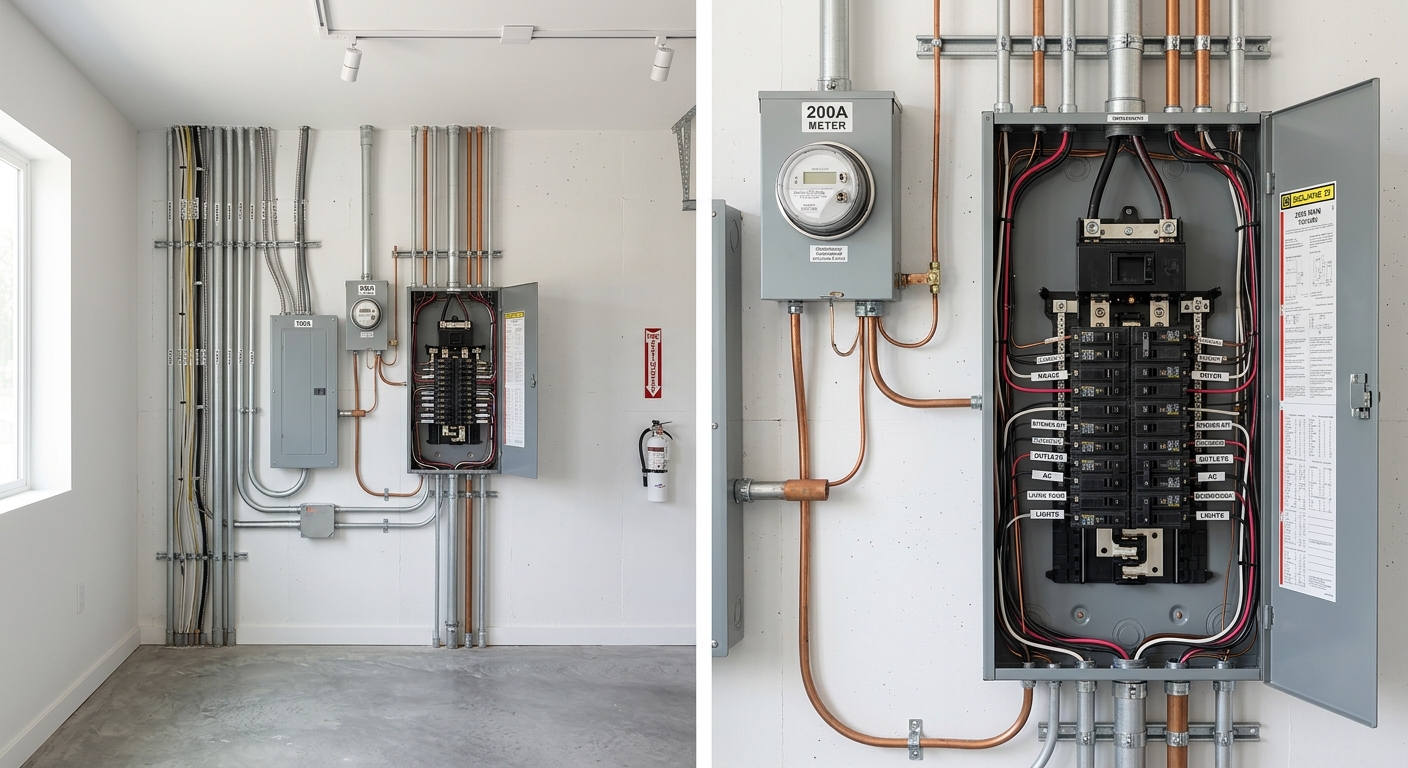
Because of that, you’ll commonly see projects land in the $2,500–$6,000 range for many 200A-oriented service/panel upgrades, while more complex rewires or remediation can run higher. Use the comparison table below to benchmark the typical “scope level” for your first quote.
| Service |
Why It's Needed |
Permit Required |
Price Range |
| Panel upgrade — 100A to 200A service |
Modern loads (EV charging, heat pumps, induction/electric cooking) often exceed older panel capacity; improves safety and adds breaker space. |
Yes (service/panel changes and major work) |
$2,500 – $6,000 |
| EV charger installation (Level 2, 40–50A) |
Adds a dedicated circuit and correct protection to run a Level 2 charger safely; many homes need load checks and sometimes a service upgrade. |
Yes (new circuit and charger connection) |
$900 – $2,500 |
| Knob-and-tube wiring removal and replacement |
K&T is a common safety/insurability concern in older homes; replacing restores reliable insulation and reduces fault risks. |
Yes (rewiring and remediation) |
$5,000 – $15,000 |
| Aluminum wiring remediation (CO/ALR connectors) |
Aluminum branch wiring can require approved terminations/connectors or partial replacement to reduce overheating risks. |
Yes (alterations/repairs to wiring system) |
$3,000 – $8,500 |
| New dedicated circuit (HVAC, appliance, hot tub) |
Ensures high-draw loads have the proper conductor size, breaker, and protection rather than overloading existing circuits. |
Yes (new circuits) |
$600 – $2,500 |
| Whole-home rewire (older home, full replacement) |
When wiring is widespread or unsafe, a full replacement restores code compliance and supports current and future loads. |
Yes (major rewiring) |
$8,000 – $15,000 |
Prices are estimates only and vary by project scope, site access and material selection.
What affects the price of electrical work in Agincourt North
In Agincourt North (and across the wider Toronto economic region), quotes for the same “headline” job can vary by 30–50% because the labour time and materials depend heavily on what’s hidden behind walls, the condition of existing wiring, and how much panel capacity you truly need. The age and type of housing stock is the dominant cost driver. Older pre-1950 homes can include knob-and-tube wiring, and some insurers increasingly restrict coverage when unsafe or unsupported wiring is present. Homes from the 1960s–70s often have 60A or 100A services that feel “fine” until EV chargers, heat pumps, electric stoves, and new electronics are added—all at once—at which point a load calculation can show you need meaningful upgrades.
Aluminum wiring is another common driver in older builds (especially when it’s present in branch circuits). Remediation using approved CO/ALR connectors can be cost-effective when the issue is localized, while widespread aluminum wiring or deteriorated terminations pushes the project toward fuller replacement. On the EV side, rising Level 2 installations are creating a surge of permit applications, and the amperage choice matters: a 40A run is typically cheaper than a 50A circuit due to breaker/cable differences and sometimes required service capacity.
Two practical examples from local conditions: (1) If your panel is in a finished basement near the mechanical room, pulling cable can be relatively straightforward, keeping a panel upgrade closer to the lower end of the $2,500–$6,000 band. (2) If you have to relocate the service, trench to a new meter/panel location, or remove extensive K&T, the same “service upgrade” conversation can become a much larger scope—often overlapping with the $3,000–$15,000 wiring/remediation bands. For budgeting, plan for at least one site visit and an honest load/condition assessment before you compare numbers.
| Price Factor |
Why It Matters |
Cost Impact |
| Panel size upgrade — 100A to 200A is the standard minimum today |
More capacity for EV charging, heat pumps, and modern kitchen loads; may require service equipment changes. |
Often the largest single line item; commonly $2,500–$6,000 for typical GTA work |
| Wiring type — copper vs. aluminum remediation vs. K&T removal |
Aluminum and knob-and-tube require specific remediation methods, more careful terminations, or replacement. |
Can shift a project upward by thousands depending on coverage area ($3,000–$15,000) |
| Number of new circuits — each adds material and labour time |
Each circuit needs correct cable, breaker, protection, and testing/documentation. |
Roughly incremental; common to add $600–$2,500 per dedicated circuit |
| Permit + ESA/TSBC inspection fee — mandatory for all major work |
Permits and inspections are required for major changes; fees are not optional. |
Typical Ontario permit/inspection fees often run $200–$500 depending on scope |
| Labour rate for licensed electricians — journeyman rates in {region} |
Local contractor hourly rates influence the total, especially for tight access and wall fishing. |
Commonly around $90–$120/hour in the Toronto area |
| EV charger amperage — 40A vs. 50A circuit affects cable and breaker cost |
A higher amperage can mean thicker cable, different breakers, and potentially a bigger service upgrade. |
May add several hundred dollars and sometimes triggers a load/service review |
| Emergency or after-hours premium |
Urgent troubleshooting, return visits, or after-hours access costs more. |
Can add a meaningful surcharge; budget extra for scheduling and call-out |
| Load calculation required for service upgrade |
Proper load calculations confirm whether 100A/150A/200A is appropriate and prevent unsafe undersizing. |
Small cost compared to failure—often adds a line item but prevents expensive rework |
Permits & regulations in Ontario
In Ontario, ALL electrical work beyond changing a light bulb must be done by a licensed electrician. For Agincourt North homeowners, the big takeaway is that permits are required for major electrical changes—particularly panel upgrades or service upgrades, new circuits (including EV charger circuits), rewiring, and any work that changes how power is distributed. Once work is permitted, the electrical work must pass inspection by the electrical safety authority (in Ontario, this is coordinated through ESA processes).
DIY electrical is prohibited for most work. Homeowners can sometimes do limited, non-electrical tasks like removing existing fixtures if the electrician disconnects and makes safe, but wiring changes, breaker/panel work, and anything involving feeders or terminations are not homeowner tasks. Also, confirm your contractor is actually licensed for the scope you’re hiring for; in Ontario you should verify the licence details and ensure they can pull the permit under their credentials.
To verify a contractor in Agincourt North, check three things in writing: (1) their Ontario licence and business registration—look them up through the provincial online registry; (2) liability insurance—ask for a current certificate of insurance showing coverage; and (3) WSIB coverage confirmation, or WCB compliance as applicable for the employer. For extra certainty, request a copy of the ESA permit submission number (or permit documentation) before work starts and ask for the inspection sign-off once complete.
When your Agincourt North home needs an electrical upgrade
Electrical problems that are “just annoying” can become safety-critical fast in Agincourt North, especially when older wiring meets modern loads. Start with the most common warning signs: (1) breakers that trip regularly. This often points to an overloaded circuit, a failing breaker, or undersized/aged wiring—immediate action is needed when it happens repeatedly, especially after running a set of appliances. (2) knob-and-tube wiring present—the concern isn’t only age; it’s also insulation condition and how the system behaves under modern loads and repairs. If K&T is active, plan for removal and replacement rather than patching.
(3) A 60A or 100A service is frequently inadequate for today’s household: EV charger, heat pump, and electric stove can all be in use on a cold winter evening. While you might limp along, many jobs end up requiring a 200A upgrade—the Toronto-market standard solution—often because a load calculation shows capacity shortfalls. (4) aluminum wiring (often in pre-1976 homes) may not be instantly dangerous if it’s been properly maintained, but it should be assessed by a licensed electrician; remediation can be simpler when localized. (5) insufficient outlets with extension cords everywhere signals a design problem that can become a fire risk.
Finally, (6) no AFCI/GFCI protection where required is a code-compliance issue that can surface during home sales and inspections. Some items are urgent (frequent tripping, damaged wiring, active K&T), while others are best handled as a planned upgrade (outlet density, older breaker styles, missing protection). For example, a well-scoped panel upgrade that lands in the $2,500–$6,000 range is often less expensive than repeated nuisance breaker calls or emergency troubleshooting after adding EV charging.
| Warning Sign |
What It Means |
Recommended Action |
Urgency |
Price Band |
| Breakers trip frequently |
Possible overload, failing breaker, or wiring/connection issues. |
Schedule an inspection and load/circuit check; identify and correct the cause before adding circuits. |
High (schedule ASAP) |
$600 – $2,500 |
| Knob-and-tube wiring present |
Outdated insulation and connection risks; may be limited by insurer requirements. |
Plan for K&T removal/replacement and safe reconfiguration of circuits. |
High (plan replacement) |
$5,000 – $15,000 |
| 60A or 100A panel (inadequate load capacity) |
Not enough capacity for EV, heat pump, and modern kitchen/electrical loads. |
Load calculation, then consider upgrading service/panel (commonly to 200A). |
Medium–High |
$2,500 – $6,000 |
| Aluminum wiring (pre-1976 construction) |
Aluminum terminations can overheat if not properly remediated. |
Have wiring assessed; remediate with approved CO/ALR connectors or replace affected runs. |
Medium |
$3,000 – $8,500 |
| Insufficient outlets — extension cords everywhere |
Circuit overload risk and code/design non-compliance. |
Add properly protected receptacle circuits; remove dependence on extension cords. |
Medium |
$600 – $2,500 |
| No AFCI or GFCI protection where required |
Increased risk of arc faults and shock; can affect inspection outcomes. |
Upgrade protection methods as required for the home’s wiring configuration. |
Planned (unless inspection is imminent) |
$200 – $1,500 |
How to choose a electrical work contractor in Agincourt North
Choosing the right contractor in Agincourt North starts with verification, not just price. First, confirm Ontario licensing for the electrical work being proposed—ask for their licence information and business details. Next, obtain a certificate of insurance for liability coverage (and ensure it covers electrical contractor work). Finally, verify WSIB/WCB compliance: request documentation that the employer has active coverage or is properly exempt where applicable. This matters because the job will include permitted work, inspections, and sometimes wall access that creates risk for both the homeowner and the crew.
Then request 2–3 itemised written quotes. A good quote breaks down labour and materials (for example: breaker and panel components, cable, connectors, conduit, drywall patch allowances, disposal fees, and testing). Watch the exclusions section carefully: ask whether the permit pull is included, whether ESA inspection scheduling is included, and if waste/disposal of old wiring or panel components is part of the price. Payment scheduling should be controlled—never pay more than 10–15% upfront, and hold back a portion until completion and cleanup are done.
For warranty, separate workmanship warranty from manufacturer warranty. Ask how long labour is guaranteed for, whether manufacturer warranties transfer to you, and how service calls are handled if something fails after inspection. Finally, insist on timeline clarity: get a start date and completion estimate in writing, with note of any dependency on inspections, panel lead times, or material delivery.
- Confirm Ontario electrical contractor licence details before booking the site visit.
- Ask for certificate of insurance (liability) and verify it’s current.
- Request WSIB/WCB proof and match it to the company name on the quote.
- Get 2–3 itemised quotes (labour + materials), not a lump sum.
- Ensure permit pull and ESA inspection scheduling are included where required.
- Ask what’s included for testing (visual inspection, continuity, torque checks).
- Confirm disposal/recycling of old breakers, panels, and removed wiring.
- Clarify the scope for drywall: patching included or separate trade cost?
- Request component brand/quality details (breakers, panel, AFCI/GFCI devices).
- Verify warranty length for workmanship and how warranty claims are processed.
- Set a payment schedule with a small deposit (10–15%) and holdback.
- Ask for a written start date, estimated duration, and what happens if inspection delays occur.
Red flags I see in Agincourt North include: contractors who won’t provide licence/insurance/WSIB paperwork, quotes that don’t mention permits or inspections, “too-good-to-be-true” pricing that skips load calculations for service upgrades, pressure to pay most of the job upfront, and vague scope language like “we’ll replace what’s needed” without listing the work items.
Frequently asked questions — electrical work in Agincourt North
How do I find a licensed electrician in Agincourt North?
Start by searching for licensed electrical contractors who work in Agincourt North and the Toronto area, then verify credentials rather than relying on reviews alone. In Ontario, you can confirm the contractor’s licence and business status through the provincial online registry, and you should ask for their certificate of insurance before any work begins. Also request WSIB/WCB documentation so you know the employer is properly covered for workplace risk. When you contact companies, ask whether they pull permits for your specific scope—panel upgrades, new circuits (including EV chargers), and rewiring always require permitting and inspection. For budgeting, it helps to request an itemised quote so you can compare apples to apples—panel/service work often sits around the $2,500–$6,000 range depending on complexity.
Can I add a subpanel to my Agincourt North home?
Yes, many Agincourt North homeowners add a subpanel when they want to expand circuit capacity—especially in homes that are running out of breaker space or need separate circuits for a finished basement, workshop, or rental area. A subpanel typically requires a permit and must be installed to Ontario Electrical Code requirements, with proper breakers, grounding/bonding, and cable sizing. Whether you can add a subpanel without upgrading your main service depends on your existing panel size and total load. If you’re also planning EV charging or electric heating upgrades, a load calculation may show that simply adding a subpanel isn’t enough—sometimes a 100A system needs to move toward a 200A setup. Expect a quote to reflect both electrical labour and any accessibility/demolition required.
How much does an electrician cost in Agincourt North?
In the Toronto area around Agincourt North, licensed electricians commonly charge on an hourly basis (often about $90–$120/hour for labour), and the total depends on how accessible your panel and wiring paths are. The biggest cost swings are usually scope-related: diagnostics and circuit additions cost less than service changes, and wiring remediation costs more than straightforward breaker swaps. Ontario permit/inspection requirements also affect totals—major work typically includes permit and ESA inspection fees that are often in the $200–$500 range depending on the project. If you’re comparing quotes, make sure each includes the same scope details (permit pull, testing, disposal, and component allowance). For homeowners planning ahead, many common jobs fall into the wiring and circuit categories that can start around the $600–$2,500 mark for smaller dedicated work, but panel/service upgrades are commonly more like $2,500–$6,000.
How much does a panel upgrade cost in Agincourt North?
Panel upgrades in Agincourt North commonly centre around service capacity changes—most homeowners are moving from 100A to 200A to support modern loads. Typical Toronto-area pricing for a 100A to 200A panel/service upgrade is about $2,500 – $6,000, assuming straightforward access and no major remediation surprises. The cost can rise if the electrician needs to relocate equipment, deal with problematic existing wiring, add new conduit pathways, or do significant remediation like aluminum/knob-and-tube fixes. If the job is paired with a larger rewiring scope, you may be closer to the higher wiring/remediation bands instead of sticking to panel-only numbers.
Do I need to upgrade to a 200A panel?
You might, and the decision should be based on a load calculation—not a guess. In Agincourt North, 100A services can handle many older loads, but modern additions like EV chargers (often 40–50A), heat pumps, induction or electric ranges, and added finished basements often push demand up. When that happens, 200A becomes the practical standard because it provides breaker space and service capacity for safe operation. That said, some homes can remain on a lower service size if their actual calculated loads stay within limits, and if EV charging can be managed appropriately. If your electrician recommends 200A, ask to see the load calculation summary and what changes trigger the recommendation. A typical panel/service upgrade price commonly falls in the $2,500 – $6,000 range for standard GTA work.
How much does an EV charger installation cost in Agincourt North?
For Agincourt North homeowners, Level 2 EV charger installation (often a dedicated 40–50A circuit) commonly falls around $900 – $2,500, assuming wiring runs are reasonable and your existing panel capacity is suitable. Your actual cost depends on whether you need extra trenching/conduit, how far the panel is from the charger location, and whether the electrician performs a load assessment to confirm the service can support the new amperage. If you’re starting from an older setup—like limited breaker space, inadequate service capacity, or aluminum/K&T issues—your EV project may overlap with broader panel/service or remediation costs. Always confirm whether the quote includes permit handling, proper protection devices, charger wiring hookup, and testing before you schedule the install.