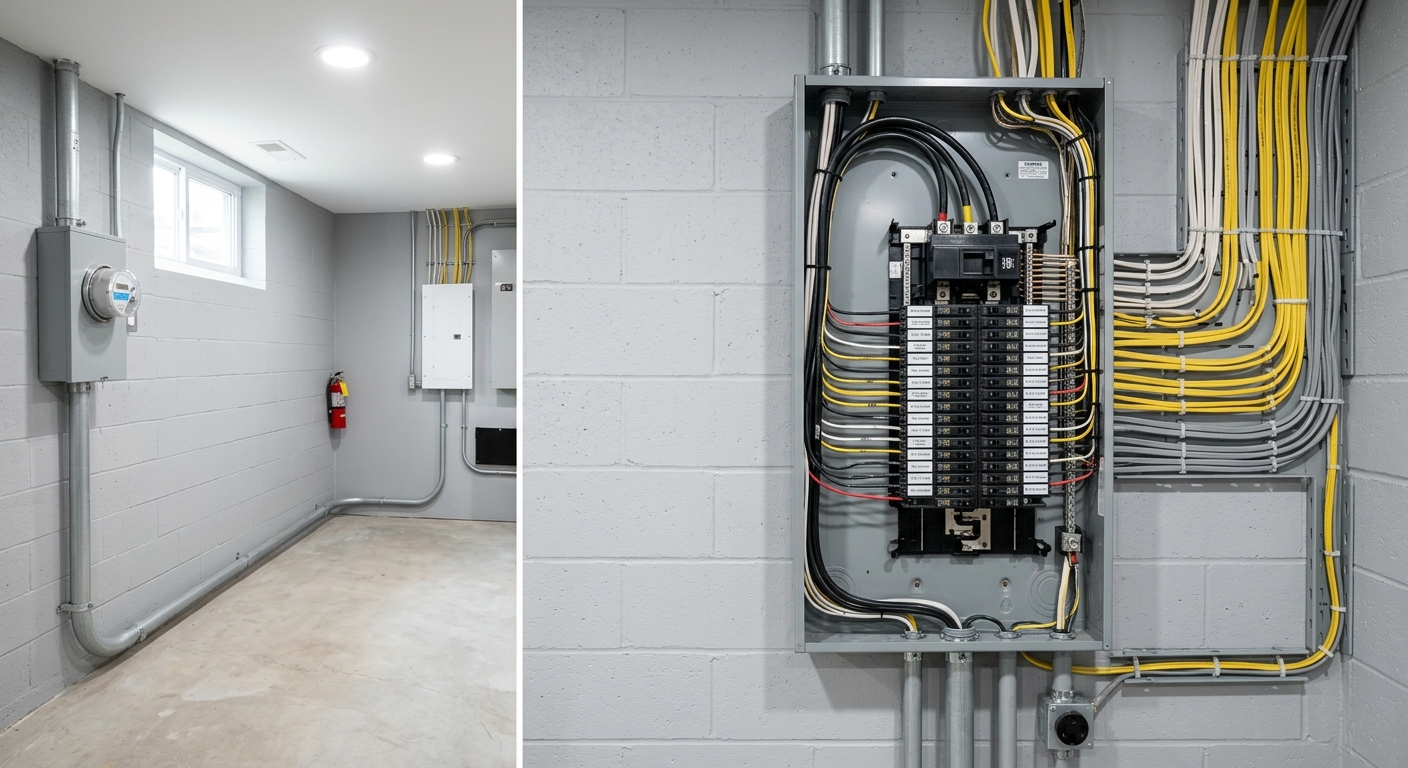
Electrical services and costs in Bracebridge
Bracebridge homeowners often start by asking what it will cost to make their electrical system safer and more capable for today’s lifestyle. With 46.4% of homes built before 1981 in the broader area, many properties arrive with older wiring practices that are increasingly incompatible with modern loads. That’s especially common where you’ll find older cottages and full-time homes along the waterfront and in established neighbourhoods—an issue that shows up during panel upgrades, outlet expansion, and insurance reviews.
In Muskoka–Kawarthas, the climate and the way people live outdoors raise steady electrical demand. Electric baseboard heat and other electric-heating setups are common in rural and cottage markets, which means your service can feel “busy” even before you plug in seasonal tools, hot tubs, or a workshop. On top of that, EV adoption is steadily increasing; more Level 2 charger installations trigger panel capacity checks, wiring upgrades, and often a jump from 100A to 200A to keep within Ontario Electrical Safety Code requirements. Contractor availability can also affect pricing—jobs that require more time for troubleshooting older wiring, pulling cable through finishes, or coordinating inspection windows through the Electrical Safety Authority (ESA) tend to land toward the upper end of the range.
In Bracebridge, areas like River Road and the downtown/Parry Sound Street corridor are seeing ongoing service work as homes are modernized for year-round use. The next table breaks down typical services and what usually drives the price in this market.
| Service |
Why It's Needed |
Permit Required |
Price Range |
| Panel upgrade — 100A to 200A service |
Modern loads (EV charging, heat pumps, induction ranges) can overload older panels; safer busbar/breaker space and proper protection. |
Yes (permit and ESA inspection) |
$2,500 – $4,500 |
| EV charger installation (Level 2, 40–50A) |
Dedicated circuit, correct breaker, suitable cable routing, and load considerations so the service stays within limits. |
Yes (permit and ESA inspection) |
$1,200 – $3,000 |
| Knob-and-tube wiring removal and replacement |
Older insulation and connection methods are not intended for today’s duty cycles; replacement improves safety and insurance acceptance. |
Yes (rewiring generally requires permits and inspection) |
$8,000 – $25,000 |
| Aluminum wiring remediation (CO/ALR connectors) |
Where aluminum branch wiring exists, approved remediation (CO/ALR devices or replacement sections) reduces overheating risk. |
Yes (major electrical remedial work typically requires a permit) |
$8,000 – $18,000 |
| New dedicated circuit (HVAC, appliance, hot tub) |
Dedicated breaker and cable for a single high-demand load improves protection and reduces nuisance trips. |
Yes (new circuits require a permit and ESA inspection) |
$900 – $2,800 |
| Whole-home rewire (older home, full replacement) |
Full modernization for capacity, safety, grounding/bonding, and code-compliant protection across the home. |
Yes (comprehensive permitting and inspection) |
$15,000 – $35,000 |
Prices are estimates only and vary by project scope, site access and material selection.
What affects the price of electrical work in Bracebridge
In Bracebridge and across Muskoka–Kawarthas, the same “type” of job can come in 30–50% apart from one quote to another because the underlying electrical condition is rarely identical. A straightforward panel swap in a newer build might be quick, but a 100A-to-200A upgrade in a home with mixed wiring, long cable runs, or unknown past repairs can take significantly more labour to document, reroute, and verify.
Housing age is the dominant cost driver here. When homes are built before 1981 (and especially when knob-and-tube or older aluminum methods are present), electricians may need additional time for safe removal, new grounding paths, and code-compliant terminations. If you’re working with a service that’s 60A or 100A, the market reality is that today’s loads—EV chargers, heat pumps, and electric stoves—often push a home beyond what the original panel was designed to support. That’s why the typical backbone panel upgrade/service budget in this tier lands around $2,500 – $4,500.
Aluminum wiring, which was common in homes from the mid-1960s to mid-1970s, can also raise costs because remediation must be done using approved connector methods (like CO/ALR) or by replacing affected sections. Meanwhile, EV adoption in the region is driving a surge of permit applications for Level 2 chargers, and the paperwork and inspection steps aren’t optional—so even a “simple charger” can price closer to the top of $1,200 – $3,000 when the existing panel has limited capacity.
Two local examples that frequently move the needle in Bracebridge: (1) waterfront and cottage properties often have longer cable routes and more finished surfaces to protect, and (2) older service equipment may require additional testing and safer termination work before anything can be connected. When those conditions don’t exist, costs come down quickly.
| Price Factor |
Why It Matters |
Cost Impact |
| Panel size upgrade — 100A to 200A is the standard minimum today |
More breaker spaces and capacity for modern loads; sometimes requires service equipment changes. |
Typically $2,500 – $4,500 |
| Wiring type — copper vs. aluminum remediation vs. K&T removal |
Aluminum and knob-and-tube often require licensed remediation or replacement sections for safety. |
Can shift from thousands to $8,000 – $25,000 on rewires |
| Number of new circuits — each adds material and labour time |
Each circuit adds breakers, cable, junctions, labour time, and testing. |
Often increases project by several hundred to multiple thousands per circuit |
| Permit + ESA/TSBC inspection fee — mandatory for all major work |
Permitting and inspections are required for panel upgrades, new circuits, rewires and EV charger work. |
Mandatory cost; commonly a meaningful portion of the estimate |
| Labour rate for licensed electricians — journeyman rates in Muskoka–Kawarthas |
Licensed hours, troubleshooting time, and travel/access all affect the final cost. |
Local rates often land around $90 – $130/hour plus minimum call |
| EV charger amperage — 40A vs. 50A circuit affects cable and breaker cost |
Cable size, breaker rating, and sometimes load management options change with amperage. |
Can move the charger install toward the upper or lower side of $1,200 – $3,000 |
| Emergency or after-hours premium |
Priority scheduling and after-hours access typically cost more. |
Often adds a surcharge on top of labour |
| Load calculation required for service upgrade |
Proper calculations help size the service and avoid future nuisance trips and code issues. |
Adds time; protects you from overspending or under-sizing |
Permits & regulations in Ontario
In Ontario, electrical work beyond changing a light bulb must be done by a licensed electrician, and most “real” projects require a permit. That includes panel upgrades (like 100A to 200A), new circuits (including EV charger dedicated circuits), rewiring, service upgrades, and major additions or removals. If your electrician is proposing anything more than simple replacement of like-for-like fixtures, assume a permit is required and plan for inspection.
Ontario uses the Electrical Safety Authority (ESA) for electrical safety inspections. Permitted work must be inspected—so even if the electrician completes the wiring, the system won’t be considered code-compliant for safety and record purposes until ESA has signed off.
Homeowner DIY is restricted. In practice, homeowners should not attempt internal panel work, new wiring, breaker changes, grounding/bonding alterations, or any work that involves opening walls to add circuits. Exceptions are narrow and still generally require proper notifications and inspections.
To verify a contractor in Bracebridge step by step: (1) confirm the electrician’s licence on the Ontario electrical licence registry (search by business or individual name), (2) ask for a clearance letter or proof of standing where applicable, (3) request a Certificate of Insurance showing liability coverage, and (4) confirm WSIB/WCB coverage for their workers (or proof of clearance/coverage status). Don’t rely on a verbal assurance—get documents before work starts.
When your Bracebridge home needs an electrical upgrade
Your Bracebridge home typically needs electrical work when you see safety or code-compliance warning signs—not just cosmetic issues. Start with the most common red flag: (1) breakers that trip regularly. That can indicate an overloaded panel, an undersized circuit, or a wiring fault. If it’s frequent, treat it as urgent.
(2) Knob-and-tube wiring present is a key concern even if everything “still works.” The issue is the condition and insulation around older conductors; it’s closely tied to insurance acceptance and safety risk. If knob-and-tube is present, plan for removal or replacement sections promptly—don’t wait for a failure.
(3) A 60A or 100A service is often inadequate for a modern Muskoka–Kawarthas home where electric heat, kitchens, workshops, and seasonal equipment are common. Add an EV charger and it becomes even more likely you’ll need more capacity. In many cases, a 200A upgrade is the standard solution, particularly when you’re also adding new circuits for heat pumps or appliances.
(4) Aluminum wiring (pre-1976 construction) isn’t always immediately dangerous, but it needs licensed remediation or properly engineered connections. (5) Insufficient outlets and constant reliance on extension cords is a safety hazard and a sign your circuit layout doesn’t match your lifestyle. (6) No AFCI or GFCI protection where required is a code issue that often surfaces during home sales and can force upgrades.
Pricing example: if a charger addition triggers a service capacity issue, the difference between options can be justified. Adding a Level 2 charger might be near $1,200 – $3,000 by itself, but pairing it with a properly sized panel upgrade commonly lands around $2,500 – $4,500. If your existing service can’t safely support it, skipping the upgrade risks repeated trips and additional corrective work later—usually costing more.
| Warning Sign |
What It Means |
Recommended Action |
Urgency |
Price Band |
| Breakers trip frequently |
Overload, faulty breaker/circuit, or undersized wiring for connected loads. |
Electrical troubleshooting + load check; possible circuit balancing or panel/service review. |
Immediate |
$900 – $2,500 |
| Knob-and-tube wiring present |
Older insulation methods not intended for modern conditions; higher risk during faults. |
Remove and replace affected sections; rewire as needed for safety and compliance. |
Planned (prioritize) |
$8,000 – $25,000 |
| 60A or 100A panel (inadequate load capacity) |
Not enough breaker space/capacity for EV, heat pumps, and modern appliance loads. |
Load calculation and panel/service upgrade, typically to 200A minimum. |
Planned (often needed before additions) |
$2,500 – $4,500 |
| Aluminum wiring (pre-1976 construction) |
Potential overheating issues at connections without approved remediation. |
Licensed aluminum remediation using CO/ALR connectors or replacement sections. |
Planned (prioritize) |
$8,000 – $18,000 |
| Insufficient outlets — extension cords everywhere |
Overloaded circuits and increased risk from damaged cords or temporary connections. |
Add circuits/outlets to match your load use; correct cable protection and placement. |
Immediate |
$900 – $3,000 |
| No AFCI or GFCI protection where required |
Reduced protection against arc faults and shock hazards; potential code non-compliance. |
Add required GFCI/AFCI protection or replace non-compliant devices as needed. |
Planned (before resale or major additions) |
$200 – $1,200 |
How to choose a electrical work contractor in Bracebridge
Choosing the right electrician in Bracebridge starts with verifying Ontario licensing and coverage, not just a low number. First, confirm licence status using the Ontario electrical licence registry and make sure the contractor’s business name matches what’s on the quote. Next, ask for a Certificate of Insurance showing liability coverage and, importantly for the homeowner, proof of WSIB/WCB coverage (or a clearance document depending on their status). If they can’t provide documentation, that’s a practical red flag.
Get 2–3 itemised written quotes. You want line items for labour, materials, permits/inspection, testing, and any make-good work (like wall patching if included). Avoid “lump sum only” quotes that don’t explain how they priced access, cable routing, or removal of old wiring—this is where costs diverge later. Confirm what’s included: is the permit pull included, are ESA inspection fees included, and is disposal of old materials included or extra?
Warranty matters. Ask for the workmanship warranty length (commonly a full project coverage period), product/manufacturer warranties for breakers/panels/chargers, and whether warranties are transferable if you sell the home. For payment terms, keep it sensible: never pay more than 10–15% upfront, and hold back funds until the job is complete and inspected/energized to satisfaction. Finally, request a written timeline with a start date and completion estimate so you’re not stuck waiting through winter access constraints.
- Verify Ontario licence and the exact legal business name on your contract.
- Request liability insurance certificate before any work starts.
- Confirm WSIB/WCB coverage (or clearance status) for the crew.
- Get an itemised quote with labour/material/permit sections.
- Confirm whether ESA permit and inspection scheduling are included.
- Ask how cable routing and patching/make-good are handled.
- Ensure the quote lists the panel/EV charger model and breaker ratings.
- Confirm whether load calculation is included for service upgrades.
- Clarify disposal/recycling of old breakers, panels, and wiring.
- Require a workmanship warranty and keep it in writing.
- Set a payment schedule with a small deposit only (10–15%).
- Get start/completion dates in writing, including inspection timing.
Red flags I see in Bracebridge: contractors who won’t show licence/insurance documents, quotes that exclude permits/ESA inspections, “too good to be true” pricing on knob-and-tube/aluminum remediation, vague scopes that don’t name panel/charger models, and requests for large upfront deposits with no written timeline.
Frequently asked questions — electrical work in Bracebridge
What is a load calculation and why does my electrician need one?
A load calculation is a structured way to estimate how much electrical demand your home has (and what it will likely need after upgrades). In Bracebridge, where many homes are older and some residents rely on electric baseboard or seasonal electric heating, the actual connected load can surprise people. A proper load calculation helps confirm whether your existing service (like 60A or 100A) is truly adequate before adding a Level 2 EV charger, new kitchen loads, or heat-pump equipment. It also supports code-compliant sizing so you don’t end up with nuisance trips or under-capacity equipment. If a calculation shows the service is short, that’s when a panel upgrade budget—often in the $2,500 – $4,500 range—becomes the safer, longer-term choice.
How do I find a licensed electrician in Bracebridge?
Start by searching for electricians who operate in or around Bracebridge and then verify they’re properly licensed in Ontario. In practice, you should check the Ontario electrical licence registry for the individual or the business name before you sign anything. Next, ask for a Certificate of Insurance (liability coverage) and proof of WSIB/WCB coverage for their workers. Don’t skip these steps—electric work is high-impact, especially in an area where many homes are built well before modern wiring standards and where knob-and-tube or aluminum remediation may be involved. You can also ask the contractor for ESA permit experience on similar projects and request itemised quotes. A reputable contractor will readily provide documentation and will explain which permits are mandatory for your specific scope.
Can I add a subpanel to my Bracebridge home?
Yes, adding a subpanel is often possible and can be a great way to expand capacity, reduce long runs through the main panel, or add dedicated protection for high-demand areas (like workshops). In Ontario, installing a subpanel typically requires a permit and inspection because it involves adding/altering branch circuit distribution equipment. Your electrician should also confirm your service size and do (or review) a load calculation to ensure the main service can support the additional circuits. Subpanel installs are commonly chosen when you need more breaker spaces without immediately replacing the whole service—though in older homes, especially those with pre-1981 wiring conditions, it may still lead to recommended remediation work. The cost depends heavily on cable routing, panel location, and whether any service upgrades are also needed.
How much does an electrician cost in Bracebridge?
In Bracebridge and the Muskoka–Kawarthas region, labour for licensed electricians is commonly in the Ontario range of about $90 – $130 per hour, plus a minimum service call. Final pricing depends on how long the job takes, how difficult access is (especially in cottage or waterfront builds), and whether troubleshooting is required due to older wiring. Some projects are priced as a project total after inspection, but you’ll still want clarity on labour hours and materials. If your work requires permitting and ESA inspection—like panel upgrades, new circuits, or EV charger installs—those mandatory steps add to the total. That’s why two quotes for the “same” job can differ: one contractor may find more hidden wiring issues or require additional corrections before it can be safely energized.
How much does a panel upgrade cost in Bracebridge?
For most Bracebridge homeowners who need to upgrade from a 100A service to a modern 200A minimum (commonly triggered by EV charging, heat pumps, and expanded circuit needs), the typical budget lands in the $2,500 – $4,500 range. Your actual number can move up when access is difficult, the service equipment needs additional upgrades, the existing wiring condition is poor, or load calculations and corrections take extra time. If your home has older wiring methods, your electrician may also recommend grounded circuit additions or remediation so the upgrade is truly safe and compliant. Because many local homes are older—over two in five built before 1981 in the Census profile—panel upgrades frequently come bundled with other safety-critical work rather than existing as a simple swap.
Do I need to upgrade to a 200A panel?
Not every job requires 200A, but many modern upgrades do, especially in Bracebridge where older housing stock and electric heating usage can affect demand. If you’re adding an EV charger (often a 40–50A Level 2 circuit) and you have electric baseboards, induction/electric cooking, or heat-pump equipment, your electrician may determine that your current service is too small or lacks capacity. In Ontario practice, a load calculation is the deciding step, not guesswork. If your load calculation supports staying at your existing panel size, you may be able to add circuits safely without a full service change. However, if the calculation shows you’re near or beyond the panel’s safe limits, upgrading to 200A is usually the standard long-term solution. It also helps prevent repeat corrections that can cost more later.