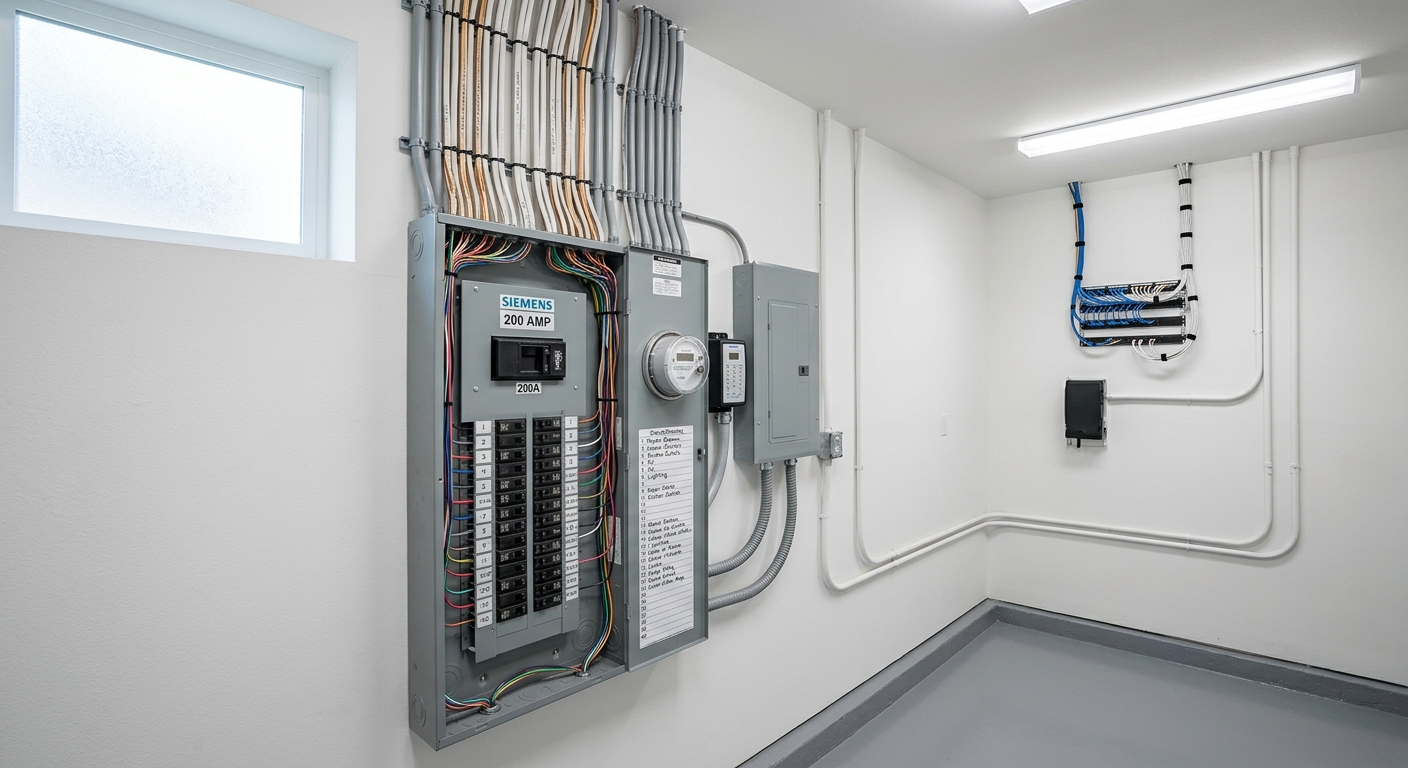
Electrical services and costs in Ottawa South
Electrical services in Ottawa South often cost more than people expect, mainly because many homes were built long before modern electrical demand. Ottawa South’s population is 125,090 (Statistics Canada, 2021 Census), and that stable, long-settled housing base is why we still see a lot of pre‑1960 and 1970s wiring. Those older neighbourhoods are prime candidates for panel upgrades, knob-and-tube removal, and aluminum branch-circuit remediation when owners add central air, EV charging, or renovate kitchens and basements.
Ottawa’s climate also shapes the workload. In winter, frequent use of electric heat (including baseboards and supplements) pushes continuous loads higher, and that affects how we plan service capacity and breaker schedules. Meanwhile, the local market has a steady flow of permit applications tied to EV adoption, so you’ll see tighter coordination between electrical contractor work, Hydro/utility requirements, and ESA inspections for anything involving a service change.
In Ottawa South’s areas like Billings Bridge and the surrounding corridors, demand is especially strong because many properties sit on older services (often 60A to 100A) and are being modernized at the same time—new appliances, heat pumps, and EVs all add up quickly. Next, here’s how the most common projects typically price out in the Ottawa South tier, so you can compare quotes confidently.
| Service |
Why It's Needed |
Permit Required |
Price Range |
| Panel upgrade — 100A to 200A service |
Modern load needs for EV charging, electric cooking, heat pumps/electric heat supplements, and more circuits |
Yes (ESA permit and inspection) |
$2,500–$6,000 |
| EV charger installation (Level 2, 40–50A) |
Dedicated, code-compliant circuit with appropriate breaker and grounding for reliable charging |
Yes (new circuit/permit) |
$900–$2,500 |
| Knob-and-tube wiring removal and replacement |
Eliminate outdated wiring practices and reduce insurance and safety risk concerns |
Yes (rewiring/changes and inspections) |
$8,000–$25,000 |
| Aluminum wiring remediation (CO/ALR connectors) |
Approved connection methods for aluminum branch circuits to reduce overheating risk |
Yes (major electrical work) |
$4,000–$12,000 |
| New dedicated circuit (HVAC, appliance, hot tub) |
Add capacity and avoid nuisance tripping from undersized/overloaded circuits |
Yes (new circuit permit) |
$1,200–$4,500 |
| Whole-home rewire (older home, full replacement) |
Replace extensive aging wiring and bring the home up to current installation requirements |
Yes (rewiring with ESA inspection) |
$18,000–$55,000 |
Prices are estimates only and vary by project scope, site access and material selection.
What affects the price of electrical work in Ottawa South
In Ottawa South, two homeowners can receive quotes that differ by 30–50% for what looks like “the same job.” The biggest driver is the existing condition of the home’s electrical system—how much panel capacity is available, what wiring types are in the walls, and how complicated it is to run or replace cable to meet current Ontario Electrical Code requirements. In addition, the costs of permits, ESA inspection time, and licensed labour add up quickly when work requires openings in plaster/drywall and careful routing around insulation and older framing.
Housing age is the dominant cost driver. Homes built before 1950 can have knob-and-tube wiring where insulation contact and termination quality matter for safety and for many insurer requirements; removing it is labour-intensive because it often involves extensive replacement, not just “touching” sections. Homes from the 1960s–70s often have 60A or 100A panels that are inadequate for today’s loads—EV chargers, heat pumps, induction stoves, and larger kitchen circuits. Aluminum wiring is also common in the 1965–1976 window, and remediation requires licensed work using approved CO/ALR connectors or, in some locations, full replacement. Separately, EV adoption is driving a surge in Level 2 charger permits, and that can nudge schedules and labour availability.
For real-life examples: upgrading a 60A service to 200A often lands closer to the higher end of the $2,500–$6,000 panel band because of heavier cable, larger meter bases, and Hydro/ESA coordination. By contrast, a standard 40–50A Level 2 EV installation typically stays nearer the $900–$2,500 band when the panel location is straightforward and capacity is already available. Ottawa’s winter use of heat and growing appliance loads are why we plan for capacity up front—doing it later usually costs more.
| Price Factor |
Why It Matters |
Cost Impact |
| Panel size upgrade — 100A to 200A is the standard minimum today |
More space for breakers and safer margins for modern continuous loads |
$2,500–$6,000 |
| Wiring type — copper vs. aluminum remediation vs. K&T removal |
Aluminum and knob-and-tube require specific, code-approved approaches and more labour |
$4,000–$25,000 |
| Number of new circuits — each adds material and labour time |
Every circuit means trenching/wall work, cable/breaker, and labelling/verification |
$1,200–$4,500 per circuit |
| Permit + ESA/TSBC inspection fee — mandatory for all major work |
Inspections are required and fees are non-optional |
$300–$1,000 |
| Labour rate for licensed electricians — journeyman rates in Ottawa South |
Licensed time and experience reflect in-site conditions, troubleshooting, and code compliance |
$100–$200 per hour (typical range) |
| EV charger amperage — 40A vs. 50A circuit affects cable and breaker cost |
Higher amperage can require larger conductors and different breaker/cable selections |
$900–$2,500 |
| Emergency or after-hours premium |
Urgent safety issues require scheduling priority and faster mobilization |
$250–$1,500 |
| Load calculation required for service upgrade |
ESA expectations and proper design depend on verifying actual and future loads |
$300–$800 |
Permits & regulations in Ontario
In Ontario, any electrical work beyond changing a light bulb must be done by a licensed electrician. For Ottawa South homeowners, that includes panel upgrades (100A to 200A), adding new circuits, rewiring, replacing outlets/switches that are part of a circuit change, and installing EV charger circuits. Permits are required for these major changes, and all permitted work must pass inspection by the Electrical Safety Authority (ESA) before it’s considered compliant. DIY electrical is prohibited for most work, and even when homeowners do small low-risk tasks, they still generally need a licensed contractor to pull permits and ensure the installation is inspected.
Typical work that does NOT usually require a permit includes replacing a like-for-like receptacle or light fixture only where there’s no change to wiring method, device type, or circuit design—and where the contractor confirms the existing conditions remain compliant. Work that DOES require a permit commonly includes any new circuit or breaker, service upgrades, panel changes, and anything tied to EV charging, hot tubs, or significant rewiring.
How to verify your electrician: first, confirm their Ontario licence using the electrical contractor registry/search tool for the licence holder. Second, request a clearance letter if applicable and ask for proof of liability insurance and WSIB/WCB coverage (or proof of coverage plan). Finally, ensure the quote states who will pull the ESA permit (the licensed contractor should pull it) and that they’ll schedule the ESA inspection and coordinate access for any required corrections.
When your Ottawa South home needs an electrical upgrade
Electrical upgrades in Ottawa South are rarely “cosmetic”—they’re usually about safety-critical capacity and wiring integrity. Start with the common warning sign: (1) breakers that trip regularly. That can point to an overloaded panel, undersized circuits, or wiring issues, and it needs prompt diagnosis because winter appliance use can make a marginal system fail more often. (2) Knob-and-tube wiring is a key concern because insulation contact and termination conditions can degrade over time; the risk is as much about current conditions and insurance expectations as about age. (3) A 60A or 100A service often can’t handle today’s household loads when you add an EV charger, heat pump, and electric stove together—200A service is commonly the standard solution for new capacity. (4) Aluminum wiring (seen in many pre-1976 builds) may not fail immediately if it’s maintained, but it requires licensed remediation or targeted connector replacements to address connection-related overheating risk. (5) Insufficient outlets and extension-cord dependence is usually a sign of circuit planning problems. (6) Missing AFCI/GFCI protection where required is a code-compliance issue that often shows up during sale or inspection.
In Ottawa’s cold months, continuous use patterns can accelerate problems. If you’re seeing repeated trips, warmth/burning odours at outlets, or flickering paired with aging wiring, treat it as urgent. Knob-and-tube or aluminum wiring typically triggers a planned upgrade—but not a do-nothing delay—especially if you’re listing the home.
For costs: if you’re staying within existing panel capacity, a dedicated circuit may fit under the $1,200–$4,500 range. If the service is truly undersized, trying to “add around it” can lead to repeated breaker trips and extra labour—often making the $2,500–$6,000 panel upgrade the more justified path.
| Warning Sign |
What It Means |
Recommended Action |
Urgency |
Price Band |
| Breakers trip frequently |
Overload, failing components, or wiring/circuit design that can’t handle current demand |
Load check and circuit diagnostics; correct overload or upgrade capacity |
Immediate |
$300–$6,000 |
| Knob-and-tube wiring present |
Outdated wiring method with insulation contact concerns and frequent insurance scrutiny |
Licensed assessment and removal/replacement plan |
Planned (but not delayed) |
$8,000–$25,000 |
| 60A or 100A panel (inadequate load capacity) |
Not enough headroom for modern appliances/EV/heat in Ottawa’s winter usage |
Service capacity review and typical 200A upgrade design |
Planned |
$2,500–$6,000 |
| Aluminum wiring (pre-1976 construction) |
Connection-related overheating risk requiring approved remediation |
Licensed remediation with CO/ALR methods or targeted replacement |
Planned |
$4,000–$12,000 |
| Insufficient outlets — extension cords everywhere |
Increased risk of overloaded cords/power strips and circuit misuse |
Add receptacles/circuits and correct circuit allocation |
Planned |
$1,200–$4,500 |
| No AFCI or GFCI protection where required |
Higher risk for arc faults and shock events; can surface at home-sale inspections |
Upgrade protection devices and verify scope for affected circuits |
Planned |
$150–$3,500 |
How to choose a electrical work contractor in Ottawa South
Choosing the right contractor in Ottawa South starts with credentials you can verify. In Ontario, make sure the contractor and/or licence holder is licensed, and request proof of liability insurance and WSIB/WCB coverage before any work begins. To check: use Ontario’s electrical contractor licence lookup to confirm the correct person/business is authorized; then ask for an insurance certificate and verify it covers the specific work type (service work, panel changes, EV circuits). For WSIB/WCB, the contractor should provide proof of coverage or appropriate exemption documentation.
Next, get 2–3 itemised written quotes. You want a breakdown separating labour, materials, permits, and any wall opening/repairs. Confirm whether the permit is included, whether ESA inspection scheduling is handled, and whether disposal/cleanup (old breakers, packaging, debris) is part of the scope. Quotes should also state exactly what wiring method and components will be installed (e.g., breaker type, receptacle type, charger circuit specs).
Warranty matters: ask for the workmanship warranty length, whether manufacturer warranties apply to devices, and whether warranties are transferable to future owners. For payment, don’t pay more than 10–15% upfront; use progress payments tied to milestones and hold back until the ESA inspection passes and the job is complete. Finally, get the timeline in writing: a start date, estimated completion date, and what happens if Hydro/ESA scheduling causes delays.
- Licence and company name match the quote and invoice
- Proof of liability insurance and WSIB/WCB coverage provided before work
- Permit responsibility is explicit (who pulls ESA permit)
- Work scope is itemised (labour, materials, devices, and any upgrades)
- Disposal and site cleanup included in writing
- ESA inspection booking included, with a target date
- Breaker/panel brand and model stated
- EV charger specs stated (amperage, breaker size, location, mounting plan)
- If knob-and-tube/aluminum is present, remediation method described (CO/ALR or replacement)
- Workmanship warranty length written on the estimate
- No unusually low price compared with $2,500–$6,000 panel upgrade band (if you need 200A)
- Payment schedule includes a holdback until successful inspection and commissioning
Red flags in Ottawa South: “permit-free” panel changes, vague scopes like “handle as needed” without listing components, refusal to provide WSIB/WCB or insurance proof, asking for large upfront payments, and promising a charger install “without checking panel capacity” (which often backfires if a load calculation and capacity review are needed).
Frequently asked questions — electrical work in Ottawa South
What electrical upgrades are required when selling a home in Ontario?
When you sell in Ontario, there isn’t one universal “must upgrade everything” rule, but buyers and inspectors commonly flag electrical safety and code-compliance issues. For Ottawa South homes, common triggers include overdue service capacity (older 60A or 100A services that can’t support modern loads), missing GFCI/AFCI protection where required, and outdated wiring conditions like knob-and-tube or problematic aluminum connections. If your home has knob-and-tube or aluminum branch wiring, it can affect insurance and sale confidence even when the system is “working.” Also, any disclosed work usually needs permits and ESA inspection completion. If you’re budgeting, many homeowners end up considering a 200A panel upgrade in the $2,500–$6,000 range or targeted circuit/protection upgrades first, depending on inspection findings.
What is a load calculation and why does my electrician need one?
A load calculation is the method electricians use to confirm your electrical service and panel can safely support present and forecasted loads under the Ontario Electrical Code framework. In Ottawa South, that matters because winter heating habits and modern additions—EV chargers, induction stoves, heat pumps and additional kitchen/laundry circuits—can push a home’s capacity beyond what older 60A or 100A setups were designed for. The calculation helps determine whether you can add circuits safely as-is or whether a service upgrade (commonly to 200A) is the correct solution. If Hydro or ESA coordination is required, accurate sizing prevents costly rework and reduces the chance of nuisance breaker trips. Even for an EV charger, a capacity review and load calculation can be the difference between staying near the $900–$2,500 EV band or needing broader panel/service work.
How do I find a licensed electrician in Ottawa South?
Start by searching for an Ontario-licensed electrical contractor and verifying the licence details match the company that will perform the work. Ask for the exact licence holder/company name shown on their quote and invoice, then confirm it using Ontario’s licensing registry/search tools for electricians/contractors. Next, request proof of liability insurance and WSIB/WCB coverage before work begins—don’t rely on verbal assurances. For projects like panel upgrades or EV charger installations, ensure they will pull the ESA permit and book the required inspection. In Ottawa South, electricians who regularly handle older housing stock (including knob-and-tube and aluminum remediation) should be able to explain their approach to coordination, cable sizing, and testing. A good contractor will also provide itemised quotes and clearly state what’s included, including disposal and any site reinstatement.
Can I add a subpanel to my Ottawa South home?
Yes, you often can add a subpanel in Ottawa South, but it depends on the existing service size, panel capacity, wiring conditions, and the layout of the home. A subpanel is typically used to distribute circuits in basements/garages or to separate loads, but it still requires proper design: correct feeder size, breaker coordination, bonding/grounding rules, and proper labelling. If your current main panel is already near capacity—common in homes with EV chargers or electric-heat supplements—a subpanel alone may not solve the problem and could trigger a broader panel or service upgrade. Subpanel work usually requires an ESA permit and inspection because it involves new circuit pathways and panel changes. If the goal is EV charging, confirm with your electrician whether the right approach is a dedicated circuit in the main panel or a charger circuit from the subpanel, based on the load calculation.
How much does an electrician cost in Ottawa South?
Electrician pricing in Ottawa South is typically a mix of labour, materials, and mandatory permit/inspection fees. Labour is generally based on licensed journeyman time, with travel/site complexity affecting total hours. Because many Ottawa South homes involve older wiring practices, the “starting” cost can rise quickly if the contractor must open walls, troubleshoot, remediate aluminum connections, or plan knob-and-tube removal. For budgeting, it’s helpful to compare your expected scope against common Ottawa South price bands. Panel upgrades commonly fall around $2,500–$6,000, while Level 2 EV charger installations are often $900–$2,500 when capacity and routing are straightforward. Larger rewiring projects can escalate into the $8,000–$25,000 range and beyond depending on how much wiring must be replaced and how extensive the access challenges are.
How much does a panel upgrade cost in Ottawa South?
For most Ottawa South homeowners, the typical panel upgrade question is about moving from an older service (often 60A or 100A) up to a 200A setup to support today’s loads and future plans. In the local Ottawa South tier, panel upgrades generally fall in the $2,500–$6,000 range. The exact number depends on factors like how much of the meter/service equipment needs replacement, the condition of existing wiring, whether a load calculation confirms the need for 200A, and how complicated the routing is. Older housing stock (including homes with older wiring types) can also increase labour time for safe terminations and proper feeder runs. If you’re adding an EV charger or upgrading heat, it’s usually more cost-effective to plan capacity once, instead of adding circuits repeatedly to an undersized panel.