Electrical services and costs in Sault Ste. Marie
Sault Ste. Marie homeowners usually notice electrical upgrades in two moments: when insurance questions pop up on older wiring, and when winter power demands expose a weak panel. With 75.3% of area homes built before 1981, it’s common to encounter service equipment and branch wiring that were sized for lower loads than today’s lifestyle—especially when electric baseboard, heat pumps, hot tubs, or a new EV charger are added. That older housing stock matters financially because older installations often require more labour time for safe isolation, re-pulling, and proper terminations.
In Ontario’s Northeast, bids can also swing because of site conditions—stiff winters can slow outdoor service work and make it harder to access soffits, crawl spaces, or buried service runs. Labour availability can be tighter during peak renovation season, and that can push rates upward compared with “standard” urban demand patterns. If your home is in the East End or near downtown where many houses are older and lots can be tight, expect more time for careful route planning and restoration.
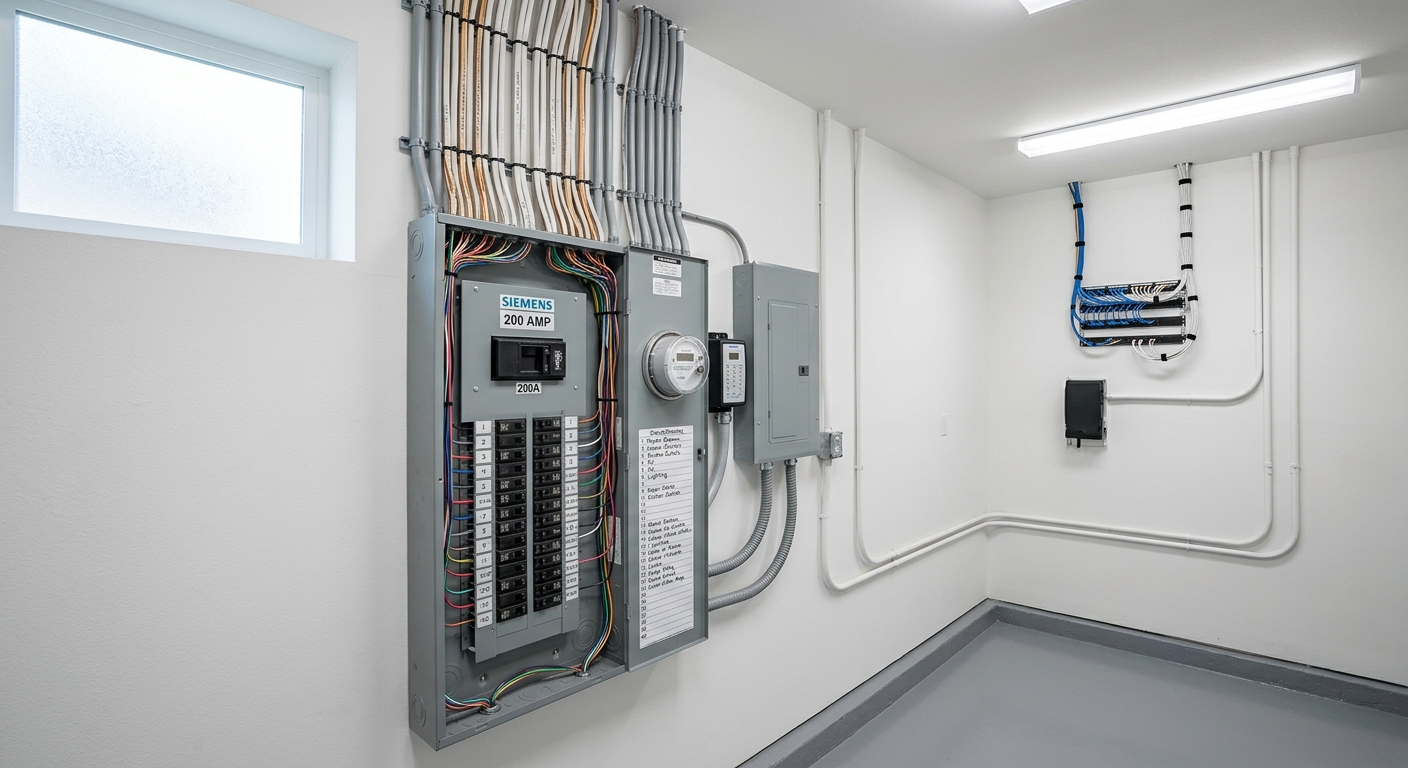
For budgeting, many projects fall into two common buckets: a panel upgrade/service work scope and broader wiring corrections. A full panel/service update often starts around the lower end of the local band, while wiring and rewire work can climb quickly when knob-and-tube or aluminum remediation is involved. Use the comparison below to sanity-check what a contractor may include in their quote, and what could move your cost up or down as the scope is confirmed.
| Service |
Why It's Needed |
Permit Required |
Price Range |
| Panel upgrade — 100A to 200A service |
Modern loads (EV charging, heat pumps, induction cooking) need capacity and proper load calculation. |
Yes |
$2,500 – $6,000 |
| EV charger installation (Level 2, 40–50A) |
Dedicated circuit and safe breaker/cable selection for continuous high-load charging. |
Yes |
$1,200 – $3,000 |
| Knob-and-tube wiring removal and replacement |
Older wiring insulation/contact risks and insurance/safety concerns; requires full approved replacement paths. |
Yes |
$4,000 – $20,000 |
| Aluminum wiring remediation (CO/ALR connectors) |
Approved connector terminations or targeted replacement for aluminum branch-circuit wiring. |
Usually, yes (major alterations) |
$4,000 – $12,000 |
| New dedicated circuit (HVAC, appliance, hot tub) |
Stops nuisance tripping and supports heavy appliances with correct conductor/breaker sizing. |
Yes |
$800 – $4,000 |
| Whole-home rewire (older home, full replacement) |
When multiple circuits/components are deteriorated, unsafe, or non-compliant; addresses throughout the house. |
Yes |
$10,000 – $25,000 |
Prices are estimates only and vary by project scope, site access and material selection.
What affects the price of electrical work in Sault Ste. Marie
In Sault Ste. Marie and the wider Northeast, it’s normal to see quotes for the “same” electrical job vary by 30% to 50%. The driver is usually not the electrician’s hourly rate alone—it’s what’s discovered once panels open, wiring is traced, and a load calculation is completed. In homes where 75.3% were built before 1981, contractors often need to plan for older wiring methods, aging insulation, and limited panel capacity. That combination pushes up labour time and increases material quantities, especially for re-routing and safe terminations.
Housing age is the dominant cost driver. Older installations can include knob-and-tube wiring, and insurer requirements increasingly push owners toward removal rather than “patching.” In addition, many mid-century homes have 60A or 100A services that can struggle when modern loads arrive—EV chargers, electric stoves, heat pumps, and even a hot tub running during peak winter demand. Aluminum wiring (notably common in homes from the 1960s to the mid-1970s) often requires approved CO/ALR connectors or section replacement, which is detail-heavy and must be done correctly to be code-compliant.
Local conditions also change costs in practical ways. For example, finishing work after wiring—drywall opening, insulation work, and reinstatement—can add several thousand dollars if the route requires ceiling or wall access. Conversely, if your home already has spare breaker spaces and copper branch wiring, a dedicated circuit for an EV charger may fall closer to the lower EV installation band; if you need a full service re-rate and panel work, your budget typically moves toward the higher end of the panel/service upgrade band (and sometimes beyond). As EV adoption grows—Sault Ste. Marie homeowners increasingly add Level 2 charging—expect more demand for permits and inspection scheduling, too.
| Price Factor |
Why It Matters |
Cost Impact |
| Panel size upgrade — 100A to 200A is the standard minimum today |
Requires reworking service conductors, panel equipment, grounding/bonding, and load calculation. |
Often the largest single line item on service work; commonly $2,500 – $6,000 |
| Wiring type — copper vs. aluminum remediation vs. K&T removal |
Aluminum and knob-and-tube increase tracing, terminations, and replacement scope. |
Can shift a project by thousands; wiring/removal often falls in the $4,000 – $20,000 range |
| Number of new circuits — each adds material and labour time |
Each circuit requires breaker, cable/conduit, routing, and testing. |
More circuits generally increases cost proportionally (materials + time) |
| Permit + ESA/TSBC inspection fee — mandatory for all major work |
Inspections and permit paperwork are required for service upgrades and new circuits. |
Direct add-on cost; also impacts scheduling |
| Labour rate for licensed electricians — journeyman rates in {region} |
Licensed work reflects higher overhead and compliance requirements. |
Higher labour time due to access/wiring complexity |
| EV charger amperage — 40A vs. 50A circuit affects cable and breaker cost |
Higher amperage can require larger conductors and breaker sizing. |
Typically small-to-moderate increase within EV install bands $1,200 – $3,000 |
| Emergency or after-hours premium |
Repairs outside standard hours require scheduling and response time. |
Can add a noticeable premium to the quote |
| Load calculation required for service upgrade |
Determines correct service capacity and avoids undersizing that causes repeated trips. |
Usually adds labour time, but prevents rework |
Permits & regulations in Ontario
In Ontario, electrical work must be done by a licensed electrician. Beyond changing a light bulb, most electrical tasks are regulated, including panel/service work, new circuits, rewiring, and anything that alters the supply, distribution, or protection devices. That means panel upgrades (for example, moving from 100A to 200A), installing a Level 2 EV charger circuit, adding a dedicated outlet circuit for an appliance, and replacing/rewiring branch circuits all require permits and inspection.
Permitted work must pass inspection by the electrical safety authority in Ontario (ESA). DIY electrical is restricted: homeowners can typically do non-electrical tasks like painting or installing fixtures that do not involve wiring connections, but they generally cannot perform wiring work that would require pulling conductors, changing breakers, modifying panels, or connecting the electrical supply. If a contractor tells you “no permit is needed,” ask what portion they’re doing versus what the permit covers.
To verify a contractor in Sault Ste. Marie step-by-step, start by confirming their Ontario licence in the ESA/online public registry (use the electrical contractor’s licence/individual licence details). Next, request a certificate of insurance (liability coverage) and confirm it’s current for the job. Finally, confirm WSIB/WCB coverage—your contractor should be able to provide clearance documentation upon request. For the specific work that’s being permitted, insist on written scope details so you can match the permit application to the actual changes being inspected.
When your Sault Ste. Marie home needs an electrical upgrade
Electrical upgrades aren’t just about avoiding inconvenience—they’re about preventing safety issues in a home that faces long, cold stretches. In Sault Ste. Marie, the winter load peak (baseboard heat, cooking, and often additional plug-in devices) can expose undersized services and aging wiring. Watch for five common warning signs.
(1) Breakers that trip regularly usually point to overloaded circuits, failing breakers, or an undersized/underserviced panel. (2) Knob-and-tube wiring is a key concern because of insulation condition and contact points, and it can trigger insurance cancellation even if it “still works.” (3) A 60A or 100A service is often inadequate when you run modern loads together—an EV charger, heat pump equipment, induction or electric stove use, and winter heating—so a 200A upgrade is commonly the standard solution after a proper load calculation. (4) Aluminum wiring (often pre-1976 construction) is not automatically an emergency if it has been maintained, but it does require licensed remediation or targeted replacement to ensure correct connections. (5) Insufficient outlets and the “extension-cord everywhere” pattern is a practical hazard and typically a code-compliance issue at home sales. (6) Missing AFCI/GFCI protection where required can also be a compliance red flag that surfaces during inspection or resale.
In this climate, minor issues can become major during cold months. For example, “just add one outlet” might be reasonable (or not) if you already have enough capacity; but if you keep tripping and you’re feeding multiple high loads, that same request can turn into a panel/service and load-capacity problem—where the cost difference is justified. A homeowner might spend a few hundred to a couple thousand on a dedicated circuit, but if the panel is at its limit, planning for a service upgrade (often in the $2,500 – $6,000 band) prevents repeat failures and improves safety.
| Warning Sign |
What It Means |
Recommended Action |
Urgency |
Price Band |
| Breakers trip frequently |
Overloaded circuits, undersized panel capacity, or faults in wiring/devices. |
Electrical troubleshooting and load assessment; may require new circuits or service upgrade. |
Immediate |
$800 – $6,000 |
| Knob-and-tube wiring present |
Aging insulation/contacts; often triggers insurance issues and safety concerns. |
K&T removal and replacement (targeted or whole-home depending on extent). |
Planned (urgent to schedule) |
$4,000 – $20,000 |
| 60A or 100A panel (inadequate load capacity) |
Modern winter demand and EV loads can exceed safe operating capacity. |
Service upgrade to 200A with load calculation. |
Planned |
$2,500 – $6,000 |
| Aluminum wiring (pre-1976 construction) |
Connection performance and termination requirements for aluminum conductors. |
Licensed remediation with approved connectors or replacement of affected sections. |
Planned |
$4,000 – $12,000 |
| Insufficient outlets — extension cords everywhere |
Overloading of receptacles and increased trip hazards; often indicates poor circuit planning. |
Add receptacles and dedicated circuits where needed; remove unsafe cord use. |
Immediate to planned |
$800 – $4,000 |
| No AFCI or GFCI protection where required |
Higher risk of arc-fault and shock hazards; common compliance gap during resale/renovation. |
Upgrade to code-compliant protection (breakers and/or receptacles as applicable). |
Planned |
$300 – $6,000 |
How to choose a electrical work contractor in Sault Ste. Marie
Choosing the right electrician matters more in Sault Ste. Marie than in many places because older housing stock can hide surprises behind finished walls. Start by verifying Ontario licensing: ask for the contractor’s licence details and confirm them through the Ontario electrical safety public tools/registry. Then verify liability insurance and WSIB/WCB coverage. Insist on current documents before work begins—don’t rely on verbal assurances.
For pricing, don’t accept a single vague line like “electrical panel work.” Get 2 to 3 itemised written quotes with a labour-and-materials breakdown. Make sure the scope is specific: what is included for panel hardware, breakers, cable, grounding/bonding, disposal, and any restoration costs. Ask directly whether permit pulling is included and whether inspection scheduling is part of the contractor’s service. A permit-required project should have that cost and process clearly listed.
Also review warranty terms. You typically want a workmanship warranty stated in writing (often at least 1 year, sometimes longer), plus clarity on manufacturer warranties for breakers, chargers, and panels. Confirm whether warranties are transferable to future owners—helpful if you’re planning to sell. On payment schedule, avoid large prepayments: never pay more than about 10% to 15% upfront, and use a holdback until the job is complete and inspected. Finally, request a written start date and a completion estimate.
- Confirm Ontario licence information (contractor and/or individual electrician) before signing.
- Request a certificate of liability insurance and verify the policy is active.
- Verify WSIB/WCB clearance documentation is current for your project.
- Get at least two itemised quotes with labour and material lines—not just totals.
- Ask who pulls the ESA permit and whether inspection fees are included.
- Confirm what’s included for cable routing, conduit, and grounding/bonding.
- Clarify restoration scope (drywall/insulation access and reinstatement).
- Make sure disposal/garbage removal is included or priced separately.
- Check warranty length for workmanship and product components.
- Use a payment schedule with a holdback until inspection and cleanup.
- Get a written start date and a completion timeframe.
- Require diagrams or a written summary of the work plan for complex jobs.
Red flags in Sault Ste. Marie include: (1) refusing to provide licence/insurance/WSIB proof; (2) giving only a lump-sum estimate without itemisation or testing details; (3) suggesting you don’t need a permit for a service upgrade or EV charger circuit; (4) asking for full payment upfront; and (5) avoiding written inspection/permit responsibilities. If you see these, keep shopping.
Frequently asked questions — electrical work in Sault Ste. Marie
What is knob-and-tube wiring and should I replace it?
Knob-and-tube (K&T) wiring is an older wiring method typically found in homes built decades earlier, where conductors are routed on porcelain knobs and carried through tubes where they pass through framing. In Sault Ste. Marie, with many homes built before 1981, K&T is a frequent topic because it’s not just “old”—it can be difficult to maintain safely as insulation ages, and connections may be deteriorated. Even if outlets still work today, insurers may refuse coverage or require remediation, and resale inspections can flag it.
Whether you must replace it depends on extent and condition, but most homeowners who have K&T (especially in active living areas) choose removal rather than partial patching. A targeted replacement can be less than a full rewire, but broad removal often lands in the $4,000 – $20,000 range once permits, testing, and full replacement runs are included. The safest approach is an electrician’s trace-and-assess visit followed by a permit-backed plan.
Is aluminum wiring safe in older Sault Ste. Marie homes?
Aluminum wiring can be safe when it’s installed and maintained correctly, but it requires special attention at terminations. In older Sault Ste. Marie homes, aluminum branch circuits (often seen in mid-century builds) can develop connection issues over time due to thermal cycling. The key is whether the wiring has been correctly terminated using approved methods and connectors, and whether connections have been inspected and remediated where needed.
Licensed remediation typically uses approved CO/ALR connectors and proper re-termination, or replaces affected sections where necessary. If the workmanship and connector type are correct, many homes operate normally. However, if the aluminum is in poor condition or the connections are not compliant, you’re better off budgeting for remediation rather than waiting for a failure.
Costs commonly depend on how many terminations are involved. For many projects, homeowners see estimates within the $4,000 – $12,000 band, especially when permits, testing, and targeted replacement are included.
Do I need a permit for electrical work in Ontario?
In Ontario, electrical work beyond very minor tasks generally requires a licensed electrician and permits for regulated changes. In Sault Ste. Marie, that means permits are typically required for panel upgrades/service changes, rewiring, adding new circuits, and installing EV charger circuits. If the work changes the circuit design, conductor routing that affects protection, or the electrical supply/panel equipment, plan on permitting and inspection.
Work must be inspected by the Electrical Safety Authority (ESA) before it’s considered compliant. DIY electrical is restricted; homeowners usually cannot perform the kind of wiring work that would require permits and inspection. The practical question to ask your contractor is: “What exactly will you pull under the permit, and what parts of the job are covered?”
To manage risk, verify your electrician’s Ontario licence and confirm permit responsibility is clearly written on the estimate. For major work like a service upgrade (often in the $2,500 – $6,000 band), a properly permitted and inspected job is essential for safety and for future resale confidence.
What are signs of an overloaded electrical panel?
Signs of an overloaded electrical panel usually show up as nuisance trips or performance issues when you use multiple loads at once. In a Sault Ste. Marie winter, it’s common to notice this when baseboard heat runs alongside cooking, laundry, and occasional plug-in devices. If breakers trip frequently—or you notice that certain rooms always “go dark” when multiple appliances are on—that points to undersized circuits, faulty breakers, or a panel that can’t comfortably support your total demand.
Another sign is when you routinely rely on extension cords for “extra outlet needs,” which often means the circuit design doesn’t match your household’s real load. Also watch for panels that feel warm, have burning odours, or have discoloured breaker terminals—those are urgent safety indicators.
If you’re seeing trips and you have a 60A or 100A service, a load calculation and panel assessment are the next step. Many service upgrades in Ontario fall around the $2,500 – $6,000 range, but the correct solution depends on your wiring type, circuit distribution, and confirmed load.
Can I do my own electrical work in Ontario?
In Ontario, you generally should not plan to do electrical wiring work yourself for regulated tasks. Sault Ste. Marie homeowners often ask this when they want to save money, but the rules are designed around safety: electrical work that changes wiring, breakers, panels, receptacles, or circuits typically must be performed by a licensed electrician and often requires permits and inspection.
There are narrow exceptions for things that are not regulated wiring work (for example, changing some non-wired components that don’t involve connecting conductors). But as soon as the job involves pulling cables, terminating in a panel, modifying protection devices, or adding circuits, you’re in permit-and-licensing territory.
If you want to reduce costs legally, you can still do non-electrical prep: clear access, document where fixtures are, confirm what loads you need, and discuss fixture placement so wiring routes are efficient. Then hire a licensed contractor to handle the regulated parts and provide the required ESA permit and inspection.
How long does a rewiring job take?
Rewiring timelines vary widely depending on the home size, the wiring method being removed, and how accessible the walls/ceilings are. In Sault Ste. Marie, older homes can add complexity—finished walls may require more opening to trace knob-and-tube sections or aluminum runs, and cold-weather conditions can affect access to certain service routes (especially if parts of the job touch exterior conduit or older service entry areas).
A partial rewire (for example, replacing specific circuits feeding kitchens or major appliances) can take days to about a week, while a whole-home rewire is often a multi-week project because it includes testing, rough-in, protection setup, and comprehensive final checks before inspection. Permits and inspection scheduling also influence the calendar.
To budget properly, ask your contractor for an itemised scope and a start-to-finish schedule in writing, including inspection milestones. Cost and time are linked: the deeper the replacement scope, the more labour time is required—projects that fall into the broader wiring bands like $4,000 – $20,000 may have very different timelines depending on how much wall opening and replacement is needed.