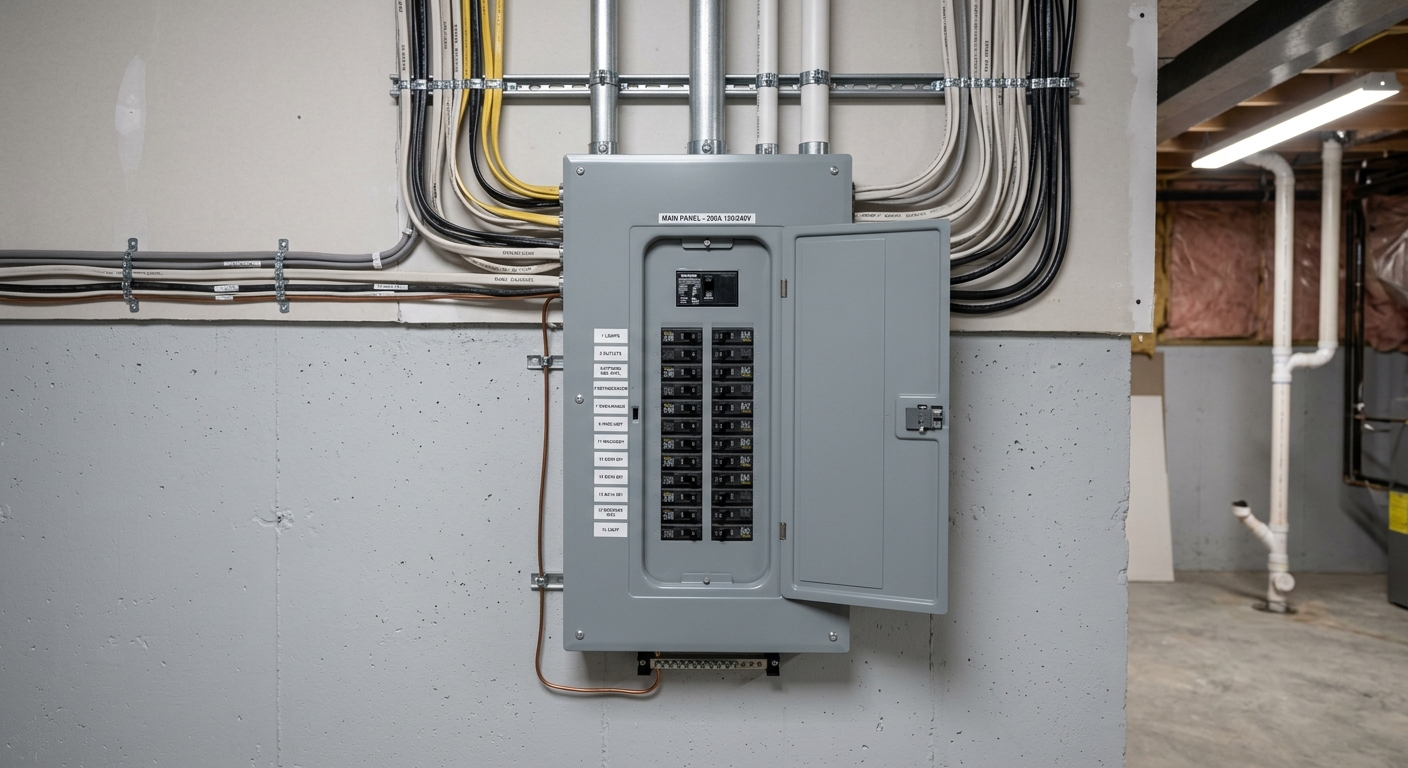
Electrical services and costs in Cambridge
Electrical work in Cambridge, Ontario is often shaped by the age and energy needs of the housing stock. With 48.4% of homes built before 1981 (Statistics Canada, 2021 Census), many homeowners end up planning panel upgrades, knob-and-tube removal, or aluminum wiring remediation—especially when finishing basements, adding a legal secondary suite, or upgrading kitchen and laundry appliances. That older construction mix also means contractor availability can be strong, but labour scheduling may vary by neighbourhood and season.
In the Kitchener–Waterloo–Barrie region, winter conditions and year-round home renovations push electrical demand upward. Cold-weather use (fans, heat sources, dehumidifiers, and entertainment loads) combined with rising EV adoption can quickly expose an undersized service. It’s common to see homes starting with 100A services that struggle once you add a 40–50A Level 2 charger, electric stove upgrades, and modern heat-pump operation—making a 200A service and modern breakers the prudent safety and code-compliance route.
In Cambridge, work is especially in demand around areas with a lot of 1970s–1980s builds and frequent renovation activity, including the south end near Preston and Galt’s older residential pockets, where service upgrades and rewires are often paired with lighting and basement development.
Below is a practical comparison of common electrical services and what homeowners typically budget for in Cambridge, so you can align quotes with the scope of work and permit requirements.
| Service |
Why It's Needed |
Permit Required |
Price Range |
| Panel upgrade — 100A to 200A service |
Increases safe capacity, adds modern circuit breakers, improves grounding/overcurrent protection, and supports today’s loads (EV chargers, heat pumps, electric appliances). |
Yes (service change/permit + ESA inspection) |
$2,500 – $7,000 |
| EV charger installation (Level 2, 40–50A) |
Adds dedicated charging with proper overcurrent protection; reduces risk of nuisance tripping and improves electrical safety. |
Yes (new circuit/permit + ESA inspection) |
$800 – $2,500 |
| Knob-and-tube wiring removal and replacement |
Addresses deteriorated insulation, improper grounding, and elevated fire risk; improves insurance insurability and compliance with modern standards. |
Yes (rewiring/permit + ESA inspection) |
$4,000 – $15,000 |
| Aluminum wiring remediation (CO/ALR connectors) |
Stabilizes connections and reduces heat risk at devices/breakers using approved CO/ALR methods or targeted replacement. |
Often yes (depending on extent; typically permit + ESA inspection for major work) |
$4,000 – $12,500 |
| New dedicated circuit (HVAC, appliance, hot tub) |
Reduces overload on existing circuits, improves performance/reliability, and supports code-compliant protection. |
Yes for most new circuits (permit + ESA inspection) |
$600 – $3,200 |
| Whole-home rewire (older home, full replacement) |
Replaces aging wiring and integrates modern protection (AFCI/GFCI where required), safer routing, and updated capacity. |
Yes (rewiring/permit + ESA inspection) |
$12,000 – $35,000 |
Prices are estimates only and vary by project scope, site access and material selection.
What affects the price of electrical work in Cambridge
In Cambridge and the wider Kitchener–Waterloo–Barrie region, two quotes for the same electrical project can differ by 30–50% because the “scope under the hood” often changes. In practical terms, an electrician may quote one option with a targeted fix and another with a full safety upgrade (new breakers, updated grounding, AFCI/GFCI where required, and sometimes cable replacement throughout). Both can be valid, but only one will reliably handle modern loads like EV charging and heat-pump demand.
Housing-stock age is the dominant cost driver. Older homes built before 1950 can involve knob-and-tube wiring and deteriorated insulation, while homes from the 1960s–70s often have 60A or 100A panels that are inadequate for today’s combined loads. In homes built during the aluminum-wiring era (commonly 1965–1976), remediation requires licensed work and approved CO/ALR connectors—targeted fixes may be cheaper, but full-area replacement is sometimes the safest path when connections are compromised. EV adoption is also driving a surge in Level 2 charger permit applications, and that often means more likely panel capacity constraints during installation planning.
Concrete local examples in Cambridge that move pricing include: (1) basement finishes in older neighbourhoods near Preston or downtown Kitchener-area commuter corridors—if drywall must be opened, rework labour can add thousands; (2) whether the service route requires new conduit through brick or difficult crawlspaces, which can shift a panel upgrade cost toward the upper end of the $2,500–$7,000 band; and (3) whether the job stays “panel-and-breakers only” versus a full wiring correction, which frequently pushes rewiring toward the $4,000–$15,000 range and beyond for whole-home replacement.
| Price Factor |
Why It Matters |
Cost Impact |
| Panel size upgrade — 100A to 200A is the standard minimum today |
More breakers and capacity are needed to safely run modern appliances, heat sources, and EV charging. |
Can move the job into the $2,500–$7,000 band for service/panel work. |
| Wiring type — copper vs. aluminum remediation vs. K&T removal |
Aluminum and knob-and-tube require specific handling, approved connections, and often more labour/testing. |
Typically increases from mid-range electrical to upper-range rewiring budgets ($4,000–$15,000). |
| Number of new circuits — each adds material and labour time |
Dedicated circuits require cable, protection, routing, and terminations. |
Each extra circuit can add several hundred to a few thousand depending on distance and finishes. |
| Permit + ESA/TSBC inspection fee — mandatory for all major work |
Major work requires ESA permits/inspections in Ontario, and fees are built into professional pricing. |
Adds a fixed base cost but prevents delays from missing inspections. |
| Labour rate for licensed electricians — journeyman rates in the region |
Ontario requires licensed electricians; insured contractors price labour accordingly. |
Labour swings can account for a large portion of the 30–50% quote variation. |
| EV charger amperage — 40A vs. 50A circuit affects cable and breaker cost |
Higher amperage can require different breaker/cable sizing and sometimes more panel capacity. |
Can affect the charger job cost within the $800–$2,500 range. |
| Emergency or after-hours premium |
Service issues after hours often require scheduling priority and additional supervision. |
Can add a noticeable premium versus daytime scheduling. |
| Load calculation required for service upgrade |
Proper calculation determines whether 200A is sufficient and what breakers/circuits can be added. |
May add design time; avoids costly rework and safety oversights. |
Permits & regulations in Ontario
In Ontario, all electrical work beyond changing a light bulb must be performed by a licensed electrician, and many projects require a permit and inspection. For Cambridge homeowners, that means panel upgrades (including 100A to 200A service changes), adding new circuits, rewiring, and installing EV charger circuits almost always require an electrical permit. Any service change is treated as major work and must be inspected by the Electrical Safety Authority (ESA) before it can be energized and signed off.
What typically does require a permit in practice: new breaker/circuit additions (including EV chargers and dedicated HVAC/hot tub circuits), replacing a panel, relocating panel components, replacing or upgrading service equipment, and full or partial rewiring. What typically does not: swapping a like-for-like receptacle cover plate, replacing a bulb or fixture where the existing wiring method remains unchanged and no new circuits are created (still follow the licensed scope rules—if in doubt, your electrician should confirm).
To verify a contractor for Cambridge work, start with: (1) confirming their Ontario licence using the ESA/public licence registry; (2) requesting proof of liability insurance (certificate of insurance naming you if required by your contract); and (3) confirming Workers’ Compensation coverage (WSIB/WCB) for their employees. Ask for the clearance letter or the COI and coverage number before work begins—good contractors will provide it quickly, because it’s part of their compliance routine.
When your Cambridge home needs an electrical upgrade
Electrical upgrades in Cambridge aren’t just about getting more outlets—they’re often about safety and code-compliance. Start with the warning signs that can impact day-to-day reliability in Ontario winters and the ability to handle modern loads.
First, breakers that trip regularly usually signal an overloaded circuit or a failing component. If you notice this when running a hair dryer, microwave, baseboards, or when charging an EV, that’s a “stop and assess” situation—planned upgrade work is typically needed, not DIY troubleshooting. Second, knob-and-tube wiring is a key concern because insulation can contact surfaces and lose integrity over time; the issue is not only age, but how the wiring has been deteriorating. Third, if you have a 60A or 100A service, it may be inadequate for a modern Cambridge setup—especially with EV charging, heat pump operation, and electric stove use occurring together. A 200A upgrade is the standard safety solution because it increases capacity and allows proper breaker configuration. Fourth, aluminum wiring (often in pre-1976 construction) may not be immediately dangerous if connections are solid, but it requires licensed remediation to restore safe, reliable terminations. Fifth, insufficient outlets with constant extension cords is a practical overload warning—extension cords are a fire-risk when used repeatedly. Finally, missing AFCI or GFCI protection (where required) can be a compliance problem that surfaces during resale or when circuits are altered.
As an example of where the “right option” is worth the spend: if your panel upgrade is only partially addressing an underlying wiring issue, you may pay less upfront but end up with repeated tripping and higher troubleshooting. In many Cambridge cases, investing within the $2,500–$7,000 panel/service range plus a proper wiring correction plan can be cheaper than repeated callbacks, especially in older, renovation-heavy homes.
| Warning Sign |
What It Means |
Recommended Action |
Urgency |
Price Band |
| Breakers trip frequently |
Possible overload, short, failing breaker, or undersized/incorrectly protected circuit. |
Schedule an electrical inspection and load/circuit evaluation; add dedicated circuits and/or upgrade protection. |
Immediate action |
$600 – $3,200 |
| Knob-and-tube wiring present |
Deteriorated insulation and increased risk; often problematic for insurance and modern code expectations. |
Plan removal/replacement and update grounding and protection. |
High urgency |
$4,000 – $15,000 |
| 60A or 100A panel (inadequate load capacity) |
Not enough capacity for modern loads like EV charging, heat pumps, and electric appliances. |
Perform a service/panel upgrade with a new breaker configuration and grounding improvements. |
High urgency |
$2,500 – $7,000 |
| Aluminum wiring (pre-1976 construction) |
Risk of heat at connections if not properly remediated with approved methods. |
Have a licensed electrician inspect and remediate with CO/ALR methods or replacement where needed. |
Planned upgrade |
$4,000 – $12,500 |
| Insufficient outlets — extension cords everywhere |
Likely circuit overload and unsafe temporary wiring practices. |
Add outlets and/or dedicated circuits; address AFCI/GFCI where required. |
Planned upgrade |
$600 – $3,200 |
| No AFCI or GFCI protection where required |
Older installations may not provide modern arc-fault and ground-fault protection. |
Upgrade receptacles/breakers and update protection as part of a broader circuit refresh. |
Planned upgrade |
$1,000 – $5,500 |
How to choose a electrical work contractor in Cambridge
Choosing the right electrical contractor in Cambridge is mostly about verification, clarity, and control of risk. Start by confirming Ontario licensing: ask for their Ontario licence number and verify it on the Electrical Safety Authority (ESA) resources. Next, request proof of liability insurance (certificate of insurance) so you’re covered for jobsite incidents. For Workers’ Compensation, confirm WSIB/WCB coverage for their employees—ask for the clearance letter or coverage proof before work starts.
Then, get 2–3 itemised written quotes. “Itemised” means labour and materials separated (for example: panel, breakers, cable/conduit, grounding components, AFCI/GFCI devices, and any access/disassembly labour). Ensure the scope is complete: confirm whether permits are included, whether ESA inspection fees are in the quote, and whether disposal of old materials is covered or quoted separately.
Warranty matters: insist on a clear workmanship warranty period (how long they stand behind installation errors) and distinguish that from manufacturer warranties on parts. For payment, avoid paying more than 10–15% upfront; hold back a portion until the job is complete and inspected. Finally, get a start date and a completion timeline in writing, including what happens if ESA inspection scheduling delays the energization.
- Ask for their Ontario licence number and verify it on the ESA resources.
- Confirm liability insurance and obtain the COI before work begins.
- Verify WSIB/WCB clearance or coverage documentation.
- Request 2–3 itemised quotes (labour + materials), not lump sums.
- Clarify whether ESA permits and inspection fees are included.
- Confirm disposal/recycling of old breakers, panels and wiring.
- Ask what brand/equipment models are being quoted (panel, breakers, AFCI/GFCI).
- Ensure the quote states exactly which circuits will be upgraded or added.
- Ask if a load calculation is included for service upgrades.
- Review warranty length for workmanship and whether it is transferrable.
- Set a payment schedule with a holdback until completion and sign-off.
- Get timelines in writing, including ESA inspection scheduling expectations.
Common red flags I see in Cambridge include: quotes that won’t list panel/breaker models, “no permit needed” claims for service changes, refusing to provide WSIB/WCB paperwork, vague scope language that excludes access/restoration, and pressuring you for full payment before inspection or commissioning.
Frequently asked questions — electrical work in Cambridge
Why do my breakers keep tripping?
In Cambridge, breakers that trip repeatedly often come down to overloads, failing breakers, or circuits that can’t handle the modern load profile of the home. Common triggers include EV charging, running kitchen appliances alongside heat sources, and older wiring that doesn’t tolerate the current demand. If your home is one of the many in Cambridge built in earlier decades—remember 48.4% of local homes were built before 1981 (Statistics Canada, 2021 Census)—you may also be dealing with outdated protection or wiring that needs remediation.
The safest next step is an inspection focused on which circuit trips, when it trips, and what’s connected. A proper load assessment can show whether you need a dedicated circuit, AFCI/GFCI changes, or—if you’re near capacity—a service/panel upgrade in the $2,500–$7,000 range.
How do I compare electrical quotes?
When comparing quotes for the same electrical work in Cambridge, don’t just compare the total price—compare what’s included. Ask each contractor for an itemised breakdown: labour hours, materials (panel model, breaker type, AFCI/GFCI devices), cable/conduit routing assumptions, and any drywall/access restoration allowances. For panel upgrades and rewiring, confirm that ESA permits and inspection fees are included, and that the quote clearly states whether a load calculation is performed.
Also look for “scope gaps” that can create surprise costs: disposal of old equipment, upgrading grounding/neutral components, and whether copper/ALR methods are specified for aluminum wiring. A realistic baseline for many Cambridge panel/service updates is the $2,500–$7,000 band, while rewiring projects often fall in the $4,000–$15,000 range depending on wiring type and the number of circuits addressed.
How long does a panel upgrade take in Cambridge?
Typical panel upgrades in Cambridge take about one day of active installation for straightforward access, but the overall timeline depends on prep work and ESA scheduling. If drywall opening is required for conduit/grounding paths, or if the existing service equipment is in a difficult location, the active work can stretch to two days. After the install, the permit and ESA inspection must be completed before the system is cleared for ongoing use.
If your upgrade is tied to adding new circuits—like an EV charger—and especially if you’re moving from a 100A service to a 200A service, plan for more coordination. EV charger installations are commonly paired with panel upgrades to keep the electrical capacity correct, so it’s not unusual for the whole project to take longer than the day the panel is swapped.
What is a GFCI outlet and where is it required in Ontario?
A GFCI (ground-fault circuit interrupter) outlet is designed to quickly shut off power when it detects leakage current to the ground, which significantly reduces shock risk. In Ontario, GFCI protection is required in locations where shock risk is higher—most notably bathrooms, kitchens where code requires it, garages, outdoors, basements (depending on wiring configuration and the specific zone requirements), and other wet or damp areas.
In Cambridge homes, this often comes up during renovations or circuit upgrades, because older panels and devices may not have modern protection. If you’re adding new circuits or replacing devices, your electrician should bring those circuits up to current Ontario requirements, including GFCI and where applicable AFCI. Pricing varies by scope, but small protection updates can be part of broader electrical refresh work within common electrical budgets.
How do I know if my Cambridge home has aluminum wiring?
You can’t reliably guess aluminum wiring just by age, but many Cambridge homes built in the aluminum-wiring era (commonly 1965–1976) are more likely to have it. The most dependable confirmation is by inspection: your licensed electrician can open accessible outlets, switches, and the panel area (with power safety procedures) and check the conductor marking. Aluminum cable is often labelled, and terminations may show signs of a different conductor type.
Another tell is the presence of devices installed with specific connector methods and whether the wiring appears unusually stiff or has unique marking/colour characteristics. Don’t rely on appearance alone—aluminum can be safely remediated only with proper licensed workmanship using approved methods (such as CO/ALR connectors) or replacement where needed. If you suspect aluminum wiring, plan for an inspection before you budget, since remediation cost depends on how much is affected.
What is the cost of rewiring a house in Cambridge?
The cost of rewiring in Cambridge depends heavily on wiring type, home size, access (finished basements vs. open framing), and how many circuits need replacement. In this region, many rewires are driven by older construction and legacy wiring. For example, whole-home rewires commonly land above smaller “targeted” projects because you’re replacing more cable, more devices, and potentially upgrading protection such as AFCI/GFCI.
As a budgeting guideline, wiring & rewiring projects often fall in the $4,000–$15,000 range for partial-to-moderate scopes, while whole-home replacement can be higher depending on the extent of the work. For many homeowners with panel capacity issues (like 60A or 100A services) and modern load demands (EV charging, heat pumps), you may also need a service/panel upgrade, which commonly fits the $2,500–$7,000 band. A detailed, itemised quote is the best way to match the price to the actual scope in your Cambridge home.