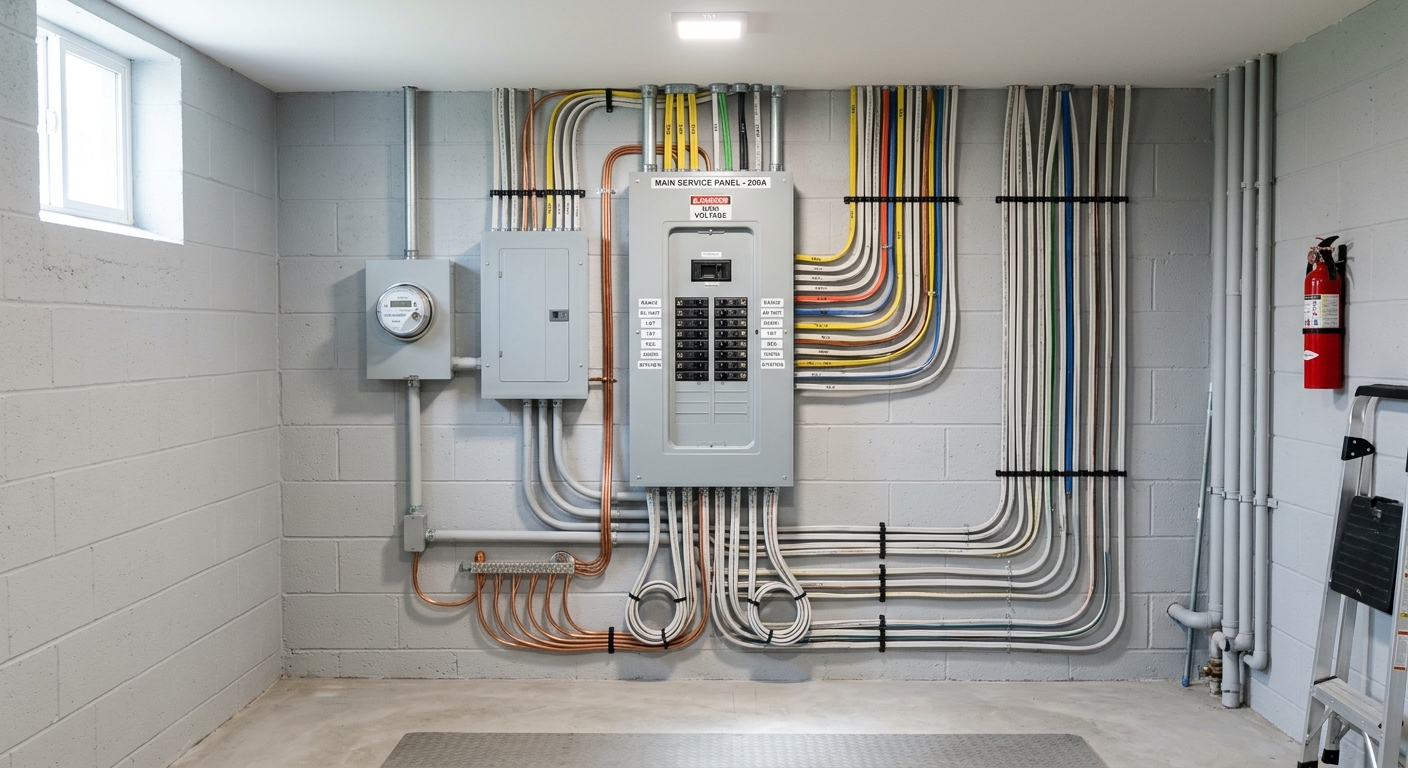
Electrical services and costs in Danforth East York
Electrical services in Danforth East York, Ontario tend to reflect two realities at once: a large stock of older housing, and a steady wave of upgrades for EVs, heat pumps, finished basements, and rental conversions. With a 2021 population of 17,180 residents (Statistics Canada, 2021 Census), the area is dense, and that density is why contractors are busy and scheduling can be tight. It also means more call-outs in older pockets—where knob-and-tube and other legacy wiring are still encountered—along with more service capacity requests when homeowners modernize kitchens, add A/C, or install Level 2 charging. In practice, many projects start as “just a new circuit” but uncover wiring and panel limits that call for a larger fix to meet today’s Ontario Electrical Code requirements.
Toronto’s market conditions directly affect labour rates and availability. Winter cold and temperature swings can also complicate service-upgrade work: outdoor service parts and conduit can be harder to access and test, and some parts may require additional time for safe handling. In Danforth East York—especially around Thorncliffe Park and the older sections near Danforth Avenue—demand is often concentrated in homes from mid-century through the postwar era. That’s where you most commonly see 60A or 100A panels that can’t comfortably support today’s combined loads, such as EV charging alongside heat pumps and electric ranges. The result is that panel and service upgrades are often paired with wiring remediation rather than priced as standalone “bolt-on” work.
Below is a practical comparison of common electrical services and what typically triggers permits, inspections, and the associated cost range in this part of Toronto, before we break down the pricing drivers in the next section.
| Service |
Why It's Needed |
Permit Required |
Price Range |
| Panel upgrade — 100A to 200A service |
Provides additional capacity for modern loads (EV charging, heat pumps, electric stoves) and improves safety and code compliance. |
Yes (permit and ESA inspection required for service/panel work) |
$2,500–$6,000 |
| EV charger installation (Level 2, 40–50A) |
Supports faster charging than Level 1 and typically requires a dedicated breaker and correct circuit wiring. |
Yes (permit and inspection required) |
$900–$2,500 |
| Knob-and-tube wiring removal and replacement |
Legacy wiring insulation and connections can be unsafe; replacing reduces fire risk and helps meet insurance expectations. |
Yes (rewiring/major electrical work) |
$5,000–$15,000 |
| Aluminum wiring remediation (CO/ALR connectors) |
Approved connections (CO/ALR devices) are used to safely terminate and reduce heat/risk at joints. |
Often yes (depending on scope; major remediation typically requires permit) |
$3,000–$8,000 |
| New dedicated circuit (HVAC, appliance, hot tub) |
Adds safe dedicated power for high-demand equipment; reduces nuisance trips and prevents overloaded shared wiring. |
Yes (new circuits commonly require permit) |
$900–$2,800 |
| Whole-home rewire (older home, full replacement) |
When legacy wiring and old panel infrastructure are widespread, full replacement is often the safest and most future-proof option. |
Yes (permitted rewiring with inspections) |
$8,000–$20,000 |
Prices are estimates only and vary by project scope, site access and material selection.
What affects the price of electrical work in Danforth East York
In Danforth East York, two homeowners can receive quotes that differ by 30–50% for what sounds like the same job because the underlying “hidden scope” varies—especially in older homes. Toronto’s dense neighbourhoods mean contractors price for labour intensity: access to panels, routing through finished walls, and the number of junction locations to remediate. On top of that, licensed electrical contractors in the GTA commonly bill around 90–120 per hour, and that labour component is a major driver of total cost in both wiring and service upgrades.
Age of the housing stock is usually the dominant cost driver. Homes with wiring dating back to the pre-1950 era can include knob-and-tube, which may lead to insurance refusals and safety concerns; that pushes projects toward partial or full rewires. Mid-century homes from the 1960s–70s often have panels that are outdated for today’s combined loads—think EV chargers plus heat pumps plus an induction range. Aluminum wiring, common in homes built around 1965–1976, generally requires licensed remediation using approved connectors (CO/ALR) or full replacement when remediation isn’t feasible. EV adoption is also changing the workload: Level 2 charger permit applications have become common, and that affects how quickly contractors can schedule capacity upgrades.
Concrete local examples in Danforth East York that change pricing: a panel located behind drywall in a narrow hallway costs more than a garage-access panel; adding a 50A EV circuit to a home with a 60A service commonly pushes you from a “new circuit” mindset into a panel upgrade plan (often in the $2,500–$6,000 range for 200A service). Conversely, if your wiring is mostly modern copper and you only need one properly routed run, dedicated circuit work can stay closer to the lower end of the $900–$2,800 band. Winter access constraints can also add labour time, because outdoor service components and conduit work must be done safely in cold conditions—especially near front entries where excavation and access are more disruptive.
| Price Factor |
Why It Matters |
Cost Impact |
| Panel size upgrade — 100A to 200A is the standard minimum today |
Modern loads often exceed 60A/100A capacity, and code-compliant margins are needed. |
$2,500–$6,000 |
| Wiring type — copper vs. aluminum remediation vs. K&T removal |
Legacy materials change the method and amount of labour needed for safe terminations or replacement. |
$3,000–$15,000 |
| Number of new circuits — each adds material and labour time |
Each circuit typically needs cable, breakers, testing, and routing work. |
$900–$2,800 (per dedicated circuit, typical) |
| Permit + ESA/TSBC inspection fee — mandatory for all major work |
Permits and inspections are required and included in contractor pricing. |
$200–$500 |
| Labour rate for licensed electricians — journeyman rates in Ontario |
Time on site is the biggest controllable variable for most installs and rewires. |
$90–$120 / hour typical |
| EV charger amperage — 40A vs. 50A circuit affects cable and breaker cost |
Higher amperage typically means heavier conductors and appropriate breaker sizing. |
$900–$2,500 (typical total) |
| Emergency or after-hours premium |
Call-outs add overhead and shift premiums to meet safety needs quickly. |
$300–$1,200 (varies by timing/scope) |
| Load calculation required for service upgrade |
Determines whether 200A is sufficient or whether additional capacity or upgrades are needed. |
$0–$600 (often bundled; sometimes separate) |
Permits & regulations in Ontario
In Ontario, ALL electrical work beyond changing a light bulb must be completed by a licensed electrician. That includes panel upgrades, new circuits, rewiring, service work, and EV charger installations—anything that can affect wiring methods, protection devices, or the service capacity. For these jobs, you must have permits, and all permitted work must pass inspection by the Electrical Safety Authority (ESA) in Ontario. If you’re hiring for Danforth East York or anywhere in the province, your electrician should discuss permitting early so there are no surprises about inspection timing or documentation.
What typically does not require a permit or electrician, in most homeowner scenarios, is like-for-like replacement of a fixture (where wiring isn’t altered), or swapping a receptacle faceplate if you’re not touching conductors. However, anything involving opening junction boxes, changing wiring routes, moving circuits, installing new breakers, or connecting to the panel/service is considered “work beyond replacement” and is where permits and licensing matter.
To verify a contractor for Ontario work, start with the electrician/business licence details using Ontario’s licence verification/registry tools, then request a Certificate of Insurance (liability coverage) and proof of WSIB/WCB coverage. Ask for a clearance letter or equivalent confirmation of coverage—especially if they’ll be working in occupied homes. Finally, confirm the permit will be pulled in your name or under the contractor’s process, and ensure the scope matches what’s on the permit application.
When your Danforth East York home needs an electrical upgrade
If you own a home in Danforth East York, the goal is to spot safety-critical electrical issues early—before they turn into damaged wiring, nuisance trips, or failing home inspections. Start with five common warning signs. (1) Breakers that trip frequently: this is often an overloaded circuit, a failing breaker, or a wiring capacity problem. If it’s repeated, treat it as a safety issue and book an inspection. (2) Knob-and-tube wiring present: the key concern isn’t just “age”—it’s deteriorated insulation and old connection methods, which can lead to insurance cancellations and elevated fire risk. (3) A 60A or 100A service: it’s frequently inadequate once you add an EV charger, a heat pump, and modern kitchen loads. In most cases, upgrading to 200A is the standard solution for safe capacity. (4) Aluminum wiring (commonly seen in pre-1976 construction): it may function safely if maintained, but it generally needs licensed remediation and approved connections (CO/ALR) to address termination issues. (5) Insufficient outlets—extension cords everywhere: that’s a “pattern” indicator of overloaded power strips and unsafe temporary wiring habits.
Don’t ignore code-compliance gaps either. No AFCI or GFCI protection where required can surface during resale or after a renovation, and addressing it sooner can be cheaper than rework later. For Danforth East York’s climate—where winter heating demand and household electronics usage rise—load stress is more likely in colder months, particularly in homes with aging panels and older wiring routes. A practical example: if you only add an EV circuit to a limited panel, you may end up paying again when you discover capacity shortfalls; spending toward a 200A upgrade (often in the $2,500–$6,000 range) can be the more justified option compared to repeated troubleshooting and partial fixes.
| Warning Sign |
What It Means |
Recommended Action |
Urgency |
Price Band |
| Breakers trip frequently |
Possible overload, faulty breaker, or circuit/wiring capacity that can’t support current loads. |
Inspection, identify tripping circuit, and add capacity or correct wiring. |
High (book promptly) |
$900–$2,800 |
| Knob-and-tube wiring present |
Legacy wiring insulation/connection issues raise safety and insurance concerns. |
Plan partial or whole-home replacement depending on spread. |
High (safety-first) |
$5,000–$15,000 |
| 60A or 100A panel (inadequate load capacity) |
Limited headroom for EV charging, heat pumps, and modern appliances simultaneously. |
Load calculation and usually upgrade to 200A service. |
Medium to High |
$2,500–$6,000 |
| Aluminum wiring (pre-1976 construction) |
Aluminum terminations may loosen/heat without proper remediation. |
Licensed remediation with approved CO/ALR connections or replacement where needed. |
Medium |
$3,000–$8,000 |
| Insufficient outlets — extension cords everywhere |
Too few receptacles leads to unsafe temporary power use. |
Add dedicated circuits/receptacles and correct grounding/GFCI needs. |
Medium |
$900–$2,800 |
| No AFCI or GFCI protection where required |
Code-compliance and shock/fire protection gaps. |
Add AFCI/GFCI protection during circuit upgrades or panel work. |
Medium |
$200–$5,000 |
How to choose a electrical work contractor in Danforth East York
Choosing the right contractor in Danforth East York starts with three verifications: Ontario licensing, liability insurance, and WSIB/WCB coverage. First, ask for the contractor’s licence information and check it through Ontario’s licence verification resources. Next, request a Certificate of Insurance showing they carry liability coverage suitable for residential electrical work. Finally, confirm WSIB/WCB clearance or equivalent proof—especially important when crews are working inside occupied homes.
Then get 2–3 itemised written quotes. You want a breakdown that separates labour from materials and clearly lists what’s included: cable type and size, breaker and panel/model, permit/inspection handling, and any drywall patching allowances if they’re included. Avoid “lump sum” quotes that don’t explain exclusions. Confirm whether permit pulling is included, whether disposal of old materials is included, and whether testing and commissioning are part of the scope (not an afterthought).
For warranty, ask for the workmanship warranty length in writing. Also note the manufacturer warranty on products (panels, breakers, EV charger equipment) and whether it’s transferable if you sell the home. For payment, use a schedule that never requires large upfront amounts—typically no more than 10–15% to start—and hold back payment until the job is completed and verified. Timing should be clear: request a start date and a completion estimate in writing, along with inspection scheduling expectations.
- Verify Ontario licence number(s) before work begins
- Request Certificate of Insurance (liability) and confirm it’s active
- Confirm WSIB/WCB clearance or coverage letter
- Get at least two itemised quotes (labour and materials separated)
- Ask what’s included: permit pull, ESA inspection, testing/commissioning
- Confirm disposal/recycling of old breakers or wiring materials
- Ensure scope lists panel make/model and breaker types
- Ask about AFCI/GFCI requirements for new/changed circuits
- Clarify if load calculation is included for service upgrades
- Ask how they’ll protect floors/walls and handle patching
- Review warranty: workmanship duration and product warranties
- Use a staged payment plan with a holdback after verification
Red flags to watch for: they won’t provide their Ontario licence details; they ask for most payment upfront; quotes aren’t itemised and don’t mention permits/inspection responsibilities; they downplay knob-and-tube or aluminum remediation risks (“no big deal”); or they refuse to confirm insurance/WSIB coverage in writing.
Frequently asked questions — electrical work in Danforth East York
Can I add a subpanel to my Danforth East York home?
Yes, you can often add a subpanel in Danforth East York, but it’s not a “plug-and-play” decision—subpanel installation depends on your main panel capacity, wiring condition, and how loads are being managed. A licensed electrician will typically do a load assessment and confirm whether your existing service (commonly 100A in older homes) can support additional circuits. In many modern upgrade paths, homeowners pair subpanel work with a 200A service upgrade so there’s enough headroom for EV charging, heat pumps, and future additions. Subpanel work almost always requires permits and inspection under Ontario Electrical Code requirements. If your home has aluminum wiring or legacy knob-and-tube in the route, the recommended scope may expand to safe remediation rather than leaving older wiring untouched.
How much does an electrician cost in Danforth East York?
In Danforth East York, Ontario, licensed electrical contractors commonly price labour around 90–120 per hour for journeyman work. Your total cost depends on how long the job takes (access, routing through finished walls, panel location), how many circuits are added or modified, and whether permit work and inspection coordination are included. For small tasks like a dedicated circuit run, many homeowners end up in the approximate $900–$2,800 band depending on wiring distance and complexity. For larger service work, panel upgrades can be the biggest budget item—often around $2,500–$6,000 for a typical 100A-to-200A upgrade, with more if service relocation or significant remediation is needed. Always request an itemised quote so labour time, parts, and permits/ESA inspection are clearly separated.
How much does a panel upgrade cost in Danforth East York?
A panel upgrade in Danforth East York commonly sits in the $2,500–$6,000 range for a standard 100A-to-200A service upgrade (materials, labour, and typical permitting/inspection handling). The range widens when the project includes service relocation, difficult access, trenching or conduit changes, or significant wiring remediation (for example, remediating aluminum connections or addressing legacy wiring concerns). Ontario Electrical Code compliance and ESA inspection are mandatory for this kind of work, so the contractor should include the permit/inspection steps in the plan. If your home’s wiring condition is poor, the electrician may recommend more than a panel swap to keep terminations safe and to support modern loads like EV chargers and heat pumps.
Do I need to upgrade to a 200A panel?
You might—especially if you’re adding an EV charger, heat pump(s), electric heating elements, or higher-demand kitchen appliances. In many Toronto-area homes, a 60A or 100A service becomes insufficient once multiple modern loads run at the same time, which is why 200A is often the “standard minimum” solution for safe capacity. Your electrician will typically perform a load calculation before recommending the panel size. If your current panel has adequate capacity and wiring is in good shape, you may be able to stay with limited upgrades (like adding a dedicated circuit). However, if you have legacy wiring (knob-and-tube) or aluminum requiring remediation along the route, a service upgrade is commonly bundled into the overall fix so you’re not paying for repeated troubleshooting. The best answer comes from an on-site assessment and code-compliant load calculation.
How much does an EV charger installation cost in Danforth East York?
For a typical Level 2 EV charger installation (about 40–50A) in Danforth East York, you’re usually looking at approximately $900–$2,500 depending on circuit distance, panel accessibility, and whether you also need a panel/service upgrade. If your existing panel capacity is limited, the EV charger may require stepping up to 200A service for safe load headroom. That can move your overall project into the panel upgrade cost band of $2,500–$6,000 (or higher if access and remediation are complex). Ontario requires permits and ESA inspection for charger installations and new circuit work. The winter climate in Toronto can also mean slightly more coordination for outdoor conduit/service routing, especially near front entrances. Request an itemised quote that shows the breaker size, conductor size, and whether a load calculation is included.
What is knob-and-tube wiring and should I replace it?
Knob-and-tube wiring is an older wiring method commonly found in homes from earlier eras, where insulated conductors are supported by ceramic knobs and tubes. The concern isn’t just that it’s old—it’s that insulation condition and connection methods can degrade over time, and that creates safety risks. In Ontario, licensed electricians treat knob-and-tube remediation seriously, and many homeowners in Danforth East York choose replacement rather than “patching” because it reduces fire risk and helps with insurance expectations. You may not need immediate full replacement if the system is limited and in good condition, but most electricians will recommend replacing the affected sections and planning for broader upgrades if the wiring is widespread or if you’re adding major loads. For a homeowner, the cost usually depends on scope: partial removal and replacement can land in the $5,000–$15,000 range, while whole-home rewires can be higher. Permits and ESA inspections are required for rewiring and major electrical changes.