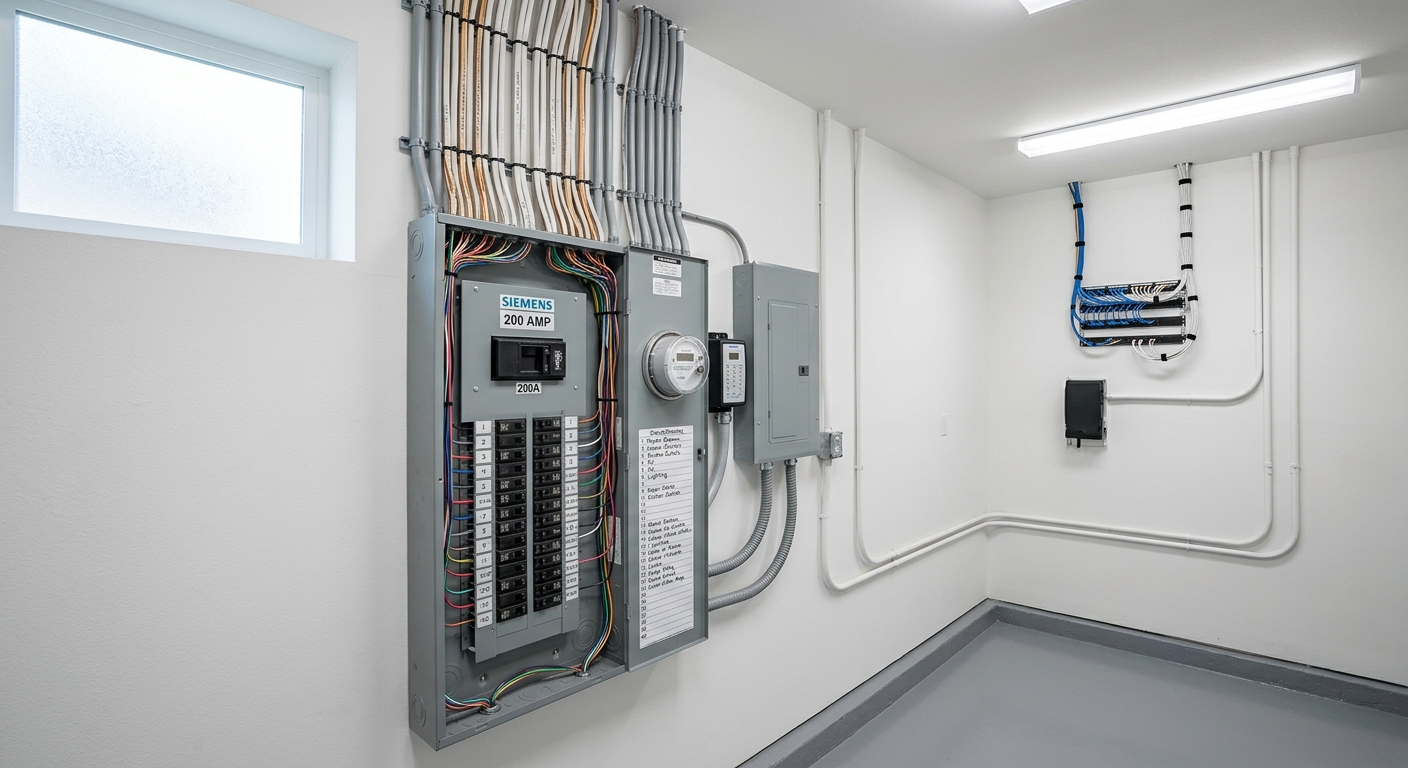
Electrical services and costs in Don Valley Village
Don Valley Village, Ontario has a unique mix of older detached homes, mid-century bungalows, and newer infill, and that housing blend shows up in electrical service calls. With a local population of 27,051 (Statistics Canada, 2021 Census), the GTA’s contractor base is busy year-round—especially around areas like Don Valley Village’s shops and nearby older neighbourhood streets where many homes pre-date today’s appliance, EV, and heat-pump loads. In many of these homes, wiring systems and panels are the limiting factor, not the outlets.
Pricing is also strongly influenced by how far a home’s electrical system is from current requirements. Toronto’s older stock often includes knob-and-tube (K&T) or mid-century branch wiring, and some insurance carriers won’t cover homes until K&T is removed. Meanwhile, homes from the 1960s–70s frequently have wiring and panel capacity that don’t keep up with modern usage—think electric ranges, basement renovations, and the growing share of households adding EV charging.
Local demand matters for cost. When Toronto’s infill, condo/row build activity and residential retrofits spike, labour availability tightens and journeyman rates commonly land in the $90–$120 per hour range for licensed contractors. Weather plays a role too: Toronto’s freeze–thaw winters increase demand for safe service equipment and problem diagnosis (loose connections, moisture ingress, and aged breakers). If you’re pricing a project, the most reliable first comparison is usually the scope-to-outcome match—then you’ll know whether you’re looking at a panel upgrade, targeted wiring remediation, or full rewire. That’s exactly what the table below is meant to help you benchmark.
| Service |
Why It's Needed |
Permit Required |
Price Range |
| Panel upgrade — 100A to 200A service |
Supports modern loads (EV charging, heat pumps, electric stove) and improves safety margins for long-term use |
Yes (permit + ESA inspection) |
$2,500 – $6,000 |
| EV charger installation (Level 2, 40–50A) |
Adds a dedicated charging circuit and reduces reliance on overloaded outlets; often pairs with a service/panel upgrade |
Yes (permit + ESA inspection) |
$900 – $2,500 |
| Knob-and-tube wiring removal and replacement |
Eliminates older insulation systems that are not reliable for today’s loads; typically required for insurance and safety compliance |
Yes (permit + ESA inspection) |
$3,000 – $15,000 |
| Aluminum wiring remediation (CO/ALR connectors) |
Addresses aluminum branch wiring risk using approved connectors or replacement of affected sections |
Yes (permit + ESA inspection) |
$3,000 – $8,500 |
| New dedicated circuit (HVAC, appliance, hot tub) |
Prevents nuisance tripping and reduces risk from undersized/shared circuits when adding major appliances |
Yes for most new circuits (permit + ESA inspection) |
$800 – $3,500 |
| Whole-home rewire (older home, full replacement) |
Best solution when wiring is widespread aging, unsafe, mixed materials, or when finishing basements/rentals across the home |
Yes (permit + ESA inspection) |
$8,000 – $20,000 |
Prices are estimates only and vary by project scope, site access and material selection.
What affects the price of electrical work in Don Valley Village
In Toronto and across the Ontario market, you can see the same electrical job priced 30–50% apart because scope surprises are common: hidden wiring conditions, panel accessibility, distance from the service equipment, and how much drywall must be opened to do the work to code. The biggest driver in Don Valley Village is the age and type of housing stock. Older homes built before 1950 can have knob-and-tube wiring and a system that simply can’t support today’s appliance mix. For homes from the 1960s–70s, many have panels that are undersized for modern loads, often requiring upgrades when EV chargers or heat pumps are added. Aluminum wiring is also a frequent theme in construction from about 1965–1976 and typically requires licensed remediation using approved CO/ALR connectors or partial/full replacement.
EV adoption is a visible cost pressure in the region. Level 2 charger permits are rising, and that often means adding circuits, increasing cable sizes, and sometimes moving from a 100A to a 200A service. A panel upgrade in the GTA frequently lands in the $2,500–$6,000 band when no major service relocation is needed, but that same project can push higher—toward $5,000–$6,000+—when trenching, difficult access, or significant remediation is required. Wiring-only fixes also vary: targeted aluminum connector work might stay lower, while K&T removal or whole-home replacement moves toward the $3,000–$15,000 wiring band.
Two concrete examples that change costs in Don Valley Village: (1) a charger location that requires running cable across a finished basement can add hours of labour and wall repair, even if the breaker and charger hardware are unchanged; (2) a panel that’s in a tight utility space (or has older wiring feeding it) can force additional testing and rework. On the other hand, open-access ceilings and unfinished basements can keep projects closer to the lower end of the $900–$2,500 EV charger range.
| Price Factor |
Why It Matters |
Cost Impact |
| Panel size upgrade — 100A to 200A is the standard minimum today |
More available capacity for modern appliances, EV charging, and heat pumps |
Typically moves projects into the $2,500–$6,000 range |
| Wiring type — copper vs. aluminum remediation vs. K&T removal |
Aluminum requires approved remediation; K&T often needs removal/replacement for safe operation |
Can shift costs by thousands, often into the $3,000–$15,000 wiring band |
| Number of new circuits — each adds material and labour time |
Each circuit requires breakers, cable, terminations, and testing |
More circuits can add several hundred to multiple thousands |
| Permit + ESA/TSBC inspection fee — mandatory for all major work |
Ontario inspections apply to panel upgrades, rewiring, and new circuits |
Often adds roughly $200–$500 depending on scope |
| Labour rate for licensed electricians — journeyman rates in GTA |
Labour is a large share of the cost, especially where access is tight or walls must be opened |
At about $90–$120/hour, complexity can quickly increase total price |
| EV charger amperage — 40A vs. 50A circuit affects cable and breaker cost |
Higher amperage can require larger conductors and specific breaker selections |
Usually modest hardware increase, but may change panel upgrade needs |
| Emergency or after-hours premium |
After-hours service impacts scheduling and sometimes requires additional staffing |
Commonly adds a noticeable premium compared to standard daytime work |
| Load calculation required for service upgrade |
Ensures the new panel/service size matches real expected demand |
Typically adds planning time; can prevent costly undersizing later |
Permits & regulations in Ontario
In Ontario, ALL electrical work beyond changing a light bulb must be done by a licensed electrician. That includes new circuits (including most EV charger installations), panel upgrades, service upgrades, rewiring, and any work that alters the way electricity is distributed or protected in your home. A permit is required for most major work, and the completed installation must pass inspection by the electrical safety authority for Ontario (ESA). DIY electrical is restricted—homeowners can’t legally install or modify hardwired circuits, panels, or anything that requires inspection. The only typical exceptions are very limited tasks like replacing an existing fixture or a switch cover, where no wiring is changed and no circuit parameters are altered (still, you should confirm with your electrician and ensure the scope stays within the rules).
To verify contractor legitimacy in Don Valley Village before work starts, ask for three things: (1) your electrician’s Ontario licence information (and confirm it through the ESA/internet registry mechanisms or documentation they provide), (2) liability insurance certificate (usually listing coverage and effective dates), and (3) proof of workplace coverage such as WSIB/WCB (as applicable to the contractor’s operations). Then, confirm the permit will be pulled under the contractor’s name and that ESA inspection is included for the work scope.
Good contractors will also give you an address-specific plan: what requires inspection, what does not, and the schedule for rough-in and final inspection milestones.
When your Don Valley Village home needs an electrical upgrade
Electrical upgrades in Don Valley Village are often about safety and code compliance, not aesthetics. Start with the warning signs. (1) Breakers that trip regularly usually means an overloaded circuit or a failing breaker—especially common when basements are finished and new appliances are plugged into older shared circuits. If the trips happen with everyday use, treat it as an urgent safety signal. (2) Knob-and-tube wiring is more than “old”: even if it still works, the insulation and connection methods are not considered reliable by today’s standards, and insurance issues are common. (3) 60A or 100A service is a strong predictor of future trouble once you add an EV charger, a heat pump, and an electric stove. In today’s Ontario homes, a 200A upgrade is the typical standard solution when the load calculation shows insufficient capacity.
(4) Aluminum wiring (often associated with pre-1976 construction) may not be immediately dangerous if maintained, but it requires licensed remediation to reduce overheating risk at terminations; that often means CO/ALR connectors or replacement of affected sections. (5) Insufficient outlets—extension cords everywhere—is a practical risk factor, particularly in winter when cords are used more frequently. (6) Missing AFCI/GFCI protection where required can become a selling and compliance issue, especially during buyer inspections.
Toronto’s temperature swings and humidity in basements increase the value of thorough terminations and proper protection. For example, paying for targeted aluminum remediation might cost less than full rewiring, but if you’re also finishing the basement and adding a Level 2 charger, the “do it once” approach can justify moving toward a broader scope. If a panel upgrade is needed, it can be in the $2,500–$6,000 band; if you’re dealing with widespread wiring issues, the $3,000–$15,000 wiring range is more realistic.
| Warning Sign |
What It Means |
Recommended Action |
Urgency |
Price Band |
| Breakers trip frequently |
Overload, short circuit, failing breaker, or improper circuit sizing |
Have an electrician diagnose the circuit load and breaker condition; may require new dedicated circuits |
Immediate if tripping with normal use |
$800 – $3,500 |
| Knob-and-tube wiring present |
Older insulation/connection method not reliable for modern loads; often an insurance red flag |
Plan K&T removal and replacement, at minimum for active/unsafe sections |
High (plan promptly) |
$3,000 – $15,000 |
| 60A or 100A panel (inadequate load capacity) |
Not enough capacity for today’s combined loads |
Run a load calculation and upgrade to a 200A service if indicated |
High (especially before EV/heat pump additions) |
$2,500 – $6,000 |
| Aluminum wiring (pre-1976 construction) |
Higher risk at terminations if not properly remediated |
Use licensed remediation (CO/ALR connectors) or replace affected runs |
Planned (but don’t ignore) |
$3,000 – $8,500 |
| Insufficient outlets — extension cords everywhere |
Risk of overloading cords and poor connection integrity |
Add receptacles and/or dedicated circuits where needed (especially kitchens/basements) |
Moderate to high |
$800 – $3,500 |
| No AFCI or GFCI protection where required |
Code compliance issue; can contribute to fire/shock risk |
Upgrade protection methods for affected areas/circuits and align with current requirements |
Medium (becomes high when selling) |
$200 – $1,500 |
How to choose a electrical work contractor in Don Valley Village
Choosing the right electrician in Don Valley Village starts with verification. First, confirm Ontario licensing: ask for the electrician/contractor licence details and how they’re registered, then cross-check using the appropriate provincial/licensing verification resources. Second, request proof of liability insurance (certificate of insurance) and ensure it covers residential electrical work. Third, ask for WSIB/WCB coverage where applicable—this matters if subcontractors or employees are working on-site.
Next, get 2–3 itemised written quotes. “Itemised” means labour hours, materials (breakers, cable, panel components), and what’s included for installation and testing—not a lump sum. Read exclusions carefully: does the quote include permit pulling, ESA inspection fees, patching/drywall restoration, electrical panel components, and disposal of removed wiring materials? A good quote will also describe how they will handle surprises like old wiring that requires additional terminations or remediation.
Warranty matters. Ask about workmanship warranty length (commonly at least 1 year), whether product warranties are provided for equipment, and if any manufacturer warranty transfer applies when selling your home. For payment, never pay more than 10–15% upfront; keep a holdback until the job is complete and inspected. Finally, require a start date and estimated completion timeline in writing so you can plan around inspection scheduling.
- Confirm licence and registration details before work begins
- Ask for liability insurance certificate and verify dates/coverage
- Confirm WSIB/WCB coverage (where applicable)
- Request itemised quotes with labour + materials breakdown
- Check whether permit pulling and inspection fees are included
- Clarify what “access” means (attic/basement drilling, drywall repair limits)
- Ask how they handle old wiring (testing, dead-front replacement, remediation plan)
- Get specifics on panel model, breakers, and EV charger hardware
- Confirm AFCI/GFCI requirements will be met for the circuits affected
- Ask about load calculation if doing a service or panel upgrade
- Verify warranty: workmanship duration and product warranty documentation
- Use a payment schedule with small deposit and holdback until completion
Red flags in Don Valley Village: (1) they won’t provide licence/insurance/WSIB proof, (2) they quote a panel upgrade without discussing load calculation or permitting, (3) they ask for a large deposit up front, (4) they give a single lump sum with no itemisation, or (5) they dismiss ESA inspection as “not necessary” for new circuits, panel work, or an EV charger.
Frequently asked questions — electrical work in Don Valley Village
How do I compare electrical quotes?
In Don Valley Village, compare quotes by scope first, not by bottom-line number. Ask every contractor for an itemised breakdown: labour hours, specific materials (panel components, breakers, cable sizes), testing, and disposal of removed wiring. Confirm whether the quote includes permit pulling and ESA inspection fees, since major work requires both. Also make sure the service target matches your plan—for example, if you’re adding EV charging, you should ask whether the contractor will do a load calculation and whether a 100A panel can be handled or a 200A service is required. A quote that seems cheaper may be skipping required components or assuming easier access that isn’t available.
How long does a panel upgrade take in Don Valley Village?
Most 100A to 200A panel upgrades in the Toronto area take about half a day to two days on-site, depending on access and how much remediation is needed. In Don Valley Village homes, the schedule varies if there’s limited workspace around the existing panel, older wiring that requires safer terminations, or the need to relocate service equipment. Planning time matters too: once the permit is pulled, you may wait for rough-in and final inspection slots with ESA. If your project also includes substantial wiring changes or service relocation, expect additional time for testing and workmanship. In many cases, electricians can still hit a start date quickly, but inspection timing can affect completion.
What is a GFCI outlet and where is it required in Ontario?
A GFCI (Ground-Fault Circuit Interrupter) outlet protects you by quickly shutting off power when it detects a ground-fault condition—important where people are near water or the risk of shock is higher. In Ontario, GFCI protection is required for specific locations under the Ontario Electrical Code, such as many receptacles in bathrooms, kitchens (where applicable by rules for receptacle placement), garages, basements (as applicable), outdoors, and other areas where shock risk is elevated. If you’re updating circuits for a renovation in Don Valley Village, the contractor should verify which receptacles fall under GFCI requirements and upgrade accordingly. If you need this work along with broader service changes, it’s often bundled into the permitting scope.
How do I know if my Don Valley Village home has aluminum wiring?
You can’t always confirm aluminum wiring by age alone, but many Don Valley Village homes from the 1960s to mid-1970s are more likely to have it. The clearest signs are markings on the cable (often “AL” or specific conductor markings), and the type of terminations at receptacles and the panel. Another tell is when homeowners notice a history of breaker/terminal overheating issues or repeated maintenance. The safest way is to have a licensed electrician inspect at the panel and representative junction points, then test and identify materials properly before recommending CO/ALR connector remediation or replacement. Aluminum remediation cost can vary widely, but targeted connector work often lands within the wiring remediation band, while full replacement can approach the larger whole-home wiring ranges.
What is the cost of rewiring a house in Don Valley Village?
Whole-home rewire pricing in Don Valley Village depends on how much of the house needs replacement, access conditions (finished vs. unfinished areas), and whether a panel/service upgrade is also required. For wiring and rewiring projects in the GTA, many estimates fall within about $3,000–$15,000 for typical rewiring scopes, while complete replacement of extensive wiring and difficult access can be higher. If you also need a service upgrade, panel work commonly sits around $2,500–$6,000 for a 100A to 200A upgrade when the job is straightforward. The key is to scope what’s “replacement wiring” versus “remediation” (like CO/ALR connectors), because those are priced and permitted differently.
What electrical upgrades are required when selling a home in Ontario?
In Ontario, selling your home doesn’t automatically mean you must upgrade everything to the newest standard, but electrical issues that are unsafe or not code-compliant can become inspection blockers—and they can also affect insurance approval. Common upgrades flagged in older Toronto-area homes include addressing knob-and-tube wiring, correcting aluminum wiring terminations with approved remediation, and updating protection where required (like GFCI/AFCI in applicable areas). If you’re adding major loads before the sale—an EV charger, a new heat pump, or a finished basement rental suite—you may also need new permitted circuits and potentially a panel upgrade based on load calculations. A licensed electrician can review your panel capacity and circuit protection so you know what’s likely to be raised during buyer inspections.