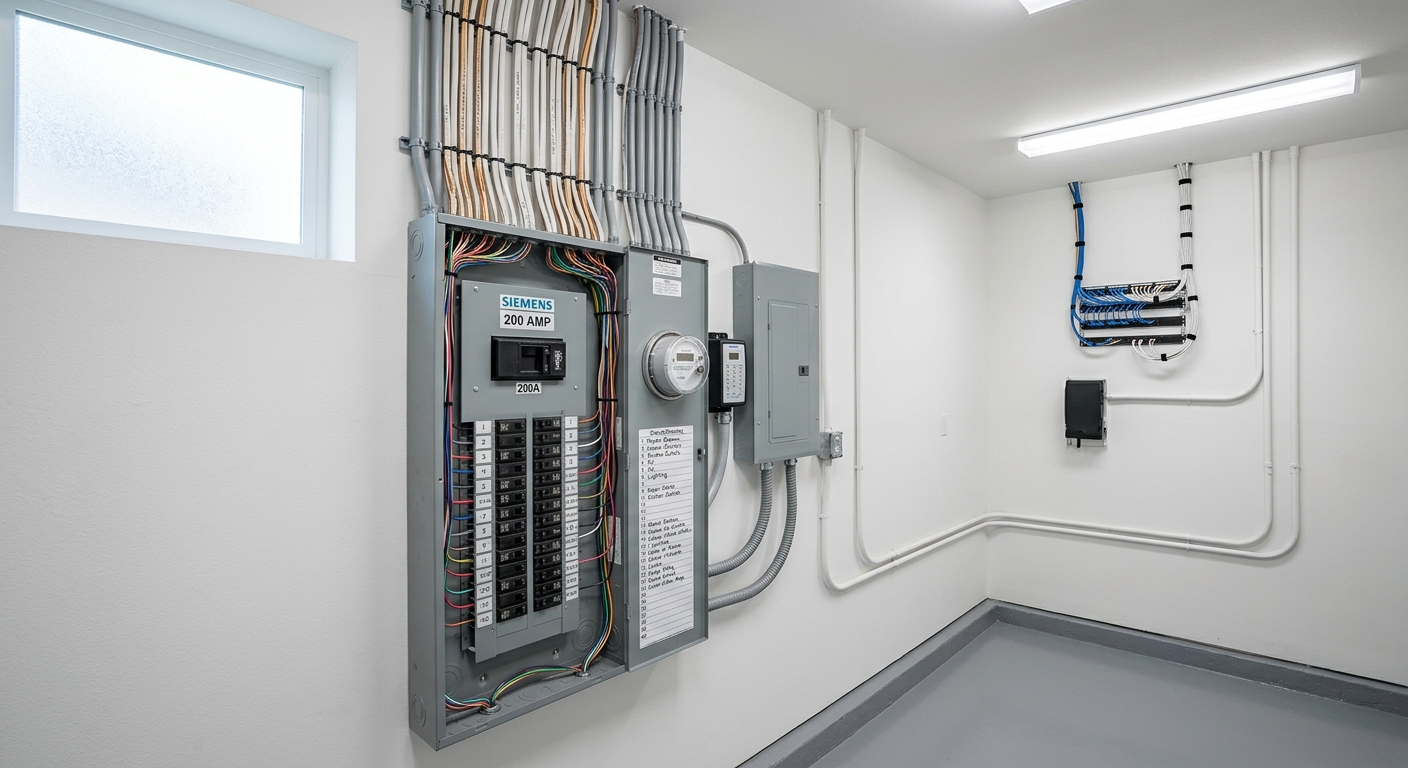
Electrical services and costs in Fort Erie
Fort Erie homeowners typically notice electrical upgrades for two reasons: older wiring that can’t handle today’s loads, and service capacity that falls short. In Fort Erie, with 62.1% of homes built before 1981, many properties are prime candidates for panel upgrades, knob-and-tube removal, and aluminum wiring remediation as owners add modern appliances, heat pumps, or EV charging. The area’s housing mix also means contractors spend more time on accessibility work—routing cable through older framing, matching existing conduits, and making safe transitions at service equipment.
Across the Hamilton–Niagara Peninsula, pricing is pushed up by the sheer volume of pre-standard homes and by the “permit to inspection” workflow governed provincially by Ontario’s Electrical Safety Authority (ESA). As you head toward Lake Erie, winter demand can be spikier during cold snaps when electric baseboards or supplementary heating run alongside other loads, increasing peak usage. At the same time, EV adoption is increasing permit applications for Level 2 charging circuits, and that’s another driver for more labour and materials. In neighbourhoods around Fort Erie proper—especially the older stock near Ferry Beach and the downtown core—electrical trade demand tends to be steady because renovation cycles are constant in established streets.
Below is a practical comparison of common services and what usually triggers permitting and inspection. Use it as a budgeting baseline when you request itemised quotes.
| Service |
Why It's Needed |
Permit Required |
Price Range |
| Panel upgrade — 100A to 200A service |
Modern homes often need more capacity for EVs, heat pumps, electric ranges, and additional circuits. |
Yes (ESA permit + inspection) |
$1,800–$4,500 |
| EV charger installation (Level 2, 40–50A) |
Dedicated power reduces nuisance trips and supports safe charging at home. |
Yes (ESA permit + inspection) |
$1,000–$3,500 |
| Knob-and-tube wiring removal and replacement |
K&T is an older wiring method with deterioration risk; replacement is often required for safe, insurable operation. |
Yes (major rewiring permits vary by scope) |
$8,000–$20,000 |
| Aluminum wiring remediation (CO/ALR connectors) |
Aluminum terminations can oxidize or loosen; approved remediation or replacement improves reliability. |
Yes (ESA permit commonly required when altering circuits) |
$2,000–$6,500 |
| New dedicated circuit (HVAC, appliance, hot tub) |
Adds safe capacity and reduces load on existing breakers. |
Yes (new circuits typically require permit + inspection) |
$800–$3,000 |
| Whole-home rewire (older home, full replacement) |
Brings the entire electrical system to current standards for safety and future renovations. |
Yes (multiple circuits typically under a major permit) |
$12,000–$28,000 |
Prices are estimates only and vary by project scope, site access and material selection.
What affects the price of electrical work in Fort Erie
In the Hamilton–Niagara Peninsula, it’s not unusual to see quotes for the “same” electrical job swing by 30–50% once you account for the hidden scope. Ontario labour, ESA/utility requirements, and the time spent making safe transitions in older homes can all change the final cost. For example, Fort Erie’s older housing stock is the dominant driver: when homes built before 1950 have knob-and-tube wiring, insurers may refuse coverage or require remediation, which pushes projects toward full replacement rather than small fixes. Meanwhile, many 1960s–70s homes still have 60A or 100A panels that simply can’t support today’s typical load mix—EV chargers, heat pumps, induction stoves, and expanded outlet needs.
Aluminum wiring (common in some houses from the mid-1960s through the 1970s) also matters. Remediation requires licensed work and approved connectors (CO/ALR) or replacement of problematic sections, and that can add material and labour. On top of that, EV adoption is increasing Level 2 charger permit activity—so cable runs, breaker selection, and load calculations are more frequently required before a utility will finalize a service change. Locally, that “extra step” shows up in the labour lines even when the hardware list seems modest.
Concrete Fort Erie examples: adding a new 50A EV circuit where the panel is already centrally located is often closer to the lower end of the $1,000–$3,500 band, while the same charger installed with a long run through finished basement ceilings can add thousands. Similarly, a panel upgrade might land near the $1,800–$4,500 range when there’s clear access and straightforward wiring, but can climb toward the higher end if the existing service is outdated, requires more demolition, or needs a more comprehensive load calculation and inspection prep. With 32,901 people in the area (Statistics Canada, 2021 Census), contractor capacity and project backlog in peak renovation seasons can also influence scheduling windows and labour availability.
| Price Factor |
Why It Matters |
Cost Impact |
| Panel size upgrade — 100A to 200A is the standard minimum today |
More breakers and conductor capacity are needed for modern appliances and chargers. |
Often the largest variable within the $1,800–$4,500 service upgrade band |
| Wiring type — copper vs. aluminum remediation vs. K&T removal |
Different hazards and different labour/material methods apply. |
Aluminum remediation and K&T removal can add thousands; whole rewire can exceed typical panel costs |
| Number of new circuits — each adds material and labour time |
Every circuit requires breakers, cable, terminations, and testing. |
More circuits commonly push projects toward the upper end of wiring bands ($8,000–$20,000 for major rewiring) |
| Permit + ESA/TSBC inspection fee — mandatory for all major work |
Permitting is required for panel upgrades, rewiring, and new circuits. |
Direct fees plus admin time; can materially add cost even before labour starts |
| Labour rate for licensed electricians — journeyman rates in {region} |
Electrical work is time-based plus skill-based for safe completion. |
Higher rates and peak demand can widen the quote spread by 30–50% |
| EV charger amperage — 40A vs. 50A circuit affects cable and breaker cost |
Higher amperage can require thicker cable and different protection. |
Typically a few hundred to over a thousand depending on materials and run length |
| Emergency or after-hours premium |
Scheduling urgency increases technician time and overhead. |
Commonly adds a premium that can be significant for panel/service emergencies |
| Load calculation required for service upgrade |
ESA/utility review often requires documented load calculations for 200A planning. |
Small paperwork cost, but may require more changes if calculation shows undersizing risk |
Permits & regulations in Ontario
In Ontario, electrical work beyond changing a light bulb must be performed by a licensed electrician. For Fort Erie homeowners, the key point is that permits and inspections are not optional for major work—specifically panel upgrades (including upgrading 60A/100A to 200A), service changes, new circuits, whole-home rewiring, and new equipment hookups like EV charger circuits. “DIY” is prohibited for most electrical tasks; even where homeowners can do non-electrical demolition or painting, the wiring, connections, and commissioning must be done by a licensed trade. Your contractor typically files the ESA permit, schedules the inspection, and can’t assume the utility will proceed until inspection passes.
To verify a contractor is properly qualified, start with licensing. In Ontario, confirm the electrician/company licence through the ESA’s online search tools (look for the exact business name and licence class used on your scope). Next, request a certificate of insurance (liability coverage) and confirm the policy includes electrical contractor activities. Also confirm workers’ compensation coverage (WSIB). If the contractor is subcontracting, make sure the registered employer is covered—not just the individual electrician.
Finally, ask for a written quote that explicitly states: the ESA permit will be pulled, the inspection is included, and the work will meet current Canadian Electrical Code requirements. Clear documentation reduces the risk of delays and failed inspections.
When your Fort Erie home needs an electrical upgrade
Electrical upgrades in Fort Erie aren’t about “newness”—they’re about safety, reliability, and meeting modern standards as your home’s demand grows. Here are the signs I most often see in this part of Ontario’s Niagara region:
1) Breakers that trip frequently usually indicate overload, a failing breaker, or circuits that were never sized for today’s usage. If you’re getting regular trips when running heaters, a microwave, or laundry, take it seriously and book an assessment promptly.
2) Knob-and-tube wiring present is a major concern. The risk isn’t only age; older insulation conditions and how K&T connections perform over time can create unsafe conditions. Treat it as high urgency—even if it “still works.”
3) 60A or 100A service often becomes inadequate when you combine electric baseboard loads, heat pumps, EV charging, or an electric range. In these situations, the standard solution is commonly a 200A upgrade, and that’s where budgets can land in the $1,800–$4,500 panel upgrade range—if access and replacement scope are straightforward. If the existing wiring is also dated, the cost can shift toward larger wiring work.
4) Aluminum wiring (pre-1976 construction) may not be immediately “dangerous” if maintained, but it typically requires licensed remediation using approved methods. Plan it as a priority upgrade.
5) Insufficient outlets / extension cords everywhere is a convenience warning that can turn into a safety issue. Replace with correctly sized outlets and circuits.
6) No AFCI or GFCI where required can surface during home sales or inspections and is a code-compliance risk. Plan this when you’re already opening walls so you can do it efficiently.
As a practical example, spending a few hundred dollars on a “quick fix” for an intermittently tripping breaker often costs less upfront than a full rewire—but when the root cause is a legacy wiring system or undersized service, the long-term correction typically protects your home and avoids repeated call-outs.
| Warning Sign |
What It Means |
Recommended Action |
Urgency |
| Breakers trip frequently |
Overload, faulty breaker, or undersized/worn circuits under real winter loads. |
Have a licensed electrician check load balance, breaker condition, and circuit sizing. |
High (safety + risk of repeated failure) |
| Knob-and-tube wiring present |
Older wiring method with deterioration/connection concerns that can affect safety and insurability. |
Plan K&T removal/replacement and update related circuits to current standards. |
High |
| 60A or 100A panel (inadequate load capacity) |
Can’t handle modern peak demand with EV charging and electric heating. |
Request a load calculation and discuss upgrading to 200A. |
High |
| Aluminum wiring (pre-1976 construction) |
Potential termination/connection issues require approved remediation. |
Have circuits inspected and remediated using CO/ALR methods or replacement where needed. |
Medium to High |
| Insufficient outlets — extension cords everywhere |
Indicates too few circuits/outlets and increased risk from overloaded cords. |
Add properly located outlets and, when needed, new dedicated circuits. |
Medium |
| No AFCI or GFCI protection where required |
Code compliance gap and increased risk for shock/arc faults. |
Upgrade protection devices and standardize receptacles where required. |
Medium (plan before sale/renovation) |
How to choose a electrical work contractor in Fort Erie
Choosing the right contractor matters as much as price in Fort Erie. Start by verifying Ontario licensing: ask for the contractor’s Ontario licence details and confirm the business/electrician is listed in ESA’s online registry. Next, require proof of liability insurance and check that the certificate names the correct legal entity. Finally, ask for WSIB coverage (workers’ compensation) or, if applicable, documentation that the contractor is properly registered—this is important for your protection if anything goes wrong on site.
Then request 2–3 itemised written quotes. Good quotes separate labour and materials (for example, breaker/panel costs, cable type and gauge, permit/inspection handling, and any drywall or disposal allowances). Be cautious of “lump sum” quotes that don’t describe what’s included—especially for older homes where access and wiring conditions drive scope.
Read the scope for exclusions: “permit pull included?” “Is ESA inspection included in the price?” “Is waste disposal included if we remove old wiring or panel components?” Also ask for warranty terms. Workmanship warranty length is important, and you should clarify whether any manufacturer warranty transfers to you for products like breakers, panels, and EV charging equipment.
For payment, avoid paying full amounts upfront. A common safe approach is no more than 10–15% deposit, with the remainder tied to milestones and a final holdback until the job is complete and inspected. Get a written timeline too: planned start date and completion estimate.
- Confirm Ontario licence/registration for the exact business quoting your work.
- Verify liability insurance limits and that the certificate is current.
- Confirm WSIB coverage applies to the contractor performing the work.
- Ask whether the ESA permit and inspection scheduling are included.
- Request itemised labour vs materials (panel, breakers, cable, conduit, outlets).
- Clarify what’s included for circuit testing, load calculations, and final documentation.
- Check how long the service change will be interrupted and whether they coordinate with the utility.
- Ensure quote notes the panel model/size and breaker/cable specs (not vague allowances).
- Ask about disposal of old equipment and any required demolition/restoration allowances.
- Verify AFCI/GFCI protection upgrades (where required) are specified.
- Confirm warranty length for workmanship and whether product warranties transfer.
- Set payment milestones (limit upfront, holdback until inspection is passed and cleanup is done).
Red flags in Fort Erie include: no proof of Ontario licensing or WSIB coverage, quotes that don’t mention ESA permitting/inspection, “we’ll do it cheaper without a permit” language, vague allowances for panel/wiring components, and refusal to put scope and warranty in writing.
Frequently asked questions — electrical work in Fort Erie
Can I add a subpanel to my Fort Erie home?
Yes, you can often add a subpanel in Fort Erie, but whether it makes sense depends on your main service size, how the existing panel is configured, and the condition of the feeder conductors. If you currently have a 60A or 100A service, adding a subpanel may still require a load calculation and could trigger an ESA-permitted service upgrade to safely feed the new circuits. For most subpanel installs, expect an ESA permit and an inspection because you’re adding circuits and modifying the distribution system. If your home is older (and many are, given Fort Erie’s older housing stock), the electrician may also recommend remediating outdated wiring routes before adding new breakers. As a budgeting guide, a subpanel project commonly sits within the broader “panel upgrade / service” cost territory, especially when service sizing and wiring conditions require more work.
How much does an electrician cost in Fort Erie?
Electrician pricing in Fort Erie is usually quoted as a flat-rate project when permits and inspections are required, because the scope drives labour time more than hourly rates. The final cost depends on access (finished basements, crawlspaces, and long cable runs), wiring type (copper vs. aluminum), and whether the work triggers a major permit. For homeowners, the most helpful way to estimate is to start from the local price bands for the key service: panel upgrades typically fall in the $1,800–$4,500 range, while major wiring and rewiring work often falls in the $8,000–$20,000 band. Your total can be higher if knob-and-tube removal or whole-home rewiring is part of the scope. Always ask for an itemised quote so you can see labour, materials, permit/inspection handling, and any disposal or restoration allowances.
How much does a panel upgrade cost in Fort Erie?
Panel upgrades in Fort Erie commonly fall in the $1,800–$4,500 range, especially when converting from a 100A service to 200A. The price moves up when there are complications such as difficult access to the existing service, required upgrades to meet current code requirements, or additional wiring work needed because of older conductors. If your home includes aluminum wiring or knob-and-tube components feeding older circuits, the electrician may recommend remediation as part of the upgrade (and that pushes the project toward the wiring bands). Also remember that ESA permitting and inspections are mandatory for this work in Ontario, and the contractor’s preparation and testing time is usually built into the quote. If you’re already planning renovations—opening walls or finishing a basement—doing the panel and wiring upgrades together often reduces the rework costs later.
Do I need to upgrade to a 200A panel?
You don’t always “need” a 200A panel, but it’s often the safest and most future-proof choice for Fort Erie homes once you add modern electrical loads. If you’re planning an EV charger, heat pump, or electric stove—especially alongside existing electric baseboard usage during cold snaps—a 100A service may become inadequate. Licensed electricians typically perform a load calculation to confirm whether your existing service has enough capacity. In many Hamilton–Niagara Peninsula older homes, upgrading to 200A is the standard minimum solution when the math and existing panel condition don’t support today’s demand. If your current service is already 200A and in good condition, you may only need dedicated circuits rather than a full service upgrade. Either way, the decision should be based on documented load calculations and the inspection requirements under Ontario’s ESA framework.
How much does an EV charger installation cost in Fort Erie?
A Level 2 EV charger installation in Fort Erie typically costs $1,000–$3,500, assuming you’re adding a dedicated 40–50A circuit and the wiring path is reasonably accessible. The price increases when you need a longer cable run, additional conduit, or modifications to older panels/services that can’t support the new load without changes. In Ontario, EV charger installations require an ESA permit and inspection because you’re installing new circuits and protection devices. If your project also includes upgrading the main panel to support charging, that’s separate from the charger install and often falls into the panel upgrade range. If your home has older wiring materials (for example, aluminum), remediation may be required before the final connections are made. Ask for an itemised quote that lists the circuit amperage, cable/conduit specs, breaker selection, and how permit/inspection steps are handled.
What is knob-and-tube wiring and should I replace it?
Knob-and-tube (K&T) wiring is an older wiring method found in many pre-standard homes across Ontario, including parts of Fort Erie. It uses porcelain knobs and tubes to route conductors without the modern grounding and insulation methods used today. While K&T can sometimes still function, the concern is the condition and performance of insulation and connections over time—especially in a region where cold weather can stress systems and where insulation aging can lead to reliability issues. From a safety and insurance perspective, K&T is frequently treated as a high-priority remediation item rather than a “wait and see” component. Whether you need a full rewire depends on how much of the system is K&T, where it feeds, and what the inspector requires, but many homeowners end up replacing K&T as part of a larger upgrade. If your home has K&T, plan for ESA-permitted work and inspection as any proper remediation will go beyond simple in-place repairs.