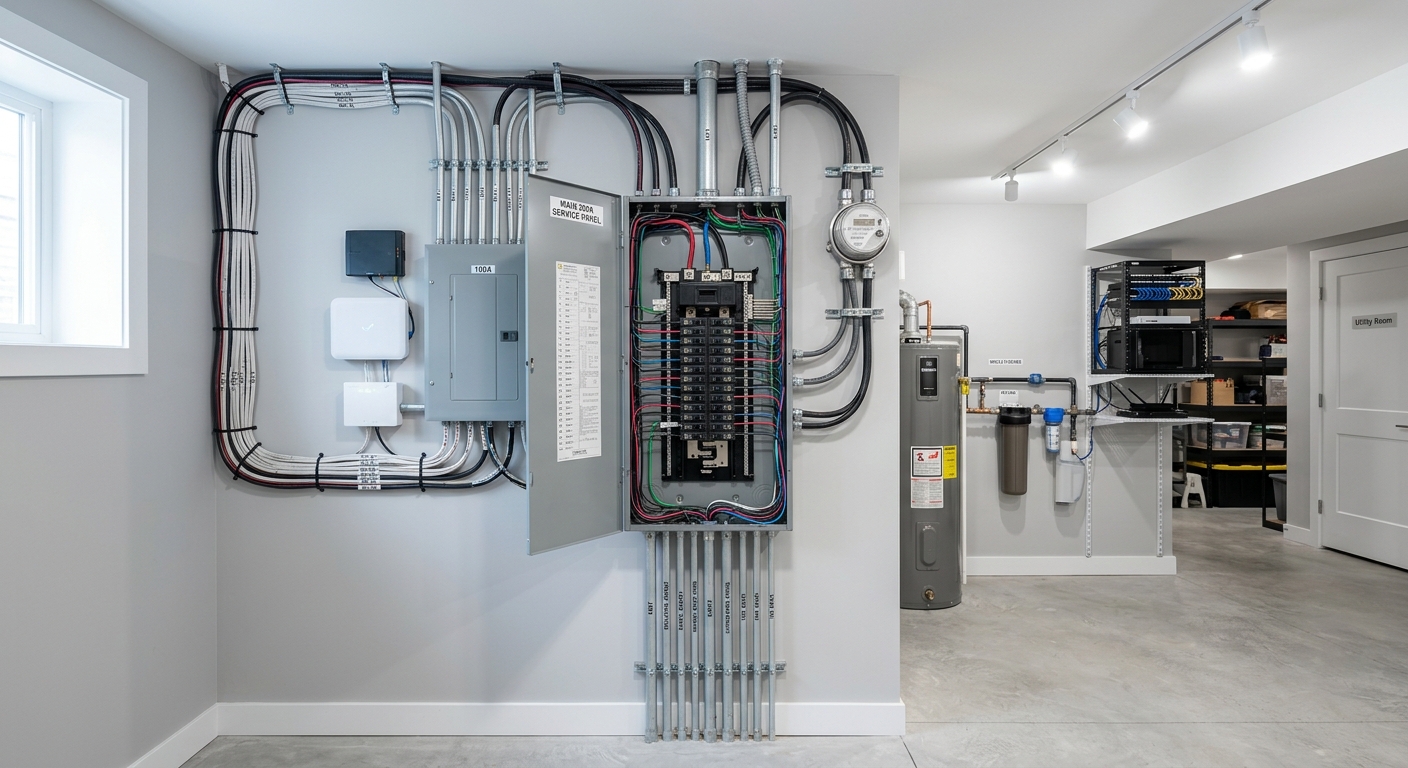
Electrical services and costs in Greater Napanee
Electrical services in Greater Napanee are shaped by a local housing mix where a large portion of homes are older—about 64.2% were built before 1981 (Statistics Canada, 2021 Census). In practice, that often means we’re not just adding outlets; we’re addressing original wiring types, aging panels, and capacity limits that show up once you add modern loads like heat pumps, induction ranges, and electric vehicle charging. Single-detached houses make up 73.7% of the local housing stock (Statistics Canada, 2021 Census), so projects frequently involve longer cable runs, attic access work, and service upgrades that have to fit the constraints of existing basements, crawlspaces, and overhead service locations.
In the Kingston–Pembroke region, the cost picture can move quickly because many jobs start with a safety and capacity review. Greater Napanee’s market also has a steady demand for panel and service upgrades as homeowners modernize for Ontario winters—when electric heating and backup heat kick in, you’ll feel the limits of older 60A and 100A services. Labour availability can fluctuate seasonally, and that affects quote timing and scheduling, especially for rewiring and EV-ready upgrades.
One area where this trade is especially active is the downtown/riverfront core and nearby older neighbourhoods, where many homes were wired decades ago and require knob-and-tube removal or aluminum remediation before you can confidently add circuits. If your electrician suspects wiring or capacity issues, costs can be justified by the need to meet the Ontario Electrical Safety Code and by mandatory ESA permitting for major work. Use the table below as a practical starting point for typical Greater Napanee price ranges.
| Service |
Why It's Needed |
Permit Required |
Price Range |
| Panel upgrade — 100A to 200A service |
Modern homes often need more capacity for EV chargers, electric heat, and high-demand appliances; older panels can be overloaded and fail load calculations. |
Yes (service change requires ESA notification/permit) |
$2,900 – $4,500 |
| EV charger installation (Level 2, 40–50A) |
Dedicated circuit for consistent charging; may require a panel upgrade or load management if the service is near capacity. |
Yes (new circuit/charger installation) |
$1,400 – $2,600 |
| Knob-and-tube wiring removal and replacement |
Knob-and-tube is outdated and insulation condition varies; removing it reduces fire risk and supports insurance acceptance. |
Yes (rewiring and permitted circuit work) |
$8,000 – $18,500 |
| Aluminum wiring remediation (CO/ALR connectors) |
Aluminum branch circuits require licensed remediation using approved connection methods (e.g., CO/ALR devices/connectors) or replacement. |
Yes (alterations to branch circuits) |
$6,500 – $14,500 |
| New dedicated circuit (HVAC, appliance, hot tub) |
Separate circuits prevent nuisance tripping and ensure required protection for specific equipment loads. |
Yes (new circuit) |
$900 – $2,300 |
| Whole-home rewire (older home, full replacement) |
Full replacement is often the safest path when wiring throughout the home is mixed, deteriorated, or incompatible with modern protection requirements. |
Yes (major rewiring) |
$12,000 – $28,000 |
Prices are estimates only and vary by project scope, site access and material selection.
What affects the price of electrical work in Greater Napanee
For the same electrical task, quotes in Greater Napanee can land 30–50% apart across the Kingston–Pembroke region and Ontario because the “hidden” scope varies. The dominant cost driver is the age and condition of the housing stock. Greater Napanee has many pre-1981 homes (64.2% built before 1981 per Statistics Canada, 2021 Census), so you’ll see older wiring types—knob-and-tube and aluminum branch wiring in particular—that require more labour for safe removal and code-compliant replacement. Homes built before 1950 may also trigger insurance concerns when knob-and-tube is present, so electricians often start by auditing existing circuits and documenting what can stay versus what must change.
For panel capacity, homes from the 1960s–70s frequently have 60A or 100A services that don’t comfortably handle today’s loads. Add an EV charger and modern cooking/heat pump demand, and the load calculation can force a move from 100A to 200A—commonly in the $2,500 – $4,500 band for service/panel work. Aluminum wiring, common in homes built around 1965–1976, also affects pricing: remediation with approved CO/ALR connectors can cost less than full replacement, but only if the issue is localized and connection points are accessible. EV adoption is adding momentum to permitting activity for dedicated 40–50A Level 2 circuits, which can increase both scheduling time and material planning.
Concrete examples from Greater Napanee: (1) If your panel is at the far end of the basement with long conductor runs, a “simple” new circuit can move toward the higher end of the $1,200 – $2,800 EV charger installation range; (2) A panel upgrade paired with knob-and-tube removal often costs more than either alone because rewiring opens pathways for new cable routes; (3) If service equipment needs rework due to corrosion or unstable mounting, electricians may add labour for mounting and testing, pushing cost upward by a few hundred to over a thousand dollars.
| Price Factor |
Why It Matters |
Cost Impact |
| Panel size upgrade — 100A to 200A is the standard minimum today |
Load calculations and modern protection requirements often exceed older panel capacity. |
$2,500 – $4,500 |
| Wiring type — copper vs. aluminum remediation vs. K&T removal |
Aluminum and knob-and-tube add time for safe connection methods or full replacement. |
$6,000 – $20,000 |
| Number of new circuits — each adds material and labour time |
More circuits mean more cable, breakers, labour for routing, and testing. |
$900 – $2,300 per major dedicated circuit |
| Permit + ESA/TSBC inspection fee — mandatory for all major work |
ESA oversight is required for permitted electrical work, including service changes and EV circuits. |
$150 – $600 typical inclusion in quotes |
| Labour rate for licensed electricians — journeyman rates in {region} |
Licensed labour time varies based on access, troubleshooting, and rough-in conditions. |
$90 – $130 per hour (labour component) |
| EV charger amperage — 40A vs. 50A circuit affects cable and breaker cost |
Higher amperage can require heavier conductors and different protective gear. |
$1,200 – $2,800 |
| Emergency or after-hours premium |
Scheduling and after-hours callout time increases labour cost. |
$200 – $900 added for urgency |
| Load calculation required for service upgrade |
Accurate load calculations affect whether you can keep existing service size or must upgrade. |
$0 – $500 often included, sometimes separate |
Permits & regulations in Ontario
In Ontario, ALL electrical work beyond changing a light bulb must be done by a licensed electrician. That includes anything that changes wiring, adds or modifies circuits, replaces or upgrades a panel, alters a service, or installs devices connected to branch wiring (such as EV charger circuits). For Greater Napanee homeowners, the key point is that “licensed” is not optional: DIY electrical is prohibited for most work, and homeowner exceptions are narrow and still generally require proper permitting, inspection, and compliance with the Ontario Electrical Safety Code.
Work that DOES typically require an ESA permit/notification in Ontario includes panel upgrades and service changes, new circuits (including dedicated EV Level 2 circuits), rewiring, knob-and-tube removal/replacement of affected wiring, aluminum remediation that involves connection changes, and any work that affects the service equipment or grounding/bonding related to permitted circuits. In contrast, small like-for-like replacements (for example, swapping an existing receptacle with one of the same type in the same location when permitted by local practice) may not require a permit, but anything that involves new wiring paths, new breaker positions, or changes to the panel/circuit layout generally does.
Step-by-step verification for contractors in Greater Napanee: (1) Ask for the electrician’s Ontario licence number and verify it through the provincial online registry; (2) Request a certificate of insurance showing current liability coverage; and (3) Confirm WSIB/WCB coverage (or the applicable exemption/coverage documentation if they operate differently). Before work starts, confirm the permit/ESA notification details are handled by the electrician and ask how inspection will be scheduled, since service changes and new circuits can’t be finalized without it.
When your Greater Napanee home needs an electrical upgrade
If you’re seeing issues in your Greater Napanee home, don’t treat them as “just annoying.” Several warning signs point to safety risks or to code compliance problems that are expensive to fix later when the problem has already damaged equipment. First, breakers that trip regularly often indicate an overloaded panel or undersized/defective circuits—especially noticeable in winter when heating loads rise. Second, knob-and-tube wiring isn’t just an age problem; insulation contact and condition can fail over time, which can lead to higher fire risk and insurance cancellations. Third, a 60A or 100A service may not handle a modern load profile. With an EV charger, heat pump, and electric stove running together, a 200A upgrade is the standard long-term solution in many Greater Napanee homes.
Fourth, aluminum wiring (commonly seen in pre-1976 construction) may not be immediately dangerous if connections were done properly and maintained, but it does require licensed remediation using approved CO/ALR methods or full replacement. Fifth, insufficient outlets and extension cords everywhere is a practical sign of a wiring layout that’s not designed for today’s loads—an outlet addition can be cheaper than replacing damaged cords or motors later. Sixth, no AFCI or GFCI protection where required can surface during a sale or inspection, and retrofits often involve replacing older breakers and adding protected circuits.
In Greater Napanee’s seasonal load swings, planned upgrades are usually cheaper than emergency troubleshooting. For example, it can be more cost-effective to bundle a panel upgrade with the EV charger circuit than to add the charger temporarily and “fix capacity later”—that’s often the difference between keeping to the $1,200 – $2,800 EV charger band versus being pushed into the $2,500 – $4,500 service upgrade after the fact.
| Warning Sign |
What It Means |
Recommended Action |
Urgency |
Price Band |
| Breakers trip frequently |
Possible overload, failing breaker, or an undersized/incorrectly protected circuit. |
Electrical inspection + load check; identify the circuit(s) and fix the root cause. |
Immediate to short-term |
$400 – $1,600 |
| Knob-and-tube wiring present |
Outdated wiring type with insulation condition risks and increased insurance scrutiny. |
Assessment and targeted removal or whole-home rewire depending on extent. |
High (plan promptly) |
$6,000 – $20,000 |
| 60A or 100A panel (inadequate load capacity) |
Panel likely can’t support modern loads like EV charging and heat pump backup demands. |
Load calculation and upgrade to 200A service if required. |
Planned upgrade (schedule soon) |
$2,500 – $4,500 |
| Aluminum wiring (pre-1976 construction) |
Connections may loosen or overheat over time without approved remediation. |
Remediate with CO/ALR connectors or replace affected circuits. |
High (not always emergency) |
$6,000 – $14,500 |
| Insufficient outlets — extension cords everywhere |
Over-reliance on temporary power and higher risk from overloaded power strips. |
Add dedicated outlets/circuits to match usage patterns. |
Short-term |
$900 – $2,300 |
| No AFCI or GFCI protection where required |
Higher risk of arc faults and shock; may fail sale/inspection expectations. |
Upgrade devices/breakers to code-compliant AFCI/GFCI protection. |
Planned upgrade |
$600 – $2,000 |
How to choose a electrical work contractor in Greater Napanee
Choosing the right contractor in Greater Napanee starts with proof, not promises. First, verify Ontario licensing by asking for the electrician’s licence number and checking it in the provincial online registry. Next, request a certificate of liability insurance that clearly covers the type of electrical work being performed. Also confirm WSIB/WCB coverage (or applicable documentation if they’re exempt), since uninsured contractors shift risk to homeowners if something goes wrong on site.
Then get 2–3 itemised written quotes. You want a breakdown that shows labour versus materials (wire, breakers, devices, panel/service components), plus what’s included for permits and ESA inspection handling. Scope should be explicit: Are conductors already included? Is disposal/dump fees included for old panel components or wiring? Is any drywall/ceiling repair included or excluded? Make sure the quote states whether a load calculation is part of a service upgrade, and who is responsible if additional circuits are discovered during opening-up work.
On warranty, ask for two things: the workmanship warranty length (often documented for a set period), and the manufacturer warranty for panels/devices. Confirm whether the warranty is transferable to a future owner if you sell. Payment schedule should be conservative—never pay more than 10–15% upfront—and use a holdback until the job is fully complete and inspected. Finally, get the start date and an estimated completion timeline in writing so you can plan for winter work constraints.
- Licence number provided and verifiable online
- Valid liability insurance certificate
- WSIB/WCB coverage confirmed
- Itemised quote (labour + materials + allowances)
- Permit/ESA inspection responsibilities stated
- Clear inclusions/exclusions (demolition, drywall patching, disposal)
- Load calculation method included for service upgrades
- Product/model numbers listed for panel, breakers, devices
- Workmanship warranty in writing
- Manufacturer warranty details and whether it’s transferable
- Payment milestones aligned to completed, inspected stages
- Start date and completion estimate documented
In Greater Napanee, red flags I often see include contractors who won’t provide their Ontario licence number on request, quotes that are “lump sum” without stating what’s included, refusing to discuss ESA permitting/inspection steps, asking for large upfront payments (beyond 10–15%), or giving vague timelines like “a few days” without a start date and completion estimate.
Frequently asked questions — electrical work in Greater Napanee
Is aluminum wiring safe in older Greater Napanee homes?
Aluminum wiring can be safe when it has been properly installed and when connections are maintained using approved methods. In Greater Napanee, many pre-1976 homes have aluminum branch wiring, and the concern is usually not the wire by itself—it’s connection compatibility. Oxidation, loosened terminations, or using the wrong connectors can create heat at connections over time. A licensed electrician should assess visible terminations, test where practical, and determine whether remediation is possible. Remediation commonly involves CO/ALR connectors and approved devices; if the wiring is widespread or conditions are poor, full replacement may be recommended. Pricing varies, but aluminum remediation often falls in the $6,000 – $14,500 range depending on how many connection points need work and whether circuits must be rewired.
Do I need a permit for electrical work in Ontario?
In Ontario, most electrical work beyond basic like-for-like tasks requires a permit through ESA processes and must be inspected. For Greater Napanee homeowners, permits are typically required for panel upgrades and service changes, new circuits, rewiring, and any work that adds or modifies wiring connected to the panel. This includes EV charger installations on a new dedicated circuit and many AFCI/GFCI retrofits when breakers or circuit wiring are changed. DIY electrical is prohibited for most work; even when a homeowner can legally do limited tasks, the permitted and inspected scope generally still belongs to licensed electrical work. Always confirm with your electrician that ESA notification/permit steps are included before work starts, and request the permit/inspection details in writing as part of your quote.
What are signs of an overloaded electrical panel?
Common signs include breakers tripping frequently, lights dimming when appliances start, warm or discoloured breaker/circuit areas, and a pattern of “nuisance” resets after using certain combinations (space heaters, kettles, microwaves, or shop equipment). In Greater Napanee winters, overload symptoms can be worse because electric heating and backup heat increases demand during cold snaps. Another clue is when you can’t add a new load—like a Level 2 EV charger—without a service review. Your electrician should run a load calculation and check circuit sizing and protection. If your panel is too small for modern usage, the typical solution is an upgrade to 200A service; panel/service work often lands in the $2,500 – $4,500 band depending on materials, access, and whether ESA requirements change the scope.
Can I do my own electrical work in Ontario?
In Ontario, electrical work generally must be done by a licensed electrician. DIY is not permitted for most tasks, especially anything involving adding circuits, working in the service equipment area, rewiring, or installing devices that require connection to branch wiring in a way that changes the circuit layout. Homeowner exceptions are narrow, and even where a limited task may be allowed, permits and inspections may still be required for the overall project scope. For Greater Napanee homeowners, the practical approach is to let a licensed electrician handle wiring, breakers, panel/service work, and any ESA-permitted changes. If you want to reduce cost, you can ask the electrician what non-electrical prep you can safely do (e.g., clearing access, confirming cable routes in finished spaces) while keeping wiring and connections within the permitted, inspected electrical scope.
How long does a rewiring job take?
Rewiring timelines vary a lot in Greater Napanee because older homes have different construction layouts, access constraints, and wiring extents. A partial rewiring (targeted circuits for kitchen/bath additions or EV-ready upgrades) can be completed in days, but whole-home rewires typically take longer due to opening walls/ceilings, routing new cable, restoring finishes, and then testing and inspection. If knob-and-tube removal is extensive, expect more time for safe removal and for opening-up work to reach junctions. Weather and scheduling can also affect timelines during Ontario seasonal transitions. As a rule of thumb, electricians plan around inspection windows and sequencing. Your contractor should provide an estimated start date and completion estimate in writing, and describe the inspection milestones ESA requires so you’re not surprised by delays.
Why do my breakers keep tripping?
Breakers keep tripping for several reasons: an overloaded circuit, a failing breaker, a short circuit, ground fault issues, or wiring that’s not properly protected for the load. In a Greater Napanee home, the problem can intensify when multiple devices run at the same time—especially during winter when heating and backup equipment are more common. Another common cause in older houses is circuit wiring deterioration or incorrect connections, which is why a proper inspection matters more than simply resetting the breaker. The electrician should identify which breaker/circuit is faulting, check cable and connections, verify the correct breaker type and protection, and then recommend fixes. If your system is undersized overall, the long-term remedy may be a service upgrade—often within the $2,500 – $4,500 range—rather than adding more circuits that overload the panel again.