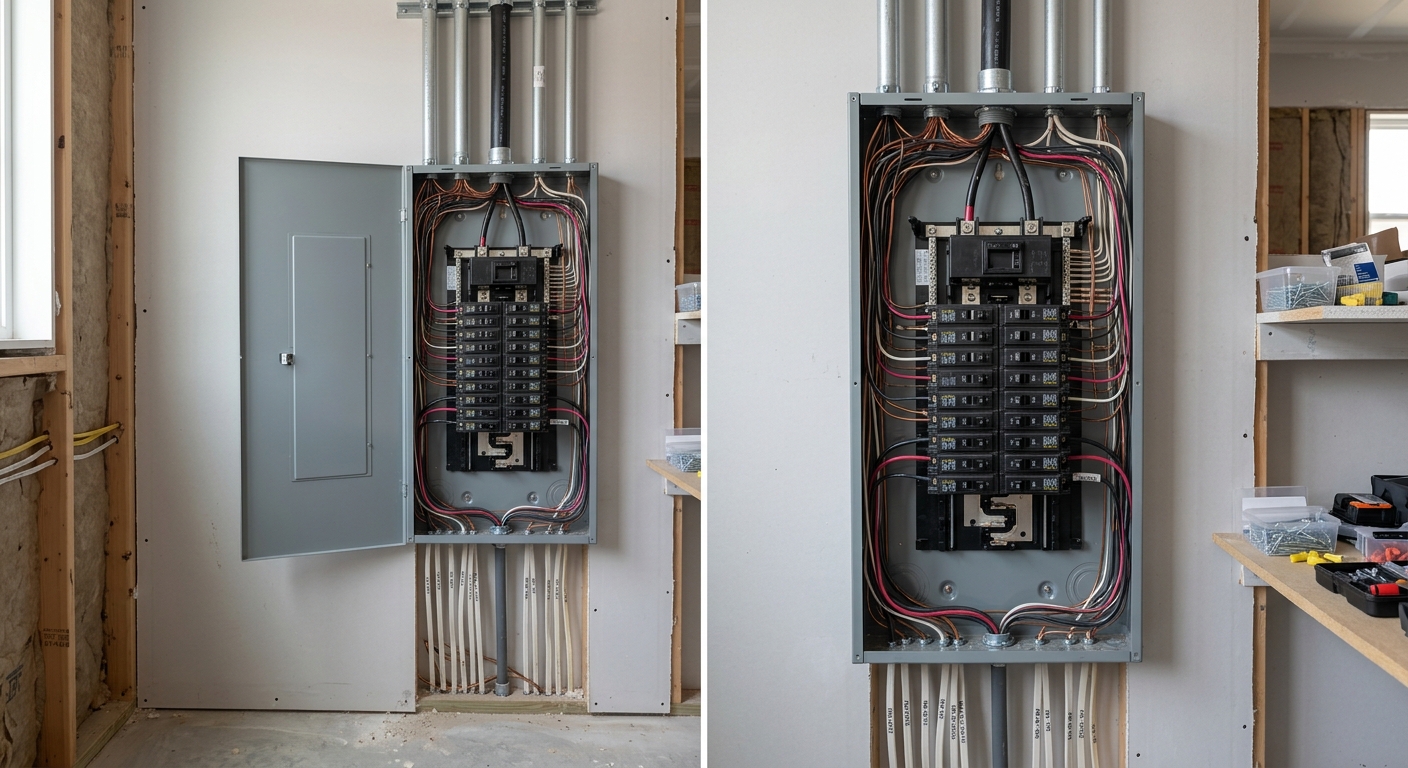
Electrical services and costs in Prescott
In Prescott, electrical service work is often driven by the age of the housing stock. With 81.5% of homes built before 1981, many properties still have older wiring practices and service capacities that predate today’s loads. For example, homeowner households account for 57.7% of all households in the community (Statistics Canada, 2021 Census), which lines up with how frequently we see homeowners planning panel upgrades, safety device retrofits, and re-wiring during renovation or before selling.
In the Kingston–Pembroke region, costs tend to run higher or lower depending on how much “hidden” work the electrician has to uncover—especially in pre-1970 homes where knob-and-tube wiring and older aluminum branch wiring are common. Prescott’s winter heating demand also influences electrical planning: when baseboard or supplemental resistance heat runs alongside heat pumps, hot tubs, EV charging, and modern appliances, contractors often need to complete a load calculation before they can confidently add circuits. Availability can also affect your quote—when permit volume rises across nearby communities, scheduling for licensed labour and ESA inspection windows can tighten, which is one reason similar jobs may land at the top of the band rather than the bottom.
In neighbourhoods around the Prescott area near the main commercial strip and older residential pockets, demand is especially strong for panel/service upgrades and wiring remediation. Next, use the table below as a practical baseline for Prescott projects, then we’ll break down what changes the price most.
| Service |
Why It's Needed |
Permit Required |
Price Range |
| Panel upgrade — 100A to 200A service |
Modern homes often need more capacity for EV charging, heat pumps, electric ranges, and heat loads during winter |
Yes (ESA permit and inspection) |
$2,500 – $4,500 |
| EV charger installation (Level 2, 40–50A) |
Provides faster charging with a dedicated circuit and proper protection (AFCI/GFCI where required) |
Yes (ESA permit and inspection) |
$1,200 – $2,800 |
| Knob-and-tube wiring removal and replacement |
Knob-and-tube circuits are aging and often create insurance and safety concerns; removal is the safest long-term option |
Yes (ESA permit and inspection) |
$6,000 – $20,000 |
| Aluminum wiring remediation (CO/ALR connectors) |
Licensed pigtailing/connectors reduce overheating risk at terminations while keeping wiring in place where appropriate |
Often (commonly required for remediation tied to major circuit work) |
$3,000 – $9,000 |
| New dedicated circuit (HVAC, appliance, hot tub) |
Dedicated wiring improves safety and avoids nuisance trips; supports higher start-up loads |
Typically (yes for new circuits) |
$1,000 – $3,500 |
| Whole-home rewire (older home, full replacement) |
Full circuit replacement is the cleanest solution when wiring is widespread and infrastructure access is available |
Yes (ESA permit and inspection) |
$10,000 – $35,000 |
Prices are estimates only and vary by project scope, site access and material selection.
What affects the price of electrical work in Prescott
In Prescott and across the Kingston–Pembroke region, two contractors can quote the same electrical job and land 30–50% apart. The biggest reason isn’t “different marketing”—it’s what’s uncovered during teardown, how much wiring work is required behind finished walls, and whether the electrician can complete the work without extra service upgrades. Older construction can multiply labour hours quickly: for homes built before 1950, knob-and-tube wiring may be present, and insurance requirements increasingly push homeowners toward replacement rather than band-aid fixes. Meanwhile, homes from the 1960s–70s often have 60A or 100A panels that are inadequate for today’s loads, including EV chargers, heat pumps, and induction or electric stoves.
Aluminum wiring (often seen in homes built roughly 1965–1976) is another major cost driver. Remediation requires approved methods—such as proper CO/ALR connectors or complete rewiring in areas where terminations are unsafe. With EV adoption rising in nearby communities, Level 2 charger permits and circuit capacity checks are also adding demand and scheduling time, which can nudge quotes higher. For Prescott homeowners, it’s common to start with an EV plan and then discover the panel must be upgraded before the charger can be installed safely.
Concrete examples from Prescott: if your service mast or panel location requires additional conduit and weatherproofing due to exterior finish, materials and labour increase. If your panel is already set up for a straightforward breaker swap and wiring runs are accessible (unfinished basement ceiling, open joists), an EV circuit might stay near the lower end of $1,200 – $2,800. Conversely, if your home needs a capacity plan and a service upgrade, the project often shifts into the $2,500 – $4,500 service band.
| Price Factor |
Why It Matters |
Cost Impact |
| Panel size upgrade — 100A to 200A is the standard minimum today |
Determines whether you can add modern loads without nuisance trips or unsafe overheating |
Often shifts the total by several thousand dollars (commonly within the service-upgrade band) |
| Wiring type — copper vs. aluminum remediation vs. K&T removal |
Different risks require different licensed approaches, testing, and sometimes full replacement |
Can move a project from “few thousand” to “mid-to-high five figures” depending on extent |
| Number of new circuits — each adds material and labour time |
Breakers, cable, boxes, labour time, and sometimes drywall access all increase per circuit |
Multiplicative effect on the quote for multi-load upgrades |
| Permit + ESA/TSBC inspection fee — mandatory for all major work |
In Ontario, major electrical work must be permitted and inspected before energization |
Adds fixed administrative costs and can affect scheduling |
| Labour rate for licensed electricians — journeyman rates in Ontario |
Labour time depends on access, corrections, and code-compliance steps |
Typical licensed labour commonly lands around $90–$130/hour |
| EV charger amperage — 40A vs. 50A circuit affects cable and breaker cost |
Higher amperage can require larger conductors and specific breaker/cable sizing |
May add a few hundred dollars and can also affect whether a panel upgrade is needed |
| Emergency or after-hours premium |
Waiting time, scheduling, and additional safety steps can increase direct costs |
Can add a noticeable premium on top of labour |
| Load calculation required for service upgrade |
ESA/inspection expectations and safe design depend on accurate load calculation |
Generally increases upfront scope, but reduces costly rework |
Permits & regulations in Ontario
In Ontario, electrical work beyond changing a light bulb must be done by a licensed electrician. Permits are required for major tasks such as panel upgrades, new circuits (including EV charger circuits), rewiring, and service upgrades. Permitted work must pass inspection by the electrical safety authority for Ontario—ESA. DIY electrical is prohibited for most work; homeowner exceptions are narrow, and even when limited homeowner work is allowed, permits and inspections are typically still part of the process for anything that affects safety-critical elements like service equipment, new circuits, or hard-wired equipment.
What typically does require a permit in Prescott: panel replacement or upgrade, adding or relocating circuits, adding a receptacle circuit where wiring changes, EV charger installations, service upgrades (including conductor/service changes), and any rewiring where the wiring system is altered. What often does not require a permit: swapping a like-for-like fixture (e.g., replacing a ceiling light with the same type), provided no new wiring is added and the existing junctions are left intact and safe.
To verify your contractor in Prescott, start with the Ontario licence registry (check the electrician’s licence number and status), then request their certificate of insurance and confirm they carry liability coverage. Ask for WSIB/WCB clearance (or the appropriate coverage documentation for your project). Finally, when they submit the job, confirm the permit is in place before any work that changes the service or adds circuits—ESA inspection completion should be clear in the paperwork before final payment.
When your Prescott home needs an electrical upgrade
Electrical upgrades aren’t about “modernising for looks”—in Prescott they’re often about preventing safety issues during winter demand. Here are warning signs that usually mean it’s time to call a licensed electrician for assessment and, in some cases, immediate action.
1) Breakers that trip frequently. This usually points to overload, failing breakers, or incorrect circuit design—especially when heat loads run together with appliances. If tripping is repeated or accompanied by burning smells, stop using the circuit and get it checked right away.
2) Knob-and-tube wiring present. The main concern is the age and condition of insulation and terminations, not just “how old it is.” Many insurers restrict coverage for K&T; planned replacement is often the safest path, and it’s typically not a DIY fix.
3) 60A or 100A service. In homes with EV charging, heat pumps, and electric cooking, those service sizes can’t reliably handle the combined load. A 200A upgrade is commonly the standard solution when adding major new loads.
4) Aluminum wiring (pre-1976 construction). Not automatically “danger today” if connections were done properly, but aluminum demands licensed remediation at terminations to reduce overheating risk.
5) Insufficient outlets—extension cords everywhere. This is a safety and code-compliance red flag and often leads to circuit additions.
6) No AFCI or GFCI protection where required. Missing modern protection can become a compliance issue at resale and during inspections, especially when circuits are updated.
Where price differences make sense: a targeted service upgrade into the $2,500 – $4,500 range may be far cheaper than repeatedly replacing overloaded breakers, fixing hot terminations, or paying for multiple “temporary” circuit additions. If you want to add a Level 2 EV charger, you’ll often compare the $1,200 – $2,800 charger-only option against the charger-plus-service upgrade if the panel can’t support the load.
| Warning Sign |
What It Means |
Recommended Action |
Urgency |
Price Band |
| Breakers trip frequently |
Likely overload, incorrect breaker/cable sizing, or failing components under winter load |
Call for a load check and circuit diagnosis; repair faults before adding new loads |
Immediate if burning odours or repeated tripping |
$300 – $1,800 |
| Knob-and-tube wiring present |
Aged insulation/terminations and elevated risk; often limited by insurance expectations |
Plan K&T removal and replacement with modern copper circuits and safety devices |
High (planned replacement) |
$6,000 – $20,000 |
| 60A or 100A panel (inadequate load capacity) |
Too little capacity for EV charging, electric appliances, and heat loads |
Do a load calculation and upgrade to 200A when required |
High |
$2,500 – $4,500 |
| Aluminum wiring (pre-1976 construction) |
Connections may overheat without approved remediation at terminations |
Licensed inspection and CO/ALR connector remediation or targeted replacement |
Planned (unless damaged/badly heated) |
$3,000 – $9,000 |
| Insufficient outlets — extension cords everywhere |
Overreliance on temporary power increases overheating risk and can violate code practices |
Add receptacles/circuits using safe locations and proper protection |
Moderate |
$1,000 – $3,500 |
| No AFCI or GFCI protection where required |
Higher risk of electrical faults and potential resale/inspection non-compliance |
Upgrade devices and add AFCI/GFCI protection as needed for the circuits |
Moderate |
$200 – $800 |
How to choose a electrical work contractor in Prescott
Choosing the right electrician matters as much as the quote. In Ontario, your contractor should be properly licensed for the work and able to document coverage. To verify licensing, ask for the electrician’s Ontario licence number and check it using the provincial online registry. For liability, request their certificate of insurance and confirm the coverage is current and appropriate for residential electrical projects. Also ask for WSIB/WCB clearance documentation (or the appropriate coverage forms for the project). If they can’t provide these items promptly, that’s a serious warning.
For pricing, request 2–3 itemised written quotes. You want a breakdown that shows labour hours, materials, permits, and any disposal or restoration costs—rather than a single lump sum. Read the scope carefully: is a permit pull included, who pays ESA fees, and is patching and clean-up included if cabling runs require access? Confirm whether trenching for exterior conduit, drilling for routing, and any required testing are included or billed separately.
Warranty should be clear. Ask for the workmanship warranty length (often longer on service and rewire work), and understand the product/manufacturer warranty coverage. For payment, never put down more than about 10–15% upfront; hold back a portion until the job is complete and inspected. Get a start date and completion estimate in writing, plus what happens if delays are due to permits or inspection scheduling.
- Licence number provided and verifiable for the Ontario work
- Certificate of insurance up to date (request before work begins)
- WSIB/WCB clearance documented
- Itemised quote (labour, materials, permits/ESA fees separated)
- Scope includes permit pull and inspection scheduling responsibility
- Clear statement on what’s excluded (drywall patching, restoration, access fees)
- Code compliance notes: AFCI/GFCI requirements and panel safety device plan
- Whether a load calculation is included for service upgrades
- Explicit warranty terms for workmanship and key components
- Payment schedule with small deposit (10–15%) and holdback until completion
- Written timeline with start date and estimated completion
In Prescott, red flags include: no permit confirmation before starting service/panel work, refusal to provide an itemised quote, vague scope language (“wiring as needed”), asking for a large upfront deposit, and inability to show licence/insurance/coverage paperwork.
Frequently asked questions — electrical work in Prescott
How much does an EV charger installation cost in Prescott?
In Prescott, a Level 2 EV charger installation (typically a 40–50A dedicated circuit) commonly falls in the $1,200 – $2,800 range. Your price depends on cable length, routing difficulty (finished walls vs. accessible joists), breaker and charging hardware selection, and whether your panel has enough capacity. In Kingston–Pembroke’s older housing stock, many homes built before 1981 may have limited panel capacity, so your electrician may first do a load calculation. If the panel can’t support the added load safely, you may also need a panel/service upgrade (often in the $2,500 – $4,500 band), which is why two quotes can differ. ESA permits for EV charger circuits are required and usually built into a complete quote.
What is knob-and-tube wiring and should I replace it?
Knob-and-tube (K&T) wiring is an older wiring method where conductors were run on ceramic knobs and through porcelain tubes. The issue isn’t just age—it’s that insulation, terminations, and conductors can degrade over decades, and the system is harder to modernise safely. In Prescott, many homes predate modern safety requirements, and with 81.5% of homes built before 1981, K&T is a common reason homeowners face insurance and safety questions. Replacement is often recommended when K&T is extensive, when outlets/lighting are unstable, or when you’re rewiring to add loads like an EV charger. If K&T is limited to a small section, your electrician may still recommend removal for safety and inspection readiness, but a proper evaluation is key.
Is aluminum wiring safe in older Prescott homes?
Aluminum wiring can be safe when properly installed and when terminations are remediated using approved methods. The risk is usually at connections: aluminum can expand and contract differently than copper, and older installations may have loose or oxidized terminations that can overheat. In the Prescott area, many homes with this wiring were built in the period when aluminum branch circuits were common, so we typically inspect terminations and look for overheating evidence. If the wiring is in good condition, a licensed remediation using CO/ALR connectors (or approved pigtailing) may be appropriate; if the wiring is damaged or connections are too compromised, full replacement may be the safest route. Expect remediation pricing to vary widely with how many circuits and access points are involved, but it often lands around the multi-thousand range depending on scope.
Do I need a permit for electrical work in Ontario?
In Ontario (including Prescott), most electrical work beyond simple light fixture replacement requires a licensed electrician and typically a permit through ESA. Permits are commonly required for panel upgrades, service changes, new circuits, rewiring, and EV charger installations. Even when the work is “small,” adding or modifying wiring circuits generally triggers permit and inspection requirements because it affects safety-critical parts of the system. A straightforward way to check is to ask your electrician what ESA permit will be filed and confirm it before work starts. Also verify the contractor’s Ontario licence and request documentation for liability coverage and WSIB/WCB clearance. For homeowners, the safest rule is: if the job involves the panel, service equipment, or adding a new circuit, assume you need a permit and inspection.
What are signs of an overloaded electrical panel?
Signs of an overloaded panel or undersized circuit design include breakers that trip regularly, lights dimming when appliances start, warm or discoloured breaker faces, and repeated nuisance trips on specific rooms during winter use. Older homes in Prescott may also show symptoms when you add high-demand loads like an EV charger or electric heating—loads that weren’t considered when the service was installed. If your home has a 60A or 100A service and you’re planning major electrification, it’s common to see performance issues that point to the need for a load calculation and often a panel/service upgrade. Upgrading to a 200A service is frequently the remedy, with pricing commonly in the $2,500 – $4,500 band when the scope is straightforward. If there are burning smells or hot spots, treat it as urgent and stop using the affected circuits.
Can I do my own electrical work in Ontario?
In Ontario, DIY electrical is limited and generally prohibited for most work. Changing a light bulb or replacing a like-for-like fixture may be acceptable if no wiring changes are required, but anything involving the panel, new circuits, service upgrades, or rewiring requires a licensed electrician, permits, and inspections. For Prescott homeowners, the practical takeaway is that if the work touches circuits or safety devices—especially for EV charger circuits, panel upgrades, or correcting knob-and-tube/aluminum wiring—hire a licensed electrician. If you attempt DIY work that requires a licence/permit, you risk safety hazards, failed inspections, and delays when ESA reviews the project. Always ask for a written scope and confirm the permit/inspection plan before work begins, and verify the contractor’s Ontario licence and insurance documentation.