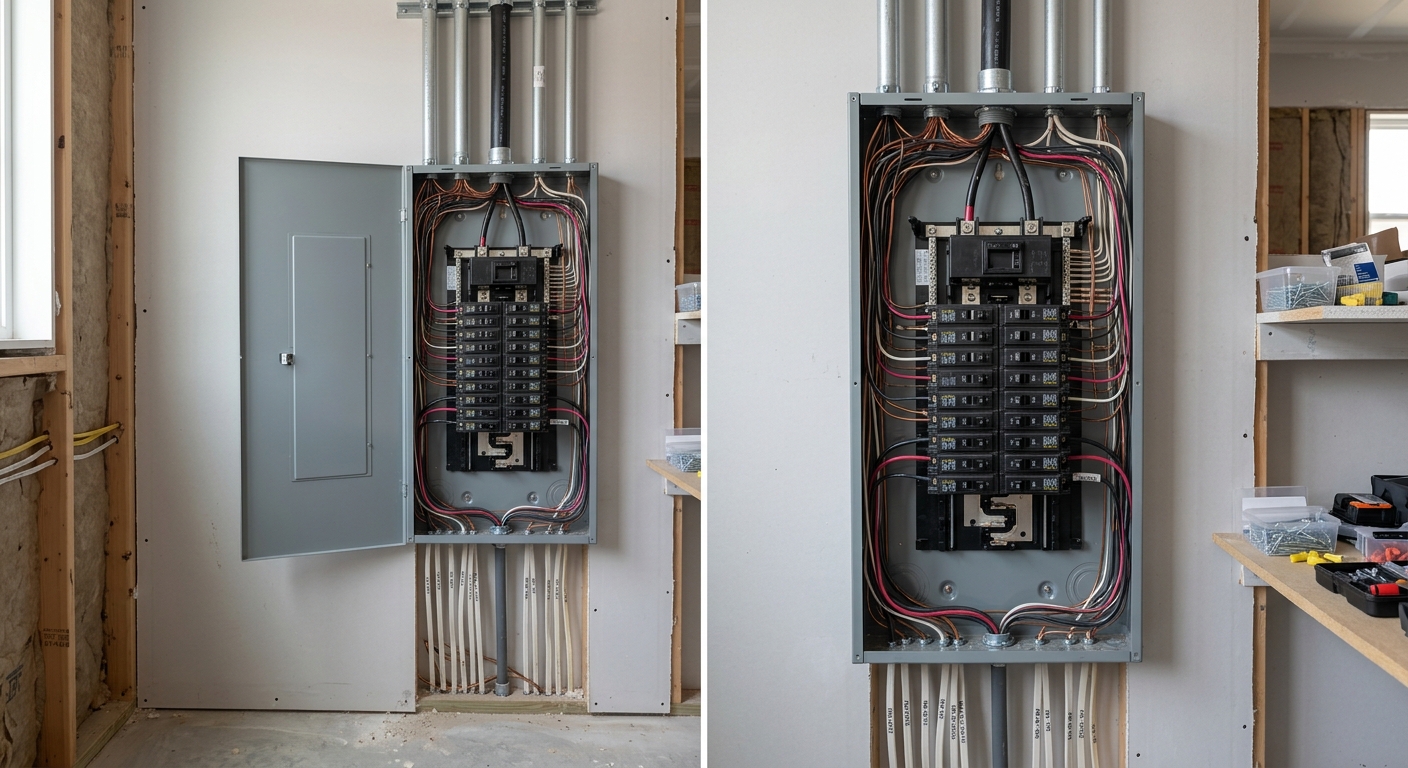
Electrical services and costs in Dryden
Electrical work in Dryden is often more involved than homeowners expect because the town’s housing stock is older and many properties need upgrades before they can safely handle modern loads. In Dryden, 67.2% of homes were built before 1981, and that matters: older wiring methods and service equipment were designed for different power demands than today’s electric heating, heat pumps, induction ranges, and (increasingly) Level 2 EV charging. According to the 2021 Census, Dryden’s population is 7,388 and there are about 2,420 owner households (73.1% own), which helps create steady contractor demand for service and safety work. Prices can still feel “lumpy” job-to-job across Ontario’s Northwest because remediating legacy wiring (knob-and-tube or aluminum), adding new circuits, and coordinating utility meter/service changes are labour-intensive.
Northwestern winters also raise the stakes: projects that involve service work or panel access may need careful scheduling for safe working conditions and faster restoration of power to heat-dependent homes. In practice, electricians in Dryden—especially around the Downtown/Sunset Drive area where many older residential blocks cluster—often see higher call volumes for panel capacity and wiring remediation. If you’re comparing quotes, use the table below as a baseline for typical permit-based ranges before you decide whether you’re tackling a targeted upgrade or a full rewire.
| Service |
Why It's Needed |
Permit Required |
Price Range |
| Panel upgrade — 100A to 200A service |
Modern homes often exceed 100A when adding EV charging, heat pumps, and new appliance loads |
Yes (service change) |
$1,900–$7,000 |
| EV charger installation (Level 2, 40–50A) |
Provides dedicated, safe charging with the correct breaker, cable sizing, and protection |
Yes (new circuit + charger connections) |
$900–$2,500 |
| Knob-and-tube wiring removal and replacement |
Legacy insulation and contact risks; many insurers and buyers require correction for sale/safety |
Yes (rewiring) |
$4,500–$10,300 |
| Aluminum wiring remediation (CO/ALR connectors) |
Aluminum terminations require approved remediation or replacement to reduce overheating risk |
Yes (alterations to branch circuits/terminations) |
$3,850–$8,800 |
| New dedicated circuit (HVAC, appliance, hot tub) |
Dedicated capacity improves safety and prevents nuisance trips |
Yes (new circuit) |
$650–$2,600 |
| Whole-home rewire (older home, full replacement) |
Best option when multiple rooms/circuits are failing, and when bringing the home up to modern code |
Yes (rewiring) |
$6,200–$12,500 |
Prices are estimates only and vary by project scope, site access and material selection.
What affects the price of electrical work in Dryden
In Dryden and across Ontario’s Northwest, the same general job can land 30–50% apart because the hidden work is different: wiring conditions, panel/service capacity, distance from the panel to the new device, and how much removal or remediation is required. Housing stock age is the dominant cost driver. Homes built before 1950 are more likely to contain knob-and-tube wiring, and insurers increasingly scrutinize or deny coverage for unresolved legacy wiring—so the “small” repair request often turns into removal and replacement. Homes from the 1960s–70s are frequently associated with older 60A or 100A service panels and, in many cases, aluminum branch wiring (commonly found in homes from about 1965–1976). When you add a 40A–50A Level 2 EV charger or heat-pump capacity, load calculations may show that the existing panel simply can’t serve today’s continuous and non-continuous loads.
Aluminum wiring remediation isn’t just “tighten and go.” It typically requires licensed CO/ALR-approved connectors or selective section replacement, and that labour depends on how many terminations exist (and whether walls are open). In addition, permitting and inspections add mandatory steps and time. For example, a straightforward 100A-to-200A panel upgrade commonly starts around the lower end of the service band (roughly $1,400–$7,000), but if the work uncovers deteriorated wiring, the project can shift toward the higher wiring band (about $3,850–$10,300). In Dryden, older finishes, plaster, and limited attic/crawl access can push labour hours up; however, if the home has good accessibility and you’re only adding circuits, costs can come down.
| Price Factor |
Why It Matters |
Cost Impact |
| Panel size upgrade — 100A to 200A is the standard minimum today |
More breaker spaces and capacity for EV charging, heat pumps, and modern appliances |
Shifts many jobs into the service/panel band; can add substantial labour if service equipment is old |
| Wiring type — copper vs. aluminum remediation vs. K&T removal |
Aluminum terminations need approved CO/ALR remediation; knob-and-tube removal is more invasive |
Remediation may increase labour by hours; K&T can move the job toward full rewires |
| Number of new circuits — each adds material and labour time |
Each dedicated circuit requires cable, breakers, protection, and structured routing |
More circuits generally increases both materials and installation time |
| Permit + ESA/TSBC inspection fee — mandatory for all major work |
Ontario permits must be issued and inspected for panel/service changes and new circuits |
Adds administrative and inspection scheduling time; not optional |
| Labour rate for licensed electricians — journeyman rates in Ontario’s Northwest |
Higher complexity and limited local availability can raise effective labour cost |
May swing labour portions noticeably between quotes (often 20%+) |
| EV charger amperage — 40A vs. 50A circuit affects cable and breaker cost |
Higher amperage often requires larger cable and breaker selection |
Small but real material and parts difference across the charger circuit package |
| Emergency or after-hours premium |
Nights/weekends require additional crew scheduling and risk controls |
Can add a meaningful premium compared with daytime installations |
| Load calculation required for service upgrade |
Confirms whether existing equipment can be used and what new demand can be supported safely |
May trigger a larger service upgrade if the math demands it |
Permits & regulations in Ontario
In Ontario, ALL electrical work beyond changing a light bulb must be completed by a licensed electrician. That includes panel upgrades (for example, 100A to 200A), new circuits for kitchens, basements, EV chargers, and any rewiring work. Permits are required for major alterations—especially anything affecting service equipment, adding circuits, and correcting wiring deficiencies. After permitted work is completed, it must pass inspection by the Electrical Safety Authority (ESA). DIY electrical is prohibited for most homeowner tasks; the narrow exceptions typically involve things like replacing a fixture when there are no wiring changes. If you’re unsure, treat anything that touches wiring or breaker/panel work as “permit required” and ask the contractor to confirm in writing before they start.
To verify your contractor in Dryden, do this step-by-step: (1) Ask for their Ontario licence number and confirm it through the ESA licensing/verification resources; (2) Request a certificate of insurance naming you (or confirming they carry liability coverage relevant to residential electrical work); (3) Confirm WSIB/WCB coverage so you aren’t exposed if a worker is injured on your property; (4) Before work, ask them to state the ESA permit number (or the planned permit application) and what inspection they will book; and (5) Keep the inspection paperwork for your records—especially if the work affects resale.
When your Dryden home needs an electrical upgrade
In Dryden, electrical upgrades are usually about safety and capacity—not convenience. Here are the warning signs that often indicate you need more than a simple fix. First, breakers that trip regularly are a common indicator of overloaded circuits, failing breakers, or an undersized/undersupplied panel for the home’s actual load. Second, knob-and-tube wiring is a key concern: the issue isn’t just “old wiring,” it’s insulation/contact condition and the risk it creates for faults—plus it can cause insurance and sale problems if not addressed. Third, a 60A or 100A service can become inadequate when you’re adding an EV charger, running heat pumps, and using an electric range or older electric heat sources at the same time; in many of these cases, a 200A upgrade is the standard solution.
Fourth, aluminum wiring (pre-1976 construction) is not automatically “dangerous today” if connections have been maintained, but it does require licensed remediation with approved CO/ALR connectors or replacement at terminations to reduce overheating risk. Fifth, insufficient outlets—so you’re relying on extension cords—often signals overloaded receptacles and unsafe temporary power habits. Sixth, missing AFCI/GFCI where required is a code-compliance gap that can become an issue during sale or inspection.
What needs immediate action: persistent breaker trips, burning smells/scorching, and confirmed knob-and-tube issues. What’s often a planned upgrade: adding new circuits for renovations, missing GFCI/AFCI, and aluminum remediation before sale. For a dollar reality check: if you only add a single dedicated appliance circuit you may stay closer to the dedicated circuit band, but if your load calculation shows you must move from 100A to 200A, the service upgrade cost (often around the $1,400–$7,000 band) becomes justified because it prevents repeat trips and supports the new equipment safely.
| Warning Sign |
What It Means |
Recommended Action |
Urgency |
Price Band |
| Breakers trip frequently |
Overload, faulty breaker, or insufficient panel/service capacity |
Inspection + load assessment; add circuits or upgrade service if needed |
Immediate/urgent (if frequent) |
$650–$7,000 |
| Knob-and-tube wiring present |
Legacy wiring with insulation/contact risks and common insurance/sale concerns |
Plan for removal/replacement and correction of any affected circuits |
Immediate/urgent |
$4,500–$10,300 |
| 60A or 100A panel (inadequate load capacity) |
Cannot safely support modern loads and continuous draw |
100A to 200A service upgrade with load calculation |
Planned soon |
$1,900–$7,000 |
| Aluminum wiring (pre-1976 construction) |
Termination/connection risk without proper remediation |
Licensed CO/ALR connector remediation or targeted replacement |
Planned soon |
$3,850–$8,800 |
| Insufficient outlets — extension cords everywhere |
Unsafe temporary power and likely overloaded receptacles |
Add properly protected receptacle circuits; reduce reliance on cords |
Planned soon |
$650–$2,600 |
| No AFCI or GFCI protection where required |
Code compliance gaps affecting safety and sale readiness |
Upgrade protection devices (breakers/receptacles) as required |
Planned soon |
$130–$500 |
How to choose a electrical work contractor in Dryden
Choosing the right contractor matters in Dryden because older homes often require troubleshooting, careful permit handling, and licensed remediation—not just “swapping parts.” Start by verifying Ontario licensing: ask for the electrician’s Ontario licence number and confirm it through ESA’s licensing resources. Next, request proof of liability insurance; the certificate should show they carry coverage appropriate to residential electrical work. Finally, confirm WSIB/WCB coverage so you aren’t responsible if a worker is injured on your property. If a contractor can’t provide documentation promptly, that’s a major warning sign.
Then get 2–3 written, itemised quotes—not a single lump sum. The best estimates show labour and materials separately, list what wiring/panel components are included, and specify whether disposal, patching, and any access (attic/crawl space) is included or excluded. Confirm whether the permit pull is included in their price and who books the ESA inspection. Ask about warranty: workmanship warranty length, manufacturer product warranties, and whether any warranty is transferable to you if you sell the home. For payment, never pay more than 10–15% upfront; use milestone payments and hold back until you have final cleanup and confirmed operation. Require a written start date and completion estimate so the project doesn’t drag out during winter.
- Licence number provided up front and verifiable (Ontario/ESA)
- Certificate of liability insurance (current) included
- WSIB/WCB clearance provided
- Itemised quote with labour + materials breakdown
- Explicit list of included breakers, cables, and protection devices
- Permit pull and ESA inspection responsibilities stated clearly
- Scope includes troubleshooting or only “successful install” work
- Patching/drywall restoration included or clearly excluded
- Disposal of old breakers/wiring debris stated
- Workmanship warranty length and exclusions listed in writing
- Payment schedule with small deposit and holdback on completion
- Written timeline that accounts for winter scheduling constraints
In Dryden, red flags include: they won’t provide their ESA-related licence details, they ask for a large deposit (more than 10–15%), their quote is not itemised, they avoid discussing permits/inspections, or they minimize findings like aluminum terminations/knob-and-tube without an inspection and plan.
Frequently asked questions — electrical work in Dryden
What is a GFCI outlet and where is it required in Ontario?
A GFCI (Ground-Fault Circuit-Interrupter) outlet protects against shock risk by tripping quickly when it detects an imbalance in current—common in damp locations. In Ontario, GFCI protection is required for many receptacle locations, especially where there’s higher likelihood of moisture or contact with water, such as kitchens, bathrooms (where applicable), basements, garages, and exterior receptacles. In Dryden, this is particularly relevant because winter conditions and snow/ice increase the chances of outdoor moisture intrusion and condensation near entryways and basement areas. If you’re updating safety during a sale or after renovations, upgrading to GFCI/AFCI where required is often a relatively smaller line item—frequently within the lighting/protection style ranges such as $130–$500 per device—though the exact cost depends on the number of locations and whether breakers are needed.
How do I know if my Dryden home has aluminum wiring?
In many pre-1976 homes in Ontario’s Northwest, aluminum wiring can be present, but you can’t confirm it safely just by age alone. The practical way is a licensed electrician’s inspection: they’ll check the marking on conductors (aluminum conductors are often stamped/labelled), inspect terminations at receptacles and panels, and look for typical installation patterns. If you’re seeing discoloration at terminations, repeated heat damage, or loose-feeling connections at older outlets, that can also be a clue—though it doesn’t replace verification. Because aluminum remediation is about approved connection methods, your contractor should test/inspect and then recommend CO/ALR-approved connectors or targeted replacement where needed. If remediation is required, pricing commonly falls in the wiring remediation band—often roughly $3,850–$8,800 depending on how many terminations are involved.
What is the cost of rewiring a house in Dryden?
Rewiring cost in Dryden depends on how extensive the wiring replacement is (full rewire versus selective rewiring), whether it includes removal of legacy wiring like knob-and-tube, and how hard the wiring access is (plaster walls, attic/crawl access, and routing). For older homes built before 1981—common in Dryden—whole-home rewires can be a major but sometimes necessary step to bring the home up to modern safety standards and reduce repeated breaker issues. In the current Dryden/Northwest pricing bands, wiring & rewiring work is typically in the range of $3,850–$10,300 for many rewiring projects, while a full replacement can go higher depending on complexity. A useful approach is to start with an inspection and a scope definition, then get itemised quotes so you can compare whether you’re being offered a targeted correction or an entire rewire.
What electrical upgrades are required when selling a home in Ontario?
Ontario doesn’t usually require you to proactively “upgrade everything” just because you’re selling, but electrical safety expectations often change through disclosure and inspections, and buyers’/insurers’ requirements can be strict. Practically, common expectations include correcting known safety hazards, ensuring required protection devices are installed (like GFCI where required), and addressing legacy wiring issues such as knob-and-tube or unsafe aluminum terminations. If the home fails inspection due to wiring/protection deficiencies, you’ll likely need to correct them before closing. In Dryden’s older housing market (many homes are pre-1981), this frequently becomes about panel/service capacity too—especially if the panel is undersized for modern loads. Even if you’re not doing a full service upgrade, fixing safety gaps can be a relatively contained expense compared with major work; for example, adding required protection devices may align with smaller bands like $130–$500 per item, while panel/service upgrades commonly sit around $1,400–$7,000 depending on what’s needed.
What is a load calculation and why does my electrician need one?
A load calculation is the electrician’s way of confirming whether your service equipment (panel size, breaker setup, and service capacity) can handle the electrical demand safely. It considers existing circuits and major appliances and estimates current draw, including continuous loads—this is especially important when you’re planning upgrades in Dryden, where electric heating and winter usage can increase demand. If you add an EV charger or new heat-pump equipment, the existing 60A/100A setup can become marginal. That’s why a load calculation often supports a 100A-to-200A upgrade; in many Northwest Ontario homes, it’s the difference between “it fits” and “it causes trips/overheating risk.” This is also a practical compliance step: it helps determine the correct breaker and cable sizes for new circuits and supports why the ESA-permitted work needs to change.
How do I find a licensed electrician in Dryden?
Start by requesting the contractor’s Ontario licence number and verifying it using ESA’s licensing/verification resources. Then ask for proof of liability insurance (a current certificate) and confirm WSIB/WCB coverage. In Dryden, where many older homes need careful inspection for legacy wiring, you should also ask how they handle permits and inspections—specifically, whether permit pull is included and who schedules the ESA inspection. Get 2–3 itemised quotes so you can compare labour and materials, and insist the scope clearly states what’s included or excluded (disposal, patching, troubleshooting, and whether emergency/after-hours rates apply). A reputable contractor will explain the plan, not just the price. If you’re comparing service upgrades, use realistic bands like $1,400–$7,000 for panel/service work to sanity-check quotes before you commit.