Electrical services and costs in Orillia
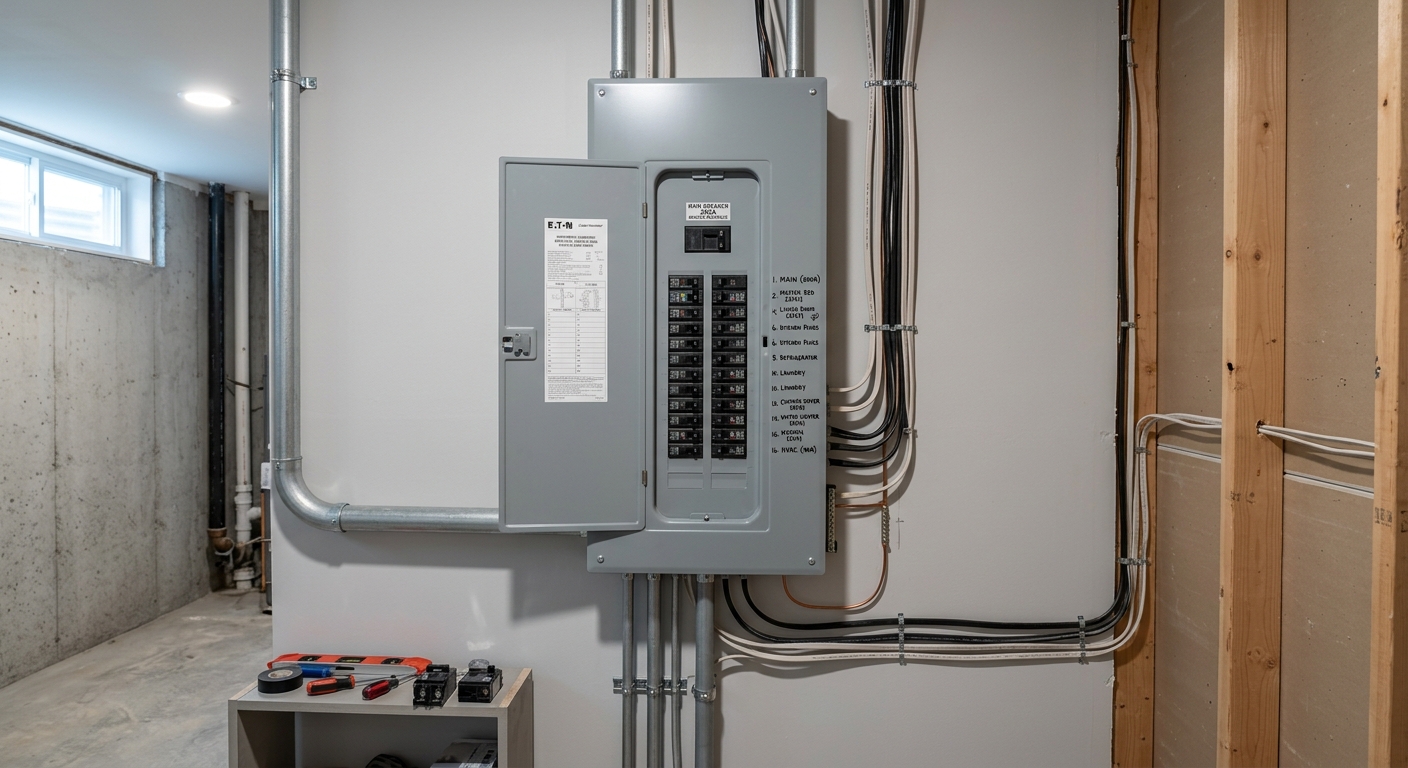
Electrical services in Orillia tend to look “bigger than they used to” because so much of the housing stock is aging. In fact, 58.0% of homes were built before 1981 (Statistics Canada, 2021 Census), which is exactly where you most often see panel upgrades from older 60A/100A setups, older wiring styles, and the need to bring circuits in line with current Ontario requirements. With 55.7% of dwellings being single-detached homes, many projects are full-service improvements—panel and breaker refreshes, basement finishing-related circuits, and whole-home safety upgrades—rather than small spot fixes.
In the Kitchener–Waterloo–Barrie region, contractor demand and scheduling are also influenced by the same housing profile: plenty of work is panel/service upgrades, knob-and-tube removal, aluminum wiring remediation, and rewiring to Ontario Electrical Code standards. Winter conditions around Orillia don’t change the wiring itself, but they do affect access (frozen ground for outdoor work, snow/ice around service entrances) and the practical timeline for larger installs. If you’re in a neighbourhood near downtown Orillia—where many properties predate modern EV-ready electrical—service capacity and legacy wiring issues come up frequently when owners add heat pumps, induction ranges, and a Level 2 EV charger.
Below is a practical comparison of common electrical work types and what typically triggers permitting and inspection, so you can benchmark your quote before you book a site visit.
| Service |
Why It's Needed |
Permit Required |
Price Range |
| Panel upgrade — 100A to 200A service |
Improves load capacity for modern appliances, electric heat, heat pumps, and EV chargers; adds up-to-date breakers, grounding, and required safety protection. |
Yes (service upgrade + permits and ESA inspection requirements) |
$2,500 – $7,000 |
| EV charger installation (Level 2, 40–50A) |
Adds a dedicated, code-compliant circuit for reliable charging; addresses capacity and breaker selection based on your service and load calculation. |
Yes (new dedicated EV circuit typically requires ESA permit/inspection) |
$800 – $2,500 |
| Knob-and-tube wiring removal and replacement |
Modernizes unsafe or hard-to-maintain wiring methods; reduces risk from deteriorated insulation and improves insurability and code compliance. |
Yes (major rewiring typically requires permit/inspection) |
$4,000 – $15,000 |
| Aluminum wiring remediation (CO/ALR connectors) |
Improves termination reliability where aluminum conductors are present; uses approved connectors/techniques or plans full replacement where needed. |
Yes (repairs/remediation that impacts conductors and connections typically requires permit/inspection) |
$4,000 – $15,000 |
| New dedicated circuit (HVAC, appliance, hot tub) |
Prevents overloads and supports correct protection for high-demand equipment; often includes AFCI/GFCI where required. |
Yes (new circuits typically require ESA permit/inspection) |
$1,200 – $3,800 |
| Whole-home rewire (older home, full replacement) |
Replaces aging wiring throughout to meet current code for safety, load distribution, and future renovations. |
Yes (full rewiring requires permit/inspection) |
$8,000 – $20,000 |
Prices are estimates only and vary by project scope, site access and material selection.
What affects the price of electrical work in Orillia
Even for the “same” electrical job, quotes across the Kitchener–Waterloo–Barrie region can vary by 30–50% because the hidden work is often what drives cost: how your service is built, where cables run, whether the wiring is accessible, and how much rework is required to meet current protection and grounding rules. Ontario also has a consistent compliance expectation—permits, ESA inspections, and code-level AFCI/GFCI where required—so the range usually comes from the engineering and labour time, not from cutting corners.
In this region, the dominant cost driver is housing age. Homes built before 1950 may contain knob-and-tube wiring, and insurers increasingly scrutinize or decline coverage when that legacy wiring is still active; that pushes homeowners toward removal and full replacement. Homes from the 1960s–70s often have 60A or 100A panels—adequate for decades ago, but commonly undersized once owners add EV charging, induction stoves, and heat pumps. In the $2,500–$7,000 panel/service band, many Orillia projects land in the lower or middle portion when the existing panel location is straightforward, while they’re closer to the top end when structural or service-entrance upgrades are required to safely modernize.
Aluminum wiring—common in houses built roughly from 1965–1976—requires licensed remediation with approved CO/ALR connectors or, in more extensive cases, full replacement. EV adoption is a major load driver now; adding a 40–50A Level 2 charger often triggers a load calculation and sometimes forces a 200A upgrade, even when the original 100A panel “seems fine” at first.
Two concrete Orillia examples: (1) a basement finish can reduce access later, so doing trenching/fishing cables during the first phase can lower wiring costs versus “retrofit-only” work; (2) properties with overhead service runs and limited working clearance often increase labour hours, pushing projects above the typical mid-point.
| Price Factor |
Why It Matters |
Cost Impact |
| Panel size upgrade — 100A to 200A is the standard minimum today |
Modern load demand often requires additional capacity and updated breaker technology. |
Can move a project into the $2,500 – $7,000 band |
| Wiring type — copper vs. aluminum remediation vs. K&T removal |
Aluminum and knob-and-tube remediation/rewiring take longer and require approved methods. |
Often increases wiring scope into the $4,000 – $15,000 band |
| Number of new circuits — each adds material and labour time |
Each circuit needs proper cable sizing, breakers, and protection (AFCI/GFCI where applicable). |
Adds incremental cost per circuit beyond any EV/heat work |
| Permit + ESA/TSBC inspection fee — mandatory for all major work |
Major electrical modifications must be permitted and inspected to be considered compliant. |
Non-optional line item that affects the quote baseline |
| Labour rate for licensed electricians — journeyman rates in {region} |
Labour is typically the biggest variable on panel/service and rewiring projects. |
Drives the spread between lower-scope and full-rewire estimates |
| EV charger amperage — 40A vs. 50A circuit affects cable and breaker cost |
Higher amperage can increase conductor size and breaker cost, and may impact load calculations. |
Can shift EV installs within $800 – $2,500 |
| Emergency or after-hours premium |
Urgent troubleshooting and scheduling adds overhead and may require priority parts procurement. |
Often adds a noticeable premium to labour |
| Load calculation required for service upgrade |
A correct calculation affects conductor/breaker selection and whether 100A can safely remain. |
May add professional time; can prevent oversizing or costly rework |
Permits & regulations in Ontario
In Ontario, ALL electrical work beyond changing a light bulb must be performed by a licensed electrician. For homeowners in Orillia, the key point is that permits are required for major changes—panel upgrades and service upgrades, adding new circuits, rewiring, and installing EV charger circuits are the most common examples. Once the permit is issued, the work must pass inspection by the Electrical Safety Authority (ESA). DIY electrical is prohibited for most work, and while homeowners can sometimes handle non-electrical tasks like paint or mounting locations, they generally cannot perform the electrical connection or make wiring changes themselves on permitted jobs.
Work that typically requires a permit and inspection includes: replacing or upgrading a breaker panel, replacing a service entrance, adding a new dedicated circuit (for example for an EV charger, hot tub, or major kitchen appliance), removing knob-and-tube wiring where conductors are replaced/rewired, and aluminum remediation that changes connections. Work that often does not require a permit in the same way includes simple fixture swaps (like exchanging a single light fixture) provided you are not altering wiring methods or making new connections beyond the approved existing setup—however, if your existing wiring is questionable or requires splicing/rewiring, a permit may be required.
To verify a contractor before you hire: (1) confirm the electrician’s Ontario licence via the provincial licence registry; (2) request a certificate of insurance showing liability coverage and ensure it matches the company name; (3) confirm WSIB/WCB clearance (ask for proof); (4) confirm they will pull the ESA permit under their licence and book the inspection; and (5) ask for their written scope so you know what’s included and what inspection coverage you’re getting.
When your Orillia home needs an electrical upgrade
Electrical upgrades in Orillia aren’t just about convenience—they’re about safety and code compliance, especially in older housing. Here are the warning signs I look for during service calls.
(1) Breakers that trip regularly: this can indicate an overloaded panel, a failing breaker, or undersized/incorrectly protected circuits. If it’s frequent or happens with normal use, it’s usually urgent.
(2) Knob-and-tube wiring present: the concern isn’t only “age”—it’s deteriorated insulation, questionable splice history, and insurance complications. If knob-and-tube is still active in a living area, plan removal rather than waiting for a failure.
(3) A 60A or 100A service: many Orillia homes built decades ago are fine until modern loads stack up. If you have an EV charger planned, heat pumps, and an electric stove, a 200A upgrade is the standard solution to prevent nuisance tripping and to support proper breaker selection.
(4) Aluminum wiring (often seen in pre-1976 construction): it may work for years, but it requires licensed remediation—commonly using approved CO/ALR connectors or full replacement at problematic terminations.
(5) Insufficient outlets or extension cords everywhere: this is often a code and safety issue, not a “convenience” one. Planned upgrades can fix the real cause—insufficient dedicated circuits.
(6) No AFCI or GFCI protection where required: this can surface during home sale inspections and can affect insurance and safety. For rentals and showings, it’s better to address before listings.
In terms of dollars, upgrading service/panel work commonly sits in the $2,500 – $7,000 range, while wiring remediation or full rewires often fall into $4,000 – $15,000 and above. The price difference is justified when you choose the approach that matches the actual wiring condition—troubleshooting an overloaded old panel without dealing with wiring limitations can cost more later.
| Warning Sign |
What It Means |
Recommended Action |
Urgency |
Price Band |
| Breakers trip frequently |
Possible overload, incorrect circuit protection, or a fault. |
Troubleshoot load/circuit and inspect panel and breaker health; add circuits or upgrade service if needed. |
Immediate or within days |
$800 – $3,800 |
| Knob-and-tube wiring present |
Legacy wiring method with deteriorating insulation risk and insurance complications. |
Plan removal and replacement of affected circuits; update protections to current code. |
Planned (but don’t ignore) |
$4,000 – $15,000 |
| 60A or 100A panel (inadequate load capacity) |
Service size may not support EV charging and modern electric loads. |
Request a load calculation and plan service/panel upgrade to 200A if indicated. |
Planned before adding new major loads |
$2,500 – $7,000 |
| Aluminum wiring (pre-1976 construction) |
Risk of connection issues requiring approved remediation. |
Inspect terminations; use CO/ALR connectors or replace conductors where required. |
Planned (schedule remediation) |
$4,000 – $15,000 |
| Insufficient outlets — extension cords everywhere |
Likely insufficient dedicated circuits and overload risk. |
Add outlets and/or dedicated circuits for high-use equipment. |
Planned (address before a bigger failure) |
$1,200 – $3,800 |
| No AFCI or GFCI protection where required |
Safety and code-compliance gap that can fail inspection and affect insurance. |
Upgrade receptacles/breakers to meet current requirements. |
Planned, especially before sale |
$600 – $2,400 |
How to choose a electrical work contractor in Orillia
Choosing the right contractor in Orillia usually comes down to proof and paperwork—not just the hourly rate. First, verify the electrician is licensed in Ontario and will pull the required ESA permits for your project scope. Ask for their certificate of insurance (liability) and confirm WSIB/WCB coverage before work begins. This matters because panel upgrades, rewiring, and service-related work carry real risk, and you want a contractor whose coverage matches their work.
Next, request 2–3 itemised written quotes. Look for a breakdown that separates labour and materials (for example, panel/bracing/upgrade components, breakers/AFCI-GFCI devices, conduit/cable, and any trenching or cable fishing). Make sure the quote identifies whether a load calculation is included for an EV or service upgrade. Confirm if permits are included, and if not, what you’re responsible for. Also ask about disposal—old panel components, removed wiring, and debris handling are not always treated the same way.
Warranty should be in writing: workmanship warranty length, product/manufacturer warranty details, and whether warranty coverage is transferable if you sell the house. On payment, don’t pay the bulk upfront—generally keep deposits to 10–15% and hold back until completion and verification. Finally, get the start date and completion estimate in writing, including inspection scheduling time.
- Licence number and ESA permit responsibility stated on the proposal.
- Certificate of insurance provided before work starts.
- WSIB/WCB clearance proof requested and reviewed.
- Itemised quote (labour, materials, devices, cables/conduit, permits).
- Specific protection upgrades listed (AFCI/GFCI where required).
- Load calculation included for service/EV-related upgrades.
- Clear scope for any drywall patching, cable fishing, and reinstatement.
- Confirmation of waste disposal and site cleanup expectations.
- Workmanship warranty length and what it covers.
- Manufacturer warranty terms and whether they apply to your specific components.
- Payment schedule with a holdback until inspection and sign-off.
- Written timeline including ESA inspection booking window.
Red flags I commonly see in Orillia: quotes that are “lump sum” with no itemization, promises to skip permits/ESA inspection, vague warranty language, requests for large upfront payments, and contractors who cannot provide licence/insurance/WSIB documentation during the quoting stage.
Frequently asked questions — electrical work in Orillia
What is a GFCI outlet and where is it required in Ontario?
A GFCI (Ground-Fault Circuit Interrupter) outlet or breaker is designed to shut off power quickly when it detects a ground-fault—like current leaking through an unsafe path instead of following the intended circuit route. In Ontario homes, GFCI protection is required in specific locations that are more likely to encounter moisture or wet conditions, such as bathrooms and areas near sinks. Outdoor receptacles and garage/workshop areas can also be required depending on the setup and location. For many Orillia homeowners, this becomes especially noticeable during renovations or sale-related updates, since older panels and older receptacles may not include modern protection. If you’re budgeting, upgrading protection devices is often smaller in scope than a service upgrade, but it can still add up—small work is commonly found in the lower bands, while anything that triggers rewiring or new circuits can move toward $1,200 – $3,800 or more.
How do I know if my Orillia home has aluminum wiring?
Aluminum wiring is often associated with older installations, commonly seen in homes built roughly in the mid-1960s through the 1970s, but the only reliable confirmation is an inspection of the conductors at accessible locations (panel, junction boxes, and at terminations). A licensed electrician can look for markings on the cable/conductors, examine the connector/terminal type, and measure for any condition issues at terminations. If your home is pre-1981 (58.0% of Orillia homes built before 1981 per Statistics Canada, 2021 Census), there’s a higher chance of legacy wiring styles being present, and aluminum is one of the more common “finds.” Note that aluminum isn’t automatically dangerous if properly terminated, but it often requires CO/ALR-approved remediation. If your electrician recommends CO/ALR connectors or partial replacement, that typically places you in the larger wiring/remediation bands like $4,000 – $15,000, depending on how widespread the wiring issues are.
What is the cost of rewiring a house in Orillia?
The cost of rewiring depends on whether you’re doing a partial rewire (specific areas/circuits), aluminum remediation with approved connectors, or a full whole-home replacement. In Orillia, many rewiring projects involve older housing stock and legacy wiring methods, so scope can change quickly once access is opened behind finished walls. For most homeowners, wiring & rewiring commonly lands in the $4,000 – $15,000 band for substantial remediation or targeted replacement, while whole-home rewires often exceed that—especially when finishes, panel moves, and extensive cable runs are required. If the job is connected to a panel/service upgrade (for example, moving to 200A to support EV charging and heat pumps), your budget also has to account for service work, which is commonly in the $2,500 – $7,000 range. A proper quote should be itemised and confirm what’s included: new cable types, device replacement, permits, ESA inspection, and any surface repair expectations.
What electrical upgrades are required when selling a home in Ontario?
Ontario doesn’t work like a single universal “must-do list” for every sale, but electrical issues can become deal-breakers because buyers often require updated safety, and insurance can refuse to cover certain unsafe or outdated conditions. In practice around Orillia, common upgrades that come up during sale readiness include adding missing GFCI protection where required, correcting ungrounded or unsafe receptacle configurations, and updating any outdated/unsafe wiring methods. Homes with legacy wiring like knob-and-tube (especially if still connected) often see pressure to replace before closing, and aluminum wiring frequently requires documented remediation. If your home sale coincides with planned load increases—like adding a Level 2 EV charger or electric appliances—your electrician may recommend a load calculation and potentially a service upgrade. Those service upgrades commonly fall in the $2,500 – $7,000 band, while wiring remediation can run into $4,000 – $15,000 depending on how much of the home is affected. Your best approach is a pre-list electrical inspection so you address the issues buyers and insurers flag most often.
What is a load calculation and why does my electrician need one?
A load calculation is a structured assessment of your home’s electrical demand based on the appliances and heat/comfort loads you have (or plan to add), and it helps determine whether your service size and breaker layout can supply that demand safely. In Orillia, this matters because many homes have older 60A or 100A services, and owners increasingly add EV charging, heat pumps, induction stoves, and other modern loads. A 40–50A Level 2 charger can be a tipping point: it may be fine on paper for one load scenario but not the real combined scenario. The calculation drives correct conductor sizing, breaker sizing, and whether upgrading to a 200A service is the prudent route. That’s also why EV-related projects often require permits and inspection in Ontario. If your calculation shows you’re at or beyond safe capacity, the work typically escalates from an EV install into a service/panel upgrade budget—often $2,500 – $7,000 in Orillia—rather than staying solely in the EV band like $800 – $2,500.
How do I find a licensed electrician in Orillia?
Start with the licensing verification and insurance documentation—don’t rely only on Google reviews. For Orillia and the rest of Ontario, confirm the electrician is licensed and ensure they will pull ESA permits where required (panel/service upgrades, new circuits, rewiring, and EV charger installs). Ask the contractor for a certificate of insurance showing liability coverage and proof of WSIB/WCB coverage before they begin. Then request an itemised quote that clearly lists labour and materials, whether permit/inspection costs are included, and what protections are being installed (for example, AFCI/GFCI where required). For EV work, ask if they’ll do a load calculation and specify the circuit amperage (40A vs. 50A) because that affects cable and breaker selection and therefore the final cost. A well-run job also includes a written timeline and a workmanship warranty. If you’re comparing bids, watch out for anyone who can’t provide licence and insurance proof—those contractors often produce quotes that don’t align with ESA inspection realities.