Electrical services and costs in Mimico
Mimico homeowners often run into electrical upgrades sooner than they expect, especially in neighbourhood pockets with older housing stock and heavy day-to-day use. With a population of 33,964 in 2021 (Statistics Canada, 2021 Census), the Mimico area sits within the broader Toronto economic region where dense older neighbourhoods and rapid infill create steady demand for licensed electricians and permitted electrical work. Many local homes are pre‑1970, which means you may see knob-and-tube wiring or mid‑century aluminum branch wiring—both can struggle with today’s appliance, EV, and heat-pump loads.
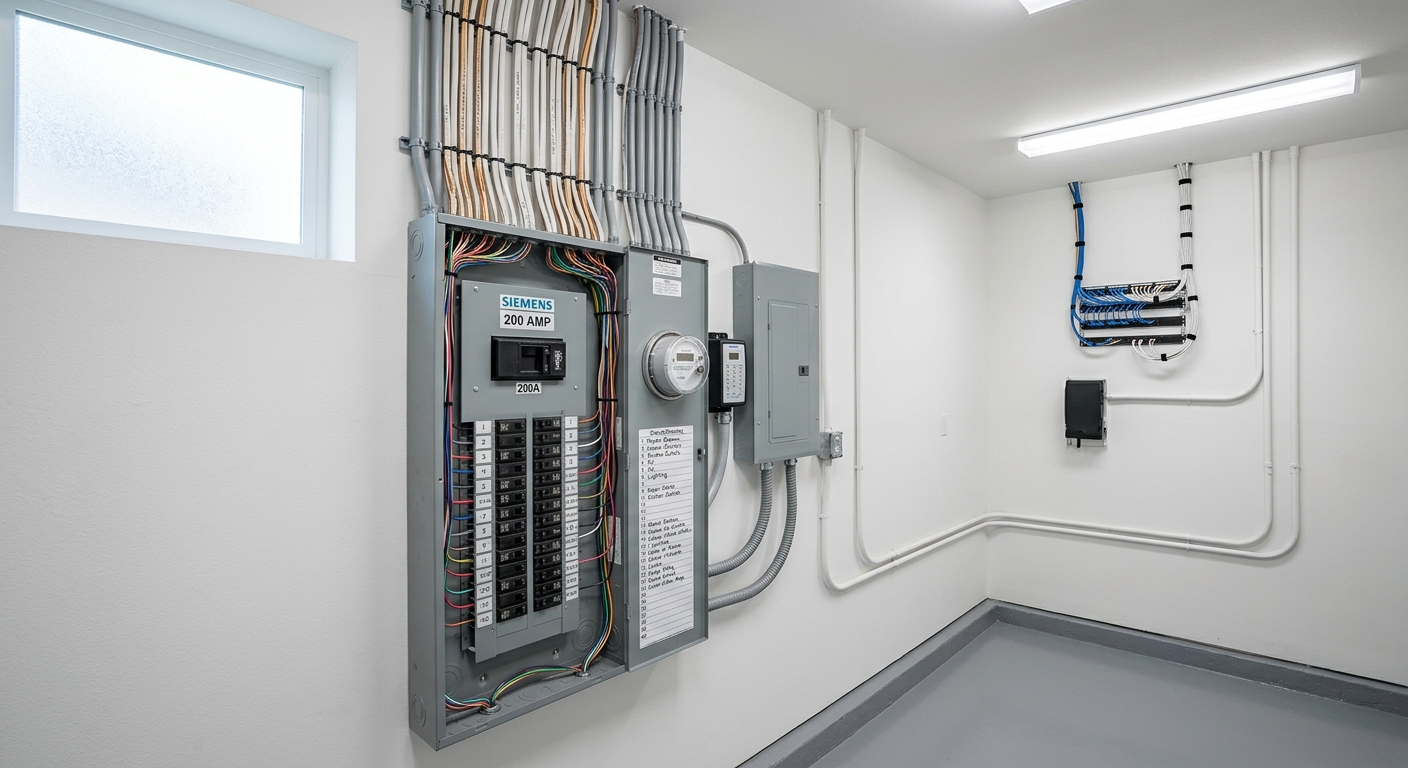
Toronto-area pricing is also influenced by how quickly electrical contractors are booked, plus the need for inspections and remediation in built-up neighbourhoods. Cold winters and ongoing temperature swings matter too: more heating demand shows up as longer run times on HVAC and electric backup, and that can expose overloaded panels and aging wiring faster. Add to that the strong retrofit cycle—finished basements, rental conversions, and service upgrades—and it’s common to pair wiring work with a 100A-to-200A panel and service upgrade.
In Mimico, trades activity is especially visible around the lakeshore corridor and established residential streets where access is tight and older wiring is common. If you’re planning an upgrade, the fastest way to budget is to line up likely scopes and compare them with current local price bands—starting with the options in the table below.
| Service |
Why It's Needed |
Permit Required |
Price Range |
| Panel upgrade — 100A to 200A service |
Modern loads (EV charging, heat pumps, induction cooking, finished basements) often exceed older panel/service capacity. |
Yes (permit and ESA inspection) |
$2,500 – $6,000 |
| EV charger installation (Level 2, 40–50A) |
Adds safe dedicated power for Level 2 charging and avoids overloading shared circuits. |
Yes (permit and inspection) |
$900 – $2,250 |
| Knob-and-tube wiring removal and replacement |
Old insulation/contact points can be unreliable; removal reduces fire risk and supports insurance requirements. |
Yes (rewiring/remediation) |
$3,000 – $15,000 |
| Aluminum wiring remediation (CO/ALR connectors) |
Improves connections and safety on aluminum branch wiring using approved remediation methods. |
Yes (major wiring alteration) |
$3,000 – $10,500 |
| New dedicated circuit (HVAC, appliance, hot tub) |
Reduces nuisance trips and supports high-demand equipment with proper breakers/cable sizing. |
Yes (new circuit) |
$500 – $3,500 |
| Whole-home rewire (older home, full replacement) |
Best when wiring is largely outdated, damaged, or difficult to troubleshoot while maintaining reliability. |
Yes (full rewiring) |
$8,000 – $18,000 |
Prices are estimates only and vary by project scope, site access and material selection.
What affects the price of electrical work in Mimico
In Toronto and the surrounding region, it’s normal to see quotes for the “same” electrical upgrade differ by roughly 30–50%. The reason is that scope details—wire routing, panel condition, grounding/bonding, and whether safety issues are discovered once walls open—can change labour time and material needs quickly. Ontario also requires permits and ESA inspections for major work, which adds scheduling and documentation steps on every project.
For Mimico, the biggest cost driver is usually housing age. Homes built before 1950 are more likely to have knob-and-tube wiring, and insurance concerns can force earlier remediation than a homeowner originally planned. Homes from the 1960s to 1970s often have undersized panels (commonly 60A or 100A) that can’t reliably support modern loads like EV charging, heat pumps, and electric cooking. Aluminum wiring, frequently found in homes built roughly between 1965 and 1976, typically needs licensed remediation using approved CO/ALR connectors—or a full replacement when conditions are beyond safe repair. EV adoption has become a major new driver in the region, with a surge in Level 2 charger permit applications and the need for load calculations before upgrading service.
Two concrete Mimico examples that move price either direction: (1) If you need a 200A upgrade alongside wiring remediation, you’re often combining scopes efficiently, which can narrow the total cost versus doing them separately; panel upgrades commonly fall in the $2,500–$6,000 band. (2) If the installer must open finishes to reroute aluminum conductors or remove knob-and-tube runs, wiring projects can move toward the $3,000–$15,000 band. Climate isn’t the direct cause of electrical failure, but Toronto’s winter heating demand amplifies load—so electricians frequently recommend changes that prevent repeated breaker trips during peak usage.
| Price Factor |
Why It Matters |
Cost Impact |
| Panel size upgrade — 100A to 200A is the standard minimum today |
Determines the breaker/cable plan for EV, heat pumps, and added circuits. |
Often $2,500–$6,000 depending on service conditions and complexity. |
| Wiring type — copper vs. aluminum remediation vs. K&T removal |
Aluminum requires approved remediation steps; knob-and-tube often needs removal. |
Can shift wiring from thousands to upper-range projects. |
| Number of new circuits — each adds material and labour time |
More circuits means more cable, outlets/fixtures, breakers, and testing. |
Typical additions can add hundreds per circuit. |
| Permit + ESA/TSBC inspection fee — mandatory for all major work |
Major work must be permitted and inspected to confirm code compliance. |
Often $200–$500 depending on scope. |
| Labour rate for licensed electricians — journeyman rates in Toronto-area |
Licensed labour is a major share of total cost in the GTA. |
Commonly about $90–$120 per hour in this region. |
| EV charger amperage — 40A vs. 50A circuit affects cable and breaker cost |
Higher amperage can require larger cable and breaker sizing. |
May move charger installs toward the higher end of $900–$2,500. |
| Emergency or after-hours premium |
Urgent callouts add higher hourly rates and scheduling constraints. |
Can add a noticeable premium on top of labour/materials. |
| Load calculation required for service upgrade |
Modern code compliance expects proper assessment of total connected load. |
Often adds time (and can confirm a higher service size). |
Permits & regulations in Ontario
In Ontario, ALL electrical work beyond changing a light bulb must be done by a licensed electrician. That includes panel and service upgrades, rewiring, adding or modifying circuits (including EV charger installations), and any work that requires inspection. For homeowners in Mimico, the key point is that permits are required for major work, and permitted work must pass inspection by the electrical safety authority in Ontario (ESA) or the local building process that routes permits through ESA. DIY is restricted: while you may change certain fixtures or bulbs in many cases, you should assume you cannot legally DIY wiring changes—especially anything inside panels, any new cable runs, new breaker installation, or anything involving grounding/bonding upgrades.
What typically DOES require a permit: new circuits, panel upgrades, service relocations, EV Level 2 charger installs, knob-and-tube removal, aluminum remediation work, and whole-home rewiring. What typically does NOT: swapping out a like-for-like receptacle faceplate or a ceiling fixture where the connection method is unchanged and it doesn’t involve wiring alterations (your electrician should confirm the exact boundaries before you touch anything).
To verify a contractor in Mimico, follow a simple checklist: (1) Confirm the electrician/firm licence using the Ontario registry/verification process provided by the provincial authority; (2) Ask for a current certificate of insurance (liability) and ensure the electrical contractor is named as insured; (3) Request proof of WSIB/WCB coverage where applicable for their employees; (4) Get the permit number or documentation they will pull under your address; (5) Ensure the estimate references ESA inspection after completion.
When your Mimico home needs an electrical upgrade
Electrical upgrades in Mimico are often discovered through safety signals, not through cosmetic issues. Here are the warning signs that point to real risk or code compliance problems—plus which ones need immediate attention versus planned budgeting. (1) Breakers that trip regularly: if they trip when only normal loads are running, you may have overloaded circuits, deteriorated connections, or failing breakers. This is a “stop and investigate” situation. (2) Knob-and-tube wiring present: the main concern is aging insulation and unsafe contact points, not just the age label. In many cases it also triggers insurance complications, so remediation should be planned promptly. (3) A 60A or 100A service: for today’s GTA load profile—EV charger, heat pump/backup, and electric stove—capacity is frequently the bottleneck. A 200A upgrade is the standard solution when a load calculation shows you’re near or exceeding capacity. (4) Aluminum wiring (often pre‑1976 construction): not always instantly dangerous if it has been properly maintained, but it does require licensed remediation to ensure safe connection behaviour. (5) Insufficient outlets: extension cords everywhere usually signals undersized circuit planning or insufficient receptacles; it’s a practical fire-safety red flag. (6) No AFCI or GFCI protection where required: this is a compliance issue that can surface at home sale or inspection.
Toronto’s winter demand can make overload issues more obvious—heavy heating seasons increase overall draw and can amplify nuisance trips. A practical example: if you’re adding a Level 2 charger and you’re currently on a small panel, choosing to upgrade service and add circuits together can be more cost-effective than making repeated, smaller “fixes.” The difference is often justified when the electrician recommends a full plan that lands in the $2,500–$6,000 panel upgrade band instead of multiple short-term circuit additions that still don’t solve capacity limits.
| Warning Sign |
What It Means |
Recommended Action |
Urgency |
Price Band |
| Breakers trip frequently |
Overloaded circuits, poor connections, failing breakers, or undersized panel/cabling. |
Call for an electrical inspection and load/circuit assessment. |
Immediate |
$500 – $3,500 |
| Knob-and-tube wiring present |
Aging insulation and unsafe junction conditions. |
Plan removal and replacement of affected runs; evaluate whole-home scope if widespread. |
Planned / urgent |
$3,000 – $15,000 |
| 60A or 100A panel (inadequate load capacity) |
Modern loads exceed service capacity or leave too little headroom. |
Service/panel upgrade with load calculation; typically move to 200A. |
Planned / urgent |
$2,500 – $6,000 |
| Aluminum wiring (pre-1976 construction) |
Connections may degrade and require licensed remediation. |
CO/ALR connector remediation or selective replacement depending on conditions. |
Planned |
$3,000 – $10,500 |
| Insufficient outlets — extension cords everywhere |
Convenience workaround for inadequate receptacle distribution. |
Add receptacles and/or dedicated circuits; address circuit loading. |
Planned |
$500 – $3,500 |
| No AFCI or GFCI protection where required |
Lower shock/fire protection and potential sale/inspection issues. |
Add GFCI/AFCI devices or replace with code-compliant protection as required. |
Planned |
$200 – $1,800 |
How to choose a electrical work contractor in Mimico
Choosing the right electrician in Mimico starts with proof and paperwork, not just a low number. First, verify Ontario licensing: ask for their licence details and confirm through the provincial registry/verification pathway. Next, get liability insurance documentation (certificate of insurance showing the contractor as insured) and ask how they handle jobsite protection and damage claims. Finally, request proof of WSIB/WCB coverage where applicable for their employees—this protects you if a worker is injured on your property. If they can’t provide documentation quickly, that’s a practical red flag.
Then get 2–3 itemised written quotes. Ideally, the quote breaks down labour and materials separately (for example: panel hardware, breakers, cable, labour hours, permit/inspection handling). Read the scope carefully: confirm what’s included—permit pull, ESA inspection scheduling, disposal/dump fees, drywall patching allowances, surface restoration, and any allowance for unexpected wiring findings. Look for a workmanship warranty length and whether product warranties transfer to you (and what happens if a manufacturer defect occurs). Payment should be controlled: avoid paying more than about 10–15% upfront, and use a holdback until key milestones or final inspection are complete. Make sure you have a start date and a completion estimate in writing, because GTA contractor schedules can shift quickly during peak demand.
- Licence verification details included on the quote and invoice.
- Certificate of insurance provided before work starts.
- WSIB/WCB proof available on request.
- Itemised breakdown (labour vs. materials) rather than a single lump sum.
- Permit and ESA inspection included—or clearly listed as “client to arrange.”
- Explicit scope for panel/service upgrades (relocation, trenching, grounding/bonding).
- Confirmation of wiring remediation method (CO/ALR connector type or removal approach).
- Testing and commissioning steps listed (torque checks, continuity tests, insulation checks).
- Disposal and restoration responsibilities stated (and any exclusions).
- Workmanship warranty duration and claim process in writing.
- Clear payment schedule with holdback until completion/inspection.
- Written timeline with start date and expected completion window.
In Mimico, common red flags include: quoting without pulling a permit for work that clearly needs it, vague scope language that leaves disposal/restoration out, refusing to provide licence/insurance proof, offering unusually low pricing that excludes inspection or remediation contingencies, and asking for a large upfront deposit without a milestone plan.
Frequently asked questions — electrical work in Mimico
How long does a rewiring job take?
In Mimico, a rewiring job timeline depends mainly on how much of the home needs replacement, whether walls must be opened, and whether you’re also upgrading the panel/service. A partial rewire (for example, specific circuits or a targeted area) can take days to a couple of weeks, while a whole-home rewire commonly runs longer due to testing, inspection prep, and restoration coordination. If knob-and-tube or extensive aluminum wiring is involved, troubleshooting and safe removal usually extend the schedule.
It’s normal for contractors to plan in phases: rough-in, testing, permit/inspection scheduling, then finish restoration. If you’re also moving from 100A to 200A, that often becomes a “core path” task and may set the pace for everything else. For budgeting, wiring scopes often fall within the $3,000–$15,000 band, but timing is usually longer than the homeowner expects.
Why do my breakers keep tripping?
Breaker trips in Ontario usually mean something is either overloaded, shorting, or experiencing a connection/grounding issue. In many Mimico homes, the cause is an aging circuit trying to serve today’s load: kitchens running microwave + toaster + induction, basement rec rooms using space heaters, or seasonal demand spikes in winter from heating appliances. Another common cause is deteriorated wiring—especially where aluminum connections were not properly remediated—or nuisance tripping from undersized breakers/circuits.
Before you reset repeatedly, stop using the affected circuit and arrange an electrical inspection. If you’re adding a Level 2 EV charger or another high-demand load, you typically need a load calculation to determine whether your panel/service is adequate. A frequent workaround is to keep “adding circuits,” but if the panel is undersized, the right fix is often a panel/service upgrade (commonly $2,500–$6,000 for many GTA panel upgrades). The goal is to resolve the underlying capacity and wiring condition—not just reset the breaker.
How do I compare electrical quotes?
To compare electrical quotes in Mimico fairly, don’t focus on the headline number alone—compare scope, inclusions, and inspection steps. Ask each contractor for an itemised breakdown that separates labour and materials, including cable/breakers, panel hardware, and any remediation supplies (like CO/ALR connectors for aluminum work). Confirm whether they will pull the permit and coordinate the required ESA inspection for major work such as new circuits, panel upgrades, EV charger installation, and rewiring.
Then check exclusions: disposal fees, drywall patching, restoration quality, wire routing limitations, and how they price “unexpected findings” once walls open. Labour rates in the Toronto economic region are often around $90–$120 per hour, so a quote that seems too low may be missing testing, permits, or restoration assumptions. Finally, verify warranty terms (workmanship and product) and payment structure—avoid quotes that demand more than about 10–15% upfront without clear milestones. A realistic panel upgrade budget is commonly within the $2,500–$6,000 band, while Level 2 charger installs often land around $900–$2,500.
How long does a panel upgrade take in Mimico?
For many Mimico homes, a panel upgrade timeline is typically about one to two working days for the electrical work itself, assuming there are no major surprises like severe service damage or extensive grounding/bonding deficiencies. The total timeline can be longer once you include permit scheduling, inspection time, and any necessary surface repairs around the panel opening. If trenching or service relocation is required due to how your service is routed, expect a longer schedule.
Because Ontario requires permits and ESA inspection for panel/service upgrades, your contractor should confirm the inspection date and planned test sequence. If you’re upgrading from 100A to 200A to support EV charging, heat pumps, or a finished basement, it’s smart to plan for load calculation and circuit additions at the same time to avoid paying for multiple openings and repeat work.
In budget terms, these upgrades commonly fall within the $2,500–$6,000 band in the Toronto region, but your exact time and cost depend on accessibility and how much ancillary remediation is needed.
What is a GFCI outlet and where is it required in Ontario?
A GFCI (Ground Fault Circuit Interrupter) outlet is designed to quickly shut off power when it detects an unsafe ground fault—helping protect against shock hazards in areas with water exposure. In Ontario, GFCI protection is required in specific locations under the Ontario Electrical Code, commonly including bathrooms and kitchen areas, as well as other wet or damp locations. The exact requirements depend on the room type and receptacle placement, which is why a licensed electrician should verify your existing conditions.
In Mimico homes, GFCI upgrades often come up during home sales inspections or when older receptacles are replaced. Some homeowners also discover missing GFCI/AFCI protection after adding new circuits in basements or renovations. If you’re planning a service/panel upgrade, it’s an efficient time to correct protection gaps rather than do multiple smaller updates.
Cost-wise, adding GFCI/AFCI devices is usually in the smaller “fixtures/protection” range compared to panel upgrades—often around $200–$1,800 depending on the number of devices and wiring conditions. Major service changes still fall into higher bands like the $2,500–$6,000 panel range.
How do I know if my Mimico home has aluminum wiring?
In Mimico, aluminum wiring is more common in certain mid‑century construction eras, and it’s often the branch wiring feeding outlets and switches. The simplest way to know is for your electrician to inspect the conductors visually and by testing once access is opened: aluminum conductors often have specific markings on cable jackets or the conductor itself, and connections may show characteristics different from copper. A qualified electrician can also identify aluminum at the panel by how branch wires terminate and by verifying the conductor type.
Even if you suspect aluminum because of the home’s build period, don’t rely on guesswork—get a professional inspection. This matters because aluminum wiring is typically addressed using licensed remediation methods like approved CO/ALR connectors, or sometimes replacement when connections or conditions are beyond safe repair. It’s also a safety and insurance consideration.
If aluminum remediation is recommended, many GTA projects land in the $3,000–$10,500 range depending on how many runs and connections are involved. Your contractor should include the remediation method in the written scope, along with required testing and inspection steps for Ontario.