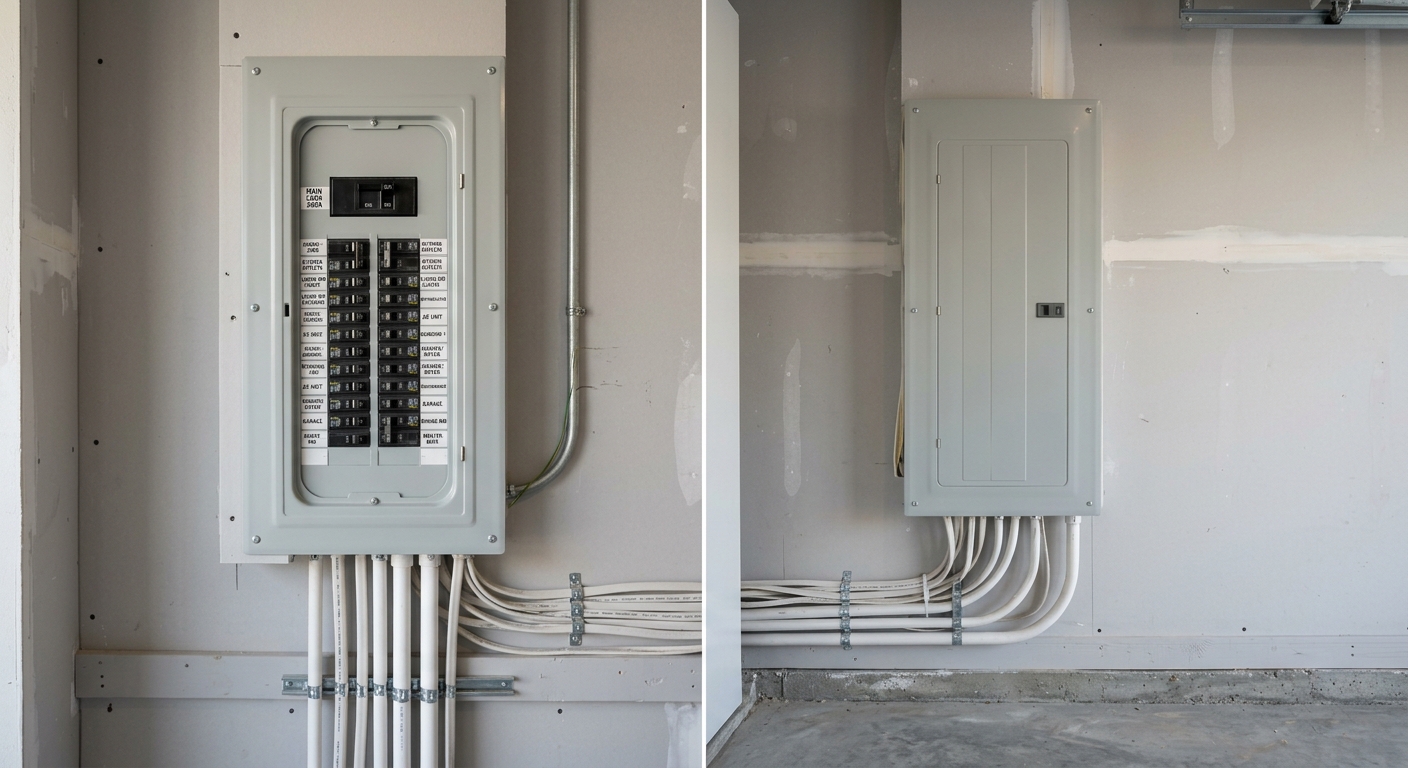
Electrical services and costs in Collingwood
Electrical work in Collingwood typically costs more than homeowners expect because a lot of local homes were built in earlier eras and need code-compliant updates, not just “new stuff.” In Collingwood, about 39.8% of dwellings were built before 1981 (Statistics Canada, 2021 Census), which means many properties still carry older wiring practices and undersized equipment. When you’re dealing with homes from the 1950s–1980s, the most common triggers are panel upgrades, knob-and-tube removal, and aluminum wiring remediation, plus modern breaker and grounding upgrades to meet Ontario Electrical Code requirements enforced through permits and inspections. (Statistics Canada, 2021 Census)
The Kitchener–Waterloo–Barrie region also shapes pricing and availability: it’s a high-renovation corridor with strong demand for licensed electricians, so labour often sits in the mid-to-high range for Ontario. At the same time, winter conditions around Georgian Bay mean more heating is used for longer stretches, which increases electrical load pressure when homeowners add heat pumps, induction cooking, or EV charging. Neighbourhoods where demand is especially steady include parts of Collingwood near downtown and the newer-growth edges where basements are frequently finished and EV adoption is rising.
To help you compare like-for-like scopes, here are common service categories and realistic price bands you can expect for Collingwood projects. Use this as a baseline, then your electrician will refine the numbers after reviewing panel condition, wiring type, access, and the permit-required scope.
| Service |
Why It's Needed |
Permit Required |
Price Range |
| Panel upgrade — 100A to 200A service |
Modern load needs (EV charging, heat pumps, upgraded kitchen/appliances) often exceed older 60A/100A capacity and require safer breaker setups and grounding. |
Yes (ESA permit + inspection) |
$2,500–$7,000 |
| EV charger installation (Level 2, 40–50A) |
Adds a dedicated circuit with the right breaker, cable sizing, and protection so charging doesn’t overload existing wiring. |
Yes (permit + inspection) |
$800–$2,500 |
| Knob-and-tube wiring removal and replacement |
Legacy wiring can present insulation and overheating risks and is often problematic for insurance and resale when discovered. |
Yes (rewiring/alteration) |
$4,000–$15,000 |
| Aluminum wiring remediation (CO/ALR connectors) |
Aluminum branch wiring requires approved termination methods (CO/ALR connectors) or replacement to reduce overheating at connections. |
Yes (major wiring work) |
$4,000–$12,000 |
| New dedicated circuit (HVAC, appliance, hot tub) |
Adds safe capacity for a specific appliance or system so you don’t rely on overloaded shared circuits. |
Yes (new circuits require permit) |
$900–$3,500 |
| Whole-home rewire (older home, full replacement) |
When wiring is broadly outdated, widespread replacement brings the entire system in line with current safety and protection requirements. |
Yes (rewiring + inspection) |
$10,000–$30,000 |
Prices are estimates only and vary by project scope, site access and material selection.
What affects the price of electrical work in Collingwood
In Collingwood and the wider Kitchener–Waterloo–Barrie region, homeowners can see quotes for the “same” electrical upgrade vary by 30–50% once you factor in wiring condition, panel capacity, and permitting scope. The dominant cost driver is housing age. Many homes here were built across the 1950s–1980s, and older installs often require more labour to make the change code-compliant than a simple swap would suggest. For instance, pre-1950 wiring can include older practices that insurers and inspectors scrutinize; while homes from the 1960s–70s often have 60A or 100A panels that are inadequate for today’s combined loads—think EV chargers, heat pump systems, and induction stoves. Aluminum wiring is also common in the region’s older stock (especially around mid-1960s through the 1970s), and it usually needs licensed remediation using approved CO/ALR connectors, or a full replacement if the wiring condition isn’t suitable.
EV adoption is another major local driver. Level 2 charger installations are increasingly tied to service upgrades, because a 40–50A circuit can push an aging 100A service beyond practical capacity—turning a “$800–$2,500 charger” project into a “$2,500–$7,000 panel upgrade plus charger” scenario. In real Collingwood jobs, that difference is justified when a load calculation shows you’re near the margin or when the existing panel lacks the right breaker compatibility and grounding. Conversely, cost can be lower when the panel is modern, wiring is copper in good condition, and there’s a clear path for cable routing to the service without major drywall removal.
Climate matters too: longer heating seasons mean steady baseline load, so electricians may plan for future-proofing (additional breakers, AFCI/GFCI where required) rather than “patching” the current arrangement. The result is a quote that reflects both safety and how you’ll use electricity in Collingwood over the next 10–20 years.
| Price Factor |
Why It Matters |
Cost Impact |
| Panel size upgrade — 100A to 200A is the standard minimum today |
Brings service capacity and breaker space in line with EV charging and modern appliance loads. |
Often the biggest single line item (commonly within $2,500–$7,000) |
| Wiring type — copper vs. aluminum remediation vs. K&T removal |
Aluminum and knob-and-tube typically require special handling, connectors, or replacement. |
Can add thousands; remediation may fall in the $4,000–$12,000 range |
| Number of new circuits — each adds material and labour time |
Every circuit needs conductors, breakers, and often new routing work. |
More circuits usually increases labour and materials proportionally |
| Permit + ESA/TSBC inspection fee — mandatory for all major work |
Major electrical work must be permitted and inspected for code compliance. |
Raises baseline quote but reduces risk and rework |
| Labour rate for licensed electricians — journeyman rates in Kitchener–Waterloo–Barrie |
Licensed, insured work and proper testing takes time. |
Labour accounts for a large portion of the total on older homes |
| EV charger amperage — 40A vs. 50A circuit affects cable and breaker cost |
Different charger and circuit sizing can change conductor size and breaker/spec components. |
Can shift EV installation costs within $800–$2,500 |
| Emergency or after-hours premium |
Urgent callouts require additional scheduling and sometimes temporary solutions. |
Often increases cost by a noticeable margin vs. standard work windows |
| Load calculation required for service upgrade |
Determines if 200A is truly needed or if a smaller/alternate upgrade is viable. |
May add assessment time but prevents over- or under-building |
Permits & regulations in Ontario
In Ontario, ALL electrical work beyond changing a light bulb must be done by a licensed electrician. Permits are required for panel upgrades, service changes, rewiring, and new circuits (including new EV charger circuits). That means if you’re upgrading from 100A to 200A, adding breakers for a hot tub, installing a Level 2 charger, or replacing the wiring in part of a home, you should expect an ESA permit, mandatory inspections, and code-compliant testing.
DIY electrical is prohibited for most work; homeowner exceptions are narrow and generally don’t apply to anything involving new circuits, service equipment, or concealed wiring changes. If an electrician tells you a permit “is optional,” ask them to put the licensing and permitting plan in writing. In Ontario, the provincial electrical safety authority for this work is the Electrical Safety Authority (ESA), and all permitted work must pass inspection.
For your Collingwood project, verify the electrician before any work starts:
- Licence: confirm their Ontario electrician licence number and status via Ontario’s licence verification tools.
- Insurance: request a certificate of insurance (liability) naming you as additional insured when appropriate.
- WSIB/WCB: ask for proof of clearance/coverage so you’re not taking on contractor labour liability.
- Clearance letter: obtain it in advance for admin compliance.
This up-front check protects you during inspection day, reduces the chance of rework, and keeps the project aligned with Ontario Electrical Code expectations.
When your Collingwood home needs an electrical upgrade
Knowing when your Collingwood home needs electrical work can prevent both safety hazards and expensive “catch-up” at sale time. Start with the practical warning signs. (1) Breakers that trip frequently usually point to an overloaded circuit, an aging breaker, or poor load distribution—sometimes it’s as simple as a bad appliance circuit, but often it’s a sign your panel capacity can’t handle today’s usage. (2) If knob-and-tube wiring is present, the concern is safety and insulation contact issues, not just age; it can become a deal-breaker for insurance and resale. (3) A 60A or 100A service is often inadequate for a modern Collingwood household that runs an EV charger, heat pump or electric furnace support, and kitchen loads at the same time; a 200A service upgrade is commonly the prudent, future-proof solution. (4) Aluminum wiring (frequent in pre-1976 homes) may not be immediately dangerous if connections were done and maintained well, but it does require licensed remediation and approved connection methods. (5) Insufficient outlets—especially when extension cords are used regularly—signals an electrical layout that isn’t set up for safe long-term use. (6) Missing AFCI or GFCI protection where required is a code-compliance and shock/fire risk issue that can surface during sale inspections.
In Ontario’s colder season, steady heating demand increases baseline load, so you don’t want to wait until everything is tripping. As an example, a homeowner might be offered a “small” fix (like a new circuit) for a few hundred to a couple thousand dollars, but when a load calculation shows the service is at its limit, the cost of a panel upgrade (commonly $2,500–$7,000) is often the better long-term spend because it reduces future rework and improves safety.
Plan immediate action when you’re seeing overheating smells, scorch marks, frequent nuisance tripping that repeats the same time after time, or confirmed legacy wiring conditions that aren’t remediated. For other signs (like outlet scarcity or missing protection), schedule a planned upgrade so you can batch permits and avoid paying for repeated site visits.
| Warning Sign |
What It Means |
Recommended Action |
Urgency |
| Breakers trip frequently |
May indicate overloaded circuits, weak components, or improper load distribution. |
Inspection + load assessment; isolate overloaded circuits; address panel capacity if needed. |
Immediate to planned (based on pattern) |
| Knob-and-tube wiring present |
Legacy wiring insulation risks and recurring failure points. |
Qualified evaluation; removal and replacement where unsafe or required. |
Immediate to planned |
| 60A or 100A panel (inadequate load capacity) |
Not enough capacity for EV/modern appliances and heating loads together. |
Perform load calculation; upgrade to 200A service when warranted. |
Planned (but schedule before adding new loads) |
| Aluminum wiring (pre-1976 construction) |
Connection and termination risks without approved remediation. |
Remediate using approved CO/ALR connectors or rewire affected runs. |
Planned with priority |
| Insufficient outlets — extension cords everywhere |
Encourages unsafe temporary usage and overloads. |
Add outlets and, if needed, add dedicated circuits. |
Planned |
| No AFCI or GFCI protection where required |
Increased shock and arc-fault risk; potential sale inspection issues. |
Upgrade protection device types/circuits to meet current requirements. |
Planned |
How to choose a electrical work contractor in Collingwood
Choosing the right contractor in Collingwood starts with proof. First, confirm they’re licensed in Ontario and ask for their licence details on the quote. Next, verify liability insurance (request a certificate of insurance) so you’re covered if there’s accidental property damage. Finally, ensure they have proper WSIB/WCB coverage and that they can provide a clearance letter—this matters for contractor labour liability in Ontario.
Then, get 2–3 written, itemised quotes—not lump sums. For electrical work, an itemised breakdown typically separates labour, materials (panel/breakers/wire), testing, and any disposal or patching allowances. Also read the scope carefully: is the permit pull included in the price, and who is handling ESA inspection scheduling? If your project involves wiring replacement, confirm what portion includes testing, circuit labelling, and cleanup.
Warranty matters. Ask for the workmanship warranty length (not just the product warranty). Product/manufacturer warranties usually come with specific conditions, and sometimes they’re not transferable if you move. Payment schedule should be conservative: never pay more than 10–15% upfront. Use a holdback until the job is complete and inspected. Get a start date and completion estimate in writing, and ask how they handle delays due to inspections or material backorders.
- Licence number included on the quote (Ontario).
- Certificate of insurance provided before work begins.
- WSIB/WCB clearance letter or proof of coverage available.
- Permit scope clearly stated (ESA permit pull and inspection).
- Itemised labour and materials line items (no single “everything” total).
- Testing and commissioning included (panel verification, functional tests).
- Labelling and directory update included after panel work.
- Protection devices specified (AFCI/GFCI requirements noted where applicable).
- Materials quality level specified (brand and model of breakers/panel components).
- Disposal/temporary patching responsibility spelled out.
- Workmanship warranty stated in the contract/quote.
- Payment schedule: small deposit, holdback until completion and sign-off.
Red flags specific to Collingwood electrical contractors include: refusing to provide their Ontario licence details, quoting “no permit needed” for panel/service or new circuit work, giving only a lump sum with no itemised labour/materials, asking for most payment upfront before rough inspections, and missing basic documentation like insurance certificates or WSIB/WCB clearance.
Frequently asked questions — electrical work in Collingwood
What is a GFCI outlet and where is it required in Ontario?
A GFCI (Ground Fault Circuit Interrupter) outlet is designed to detect leakage current that can happen when electricity finds an unintended path—like through water—then shut the circuit off quickly. In Ontario, GFCI protection is required for specific locations such as areas where water is present (for example, kitchen countertop circuits, bathrooms, garages, exterior receptacles, and unfinished basements depending on how the space is finished/used). For Collingwood homeowners, this matters because basements and garages can be damp in shoulder and winter seasons.
When your electrician is updating outlets as part of rewiring or adding a new circuit, they’ll typically recommend GFCI/AFCI-compliant protection where required. If you’re comparing quotes for outlet upgrades, ask whether the new receptacles include GFCI protection and whether the work includes ESA permit and inspection (it usually does for new circuits).
How do I know if my Collingwood home has aluminum wiring?
The easiest “at home” indicator is the conductor markings and connector type used at receptacles and switches. Aluminum wiring is often identifiable by markings on the cable jacket and by the condition of the terminations—especially if you see older screw terminals that aren’t rated for copper/aluminum transitions. In many mid-century homes around Collingwood (including those built before 1976), aluminum conductors were common for branch circuits, and connections may later have been remediated improperly or left as-is.
A licensed electrician can confirm by checking the cable/insulation markings and by opening accessible boxes safely. If aluminum is present, remediation usually means approved CO/ALR connectors or replacement of affected runs, followed by correct tightening and testing. Quote comparisons are easier when one contractor is clear about whether it’s CO/ALR connector work versus full rewiring (which is a broader scope).
When you request a quote, ask which remediation approach they recommend and what protection devices they’ll install; pricing can move from a few thousand to a full rewire range depending on extent.
What is the cost of rewiring a house in Collingwood?
Rewiring cost in Collingwood depends heavily on how much of the wiring system is being replaced (partial vs. whole-home), accessibility (finished walls/insulation), and whether the service and panel are also being updated. A whole-home rewire typically lands in the broader range because it includes new cable runs, new breakers, device changes, testing, and often permit/inspection work.
For realistic budgeting in this area, many homeowners see whole-home rewire quotes spanning roughly $10,000 up to $30,000 depending on complexity, while focused wiring replacement or knob-and-tube removal can fall into the $4,000–$15,000 band. Panel upgrades alone are often a separate category and commonly run about $2,500–$7,000 when bringing a 100A service to 200A.
Your electrician should explain scope clearly and include how they’ll handle ESA permits and testing. If your home is older (around 39.8% of homes in Collingwood were built before 1981), expect discovery work—meaning they may need to open junction points to confirm wiring type before final pricing.
What electrical upgrades are required when selling a home in Ontario?
Ontario generally doesn’t require a homeowner to “retrofit everything” to today’s code before sale, but certain electrical conditions can cause major problems in real transactions—especially when safety devices are missing or when legacy wiring is discovered. In Collingwood, buyers and inspectors commonly flag outdated or hazardous situations like knob-and-tube wiring, unsafe aluminum terminations, or the absence of required protection (such as GFCI/AFCI where applicable to the circuit type/location).
What you’re actually required to upgrade is often tied to what’s unsafe or what a lender/insurer/buyer’s inspection finds. If you have an electrical system that’s clearly undersized—like an older 60A/100A service that can’t support common modern loads—upgrading to a 200A service and updating breakers/grounding is often the practical fix. That kind of panel upgrade commonly sits in the $2,500–$7,000 range, while targeted wiring and remediation can vary widely.
Because requirements can vary by insurer and transaction, the best move is to get an electrician’s assessment early so you know which items are likely to be deal-breakers and which are “nice to have.”
What is a load calculation and why does my electrician need one?
A load calculation is a method used to estimate how much electrical demand your home is likely to use, based on connected loads (like heating equipment, kitchen loads, laundry, receptacle circuits, and any EV charger). Your electrician uses it to determine whether your existing service size is adequate and what service/panel configuration will be safe and code-compliant.
This is especially important in Collingwood because many older homes were built around 60A or 100A service capacity, and winter heating plus modern additions can change the picture quickly. If you’re adding a Level 2 EV charger (often a 40–50A circuit), a load calculation helps decide if you can add it safely as-is or if you should plan a panel/service upgrade first. This is how the pricing difference becomes justified—an EV charger installation might be $800–$2,500, but if your load calculation shows the panel is at its limit, you may also need the commonly quoted $2,500–$7,000 panel upgrade path.
Ask your electrician to show how they’re doing the calculation and what it means for your specific panel and wiring.
How do I find a licensed electrician in Collingwood?
Start by verifying the licence and documentation before you schedule anyone. In Ontario, electricians must be licensed, and for major work (like panel upgrades, rewiring, new circuits, and service changes), permits and ESA inspections are required. Ask for the electrician’s Ontario licence number and confirm it through the provincial licence verification tools. Next, request a certificate of insurance (liability) so you’re protected if there’s damage during the job.
Also confirm WSIB/WCB coverage. A reputable contractor should provide proof (often a clearance letter) and be willing to share it before work starts. For an EV charger or panel/service upgrade in Collingwood, ensure the permit handling is clear—your contractor should explain who pulls the ESA permit and when inspection is expected.
Finally, request 2–3 itemised written quotes so you can compare labour and materials, not just the final total. If someone won’t itemise the scope or suggests bypassing permits, that’s a strong warning sign.