Electrical services and costs in Highland West
Electrical services in Highland West often start with one shared problem: homes are aging in a dense Toronto-area market where electrical demand keeps rising. With a Highland West population of 13,066 (Statistics Canada, 2021 Census), there’s steady pressure on contractors—especially in neighbourhood pockets with older housing stock that still has knob-and-tube or mid-century wiring. While exact build-year shares aren’t tracked for Highland West in the local profile, Toronto’s mix of pre-1970 homes and infill means many owners end up addressing outdated wiring and insufficient panel capacity.
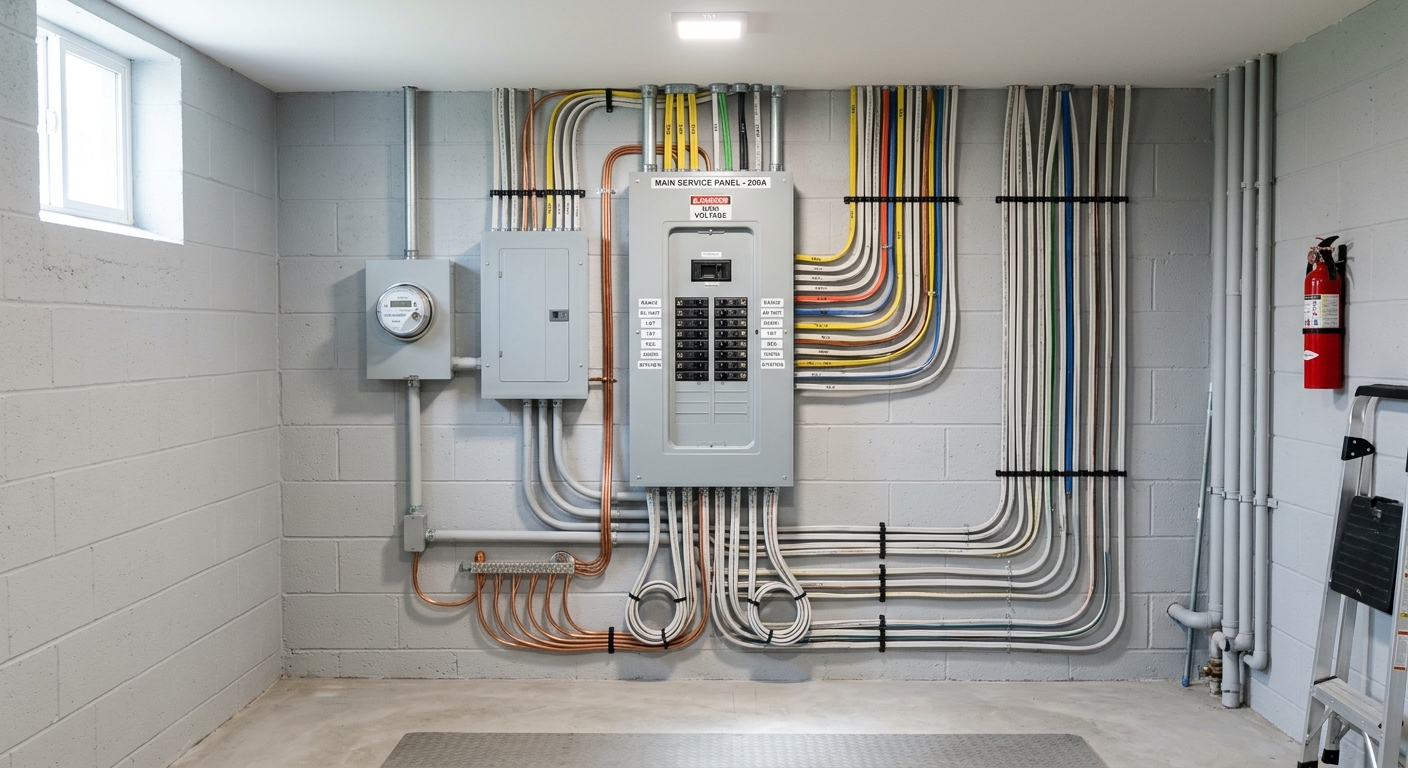
Cost is shaped by the GTA’s active real estate cycle and the way upgrades stack together. Cold snaps can push loads higher (space heating and, in some homes, older baseboard systems), while market trends add new electrical needs—EVs, heat pumps, finished basements, and rental units. That combination is why full or partial rewiring is commonly paired with a 100A-to-200A panel and service upgrade, and why panel upgrades in the GTA typically land around $2,500 – $6,000 when permitting and remediation are straightforward.
In Highland West, the trade is especially in demand around established residential streets where pre-1970 wiring is more common and where homeowners frequently add outlets, relocate laundry, or finish basements. Once the “safety + capacity” work is identified, the next step is aligning your budget with the right scope. Use the table below as a realistic baseline for the most common electrical projects.
| Service |
Why It's Needed |
Permit Required |
Price Range |
| Panel upgrade — 100A to 200A service |
Modern loads (EV chargers, heat pumps, electric cooking, finished basements) often exceed older panel/service capacity. |
Yes (permit + ESA inspection) |
$2,500 – $6,000 |
| EV charger installation (Level 2, 40–50A) |
Adds a dedicated, code-compliant circuit with proper breaker, grounding, and load planning. |
Yes (permit + ESA inspection) |
$900 – $2,500 |
| Knob-and-tube wiring removal and replacement |
Old insulation and wiring methods can be unsafe and often create insurance coverage problems. |
Yes (permit + ESA inspection) |
$3,000 – $15,000 |
| Aluminum wiring remediation (CO/ALR connectors) |
Approved remediation addresses oxidation/loose connections using CO/ALR-rated components or replacement. |
Yes (permit + ESA inspection) |
$2,500 – $8,500 |
| New dedicated circuit (HVAC, appliance, hot tub) |
Prevents overloads and supports higher-starting loads with correct wire size and breaker protection. |
Yes (permit + ESA inspection) |
$500 – $2,500 |
| Whole-home rewire (older home, full replacement) |
Provides consistent, modern wiring standards and clearer troubleshooting for today’s devices and appliances. |
Yes (permit + ESA inspection) |
$8,000 – $20,000 |
Prices are estimates only and vary by project scope, site access and material selection.
What affects the price of electrical work in Highland West
In Highland West, two owners can receive noticeably different quotes for the “same” electrical upgrade—often 30–50% apart—because the final scope depends on what’s behind the walls and how the existing service is built. In the Toronto economic region, pricing is also influenced by contractor availability, inspection scheduling, and the reality that many homes were wired for a much smaller load than today’s kitchens, laundry, heating, and EV use. Labour is commonly a major driver, with licensed electricians billing about 90–120 per hour in this region, plus materials, grounding, and code-driven upgrades.
The dominant cost driver is housing age. Pre-1950 wiring is more likely to include knob-and-tube, and some insurance providers are increasingly strict, which pushes homeowners toward removal and replacement. Homes from the 1960s–70s may still have 60A or 100A services that struggle with modern loads—especially when an EV charger, heat pump, and electric range are all in play. Aluminum wiring is another common factor in homes built roughly 1965–1976; remediation typically requires approved CO/ALR connectors, and it can also evolve into partial or full replacement if the wiring condition is poor.
In practice, EV adoption is driving a surge in Level 2 charger permit applications. A straightforward Level 2 install might fit within $900 – $2,500, but if the panel can’t support it, the job becomes a “service + charger” project, moving closer to the $2,500 – $6,000 panel upgrade band. For Highland West, that means older homes can see the biggest jumps when load calculations and service upgrades are required rather than “just adding a breaker.”
| Price Factor |
Why It Matters |
Cost Impact |
| Panel size upgrade — 100A to 200A is the standard minimum today |
Modern appliances and new EV charging require capacity and proper breaker space. |
$2,500 – $6,000 typical for many GTA upgrades |
| Wiring type — copper vs. aluminum remediation vs. K&T removal |
Aluminum and knob-and-tube often need specific remediation or replacement to meet safe connection practices. |
$2,500 – $15,000 depending on extent and access |
| Number of new circuits — each adds material and labour time |
Each added circuit means wiring runs, breakers, testing, and time for routing and termination. |
$500 – $2,500 per dedicated circuit (typical) |
| Permit + ESA/TSBC inspection fee — mandatory for all major work |
Major electrical work needs a permit, paperwork, and inspection before cover-up. |
Often $200 – $500 in total fees depending on scope |
| Labour rate for licensed electricians — journeyman rates in {region} |
Time spent diagnosing old wiring, tracing circuits, and safe installation drives labour cost. |
Commonly 90–120 per hour in the Toronto region |
| EV charger amperage — 40A vs. 50A circuit affects cable and breaker cost |
Higher amperage requires appropriately sized conductors, breaker sizing, and load planning. |
Difference can move the job within $900 – $2,500 |
| Emergency or after-hours premium |
Rework for urgent safety issues often requires scheduling priority and additional crew time. |
Can add roughly 20–50% depending on urgency and access |
| Load calculation required for service upgrade |
Some homes need formal load calculations to justify panel/service changes under code requirements. |
May add time and documentation, often pushing more complex projects toward $2,500 – $6,000+ |
Permits & regulations in Ontario
In Ontario, ALL electrical work beyond changing a light bulb must be done by a licensed electrician, and most significant upgrades require a permit and inspection. That includes panel upgrades and service changes, new or additional circuits (including dedicated circuits for EV chargers), any rewire work, and remediation that affects wiring methods or terminations. Typical examples of work that usually requires a permit include: adding a new breaker/circuit for an appliance or hot tub, installing Level 2 EV charging, updating a panel, and replacing or relocating receptacles where wiring changes are involved. Conversely, minor like-for-like repairs such as swapping a like-for-like receptacle or replacing a fixture may fall into narrower categories—but in practice, if wiring is touched beyond a simple swap, assume a permit may be needed and ask the contractor to confirm before work starts.
In Ontario, permitted work must pass inspection by the Electrical Safety Authority (ESA). DIY electrical is prohibited for most work; homeowner exceptions are limited and still involve permitting/inspection requirements depending on the scope. When you’re choosing a contractor in Highland West, ask for their licence information and check it using Ontario’s online licensing registry, request a Certificate of Insurance showing general liability coverage, and confirm they carry WSIB coverage (or provide documentation showing how they meet employment coverage obligations). Step-by-step: (1) confirm the electrical contractor licence number, (2) request COI and verify active dates, (3) confirm WSIB/WCB clearance or coverage letter, and (4) ensure the permit number is tied to your address before any walls are closed.
When your Highland West home needs an electrical upgrade
If you’re in Highland West, the warning signs aren’t cosmetic—they’re safety-critical and they often show up at the exact moment you add a new appliance, finish a basement, or plug in an EV. Start with breakers that trip frequently: repeated tripping usually means an overloaded circuit, failing connections, or an undersized/obsolete circuit design, and it’s a “stop using and diagnose” situation rather than a habit to ignore. Second, knob-and-tube: the concern is not only age, but insulation condition and connection reliability—plus the practical reality that many insurers won’t cover K&T systems, making this a high-priority upgrade even if everything “seems to work.”
Third, evaluate your service size. If you have a 60A or 100A panel, today’s load profile can exceed capacity when an EV charger, heat pump, and electric stove run together—Ontario winters make heating loads less forgiving, and the Toronto market’s “add-on” renovations stack circuits fast. In most cases, a 200A upgrade is the standard solution to regain headroom. Fourth, aluminum wiring (often seen in pre-1976 construction): it may function for years, but it requires licensed remediation and CO/ALR-rated connections where applicable. Finally, insufficient outlets and missing AFCI/GFCI where required can become a code-compliance problem at home sale, and extension cords are a red flag for ongoing risk.
For example, if you’re adding a Level 2 EV charger at $900 – $2,500 but your panel is at the edge, the price difference is justified if a load calculation pushes you into a panel upgrade band of $2,500 – $6,000. Skipping that step often leads to nuisance tripping—or worse, higher heat at worn connections.
| Warning Sign |
What It Means |
Recommended Action |
Urgency |
Price Band |
| Breakers trip frequently |
Overload, failing connections, or undersized/obsolete circuit wiring. |
Schedule a load + circuit inspection; identify the tripping device(s) before expanding circuits. |
Immediate to urgent |
$500 – $3,000 |
| Knob-and-tube wiring present |
Outdated wiring method with insulation and connection concerns; often affects insurance eligibility. |
Plan K&T removal and replacement (partial or targeted by fire-risk zones, depending on conditions). |
Urgent / planned soon |
$3,000 – $15,000 |
| 60A or 100A panel (inadequate load capacity) |
Not enough service headroom for modern loads like EV charging and heat pumps. |
Request a load calculation; consider 100A to 200A upgrade. |
Planned upgrade |
$2,500 – $6,000 |
| Aluminum wiring (pre-1976 construction) |
Potential connection issues unless remediated with approved methods/connectors. |
Have wiring terminations inspected; remediate with CO/ALR connectors or replace sections as needed. |
Planned soon |
$2,500 – $8,500 |
| Insufficient outlets — extension cords everywhere |
Often indicates overloaded circuits and inadequate receptacle spacing. |
Add receptacles and dedicated circuits where appropriate; reduce reliance on cords. |
Planned upgrade |
$500 – $2,500 |
| No AFCI or GFCI protection where required |
Code-compliance and shock/fire protection gaps that can surface during sale or inspection. |
Upgrade protection devices or breakers as required and verify correct wiring. |
Planned soon |
$200 – $2,000 |
How to choose a electrical work contractor in Highland West
Choosing the right electrical contractor matters as much as the price—especially in Highland West, where older wiring, crowded panels, and hidden route surprises are common. First, verify Ontario licensing: ask for the electrical contractor licence number (or individual licence information if they’re providing labour directly) and check it in Ontario’s online licensing registry. Second, request proof of liability insurance and confirm the certificate of insurance is current and includes electrical contracting activities where applicable.
Third, confirm WSIB/WCB coverage. Ask for documentation (often a clearance letter or coverage proof) and verify it matches the contractor’s legal entity name. When you request quotes, insist on itemised proposals, not lump sums: you want labour + materials separated (wire, breakers, panel gear, connectors, conduit, disposal charges) and clear notes on what’s included vs excluded. Ask whether the permit pull is included, who coordinates ESA inspection, and whether drywall patching or disposal of removed components is part of the job.
Warranty should be in writing—workmanship warranty length, product/manufacturer warranty details, and whether warranties remain valid if you sell the home. Payment schedule matters: never pay more than 10–15% upfront; use staged payments and hold back until the job is complete and tested. Finally, get the timeline in writing—start date, expected inspection day, and completion estimate—so you’re not stuck waiting during the colder Ontario months when power disruptions are more painful.
- Licence number provided up front and verifiable online
- Certificate of insurance with active dates and correct contractor name
- WSIB/WCB coverage proof or clearance letter
- Itemised quote: labour hours, materials, breakers/panel gear, wiring, connectors
- Permit pull included (or listed clearly as separate cost)
- Inspection coordination stated (ESA appointment timing and who attends)
- Scope exclusions listed (drywall repair, cable fishing, panel relocation, trenching)
- Disposal/recycling of old breakers/wiring gear specified
- Load calculation included if panel/service upgrade is proposed
- Workmanship warranty stated in writing, with duration and coverage limits
- Product warranties listed with model numbers and dates of installation
- Payment schedule with ≤10–15% deposit and holdback after testing/inspection
In Highland West, red flags include: refusing to provide a licence/COI/WSIB documentation, offering only lump-sum pricing without itemisation, promising “no permit required” for panel, EV, or rewiring work, pushing large upfront payments, and skipping written scope details while walls are open.
Frequently asked questions — electrical work in Highland West
How long does a rewiring job take?
In Highland West, rewire timelines depend heavily on how much of the home is being opened and how many circuits are replaced. A targeted partial rewire (for example, kitchen + key bedroom circuits) can take days to a couple of weeks, while a whole-home rewire commonly runs longer due to circuit mapping, safe routing, testing, and inspection pacing with ESA. Cold-weather scheduling can matter too—if drywall cannot be opened/closed as planned, the workflow slows.
Also, many homeowners pair rewiring with a panel upgrade to modernize capacity, which can move the project into the $2,500 – $6,000 panel/service band range on top of wiring costs. Plan for inspection downtime and ask your contractor for a week-by-week schedule and ESA coordination in writing.
Why do my breakers keep tripping?
Frequent breaker trips in Ontario are usually caused by overload, wiring issues, or connection problems—not a “set it and forget it” nuisance. In Highland West homes with older wiring methods, tripping can result from circuits that are undersized for modern usage, failing receptacle/terminal connections, or devices that draw more current than the circuit can safely handle. If the issue started after adding an appliance or EV charger, the cause is often that the system is now operating closer to its limits.
Next step is diagnostic: a licensed electrician should test the specific circuit load, inspect breaker condition and panel terminations, and verify correct breaker sizing. Depending on findings, you may need a dedicated circuit add (often around $500 – $2,500) or a service/panel upgrade if the overall supply capacity is inadequate.
How do I compare electrical quotes?
When comparing quotes in Highland West, treat the price as only part of the decision. Ask for itemised labour and materials so you can compare wire types, breaker models, panel gear, connectors (especially for aluminum CO/ALR remediation), and whether load calculations and permits are included. A quote that’s lower may be leaving out trenching, cable fishing, disposal, or ESA inspection coordination, which can increase your final cost.
Also compare scope boundaries: does the contractor include permit pull and inspection attendance? Is drywall patching excluded or included? Finally, compare warranty terms and payment schedule. If one quote stays near $900 – $2,500 for an EV charger but another includes a required service upgrade, the “difference” is often justified by safety and code compliance rather than a better deal.
How long does a panel upgrade take in Highland West?
A typical 100A to 200A panel upgrade in Highland West often takes a short crew window for the electrical change itself—commonly a day to two—because the work is concentrated around the service equipment, grounding/bonding updates, breaker installation, and testing. However, the total timeline includes permit processing and ESA inspection scheduling, which can add days. If the contractor must relocate the panel, upgrade service routing, or deal with old wiring conditions inside the panel area, expect a longer duration.
In practical GTA terms, many homeowners budget for the electrical work plus inspection timing in the same week when access is ready. The cost typically sits in the $2,500 – $6,000 range for many standard installations, with higher totals when complex remediation or service relocation is required.
What is a GFCI outlet and where is it required in Ontario?
A GFCI (Ground-Fault Circuit Interrupter) outlet is designed to quickly shut off power when it detects leakage current that could indicate shock risk. In Ontario, GFCI protection is required in specified areas under the Ontario Electrical Code, commonly including locations with higher shock risk such as bathrooms, kitchens near sink areas (depending on configuration), garages, outdoors, basements in certain scenarios, and other damp/wet environments.
For Highland West homes, upgrades often come up during renovations or when homeowners notice “no protection” after reviewing their electrical panel and receptacles. If your home sale or inspection flags missing protection, remediation is usually straightforward compared with service upgrades—often falling within the $200 – $5,000 lighting/fixture-to-device upgrade spectrum depending on the number of locations.
How do I know if my Highland West home has aluminum wiring?
You can often identify aluminum wiring by looking at receptacle/terminal markings, inspecting the panel conductors where accessible, or checking the wire’s imprint/colour and the type of connectors used at terminations. However, homeowners shouldn’t rely on guesswork: the safe way is to have a licensed electrician open a representative number of receptacles (and inspect panel terminations) and confirm the conductor material.
Aluminum wiring was more common in homes built around the mid-century period, and in Ontario it frequently needs approved CO/ALR remediation for terminations. If aluminum is present and connections aren’t properly addressed, the remedy can move from targeted connector work into wider remediation. Depending on the extent, pricing may land in the $2,500 – $8,500 band, while full rewiring can be significantly higher for whole-home replacement.