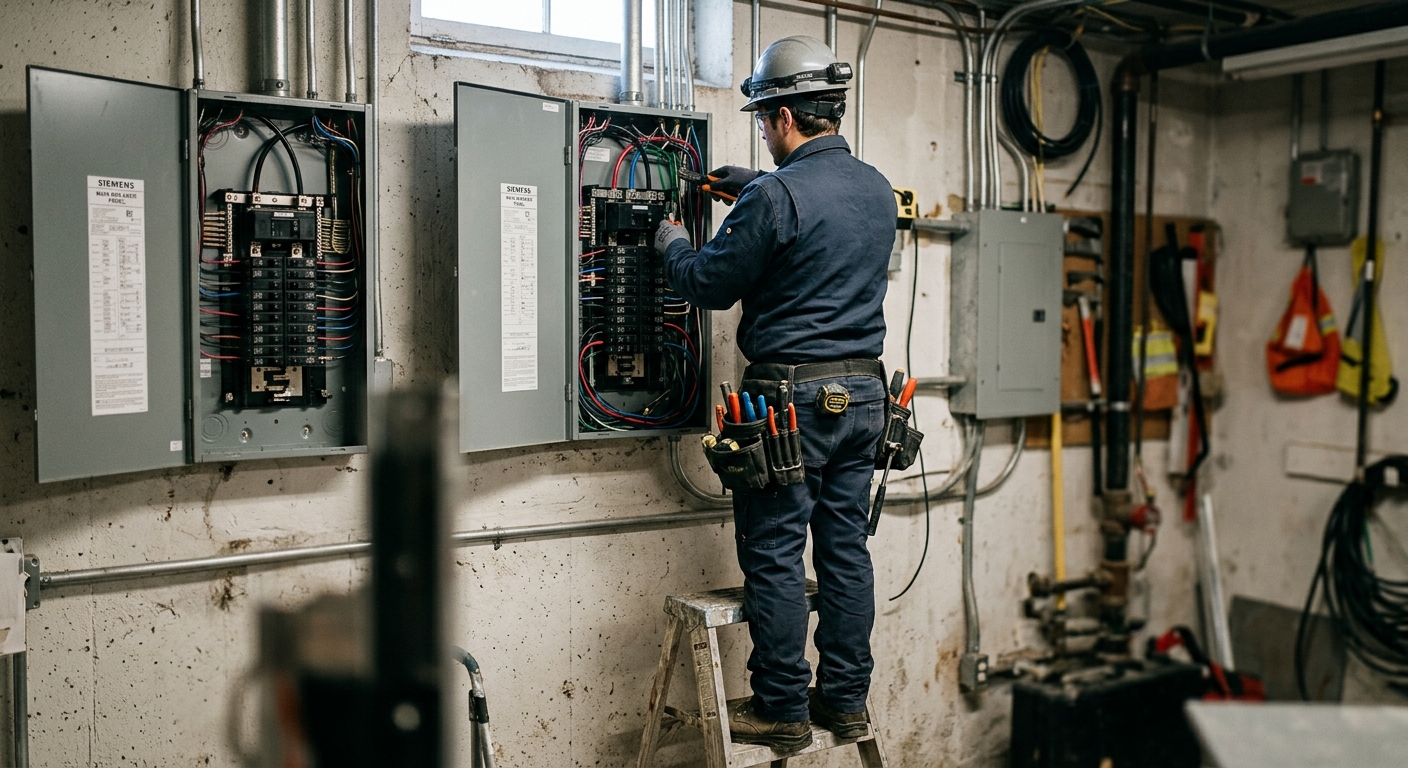
Electrical services and costs in Nipigon
Nipigon residents often notice that electrical service work doesn’t feel “one-size-fits-all,” because homes here are built across very different eras. With 87.1% of dwellings built before 1981, it’s common to encounter older wiring methods, dated panel capacity, and grounding that no longer matches how modern homes use power (Statistics Canada, 2021 Census). In Nipigon—part of Ontario’s Northwest—costs are also shaped by cold-weather reality: when it’s windy or icy, troubleshooting takes longer, parts inventories can be less immediate, and installers need extra time for safe panel access and weather-protected work. Demand is concentrated in practical service areas like the Townsite and along main corridors into nearby properties, where upgrades are often triggered by home renovations, added heating, and electrical vehicle (EV) planning.
Across the Northwest, you’ll also see projects pushed toward bigger upgrades than homeowners initially expect. For example, a 100A-to-200A service or panel change is often the minimum step when adding continuous loads like EV charging, heat pumps, or high-demand appliances. If your home has aluminum wiring or knob-and-tube, electricians may recommend remediation or replacement before they will safely add circuits. That “prep work” is a big reason why estimates can differ even when the end goal looks similar on paper—your existing wiring, panel capacity, and safety defects drive the final scope and price. Use the table below as a realistic starting point for what trades typically quote in Nipigon.
| Service |
Why It's Needed |
Permit Required |
Price Range |
| Panel upgrade — 100A to 200A service |
Modern load planning for heat pumps, EV charging, and kitchen/laundry appliances; also to replace aging equipment and improve safety margins. |
Yes (ESA permit and inspection) |
$1,800–$6,200 |
| EV charger installation (Level 2, 40–50A) |
Dedicated circuit for reliable charging; typically requires adequate panel/service capacity and proper grounding and protection. |
Yes (ESA permit and inspection) |
$1,050–$2,500 |
| Knob-and-tube wiring removal and replacement |
Address degraded insulation and outdated installation methods; needed before adding new circuits safely or meeting insurance requirements. |
Yes (ESA permit and inspection) |
$4,250–$10,300 |
| Aluminum wiring remediation (CO/ALR connectors) |
Corrects connection issues in aluminum branch wiring using approved methods (CO/ALR connectors) or targeted replacement. |
Yes (ESA permit and inspection) |
$3,850–$8,900 |
| New dedicated circuit (HVAC, appliance, hot tub) |
Ensures safe capacity, correct breaker sizing, and proper protection for high-demand equipment and reduced nuisance trips. |
Yes (ESA permit and inspection) |
$750–$2,600 |
| Whole-home rewire (older home, full replacement) |
Full safety upgrade when wiring is widespread, service is limited, and multiple rooms need replacement to support modern loads. |
Yes (ESA permit and inspection) |
$6,500–$10,300 |
Prices are estimates only and vary by project scope, site access and material selection.
What affects the price of electrical work in Nipigon
In Nipigon and across Ontario’s Northwest, it’s very normal to see quotes for the “same” electrical task land 30–50% apart. The dominant reason isn’t the electrician—it’s what your existing house is hiding. The region’s housing stock is older (87.1% built before 1981), so cost often hinges on wiring condition, panel capacity, and the level of remediation needed before a permit can be issued. Homes built before about 1950 can include knob-and-tube wiring where degraded insulation can drive safety concerns and make insurance less willing to cover the risk. Meanwhile, many 1960s–70s houses were built around 60A or 100A panels; today’s loads—especially EV chargers, heat pumps, induction ranges, and electric water heating—create continuous demand that can push you toward a 100A-to-200A upgrade.
Aluminum wiring (commonly seen in homes built from about 1965–1976) also changes pricing. Remediation with approved CO/ALR connectors takes time and careful workmanship, and if connections are compromised or wiring runs are too limited, the job can shift toward partial or full replacement. EV adoption is a growing driver in the Northwest, with more homeowners adding Level 2 chargers—typically 40A or 50A—which affects cable size and breaker costs. In practice, the difference between an “add a circuit” job and a service upgrade is often a few factors: load calculation results, where the existing panel is located, and whether meters/supplies require coordination through the utility for a service change.
Local conditions that raise costs include uninsulated crawlspaces, winter access constraints, and older fuse/panel layouts that force rewiring pathways to be reopened. Costs can be lower when your panel already has spare capacity—so a dedicated EV circuit may fit without a service upgrade, often aligning with an EV installation band like $1,050–$2,500. Conversely, whole-home rewiring can quickly exceed the simpler ranges because it replaces not only outlets and switches, but also the concealed wiring needed to safely support modern equipment.
| Price Factor |
Why It Matters |
Cost Impact |
| Panel size upgrade — 100A to 200A is the standard minimum today |
Allows safe capacity for modern continuous loads and reduces the chance of future nuisance trips. |
Can add roughly $1,400–$7,000 depending on service work scope |
| Wiring type — copper vs. aluminum remediation vs. K&T removal |
Aluminum often requires specific connectors (CO/ALR) or replacement; knob-and-tube may require extensive rewiring. |
May shift costs upward by $1,000–$6,000 |
| Number of new circuits — each adds material and labour time |
Every new breaker/cable run includes labour, wire, boxes, and testing time. |
Often increases total by hundreds per circuit, depending on distances |
| Permit + ESA/TSBC inspection fee — mandatory for all major work |
Major electrical work must be permitted and inspected before it’s energized. |
Typically adds a few hundred dollars to the project |
| Labour rate for licensed electricians — journeyman rates in region |
Older builds require more diagnosis, careful routing, and code-compliant termination work. |
Labour intensity can swing totals by 30–50% |
| EV charger amperage — 40A vs. 50A circuit affects cable and breaker cost |
Higher amperage can require larger cable and different protection components. |
Can change EV install pricing by several hundred dollars within the band |
| Emergency or after-hours premium |
Winter outages and urgent safety issues sometimes require rush dispatch. |
Often adds 25%+ to labour for time-sensitive scheduling |
| Load calculation required for service upgrade |
Utilities/ESA-required planning determines whether 200A is truly needed and what size equipment can be supported. |
May trigger additional testing/diagnostics; prevents rework later |
Permits & regulations in Ontario
In Ontario, ALL electrical work beyond changing a light bulb must be completed by a licensed electrician. For Nipigon homeowners, the key point is that permits are not optional: panel upgrades, new circuits (including EV charger installs), rewiring, and any service upgrade require an Electrical Safety Authority (ESA) permit and inspection. Work that commonly does not need a permit is typically limited to like-for-like replacements such as swapping a breaker that is identical, replacing a single light fixture where wiring stays unchanged, or replacing an existing receptacle with one of the same type—however, you should still confirm the scope with your electrician because Ontario rules and ESA requirements can be strict depending on what is being altered.
DIY electrical is prohibited for most work, and the homeowner “exceptions” are narrow; even when a homeowner can do something, the permit/inspection chain for the broader project still applies. Before hiring, verify the contractor’s Ontario licence (via the provincial licence registry) and request a Certificate of Insurance showing liability coverage. Also ask for WSIB/WCB coverage documentation where applicable—especially important if the electrician subcontracts any labour on your site. For service changes, you’ll also want the electrician to confirm coordination steps with the utility and the inspection schedule so your panel can be energized safely and legally.
Step-by-step: (1) confirm licence number and trade category; (2) ask for a current insurance certificate; (3) request WSIB/WCB clearance documentation; (4) ensure the permit is pulled under the electrician’s licence; and (5) verify the inspection is scheduled for the final test/energization.
When your Nipigon home needs an electrical upgrade
In Nipigon, electrical upgrades aren’t just about convenience—they’re about safety and reliable performance in a harsh-weather setting where power problems show up as nuisance trips, delayed heating, and higher repair costs. Start with these warning signs. (1) Breakers that trip regularly are often an overloaded panel, undersized circuits, or loose/aging connections—this should be treated as a safety issue, not a “wait and see.” (2) Knob-and-tube wiring is a key concern mainly due to deteriorating insulation and how it affects reliability and insurance risk; if you see it, plan for replacement rather than adding new loads. (3) A 60A or 100A service can be inadequate for today’s combined loads—EV charger plus heat pump plus electric range—so a 200A upgrade is commonly the standard solution to avoid future capacity shortages. (4) Aluminum wiring (especially pre-1976 construction) isn’t automatically “instant danger” if it’s been maintained, but it does require licensed remediation or targeted replacement when connections are identified as problematic. (5) Insufficient outlets (extension cords everywhere) increases risk and can indicate overloaded circuits. (6) No AFCI/GFCI where required is a compliance and protection gap that can surface during home sale or when adding new wiring.
Which signs need immediate action? Frequent tripping, burning odours, heat marks at outlets/panels, and any sparking or repeated protection trips call for urgent inspection. Planned upgrades typically include panel capacity planning, EV readiness, and rewiring/remediation where the system is stable but dated. For example, upgrading a 100A service toward 200A may cost in the $1,800–$6,200 range, and that can be justified if you’re adding a Level 2 charger (often $1,050–$2,500) and a heat pump—because without capacity, you’d likely pay for circuit additions that still don’t solve the underlying load limits.
| Warning Sign |
What It Means |
Recommended Action |
Urgency |
Price Band |
| Breakers trip frequently |
Possible overload, aging connections, or inadequate circuit design for your loads. |
Inspection + load check; may require new circuits and/or panel assessment |
Immediate / as soon as possible |
$750–$6,200 |
| Knob-and-tube wiring present |
Outdated wiring with degraded insulation risk; often incompatible with safe modern additions. |
Plan removal and replacement (partial or whole-home depending on extent) |
Planned (safety-driven) |
$4,250–$10,300 |
| 60A or 100A panel (inadequate load capacity) |
Not enough capacity for common modern equipment and continuous loads. |
100A-to-200A upgrade with load calculation |
Planned (before adding new loads) |
$1,800–$6,200 |
| Aluminum wiring (pre-1976 construction) |
Requires proper remediation to reduce overheating risk at connections. |
CO/ALR connector remediation or targeted rewiring where needed |
Planned (don’t ignore) |
$3,850–$8,900 |
| Insufficient outlets — extension cords everywhere |
Indicates increased load on limited circuits and a tripping risk. |
Add outlets and dedicated circuits where appropriate |
Planned / mid-term |
$750–$2,600 |
| No AFCI or GFCI protection where required |
Missing safety protection increases risk and can complicate resale/compliance. |
Update protection devices as part of code-compliant circuit upgrades |
Planned (before sale/major renovations) |
$130–$1,400 |
How to choose a electrical work contractor in Nipigon
Choosing the right contractor matters more in Nipigon than in larger cities because older wiring issues can turn a “simple” job into a multi-day rebuild. Start by verifying Ontario licensing: ask for the electrician’s Ontario licence number and confirm it through the provincial licence registry. Next, request proof of liability insurance—your electrician should be able to provide a current Certificate of Insurance upon request. For worker coverage, ask for WSIB/WCB clearance documentation; it’s especially important if the contractor uses sub-trades or if your project involves any physical access that could increase workplace risk.
Then get 2–3 itemised written quotes. The best quotes break down labour and materials separately, show what’s included (for example, permit pull, wiring materials, breaker/panel components, disposal), and list exclusions clearly. Don’t accept a vague lump sum without details—older Ontario Northwest builds frequently require concealed cable routing, testing, and remediation work that only becomes obvious during inspection. Warranty should be in writing: confirm workmanship warranty length, whether manufacturers’ warranties on panel/charger components apply, and whether warranties are transferable to you as the homeowner.
For payment scheduling, a safe rule is never paying more than 10–15% upfront, and holding back a portion until the final inspection/clean-up is complete. Finally, insist on a written timeline with start date and a completion estimate—winter conditions can affect scheduling, but reputable contractors plan around site access.
- Ask for the ESA permit number (or confirmation the permit will be pulled) before work starts.
- Require a full scope breakdown: labour hours, parts, and testing/inspection steps.
- Confirm whether a service upgrade triggers utility coordination for meter/supply work.
- Check that disposal/haul-away of old breakers/panel materials is included.
- Verify connector type for aluminum remediation (approved CO/ALR approach).
- Ask how knob-and-tube removal will be handled (zone-by-zone vs. whole-home).
- Confirm AFCI/GFCI strategy if circuits are being added or modified.
- Ensure the EV charger quote includes mounting, cable routing, breaker/protection, and labelling.
- Request photos/video of pre- and post-work panels (especially for aluminum/K&T remediation areas).
- Get warranty terms in writing (workmanship + manufacturer coverage details).
- Use a payment schedule with 10–15% max upfront and a holdback until energization and final test.
- Ask who you call if ESA inspection fails on first attempt (rework policy).
Red flags I see too often in the Nipigon market include: refusing to provide a licence/insurance certificate, quoting a service upgrade without any load calculation discussion, claiming DIY or “no permit needed” for major work, offering only vague lump sums without scope exclusions, or asking for large upfront payments before any inspection/permit steps are completed.
Frequently asked questions — electrical work in Nipigon
How much does an EV charger installation cost in Nipigon?
In Nipigon, most Level 2 EV charger installs price primarily off circuit amperage (40A vs. 50A), cable run length, and whether your panel/service has spare capacity. If your home already has suitable capacity, a typical Level 2 install often lands around the $700–$2,500 overall band, with many real-world projects clustering in the $1,050–$2,500 range for labour, breaker/protection, and ESA permit/inspection time. If you need a service/panel adjustment first (common in older homes with 60A/100A limits), you may be looking at the panel upgrade band in the $1,400–$7,000 range as part of making the charger safe and code-compliant. Cold-weather site access can add labour time, too, so always expect an itemised quote after an on-site assessment.
What is knob-and-tube wiring and should I replace it?
Knob-and-tube (K&T) wiring is an older wiring method typically found in homes from the early-to-mid 1900s, and in Ontario it’s considered outdated due to insulation aging and connection practices. In Nipigon and the wider Northwest, homeowners often assume “it still works, so it’s fine,” but K&T can create safety and insurance issues—especially when you’re trying to add modern loads like heat pumps or an EV charger. Whether you replace all of it depends on how much exists and how it’s routed, but electricians generally recommend replacement rather than relying on it for new circuits. If you see K&T, discuss a plan that may start with removing the portion that impacts current work and then expanding if necessary. Any rewiring/removal beyond very minor work requires an ESA permit and inspection.
Is aluminum wiring safe in older Nipigon homes?
Aluminum wiring can be safe when it’s properly installed and—critically—when connections are remediated using approved methods. Many older Nipigon homes include aluminum branch wiring (often from the 1960s through the mid-1970s), and over time, certain connector types and connection integrity can become a risk factor. The key is not just the presence of aluminum, but whether it has compatible termination methods and whether there are signs of heat damage. In practice, licensed remediation using CO/ALR connectors can bring the wiring back into a safer state, with many projects falling within the $3,850–$10,300 wiring/remediation range depending on how extensive the aluminum runs are. If wiring is widely compromised, partial remediation may not be enough and full replacement becomes more cost-effective long-term. Your electrician should also document the changes made for insurance and future resale.
Do I need a permit for electrical work in Ontario?
In Ontario, permits are required for most electrical work that changes circuits or affects how the home is protected and supplied. In Nipigon, that includes panel upgrades, service changes, rewiring, and adding new circuits such as those for EV chargers, hot tubs, or major appliances. You’ll also need permits for work that modifies wiring methods or requires inspection before energization. Simple like-for-like swaps may fall into a narrower category, but homeowners should avoid guessing—Ontario rules are specific, and the ESA requires inspection for permitted electrical work. A licensed electrician will typically handle the permit pull under their licence and coordinate the inspection step so the system passes before it’s turned on.
What are signs of an overloaded electrical panel?
Common signs include breakers that trip frequently, lights dimming when appliances start, warm/hot breaker panels, buzzing sounds, and persistent nuisance trips when you run multiple devices (like a dryer and microwave together). In older Nipigon homes, these symptoms often point to inadequate panel capacity (for example, 60A or 100A), wiring stretched beyond safe limits, or the need for proper circuit separation. If you’re seeing frequent trips, treat it as more than a convenience issue—get an inspection and load calculation. The remedy might be adding dedicated circuits, but it often becomes a panel/service upgrade to 200A once you plan for EV charging and additional heating. Those upgrades commonly align with the $1,400–$7,000 service/panel price band depending on your exact panel/service configuration and the amount of wiring work required.
Can I do my own electrical work in Ontario?
For most electrical work in Ontario, including work that affects circuits, outlets, breakers, panels, or wiring methods, you cannot legally do it yourself—DIY electrical is restricted and typically prohibited beyond very limited categories. For Nipigon homeowners, the practical impact is that any work requiring ESA approval (panel changes, new circuits, EV charger installations, rewiring, and service upgrades) must be done by a licensed electrician and tied to a permit and inspection. If you’re tempted to “save money” by doing part of the job, the work may be rejected at inspection or create safety risks that lead to more labour later. Your safest approach is to hire a licensed electrician for the permitted portions and only handle non-electrical tasks around the work area (like moving furniture or preparing access) if permitted by the contractor’s scope.