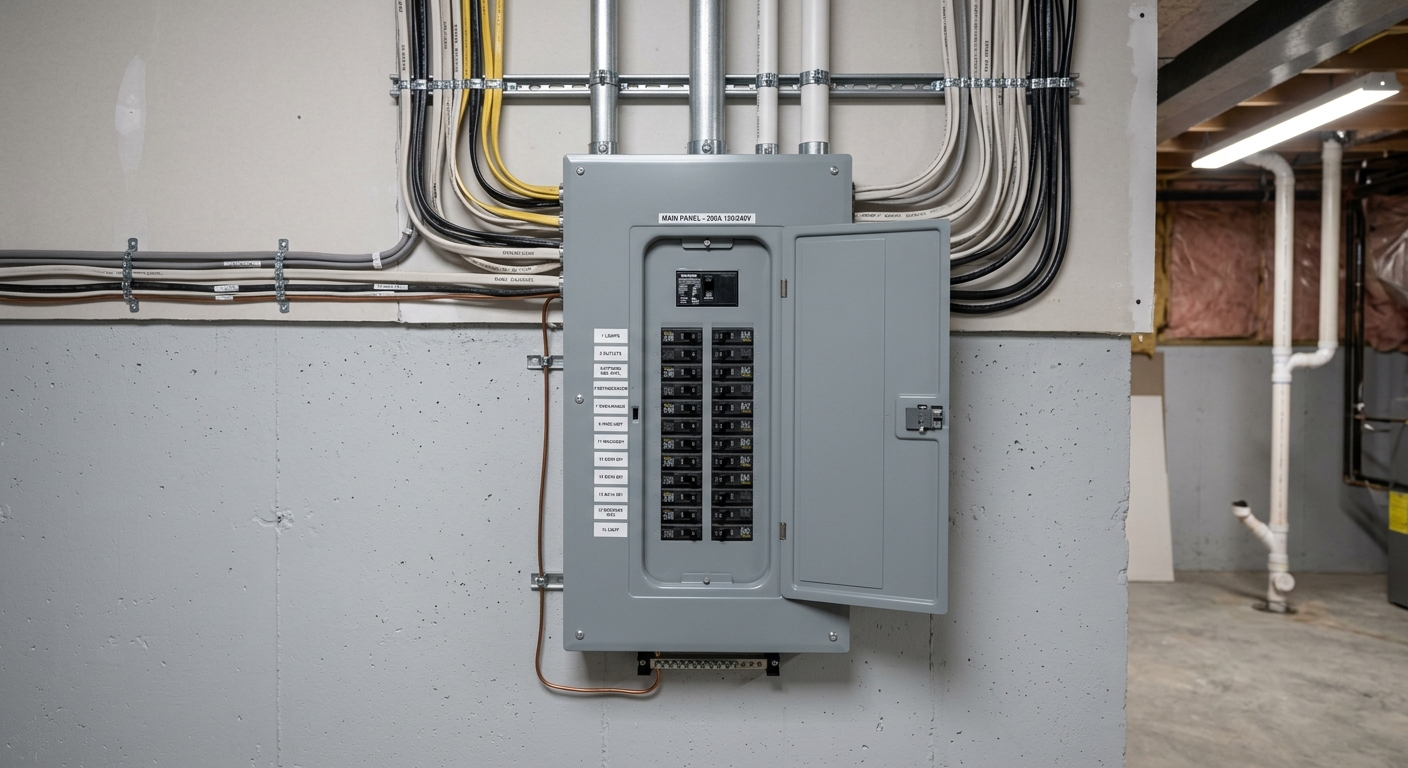
Electrical services and costs in Humber Summit
Electrical services and costs in Humber Summit are shaped by the area’s mix of older housing and faster infill development. With a population of 12,416 (Statistics Canada, 2021 Census), Humber Summit is small enough that contractor availability can tighten during busy periods in the Greater Toronto Area, but large enough that you’ll still find experienced licensed crews active across nearby neighbourhoods. In practice, many homes in this part of Toronto have older wiring types—especially in pockets where pre-1980 builds are more common—so homeowners often need panel work, wiring remediation, or both.
Toronto’s market also pushes demand for modern power: EV adoption, heat pumps, finished basements, and electric cooking all increase load. Cold snaps and freeze-thaw cycles don’t directly “break” wiring, but they affect construction access (parking, driveway conditions, and late-season scheduling) and can make service-upgrade work more time-consuming. Where you see older electrical systems—like homes around the Humber Summit/Weston Road corridor where renovations are frequent—you’ll often find 60A or 100A panels and/or older conductors that aren’t sized for today’s appliance and charging loads.
Because electrical safety rules require permitting and inspection for major work, the price range is usually wider than people expect. The table below compares the most common services you’ll see when upgrading for EV charging and modern electronics—then helps you map typical project costs to what you’re actually dealing with.
| Service |
Why It's Needed |
Permit Required |
Price Range |
| Panel upgrade — 100A to 200A service |
Modern homes often need more capacity for EV chargers, heat pumps, and additional circuits; older 60A/100A systems can’t handle today’s combined loads safely. |
Yes (permit + inspection) |
$2,500 – $6,000 |
| EV charger installation (Level 2, 40–50A) |
Dedicated circuit and correct breaker/cable sizing reduce nuisance trips and improve charging reliability. |
Yes (permit + inspection) |
$900 – $2,500 |
| Knob-and-tube wiring removal and replacement |
Older K&T wiring can have insulation-contact and overheating risks; insurers often require it to be removed. |
Yes (permit + inspection) |
$5,000 – $15,000 |
| Aluminum wiring remediation (CO/ALR connectors) |
Aluminum branch wiring (common in mid-1960s–1970s homes) typically needs approved connector remediation or replacement to restore safe terminations. |
Yes (permit + inspection) |
$3,000 – $8,500 |
| New dedicated circuit (HVAC, appliance, hot tub) |
High-demand equipment often needs a dedicated breaker/cable run and correct protection to meet code. |
Yes (permit + inspection) |
$800 – $2,500 |
| Whole-home rewire (older home, full replacement) |
When wiring is end-of-life across multiple rooms, replacing the system reduces future failure risk and supports modern load needs. |
Yes (permit + inspection) |
$8,000 – $20,000 |
Prices are estimates only and vary by project scope, site access and material selection.
What affects the price of electrical work in Humber Summit
In Humber Summit, two electricians can quote the same “panel + charger” project with a 30–50% difference, even when the basic goal is identical. The reason is that Toronto-area homes vary a lot in electrical condition and installation complexity: the service size, wiring type, how accessible the panel area is, whether walls/ceilings require opening, and how far new cable must travel. On top of that, permit and inspection handling, contractor scheduling, and material sourcing can shift the final number.
Housing age is the dominant cost driver. Homes built before 1950 are more likely to include knob-and-tube wiring, and many insurance situations and safety assessments treat it as a high risk material. Homes from the 1960s–70s often have 60A or 100A panels that are inadequate for today’s combined loads—especially when EV charging, heat pumps, induction cooking, and basement renovations happen at the same time. Aluminum wiring, common roughly from 1965–1976, usually needs licensed remediation using approved CO/ALR connectors or a full replacement strategy.
EV adoption across the Toronto economic region is also pushing more Level 2 charger permit applications, and those jobs often require a load calculation and sometimes a service upgrade to avoid future overload. In practical Humber Summit examples: (1) a straightforward 200A panel swap with short cable runs is closer to the lower end of the panel band (about $2,500–$6,000), while (2) a panel relocation plus significant aluminum remediation can push totals toward the higher end of wiring projects (within the $3,000–$15,000 wiring band).
Labour matters too. Licensed contractors in this region commonly bill around $90–$120 per hour, so time-consuming access issues—wet locations, unfinished-to-finished basement transitions, or long conduit runs—translate directly into cost. When you’re planning a modern upgrade, the “hidden” work is often the wiring verification and remediation needed to make the finished system safe and insurable.
| Price Factor |
Why It Matters |
Cost Impact |
| Panel size upgrade — 100A to 200A is the standard minimum today |
More capacity reduces nuisance trips and supports EV charging, heat pumps, and modern kitchen loads. |
$2,500 – $6,000 typical band |
| Wiring type — copper vs. aluminum remediation vs. K&T removal |
Aluminum and K&T typically require extra remediation steps, approved parts, or replacement to meet safety expectations. |
$3,000 – $15,000 depending on scope |
| Number of new circuits — each adds material and labour time |
Each circuit requires correct cable, breaker, testing, and often additional wall/ceiling access. |
Commonly hundreds to a few thousand per circuit |
| Permit + ESA/TSBC inspection fee — mandatory for all major work |
Permits are required for major upgrades and inspections; the administrative process is not optional. |
Typically within $200 – $500 total fees |
| Labour rate for licensed electricians — journeyman rates in GTA |
Complex routing, troubleshooting, and safe termination work is labour-intensive. |
Often $90–$120/hour affects final labour hours |
| EV charger amperage — 40A vs. 50A circuit affects cable and breaker cost |
Higher amperage can require larger conductors and breaker adjustments, plus different mounting/termination requirements. |
May shift EV installs by hundreds within the charger range |
| Emergency or after-hours premium |
After-hours work increases scheduling overhead and readiness costs. |
Frequently adds a service-call premium |
| Load calculation required for service upgrade |
Modern code-compliance and utility requirements often demand a calculation before sizing conductors and service. |
Usually a few hundred dollars in labour time, but prevents costly rework |
Permits & regulations in Ontario
In Ontario, ALL electrical work beyond changing a light bulb must be performed by a licensed electrician. For most Humber Summit projects, that includes work such as panel upgrades, new circuits, rewiring, and service changes for EV chargers or major appliances. If the work is permitted, it must also pass inspection by the electrical safety authority—ESA in Ontario. DIY electrical is restricted for homeowner activities to very narrow cases; for anything that involves a permanent connection, breaker/panel changes, or new wiring runs, a permit and inspection are typically required.
To be concrete, the following typically do require permits: installing a new breaker and running new cable for an EV charger, upgrading a service/panel from 100A to 200A, replacing or relocating a panel, rewiring a room or whole home, and doing aluminum remediation that involves approved terminations/connectors. The following typically do not require a permit/inspection: swapping a fixture for a like-for-like device, replacing a receptacle cover plate, or changing a light switch where no wiring is altered—though the electrician still must be involved if the wiring isn’t simple or if any safety-critical changes occur.
Step-by-step, Humber Summit homeowners can verify the contractor first by checking their Ontario licence through the provincial licence registry, then requesting a certificate of insurance (liability) and confirming WSIB/WCB coverage where required. Ask for the licence number on the quote, a written ESA permit reference once issued, and—at completion—a clearance/inspection documentation tied to your permit number.
When your Humber Summit home needs an electrical upgrade
Electrical upgrades in Humber Summit are usually about safety-critical capacity and code compliance—not aesthetics. Start with five common warning signs. (1) Breakers that trip regularly: that’s often a sign of overload or failing components; it needs diagnosis and could require an immediate reduction of load while you investigate. (2) Knob-and-tube wiring present: the concern is aged insulation and contact risk, and it can lead to insurance cancellation; treat this as a planned priority with urgency because many homes become “high-risk” in resale or claims. (3) A 60A or 100A service: combined modern loads—EV chargers, heat pumps, and electric ranges—can exceed what the panel and feeder were designed to handle; in most cases, a 200A upgrade is the standard long-term fix.
(4) Aluminum wiring (often pre-1976 construction): it isn’t always instantly dangerous if properly terminated, but it requires licensed remediation (commonly CO/ALR connectors) or replacement to prevent overheating at terminations. (5) Insufficient outlets, with lots of extension cords: this frequently pushes homeowners into unsafe practices and can justify new circuits and better spacing. (6) Missing AFCI or GFCI protection where required: this is a compliance issue that often comes up at home sale and inspection, and it typically warrants a planned upgrade rather than waiting for an outage.
In Humber Summit’s Toronto housing stock, the most cost-effective pattern is to address capacity and wiring type together. For example, pairing a panel upgrade (often $2,500 – $6,000 depending on conditions) with EV-ready circuit planning can prevent a second round of wall openings later. If you only add a charger to an undersized service, you may end up paying more overall after troubleshooting and load restrictions.
| Warning Sign |
What It Means |
Recommended Action |
Urgency |
Price Band |
| Breakers trip frequently |
Likely overload, failing breaker, or circuit issues that can become overheating hazards. |
Schedule an inspection and load assessment; identify the circuit(s) first. |
Immediate to urgent |
$300 – $1,500 |
| Knob-and-tube wiring present |
Older wiring can have insulation deterioration and termination risks; often problematic for insurance. |
Plan removal/replacement in phases or full rewire depending on extent. |
Planned (often urgent for resale/insurance) |
$5,000 – $15,000 |
| 60A or 100A panel (inadequate load capacity) |
Service size may be too small for EV charging and modern appliances running together. |
Request a load calculation and consider upgrading toward 200A. |
Urgent/priority |
$2,500 – $6,000 |
| Aluminum wiring (pre-1976 construction) |
Terminations may be at higher risk without approved remediation. |
Have wiring inspected; remediate with approved CO/ALR connectors or replace sections. |
Planned with safety-first scope |
$3,000 – $8,500 |
| Insufficient outlets — extension cords everywhere |
Increased risk from daisy-chaining power bars/cords and overloaded circuits. |
Add circuits and receptacles; correct any grounding/GFCI needs. |
Planned but address quickly |
$800 – $2,500 |
| No AFCI or GFCI protection where required |
Higher risk of electrical faults and shock; may fail inspection at sale. |
Add/upgrade protection devices as required and verify downstream wiring. |
Planned (often for resale timelines) |
$200 – $1,200 |
How to choose a electrical work contractor in Humber Summit
Choosing the right contractor in Humber Summit starts with verification. First, confirm their Ontario licence number and scope using the provincial licence registry. Next, request a certificate of liability insurance and confirm that they carry WSIB/WCB coverage where applicable—this protects you if a worker is injured on your property. Avoid anyone who won’t provide paperwork upfront or tries to quote without confirming the permit pathway.
Get 2–3 itemised written quotes. Look for a breakdown that separates labour and materials, includes estimated hours, specifies breakers/cable/connector parts, and states whether a permit is included. Scope clarity matters: ask if permit pull, ESA inspection scheduling, and any required documentation are included. Confirm whether disposal and restoration (like patching access openings) are included or billed separately. Also ask who is responsible for returning areas to their pre-work condition and whether drywall repair is an allowance or part of the base price.
Warranty should be in writing. Ask for the workmanship warranty length (often different from manufacturer parts warranties), whether it’s transferable if you sell the home, and what it covers if a breaker/charger fails due to installation issues. For payment, never pay more than 10–15% upfront, and hold back a portion until the job is complete and inspected. Require a start date and completion estimate in writing, because tight GTA scheduling can affect inspection windows.
- Provides licence number and permit/inspection plan in the quote
- Shows itemised labour hours and materials (not just a lump sum)
- Confirms ESA permit pull is included where required
- Lists the specific products (panel brand, breakers, charger model)
- Includes warranty terms for workmanship and materials
- Schedules inspection timing and identifies who books it
- Verifies liability insurance and WSIB/WCB coverage documents
- Explains cable routing options and any wall/ceiling access assumptions
- Includes restoration/cleanup scope and whether patching is included
- Provides a clear payment schedule with holdback tied to milestones
- Offers load calculation details when doing service upgrades
- Communicates permit clearance/inspection paperwork at close-out
In Humber Summit, red flags include quotes that omit permits, contractors who won’t verify their Ontario licence, “cash-only” payments without documents, vague scopes that don’t specify materials, and delays that push inspections without clear reasons.
Frequently asked questions — electrical work in Humber Summit
What is a load calculation and why does my electrician need one?
A load calculation is a method electricians use to confirm your home’s electrical demand—basically, how much power you actually need across lighting, outlets, HVAC, electric heating, and large appliances. In Humber Summit and across Ontario, it’s especially important when upgrading services (like moving from 100A toward 200A) and when adding major new loads such as EV chargers or heat pumps. Without it, you risk installing a system that “works today” but trips breakers when multiple loads run at the same time. It also helps ensure the correct sizing of feeders, breakers, and cable. If your project is in the service upgrade band of $2,500 – $6,000, a proper calculation often prevents costly rework and supports permit/inspection compliance.
How do I find a licensed electrician in Humber Summit?
Start by asking for the electrician’s Ontario licence number and confirming it using the provincial licence registry. Next, request proof of liability insurance and WSIB/WCB coverage where applicable—legitimate contractors should provide these documents readily. In Humber Summit, it helps to request a local visit for a real assessment rather than relying on a phone quote, because older wiring types (knob-and-tube or aluminum) can change the scope quickly. You should also confirm the electrician will pull the required ESA permit for major work and will provide inspection documentation at completion. If you’re comparing quotes, ask for itemised labour/materials so you can see whether you’re paying for proper remediation or just a basic parts change.
Can I add a subpanel to my Humber Summit home?
Yes, you often can add a subpanel, but it depends on your existing service capacity, wiring condition, and how the new circuits will be supplied. Subpanels are commonly used when finishing basements, adding workshops, or separating loads for renovations—especially when homeowners want more circuit capacity without immediately replacing everything. For many Humber Summit homes with older wiring, the contractor may recommend a full or partial service upgrade first, because a subpanel doesn’t increase the main service’s total capacity; it only redistributes circuits. In Ontario, adding a subpanel typically requires a permit and ESA inspection, since it involves changes to distribution wiring and breaker protection.
How much does an electrician cost in Humber Summit?
In the Toronto economic region that includes Humber Summit, many licensed electrical contractors bill around $90–$120 per hour for journeyman work, with the total depending on troubleshooting time, labour hours, and materials. Your quote may include travel, diagnostic, permit handling, and inspection scheduling—so always ask what’s included. For smaller jobs like adding a dedicated circuit or correcting protection gaps, you might see smaller totals within the broader service-and-circuit ranges. For larger projects—like EV-ready work or panel upgrades—expect higher totals because permits, new breakers/cable, and sometimes wiring remediation are involved. Always compare itemised quotes, because an electrician who charges more hourly can still be cheaper if they’re faster at identifying the real scope.
How much does a panel upgrade cost in Humber Summit?
Panel upgrade pricing in Humber Summit commonly falls around the regional band of $2,500 – $6,000, assuming typical conditions. The final number changes with how much work is required: whether it’s a straightforward 100A-to-200A swap, whether the panel location must be changed, whether aluminum remediation is also needed, and how long cable runs are. Permits and ESA inspection requirements apply to service upgrades, and access/restoration work can add time. If the home has older wiring types (such as knob-and-tube) or requires extensive remediation before the new panel can be safely connected, the project can extend well beyond a basic panel-only estimate.
Do I need to upgrade to a 200A panel?
Not every Humber Summit home needs 200A, but it’s a very common recommendation when you’re planning modern load additions like a Level 2 EV charger (often a 40–50A circuit), heat pumps, and electric cooking—especially in houses that already have older panels like 60A or 100A. A load calculation determines whether 200A is truly necessary or if a lesser upgrade is adequate. If you already have nuisance breaker trips, flickering, or you’re adding multiple high-demand appliances in one renovation cycle, upgrading to 200A is often the safer long-term solution. If 200A is recommended, expect the cost to align with the panel upgrade band of $2,500 – $6,000, plus any wiring remediation or additional circuits required to make everything code-compliant and inspection-ready.