Electrical services and costs in King
Electrical work in King, Ontario often starts with an old home’s wiring and panel capacity. With 27,333 residents in the broader King area (Statistics Canada, 2021 Census) and 7,910 homeowner households, many properties were built long before modern appliance and heating loads. Notably, 37.9% of homes in the area were built before 1981 (Statistics Canada, 2021 Census), which is when you most commonly see knob-and-tube wiring, older fuse/early breaker setups, and undersized services that struggle when homeowners add EV charging, heat pumps, and finished basements.
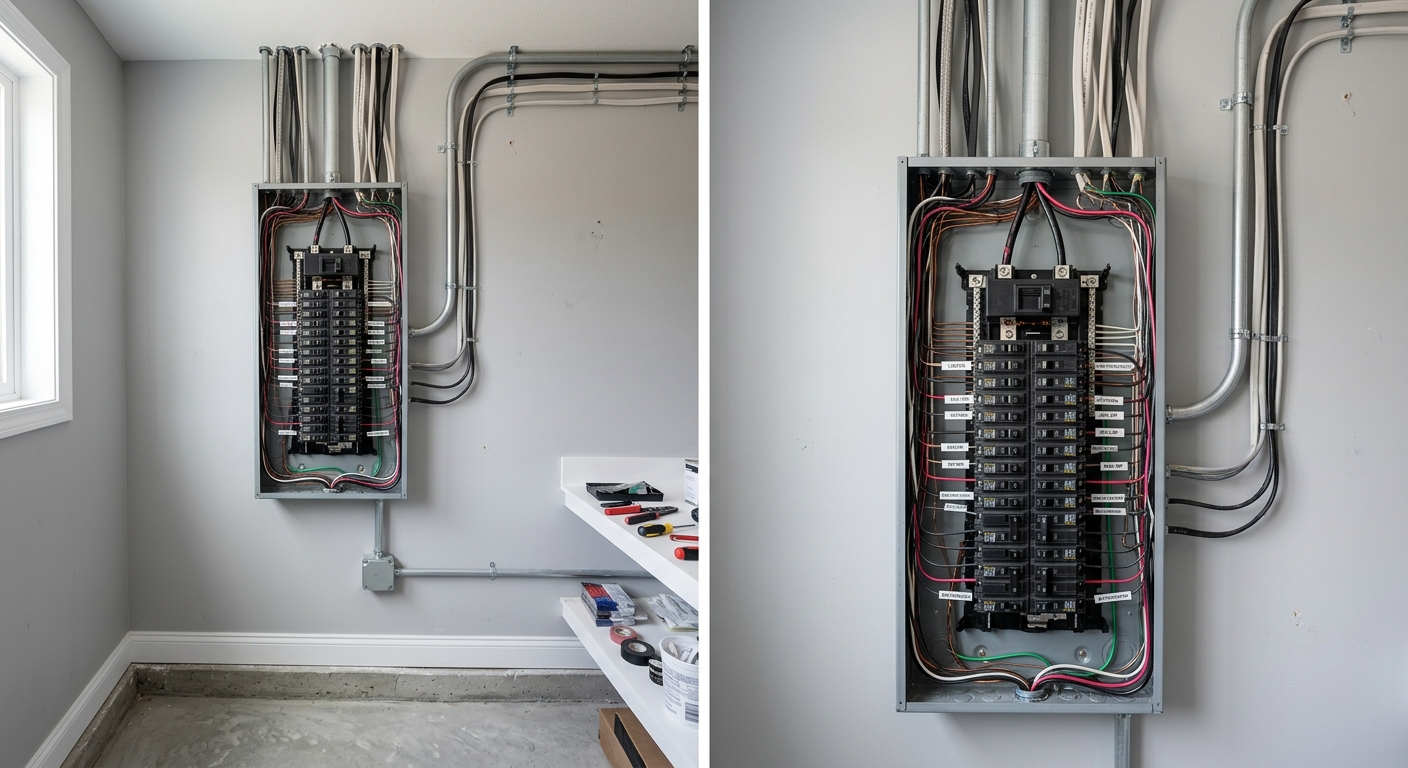
Toronto and the surrounding economic region (including Vaughan and Markham) brings constant demand—dense older neighbourhoods plus fast infill means licensed electricians are busy, and that pushes hourly labour into the 90–120/hour range for many contractors. Winter conditions also matter: Ontario homes typically run space heating, dehumidification, and ventilation longer during cold snaps, which can expose weak wiring and marginal connections. In addition, service upgrades are frequently paired with 100A-to-200A panel changes so the electrical system can safely support today’s loads. As a result, a typical panel upgrade in the GTA often lands around $2,500–$4,500 for a straightforward 200A job, while more complex remediation or service relocation can reach $5,000–$6,000 or more.
In King’s older pockets such as the King City area and along established collector roads, full or partial rewiring is especially in demand, particularly where buyers are updating an older home for electric cooking, air conditioning, and Level 2 EV chargers. Use the table below to benchmark the most common electrical services and what typically drives the permitting and inspection requirements.
| Service |
Why It's Needed |
Permit Required |
Price Range |
| Panel upgrade — 100A to 200A service |
Modern homes often outgrow 60A/100A capacity when adding EV charging, heat pumps, electric ranges, and basement renovations. |
Yes (ESA permitting + inspection) |
$2,500–$6,000 |
| EV charger installation (Level 2, 40–50A) |
Supports daily EV charging without overloading existing circuits; typically requires new dedicated wiring and breaker. |
Yes (new circuit and electrical work) |
$900–$2,500 |
| Knob-and-tube wiring removal and replacement |
Older insulation and termination methods can be unsafe and are commonly not compatible with today’s load expectations. |
Yes (rewiring scope) |
$6,000–$15,000 |
| Aluminum wiring remediation (CO/ALR connectors) |
Aluminum branch wiring needs licensed remediation using approved connectors and proper torque/termination to reduce overheating risk. |
Yes (major wiring remediation) |
$3,000–$9,000 |
| New dedicated circuit (HVAC, appliance, hot tub) |
Dedicated circuits improve safety and performance and reduce nuisance tripping caused by shared/undersized wiring. |
Yes (new circuits) |
$900–$3,000 |
| Whole-home rewire (older home, full replacement) |
Best option when wiring is mixed, aged, and difficult to troubleshoot or extend safely to meet current code and insulation standards. |
Yes (full rewiring scope) |
$8,000–$18,000 |
Prices are estimates only and vary by project scope, site access and material selection.
What affects the price of electrical work in King
Even when you’re comparing the same service in King, Ontario, quotes can differ by 30–50% across the Toronto region because electrical pricing is heavily driven by risk, labour time, and how much existing wiring remediation is required. The dominant factor is the age of the housing stock. Homes built before 1950 are more likely to contain knob-and-tube wiring, and insurance coverage can become difficult when older systems remain in place. Meanwhile, many homes from the 1960s–70s have 60A or 100A panels that are inadequate for today’s load mix—especially with heat pumps, EV chargers, electric stoves, and basement finishing. Aluminum wiring is also a major driver in many houses built in the mid-1960s to mid-1970s era, where proper CO/ALR connector remediation (or full replacement) must be done by a licensed electrician.
EV adoption is a current surge driver. In King and the wider Toronto economic region, more homeowners are applying for Level 2 charger installs, and many require load calculations and potentially a service/panel upgrade to do it safely. You might see a Level 2 charger come in closer to $900–$2,500 when the panel capacity and routing are straightforward, but costs rise quickly when trenching, long wire runs, or panel upgrades are required—often aligning with the $2,500–$6,000 panel/service band.
Concrete examples that commonly move cost up or down in King: (1) If the panel location is hard to access from the basement (blocked joists, finished walls), labour increases because wiring must be opened and restored; (2) If the service mast and grounding require remediation due to corrosion or mismatched components, a “simple” upgrade becomes a higher-end $5,000–$6,000 job; (3) If your home already has spare breaker spaces and safe copper terminations, a new dedicated circuit is often faster and cheaper than a project that needs extensive wiring replacement.
| Price Factor |
Why It Matters |
Cost Impact |
| Panel size upgrade — 100A to 200A is the standard minimum today |
New bus capacity, proper main breaker, and often grounding changes to support modern loads. |
Typically adds major portion of the cost (about $2,500–$6,000 for common Toronto-area installs) |
| Wiring type — copper vs. aluminum remediation vs. K&T removal |
Aluminum requires approved terminations; knob-and-tube removal is invasive and high-risk. |
Can move a job from a few thousand to the upper end of $3,000–$15,000+ depending on scope |
| Number of new circuits — each adds material and labour time |
Every circuit means breaker, wiring, labeling, testing, and often wall access. |
Frequent increases; more circuits often correlate with higher-end wiring/reconnect work |
| Permit + ESA/TSBC inspection fee — mandatory for all major work |
Permitted electrical work must be inspected before it’s energized for safety compliance. |
Adds baseline administrative cost (commonly $200–$500 depending on scope) |
| Labour rate for licensed electricians — journeyman rates in {region} |
Toronto-region demand and job complexity raise labour time and contractor availability. |
Commonly 90–120/hour, so extra hours can swing totals by hundreds or thousands |
| EV charger amperage — 40A vs. 50A circuit affects cable and breaker cost |
Higher amperage can require heavier cable and specific breaker selection. |
Can raise the charger install toward the upper EV band ($900–$2,500) |
| Emergency or after-hours premium |
Urgent call-outs often require scheduling priority and additional crew costs. |
Typically increases labour cost significantly versus daytime installs |
| Load calculation required for service upgrade |
Utilities and inspectors may require documentation that your system can safely handle loads. |
May add time for calculations and revision of upgrade scope (usually minor versus full rewiring) |
Permits & regulations in Ontario
In Ontario, all electrical work beyond changing a light bulb must be completed by a licensed electrician. Permits are required for panel upgrades, new circuits (including EV charger installations), rewiring, and service upgrades. Once permitted, the work must pass inspection before it’s considered compliant. In Ontario, inspection is coordinated through the Electrical Safety Authority (ESA). The rules exist to reduce fire risk from poor terminations, overloaded wiring, and unsafe grounding—issues that can be more common in older King neighbourhoods.
What typically does not require a permit: replacing a fixture with an identical, pre-approved unit and working within the existing junction where the wiring method doesn’t change (for example, a like-for-like swap). What does require a permit in practice: any new breaker circuit, any wiring extension that changes the wiring method, panel replacement/upgrade, service relocation, rewiring, and any work needed to bring wiring up to code (including GFCI/AFCI additions when required by the scope).
For homeowners in King, the verification process is straightforward. First, ask for the electrician’s Ontario licence number and verify it using the appropriate provincial licence registry. Second, request a certificate of insurance showing liability coverage and confirm it’s current. Third, ask for evidence of WSIB/WCB coverage (or an exemption letter if applicable). Finally, keep your estimate and permit documents—your inspection record ties directly to the permitted scope.
When your King home needs an electrical upgrade
Electrical upgrades in King are usually prompted by safety-critical warning signs, not “cosmetic” issues. Start with breakers that trip frequently: if you notice a breaker going off when you run a hair dryer, microwave, or the washing machine, that can indicate an overloaded circuit, failing connections, or undersized wiring that’s not suited for modern usage. Next, look for knob-and-tube wiring. The concern isn’t just age; it’s the condition of insulation and terminations, and it can be incompatible with today’s safety expectations and insurance requirements.
Third, pay attention to service size. If you have a 60A or 100A panel, it may be inadequate once you add an EV charger and modern heating. Many King homes are now pairing heat pumps and electric cooking with basement renovations, which increases demand. A 200A upgrade is commonly the standard solution when you’re also planning EV charging, and it often fits the $2,500–$6,000 panel/service band for Toronto-area projects. Fourth, aluminum wiring (often found in pre-1976 construction) may not be “immediately dangerous” if it’s been well maintained, but it typically needs licensed remediation—such as CO/ALR connectors—or replacement at problem terminations.
Fifth, insufficient outlets and extension cords everywhere are a practical sign of an undersupplied system; unsafe cord use can hide a deeper circuit capacity problem. Sixth, missing AFCI/GFCI protection (where required by code and by the scope of work) can become a compliance issue—especially visible during resale. Breakers tripping and knob-and-tube discovery merit immediate attention; panel capacity and wiring type issues are often better addressed as a planned upgrade
For example, swapping a few outlets without addressing an undersized panel may cost only a few hundred, but it won’t prevent ongoing trips. In contrast, a properly scoped 200A panel upgrade—often starting around $2,500 and reaching $6,000+ when there’s complexity—can reduce nuisance trips and make EV charging and heat pump loads possible.
| Warning Sign |
What It Means |
Recommended Action |
Urgency |
Price Band |
| Breakers trip frequently |
Overload, faulty breaker, or inadequate circuit design for modern loads. |
Inspection + load assessment; check for loose/burnt terminations; add circuits or upgrade panel if needed. |
Immediate |
$900–$6,000 |
| Knob-and-tube wiring present |
Older insulation/termination method increases safety risk and complicates code-compliant upgrades. |
Evaluate extent; plan removal/replacement or controlled isolation depending on findings. |
Immediate to planned (depending on condition) |
$6,000–$15,000 |
| 60A or 100A panel (inadequate load capacity) |
Not enough capacity for EV chargers, heat pumps, electric ranges, and basement loads. |
Load calculation and 100A-to-200A panel/service upgrade. |
Planned (if stable) or prioritize before EV/renos |
$2,500–$6,000 |
| Aluminum wiring (pre-1976 construction) |
Requires approved remediation to reduce overheating at connections. |
CO/ALR connector remediation, torque verification, and targeted replacement where needed. |
Planned |
$3,000–$9,000 |
| Insufficient outlets — extension cords everywhere |
Too few circuits/outlets for the home’s actual use; higher risk of overloading cords. |
Add dedicated circuits and receptacles; review grounding/GFCI needs. |
Planned |
$900–$3,000 |
| No AFCI or GFCI protection where required |
Code-compliance gap that can also affect safety around moisture and arc-fault hazards. |
Upgrade affected devices/circuits to meet Ontario code requirements for the scope. |
Planned |
$200–$1,500 |
How to choose a electrical work contractor in King
Choosing the right contractor in King, Ontario starts with verification. Ask for the electrician’s Ontario licence number and confirm it through the provincial licence lookup. Next, request proof of liability insurance (certificate of insurance) and review effective dates and coverage limits. Then confirm WSIB/WCB coverage—if they’re doing work under their company, you should see current coverage documentation or a valid exemption/clearance letter.
For pricing, get 2–3 itemised written quotes rather than a lump sum. The best quotes break out labour hours, materials, breaker/cable costs, any wall opening/patching assumptions, and whether permit/inspection fees are included. Confirm what’s excluded (drywall repair, concrete cutting, disposal of old wiring, load calculation, ESA application time). For major work, verify if the permit is pulled under your address and name, and whether the contractor handles all paperwork.
Warranty matters too. Look for a workmanship warranty (often 1–2 years in common contracting practice) and ask how product/manufacturer warranties apply to breakers, panels, and EV chargers. Also confirm whether warranty transfer is possible if you sell the home.
Payment schedule should be cautious. Avoid paying more than 10–15% upfront; hold back the remainder until the job is complete, tested, and any deficiencies are corrected. Get a start date and completion estimate in writing, plus what happens if ESA inspection delays the energization timeline.
- Licence number and contractor business name match the invoice and permit
- Proof of liability insurance is current
- WSIB/WCB coverage confirmed (or proper exemption letter)
- Quote includes labour hours estimate and material list (breakers, cable, connectors)
- Explicitly states whether permit and ESA inspection fees are included
- Clarifies any drywall/patching responsibility and who supplies matching materials
- Confirms disposal of old wiring/components (especially K&T or aluminum remediation)
- Mentions testing steps: continuity/megger (where applicable), polarity, and functional checks
- Provides a wiring diagram or circuit map where scope is extensive
- Workmanship warranty terms are written, with exclusions clearly stated
- EV charger quotes specify amperage, cable routing method, and charger compatibility
- Includes a realistic timeline for permit approval and ESA inspection booking
In King, red flags include: quoting “same price” without inspecting your panel/wiring first, refusing to itemize labour/materials, promising work without pulling a permit, minimizing knob-and-tube or aluminum remediation concerns, and asking for large upfront payments (well beyond 10–15%) before any testing or inspection results.
Frequently asked questions — electrical work in King
How long does a rewiring job take?
In King, Ontario, a full rewiring timeline depends on house size, access, and how much of the existing wiring must be removed rather than extended. A partial rewire (for a few rooms, a basement renovation, or targeted circuit replacement) can take a few days to a week, while whole-home rewires often take multiple weeks because the work is both labour-intensive and inspection-driven. Ontario permitting also adds calendar time: the contractor must complete the work, have it tested, and then schedule inspection through the ESA process before the system is signed off. If your home includes knob-and-tube wiring, removal is more disruptive and can extend duration. On cost, rewiring often sits in the $3,000–$15,000 band, with larger homes or difficult access trending higher.
Why do my breakers keep tripping?
Breakers that trip repeatedly usually point to one of three issues: overload (too many devices on one circuit), a wiring problem (loose or damaged terminations), or equipment-related faults. In older King homes—especially those with 60A/100A service or older wiring methods—modern appliance use (microwaves, induction/electric ranges, dehumidifiers, and heat-pump/ventilation systems) can push circuits beyond what they were designed for. Aluminum wiring can also contribute when connections aren’t properly remediated with approved CO/ALR connectors. The right next step is a licensed electrician’s inspection and load assessment, not simply replacing breakers. Sometimes the fix is adding dedicated circuits; in other cases, it’s a panel upgrade toward a typical 200A setup, which commonly fits the $2,500–$6,000 panel/service band in the Toronto area.
How do I compare electrical quotes?
Compare electrical quotes like you would compare roofing quotes: look for clarity on scope and responsibilities, not just the total. Ask for itemized labour and materials, including the exact breaker and cable sizes, and whether connectors are specifically addressed for aluminum or K&T remediation. Confirm whether permits and ESA inspection fees are included, and whether the contractor is handling ESA documentation or expects you to. Also compare exclusions: drywall repair/patching, disposal of removed wiring, concrete cutting, long wire pulls, and any load calculation required for service upgrades. If an EV charger is included, verify the amperage (40A vs 50A) and whether a dedicated circuit and proper breaker are part of the quote. If one quote lands in the $900–$2,500 EV band while another is in the $2,500–$6,000 panel/service band, ask what’s actually driving the difference (capacity, routing, or remediation). That’s usually where value shows up.
How long does a panel upgrade take in King?
In King, a straightforward 100A-to-200A panel upgrade is often completed within a single workday, but the overall project timeline can stretch because permitting and inspection must be scheduled. Typical scheduling practice is that the electrical work is done first, then inspected before final approval/energization. If the job is more complex—such as service relocation, extensive grounding work, difficult panel access, or additional wiring remediation—the work can take longer and may involve multiple visits. The price range for a common 200A upgrade in the Toronto area typically falls around $2,500–$6,000 depending on complexity. If your home also needs EV-ready circuits, surge protection additions, or significant remediation (like aluminum terminations), the project often expands both in time and cost. Your electrician should provide a start date estimate and identify when ESA inspection is expected.
What is a GFCI outlet and where is it required in Ontario?
A GFCI (Ground-Fault Circuit Interrupter) outlet is designed to quickly shut off power if it detects an unsafe ground-fault condition, reducing shock risk—especially where moisture is present. In Ontario, GFCI protection is required in specific locations and scenarios, and it becomes part of code compliance when circuits are installed/altered. Common areas include kitchens and bathrooms where water exposure exists, garages and outdoors, and other wet or damp environments as defined by the Ontario Electrical Code. In King, you’ll often see GFCI needs come up during renovations—like adding basement bathrooms, finishing a basement kitchen, or upgrading circuits near laundry areas. If your electrician is adding new circuits for an EV charger or panel upgrade, they’ll typically assess broader protection requirements as well. If you’re only adding GFCI to an existing circuit, costs can be relatively modest compared to a panel upgrade, but exact pricing depends on whether you’re changing wiring methods.
How do I know if my King home has aluminum wiring?
You can often identify aluminum wiring by looking at the markings on conductors and by having your electrician confirm it during an inspection. Aluminum conductors usually have specific lettering/inscriptions on the cable jacket or at terminations; sometimes they’re also visibly different from copper in appearance and handling. However, the most reliable method is a licensed electrical contractor checking terminations inside the panel and at key outlets/switch boxes, then confirming with appropriate testing and observations. This matters in King because aluminum wiring is commonly seen in homes built in certain mid-century periods (many around the pre-1976 range), and it often requires licensed remediation using approved CO/ALR connectors. If you’re also planning an EV charger or service upgrade, don’t assume it’s “fine as-is”—a 200A upgrade may still require addressing aluminum terminations to pass inspection and improve safety. Remediation projects frequently land in the $3,000–$9,000 band depending on how extensive the aluminum wiring is.