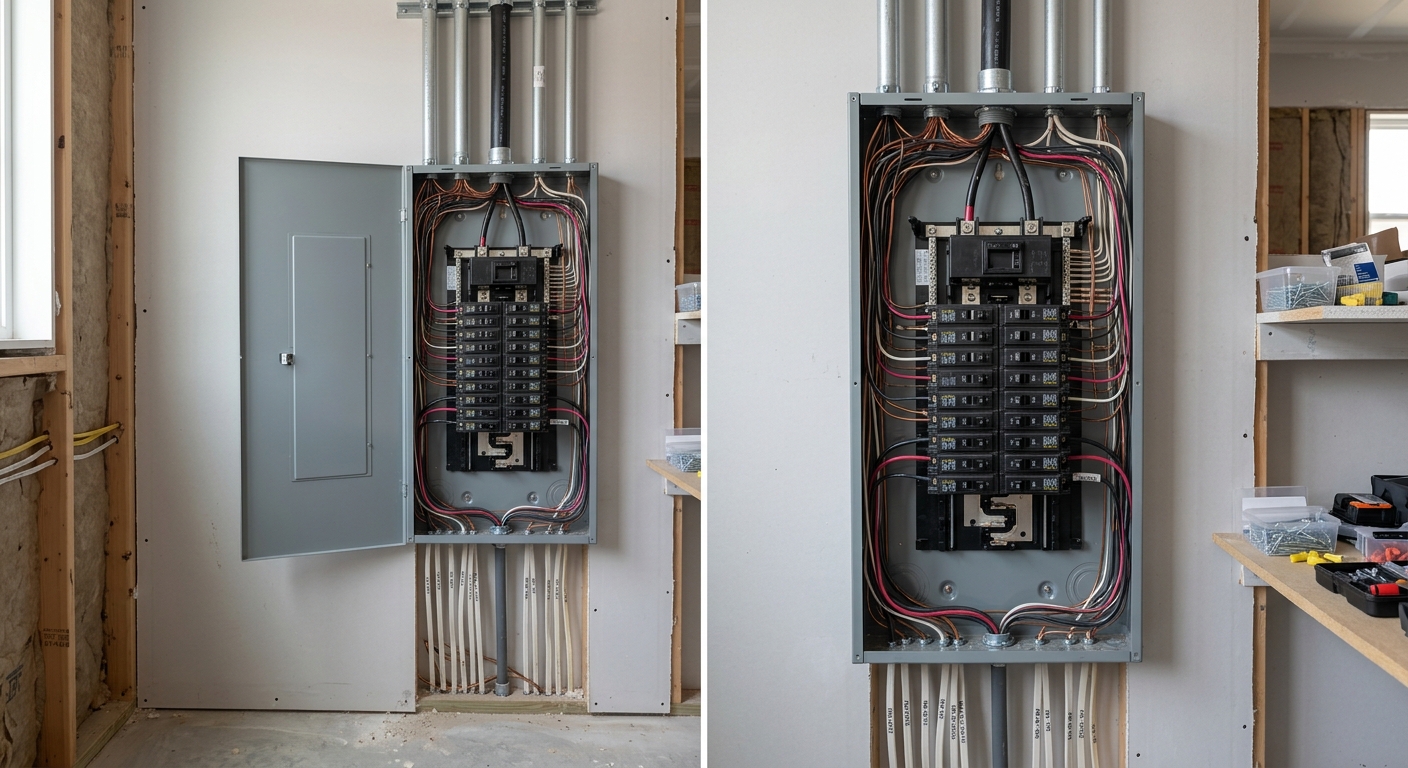
Electrical services and costs in Mattawa
Electrical services in Mattawa are shaped by a mix of older housing and winter-driven electrical demand. With 78.9% of local homes built before 1981, many properties are prime candidates for modern panel work and safety upgrades, especially where older wiring types remain in service. In 2021, Mattawa had 555 homeowner households, and that steady owner base supports ongoing renovations—often the same homes that first need electrical makeovers to keep up with new appliances, comfort upgrades, and household electrification. Northeast Ontario winters also play a role: long heating runs and increased use of resistance heat and household appliances can push peak winter loads higher than they are in milder seasons, which is why load capacity and panel condition matter so much. Access and travel time can further affect contractor availability and pricing; even when crews are experienced, working around frozen ground and weather delays can add labour time on site.
In Mattawa, electrical trade activity tends to be especially noticeable around the busier residential areas near the town core, where older service equipment and renovation projects intersect. Common triggers include service bottlenecks, dated breakers, and wiring that no longer meets today’s safety expectations.
Because the scope can change quickly after the electrician opens the panel or traces wiring, it helps to compare the typical service categories before you request a quote.
| Service |
Why It's Needed |
Permit Required |
Price Range |
| Panel upgrade — 100A to 200A service |
Modern load demand (EV chargers, heat pumps, electric stoves, hot tubs) and improved safety/room for new breakers. |
Yes (service upgrade requires permitting and inspection) |
$2,500–$6,000 |
| EV charger installation (Level 2, 40–50A) |
Adds a dedicated circuit for reliable charging with correct breaker sizing, GFCI/AFCI considerations, and load balancing if needed. |
Yes (new circuit/branch wiring typically requires permitting) |
$1,200–$3,000 |
| Knob-and-tube wiring removal and replacement |
Knob-and-tube is typically treated as high-risk by insurers and can have degraded insulation; replacement restores safer wiring practices. |
Yes (rewiring/removal generally requires permitting and inspection) |
$4,000–$20,000 |
| Aluminum wiring remediation (CO/ALR connectors) |
Homes with aluminum branch wiring may require approved remediation (CO/ALR-rated devices/connectors) to reduce overheating risk. |
Yes (major alterations generally require permitting) |
$2,500–$10,000 |
| New dedicated circuit (HVAC, appliance, hot tub) |
Separate circuits reduce nuisance tripping and improve safety when high-draw appliances or outdoor loads are added. |
Yes (new branch circuits typically require permitting) |
$600–$2,500 |
| Whole-home rewire (older home, full replacement) |
When multiple rooms, junctions, and feeds are outdated, full replacement brings the system up to current safety expectations. |
Yes (rewiring requires permitting and inspection) |
$10,000–$35,000 |
Prices are estimates only and vary by project scope, site access and material selection.
What affects the price of electrical work in Mattawa
For the same electrical job, homeowners in the Northeast can see quotes vary by 30–50% once you compare travel time, wiring conditions behind walls, and how many hours it takes a licensed electrician to bring an older system up to modern standards. The dominant cost driver is housing age. In Mattawa, 78.9% of homes were built before 1981, and that matters because older wiring methods and undersized service equipment are frequently paired together—so an “easy” add-on can turn into panel work, circuit redesign, and sometimes full rewiring in portions of the home.
Homes built in the 1960s–70s are particularly relevant for aluminum wiring remediation. Aluminum branch circuits often need licensed remediation with approved CO/ALR connectors at junctions and devices, and in some cases full replacement if the wiring layout or terminations are too compromised. Meanwhile, panels from earlier decades may start at 60A or 100A, which is commonly inadequate for today’s loads—think EV charger installs, heat pumps, induction stoves, and even a hot tub running seasonally. That’s where a typical panel upgrade / service budget of $2,500–$6,000 can become the “justified” foundation cost rather than optional.
EV adoption is also changing what electricians see in Mattawa. Level 2 charger permit applications typically rise alongside renovation projects, and the amperage choice (40A vs. 50A) can change cable type, breaker cost, and how much load capacity is left on a crowded panel. A concrete example: if your panel can’t support the charger safely, you’re not just buying an EV circuit—you’re paying for the panel upgrade first, and the total can shift by several thousand dollars. On the other hand, if the wiring pathway is accessible and the service has spare capacity, a dedicated EV charger may stay closer to the $1,200–$3,000 band.
| Price Factor |
Why It Matters |
Cost Impact |
| Panel size upgrade — 100A to 200A is the standard minimum today |
Modern appliances and charging loads require spare breaker space and ampacity; it also reduces overheating risk. |
Often adds roughly $2,500–$6,000 |
| Wiring type — copper vs. aluminum remediation vs. K&T removal |
Aluminum requires approved devices/connectors; knob-and-tube typically triggers larger replacement scopes. |
Can move from “few thousand” to $4,000–$20,000+ |
| Number of new circuits — each adds material and labour time |
Each circuit needs a breaker, cable, routing time, and termination work. |
Usually increases the quote by $500–$2,500 per circuit |
| Permit + ESA/TSBC inspection fee — mandatory for all major work |
Permits ensure the work is inspected and brought up to safety requirements. |
Adds fixed administrative cost plus scheduling time |
| Labour rate for licensed electricians — journeyman rates in {region} |
Licensed labour is priced to reflect competency, liability, and jobsite conditions. |
Travels and cold-weather work can raise labour hours on site |
| EV charger amperage — 40A vs. 50A circuit affects cable and breaker cost |
Higher amperage can require heavier conductors and changes in breaker/cable selection. |
Typically shifts the EV band within $1,200–$3,000 |
| Emergency or after-hours premium |
Priority scheduling and after-hours conditions increase labour cost. |
Can add a noticeable premium to hourly labour |
| Load calculation required for service upgrade |
A proper calculation prevents undersizing and helps confirm the right service size/feeder arrangement. |
Usually adds planning time; prevents costly rework |
Permits & regulations in Ontario
In Ontario, all electrical work beyond changing a light bulb must be done by a licensed electrician. That includes panel upgrades, new circuits (for example, outlets and dedicated appliance circuits), rewiring work, and service upgrades. Adding an EV Level 2 charger also falls under permitted work because it typically involves new branch wiring, a breaker, and safe connection to your service capacity. In practice, permit-required jobs are the ones that change how power is distributed or create new permanent wiring connections—so “small” jobs can still require permits when they involve new circuits or modifications inside panels.
Once the electrician completes the work and submits the permit, the permitted installation must pass inspection by the electrical safety authority for Ontario (ESA). DIY electrical is restricted because incorrect work can create shock, fire, or overheating hazards that aren’t always obvious right away. Homeowner exemptions are narrow and usually don’t apply to panel and service changes, new wiring, or anything that must be inspected.
Step-by-step, how to verify your contractor before you sign: (1) confirm the licence status using the Ontario electrical contractor/licence registry online; (2) request a current certificate of insurance naming you appropriately as required by contract; (3) ask for WSIB coverage confirmation (or an appropriate clearance letter, if their situation fits); and (4) keep the permit/inspection paperwork for your records after the job. Don’t rely on verbal assurances—ask for documents up front.
When your Mattawa home needs an electrical upgrade
Some electrical issues in Mattawa are “notice it now” safety problems, while others are better treated as planned upgrades before they cause a failure. Start with the warning signs that point to safety-critical risks. First, breakers that trip regularly usually means an overloaded circuit, a failing breaker, or undersized wiring relative to current use—especially common in older homes where resistance heat, multiple plug loads, and winter appliance use stack together.
Second, knob-and-tube wiring is a key concern. The risk is not just age; it’s insulation condition and how old connections behave under modern loads, and insurers may refuse coverage or require remediation. Third, a 60A or 100A service can’t reliably handle today’s load combinations—an EV charger plus heat pump systems and an electric range can push the panel beyond comfortable limits. In those cases, a 200A upgrade is the standard solution, and budgeting using the typical panel upgrade / service range of $2,500–$6,000 is usually more cost-effective than repeated “fixes” that never fully resolve capacity.
Fourth, aluminum wiring (often seen in pre-1976 construction) isn’t always immediately dangerous if well maintained, but it does require licensed remediation to address terminations—typically using approved CO/ALR connectors or replacement where needed. Fifth, insufficient outlets and reliance on extension cords are a practical hazard in winter when cords sit across walkways and get stressed. Sixth, missing AFCI/GFCI protection where required is a code-compliance and safety issue that can surface during a home sale or inspection.
In cold weather, minor faults can worsen; for example, a loose connection can “feel fine” in summer and heat up under winter peak loads. If you’re seeing tripping, burning smells, discoloured outlets, or visible damage, treat it as urgent. If you’re seeing capacity constraints (like a panel that’s always full), plan upgrades to align with renovation timing to reduce drywall disruption.
| Warning Sign |
What It Means |
Recommended Action |
Urgency |
Price Band |
| Breakers trip frequently |
Possible overload, failing breaker, or circuit wiring/connection issues. |
Electrician diagnosis, circuit load balancing, and safety checks; add dedicated circuits if needed. |
Immediate to short-term (days to weeks) |
$600–$2,500 |
| Knob-and-tube wiring present |
Degraded insulation and higher failure risk under modern use; often an insurance concern. |
Remove and replace affected runs; consider broader rewiring if damage is widespread. |
Immediate to short-term |
$4,000–$20,000 |
| 60A or 100A panel (inadequate load capacity) |
Panel may be unable to safely support modern loads during winter peaks. |
Load calculation and panel/service upgrade, typically toward 200A. |
Short-term (weeks) |
$2,500–$6,000 |
| Aluminum wiring (pre-1976 construction) |
Potential overheating at terminations unless properly remediated. |
Licensed remediation with approved CO/ALR connectors or partial/full replacement. |
Planned (but schedule soon) |
$2,500–$10,000 |
| Insufficient outlets — extension cords everywhere |
Increased risk from overloaded cords and poor routing in winter. |
Add outlets and circuits; address load distribution instead of relying on cords. |
Planned (next 1–3 months) |
$300–$2,500 |
| No AFCI or GFCI protection where required |
Higher risk of arc faults and shock; may be flagged during home sale/inspection. |
Replace/upgrade devices and update protection as required by code. |
Planned (before sale/inspection) |
$300–$6,000 |
How to choose a electrical work contractor in Mattawa
Choosing the right electrician in Mattawa comes down to proof, paperwork, and clarity on scope. First, verify Ontario licensing by asking for their licence number and checking the status through the provincial licensing registry. Next, request a certificate of insurance and ensure it covers the type of work being quoted (electrical liability). Finally, confirm WSIB coverage (or obtain the contractor’s WSIB clearance letter if applicable). If they can’t provide these, walk away—licensed work carries liability and you should be protected.
Then get 2–3 itemised written quotes rather than a single lump sum. The best quotes break labour and materials into clear line items: breakers, panel components, wire/cable, conduit (if needed), and any specialty items like CO/ALR connectors or EV-rated charging components. Read exclusions carefully—ask whether permits are included, who pays inspection fees, and whether disposal/damaged-material remediation is part of the price (for example, drywall cut-outs for accessible wiring routes). Ask whether the electrician will do a load calculation for service upgrades and whether it will be documented.
On warranty and payment, expect a workmanship warranty in writing and keep manufacturer warranty details separate. Workmanship should be backed for a meaningful period; also ask if product warranties are transferable to the homeowner. Payment should stay conservative: never pay more than about 10–15% upfront. Use a holdback until final inspection and completion, and get the start date plus estimated timeline in writing to avoid winter schedule surprises.
- Licence number provided in the quote and confirmable online.
- Insurance certificate requested before the first payment.
- WSIB clearance/coverage proof provided (not just “we’re covered”).
- Itemised quote with labour + materials breakdown, not a single total only.
- Permit pull responsibility clearly stated (included vs. billed separately).
- Inspection and documentation included for permitted work.
- Scope includes cable routing and panel interior modifications where needed.
- Clear exclusions (e.g., drywall repairs, concrete cutting, restoring finishes).
- Waste/disposal handling stated in writing.
- Workmanship warranty stated with length and process to claim.
- Payment schedule: small deposit, milestone-based progress, holdback at end.
- Timeline with expected start date and completion estimate.
Red flags in Mattawa include: an electrician who won’t provide licence/insurance/WSIB details in writing; quotes that refuse to specify permit responsibility; “too-good-to-be-true” pricing without a load calculation or inspection plan; asking for a large upfront deposit; and promising work “without opening the panel” when the job requires verifying service capacity or wiring condition.
Frequently asked questions — electrical work in Mattawa
How do I know if my Mattawa home has aluminum wiring?
In Mattawa, the fastest way to confirm aluminum wiring is through a licensed electrician’s inspection at the panel and accessible junctions. They’ll look for conductor markings on cable jackets and check device terminations for the typical characteristics of aluminum branch wiring. Many pre-1976 homes carry aluminum, and the key is whether terminations were made with proper connectors and compatible devices over time. If you see repeated warm spots, discoloured device faces, or brittle/poor terminations, that’s another clue. For a definitive assessment, ask for a CO/ALR connector remediation review or a partial replacement plan. If remediation is required, typical budgets can land in the $2,500–$10,000 range depending on how many terminations are affected.
What is the cost of rewiring a house in Mattawa?
Rewiring costs depend heavily on how much of the home needs replacement and how accessible the wiring paths are. In older Mattawa homes—where a large share were built before 1981—rewiring can range from targeted replacements to whole-home work. Whole-home rewire budgets commonly fall into the $10,000–$35,000 range in practice, while smaller scoped replacements (like removing problematic sections such as knob-and-tube runs) may sit around $4,000–$20,000. If the electrician plans a full rewire, they should include an itemised breakdown for new cable, breakers, and labour, plus permit and inspection steps. Expect additional cost if the job requires extensive fishing through finished walls or if hidden wiring damage is found during opening walls.
What electrical upgrades are required when selling a home in Ontario?
Ontario doesn’t require a homeowner to proactively upgrade everything to today’s standard before sale, but sale-time issues usually arise when systems are unsafe, improperly installed, or missing required protection. For example, missing GFCI/AFCI protection where required can become a concern during inspection or disclosure. Also, selling often brings to light older hazards such as knob-and-tube wiring or severely outdated/unsafe wiring conditions. Service capacity can also matter if buyers expect modern loads (like EV charging readiness) and the electrical system is clearly undersized. Practically, many sellers end up budgeting for panel/service work or a targeted safety remediation. A common starting point is a panel upgrade/service range of $2,500–$6,000 if the load calculation indicates you need more capacity.
What is a load calculation and why does my electrician need one?
A load calculation is the electrician’s documented method for estimating your household’s electrical demand under Ontario electrical code rules, considering connected loads (heating type, kitchen appliances, laundry, EV charger demand, and other major circuits). Your electrician needs it to confirm whether the existing service and panel can safely support current and planned loads—especially in Mattawa where winter usage and long heating runs can push demand higher. If your electrician is proposing a service upgrade (often toward 200A), the load calculation helps justify the upgrade size and prevents rework from an undersized service. It also improves quote accuracy, because the right equipment and breaker/feeder setup depend on the calculation. For service upgrades, planning around the $2,500–$6,000 band is common when permits and inspections apply.
How do I find a licensed electrician in Mattawa?
In Mattawa, the best approach is to shortlist contractors and verify them before you book. Ask each electrician for their Ontario electrical licence number and confirm it through the province’s online registry. Next, request a current certificate of insurance and ensure it matches the type of work (panel/service work should be covered appropriately). Confirm WSIB/WCB coverage by asking for proof or a clearance letter, not just a verbal statement. Then compare quotes only after confirming their scope includes permits, inspection responsibility, and itemised materials. A good sign is that they’ll discuss wiring conditions (for example, signs of aluminum terminations or knob-and-tube) and explain how they’ll verify capacity. If you’re budgeting for a service upgrade, ask whether their price aligns with the typical $2,500–$6,000 panel/service band for 100A-to-200A work.
Can I add a subpanel to my Mattawa home?
Yes, adding a subpanel is possible in many Mattawa homes, but it must be designed around your existing service capacity and your load requirements. A licensed electrician will typically start with a load calculation and confirm whether your main panel has enough spare capacity and appropriate bus/space. If you’re adding a subpanel for a shop, hot tub circuits, or to support EV charging plans, the work may also trigger a need for a service upgrade depending on available ampacity and breaker space. Subpanels involve new wiring (feeders) and proper circuit distribution, so permits and inspection are normally required in Ontario. If your main panel is already full or undersized, you may end up with both a 100A-to-200A style upgrade and subpanel work; that’s why quotes often vary. As a reference point, the panel/service portion commonly sits in the $2,500–$6,000 range when going to 200A.