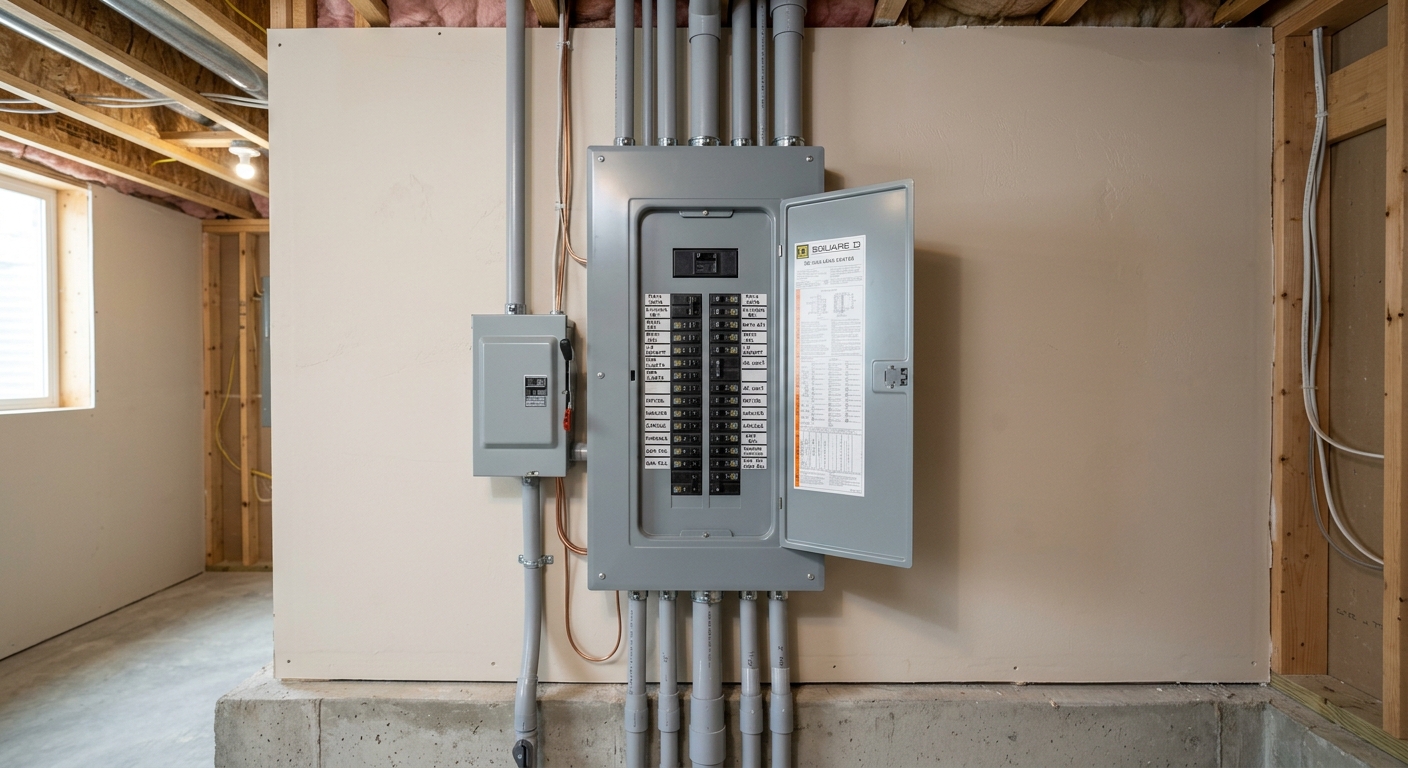
Electrical services and costs in Welland
Welland is seeing steady demand for electrical services because a large share of local housing is older and built for lower power needs than today. In fact, 65.6% of dwellings were built before 1981 (Statistics Canada, 2021 Census), which means many homes are prime candidates for panel work, knob-and-tube removal, and aluminum wiring remediation. With 64.5% of dwellings being single-detached houses, there’s plenty of room for safe upgrades—but also plenty of crawlspaces, basements, and older wiring routes that can make replacement more time-consuming.
In the Hamilton–Niagara Peninsula market, costs are also shaped by how frequently we’re balancing service upgrades with new high-load equipment. The region is known for homes from the earlier decades that often start with 60A or 100A services, so homeowners adding EV charging, heat pumps, induction stoves, or even electric hot tubs commonly need a larger backbone before the new appliance can be installed safely. Weather matters too: Niagara winters and shoulder-season freezes can drive up troubleshooting time, especially when older panels, weathered exterior feeds, or moisture-prone terminations are involved.
Contractors stay busy in neighbourhoods like Westdale and surrounding areas where renovation activity is high, including finished basements and garage build-outs. If you’re planning an upgrade in Welland, it helps to compare typical cost ranges by job type—then confirm the details with a licensed electrician and the required ESA permit pathway. Below is a practical comparison to guide your budget.
| Service |
Why It's Needed |
Permit Required |
Price Range |
| Panel upgrade — 100A to 200A service |
Modern loads (EV chargers, heat pumps, electric stove) often exceed older panel capacity and breaker space. |
Yes (ESA permit + inspection) |
$1,800 – $4,500 |
| EV charger installation (Level 2, 40–50A) |
Dedicated circuit provides safe continuous-load power and reduces nuisance trips. |
Yes (ESA permit + inspection) |
$1,000 – $3,500 |
| Knob-and-tube wiring removal and replacement |
Older insulation and wiring methods can be unsafe and are often required to be corrected for underwriting and code compliance during renovations. |
Yes (ESA permit + inspection) |
$8,000 – $20,000 |
| Aluminum wiring remediation (CO/ALR connectors) |
Approved connectors and terminations reduce risk at connection points; sometimes full replacement is required. |
Yes (ESA permit + inspection) |
$4,000 – $14,000 |
| New dedicated circuit (HVAC, appliance, hot tub) |
Dedicated breakers help manage peak loads and improve safety and nuisance-trip reliability. |
Yes (typically for new circuits) |
$900 – $3,200 |
| Whole-home rewire (older home, full replacement) |
When wiring is broadly degraded or mixed wiring is present, a full replacement reduces recurring fault risk. |
Yes (ESA permit + inspection) |
$14,000 – $35,000 |
Prices are estimates only and vary by project scope, site access and material selection.
What affects the price of electrical work in Welland
In Welland and across the Hamilton–Niagara Peninsula, two quotes for the “same” electrical job can differ by 30–50% because the real driver is usually what the electrician uncovers after the walls are opened and the load is calculated. Panel and service upgrades aren’t just replacing a box; they can involve conductor upgrades, grounding/bonding corrections, meter/utility coordination, and sometimes asbestos/older insulation access considerations that change labour time. Permit processing and inspection scheduling can also affect how quickly crews can mobilize.
Housing age is the dominant cost driver. Homes built before mid-century often include knob-and-tube wiring, while many builds from the 1960s to the mid-1970s used aluminum wiring, which requires licensed remediation using approved CO/ALR connectors or full replacement. It’s also common to find 60A or 100A panels in older homes that can struggle with today’s peak loads—especially when owners add Level 2 EV charging (continuous load), heat pumps, and an electric stove. In these cases, a 200A upgrade may be the safer long-term solution rather than repeatedly adding breakers.
Local conditions can raise or lower costs in tangible ways in Welland. For example: longer cable runs from a panel to a detached garage or exterior charger location typically add labour and trenching/route work. Conversely, if the panel is already adjacent to the proposed circuit route and there’s clear basement access, the cost can land closer to the lower end of the $1,800 – $4,500 panel-service band. Another example: homes with straightforward wiring paths may keep EV charger installs closer to $1,000 – $3,500, while homes needing new surface raceways or complicated stud-bay routing can come in higher.
| Price Factor |
Why It Matters |
Cost Impact |
| Panel size upgrade — 100A to 200A is the standard minimum today |
More capacity requires larger service conductors, breakers, and often layout changes. |
Typically adds material + labour; commonly the biggest single line item. |
| Wiring type — copper vs. aluminum remediation vs. K&T removal |
Aluminum needs approved terminations; knob-and-tube may require replacement. |
Can shift a job by thousands due to labour complexity and material. |
| Number of new circuits — each adds material and labour time |
Each circuit requires cable, breakers, labour for routing/boxes, and testing. |
More circuits can increase cost quickly even if the panel size stays the same. |
| Permit + ESA/TSBC inspection fee — mandatory for all major work |
Permitted residential work requires inspection before utility finalization. |
Non-optional fees plus scheduling time can affect total pricing. |
| Labour rate for licensed electricians — journeyman rates in Hamilton–Niagara Peninsula |
Licensed labour time varies with access, troubleshooting, and rework. |
Two contractors may price labour differently based on crew size and schedule. |
| EV charger amperage — 40A vs. 50A circuit affects cable and breaker cost |
Higher amperage requires thicker conductors and correctly sized protection. |
Often a mid-range price difference within EV charger projects. |
| Emergency or after-hours premium |
Priority scheduling increases labour cost and can require additional crew mobilization. |
Usually adds a noticeable premium over standard daytime work. |
| Load calculation required for service upgrade |
ESA/utility coordination can require proper sizing based on connected load assumptions. |
If calculations show undersizing, you may need a larger panel than first expected. |
Permits & regulations in Ontario
In Ontario, ALL electrical work beyond changing a light bulb must be completed by a licensed electrician. For typical Welland homeowners, that means you should expect an ESA permit for major work such as panel upgrades (for example, 100A to 200A), new circuits, rewiring portions of a home, replacing or relocating service equipment, and installing EV chargers (including Level 2 chargers that require a dedicated breaker and properly sized conductors). DIY electrical is prohibited for most work; homeowner allowances are narrow and generally don’t cover new wiring, service work, or anything that requires inspection.
The key concept is that permitted electrical work must pass inspection by the electrical safety authority (ESA in Ontario). Practically, the electrician pulls the permit, the work is inspected, and the utility will only finalize certain service changes after inspection is passed. Before booking, ask for the ESA permit reference number or confirm that the permit will be pulled for your project.
Step-by-step, here’s how a homeowner in Welland can verify a contractor: (1) check the electrician/company licence/registration using Ontario’s public licensing registry; (2) request a current Certificate of Insurance (liability coverage) and confirm it includes residential electrical work; (3) confirm workers’ coverage (WSIB/WCB where applicable) by asking for proof of coverage or clearance; and (4) request the written scope and the inspection/permit plan so you know what’s included. If they can’t provide documentation promptly, that’s a red flag.
When your Welland home needs an electrical upgrade
Your Welland home may need an electrical upgrade when warning signs show up that are safety-critical—not just inconvenient. First, breakers that trip regularly often point to an overloaded panel, undersized circuits, or failing connections; if it’s happening more than occasionally, plan action soon. Second, knob-and-tube wiring is a major concern because older insulation and contact points can deteriorate, creating fire risk; it’s not just “age,” it’s wiring method compatibility with modern code expectations and insurance requirements.
Third, consider service size: if you have a 60A or 100A panel, it’s commonly inadequate for a modern household running an EV charger, heat pump, and electric stove at the same time. In these situations, a 200A upgrade is typically the standard, with both capacity and breaker space addressed. Fourth, aluminum wiring (common in homes built before about 1976) isn’t automatically dangerous if properly maintained, but it does require licensed remediation at terminations, often using CO/ALR connectors or corrective replacement.
Fifth, insufficient outlets and reliance on extension cords signals underlying circuit capacity and spacing issues; treat it as a planning upgrade, not a band-aid. Sixth, missing AFCI/GFCI protection where required can surface during home sales or renovations—often leading to corrective work.
Because Welland sees cold winters, moisture-related issues and older insulation stresses can worsen connection problems over time. For example, a dedicated circuit add-on might land in the $900 – $3,200 band, but if your load calculation shows you’ll still be short after adding circuits, you may avoid recurring costs by budgeting for a $1,800 – $4,500 panel-service upgrade instead.
| Warning Sign |
What It Means |
Recommended Action |
Urgency |
Price Band |
| Breakers trip frequently |
Possible overload, faulty breaker, undersized circuit, or poor connections. |
Have an electrician do load and breaker checks; correct the root circuit/panel issue. |
High (schedule promptly) |
$900 – $3,200 |
| Knob-and-tube wiring present |
Older wiring method with degraded insulation risk and poor compatibility with modern requirements. |
Plan targeted removal/replacement or whole-home rewire depending on extent. |
High (plan within months) |
$8,000 – $20,000 |
| 60A or 100A panel (inadequate load capacity) |
Not enough capacity for modern loads like EV charging and heat pumps. |
Service upgrade and proper load calculation; typically to 200A. |
Medium to High (before adding major loads) |
$1,800 – $4,500 |
| Aluminum wiring (pre-1976 construction) |
Connection points may require remediation to prevent overheating over time. |
Inspect terminations and remediate with approved CO/ALR connectors or replacement. |
Medium (time it with upcoming renovations) |
$4,000 – $14,000 |
| Insufficient outlets — extension cords everywhere |
Convenience workarounds often indicate circuit spacing and capacity issues. |
Add outlets and, if needed, add new circuits (and protect with proper devices). |
Medium |
$500 – $2,800 |
| No AFCI or GFCI protection where required |
Improper protection can be flagged during inspection or at home sale. |
Update devices/circuits to compliant protection as required by code. |
Planned (schedule before sale/renovation) |
$150 – $1,600 |
How to choose a electrical work contractor in Welland
Choosing the right contractor in Welland starts with proof that they’re properly licensed and insured. Ask for their Ontario licence information (and confirm it using Ontario’s public licensing registry), then request a Certificate of Insurance showing liability coverage for residential electrical work. Also ask for proof of WSIB/WCB coverage or clearance—this matters for your protection if a worker is injured on-site. A legitimate contractor should share these documents without pushing back.
Next, get 2–3 itemised written quotes. Don’t accept a single lump-sum number without a breakdown of labour and materials (for example: panel equipment, breakers, conductors, labour hours, and any specialty parts for aluminum remediation). Ask if the permit pull is included and who pays ESA/inspection-related requirements. Clarify whether disposal of old wiring/panel components is included and whether surface restoration (patching/paint allowance) is part of the scope or excluded.
For warranty, confirm the workmanship warranty length and what it covers. Also separate manufacturer warranties (for panels/breakers/EV equipment) from contractor workmanship. Payment schedule matters: never pay more than 10–15% upfront, and agree on a holdback until completion and cleanup are finished. Finally, insist on a written start date and an estimated completion window so the project doesn’t stall while waiting for parts or inspection appointments.
- Verify Ontario licence/registration using the provincial registry before signing.
- Request a current Certificate of Insurance (liability) and check coverage dates.
- Confirm WSIB/WCB coverage or clearance with documentation.
- Require an itemised quote with labour + materials (no vague “miscellaneous” buckets).
- Ask whether ESA permit pull is included for your specific scope (panel, new circuits, EV charger).
- Confirm who schedules the inspection and when work will stop for inspection.
- Clarify what’s excluded: drywall patching, conduit/raceway finish, disposal, site protection.
- Ask for the exact equipment make/model for panels, breakers, and surge protection.
- Confirm warranty: workmanship duration, exclusions, and whether it’s transferable.
- Agree on payment milestones (≤10–15% upfront) and a holdback until final walkthrough.
- Get start/completion dates in writing and confirm lead times for panel/EV parts.
- Request a load calculation plan for service upgrades to 200A (or the reasoning for not upgrading).
Red flags to watch for in Welland include: refusing to provide a written, itemised scope; quoting without acknowledging ESA permits for new circuits/panel/EV charger work; asking for a large deposit (well beyond 10–15%); vague warranty terms; and promising “no inspection needed” for permitted electrical changes.
Frequently asked questions — electrical work in Welland
Do I need to upgrade to a 200A panel?
In many Welland homes, a 200A upgrade is needed if you’re adding modern high loads. Common triggers include installing a Level 2 EV charger, upgrading heating (heat pumps), adding an electric stove, or finishing a basement with new appliances and outlets. Older housing stock is often the issue: with 65.6% of dwellings built before 1981 (Statistics Canada, 2021 Census), you may start with a 60A or 100A service that’s simply undersized for today’s connected load. The right answer comes from a load calculation plus breaker-space and conductor assessment—your electrician should explain the numbers. If a 200A upgrade is required, typical panel-service pricing in this region often lands in the $1,800 – $4,500 range, depending on access and what ESA/utility require.
How much does an EV charger installation cost in Welland?
For Welland homeowners, a Level 2 EV charger installation typically costs within the $1,000 – $3,500 range. The difference usually comes down to trenching or surface raceway needs, how far the panel is from the charger location, and whether your panel needs capacity upgrades first. A 40A versus 50A circuit can also affect breaker and conductor selections. If the job involves only a dedicated circuit and proper mounting, it often stays closer to the lower end. If the electrician must add new service capacity or do additional wiring corrections to meet ESA requirements, pricing moves toward the higher end. For permitted work in Ontario, the electrician will pull the ESA permit and the installation must pass inspection before the utility finalizes.
What is knob-and-tube wiring and should I replace it?
Knob-and-tube wiring is an older wiring method found in some pre-modern homes. The concern isn’t just “age”; it’s that the insulation materials and installation method can deteriorate and may not meet modern safety expectations when the home is serviced, renovated, or increased in electrical demand. In Welland, many older properties built before current electrical standards are more likely to include it, especially in homes from the earlier decades. Replacement is usually recommended when the wiring is widespread, when you’re doing a major renovation, or when the goal is insurability and long-term safety. In practice, electricians often start with an inspection and then propose targeted removal and replacement where feasible—or a full rewire for whole-home risk reduction. Depending on scope, wiring removal/replacement can commonly fall into the $8,000 – $20,000 band, but exact pricing depends on access and how much of the home is affected.
Is aluminum wiring safe in older Welland homes?
Aluminum wiring can be safe when it has been properly terminated and maintained, but older aluminum installations are known for connection-point issues over time. In Welland (and the broader Hamilton–Niagara Peninsula), aluminum wiring is more likely in homes built in the 1960s to mid-1970s era. Many owners worry because older terminations may heat under load; the fix is typically licensed remediation at junctions and connections using approved CO/ALR connectors, torque procedures, and sometimes replacement of the affected sections. Whether you need full replacement depends on inspection results—an electrician should look for deteriorated terminations, improper connectors, and the extent of aluminum-to-copper transitions. This kind of remediation can vary widely, but many projects land in the $4,000 – $14,000 range depending on how extensive the problem areas are.
Do I need a permit for electrical work in Ontario?
In Ontario, most electrical work beyond simple like-for-like replacements must be done by a licensed electrician and requires an ESA permit. For Welland homeowners, permits are generally required for panel upgrades (for example, 100A to 200A), new circuits, rewiring work, service-related changes, and EV charger installations (including Level 2 chargers that require dedicated breakers and conductors). The permitted work must pass inspection by ESA before the utility finalizes the service change. DIY electrical is restricted—homeowners can’t generally “do the wiring” and then ask for an inspection afterward. To protect yourself, confirm the contractor will pull the ESA permit for your exact scope, and ask for evidence of licence verification and insurance. A reputable contractor will treat permits as part of the job, not an optional add-on.
What are signs of an overloaded electrical panel?
Common signs in Welland homes include breakers that trip repeatedly, lights that dim when large appliances start, buzzing at the panel, and scorch marks or heat discoloration around breakers or connections. Another clue is when your “normal” routine is suddenly harder after you add equipment such as a heat pump, electric stove upgrades, or an EV charger. If you’re noticing frequent trips or you’re constantly rearranging loads, it may indicate that your panel is undersized for modern demand or that circuits aren’t properly balanced. Because many older homes have 60A/100A service, the solution is often either a dedicated-circuit correction or, more commonly, a service upgrade with a proper load calculation. For budgeting, panel-service upgrades in this area often sit in the $1,800 – $4,500 range. In any case, don’t ignore nuisance tripping—have the electrician diagnose the root cause and verify ESA-compliant protection.