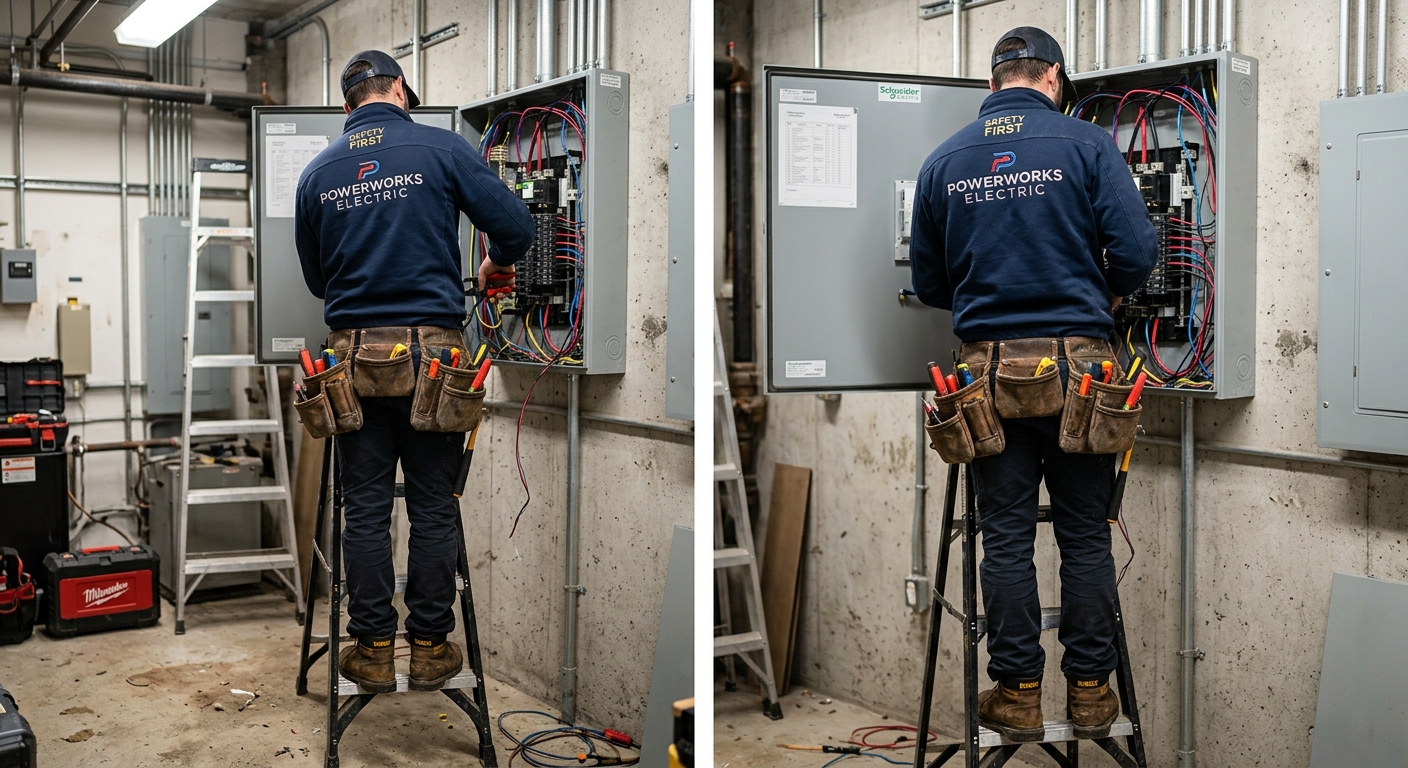
Electrical services and costs in Stittsville
Electrical work in Stittsville usually isn’t “one-size-fits-all,” because many homes in the Ottawa area are older—many built before 1980—so it’s common to see knob-and-tube or legacy wiring methods that need upgrading to match today’s Ontario Electrical Code expectations. In fact, Stittsville’s population was 40,889 in the 2021 Census (Statistics Canada, 2021 Census), and that steady growth means contractors are busiest where owners are adding modern loads like central air, heat pumps, induction cooking, basement renovations, and now EV charging.
Ottawa’s winter conditions also matter. Longer heating seasons push continuous demand higher, so panel capacity reviews are more frequent than you’d see in milder climates. At the same time, material costs and labour availability fluctuate across the Ottawa economic region, so two electricians can quote the “same” panel size change differently depending on whether heavier service conductors, meter-base coordination, or Hydro/utility steps are included. Neighbourhoods with lots of older detached homes—such as parts of Stittsville’s Carp Road and surrounding rural-edge pockets—tend to generate the most service-upgrade and rewiring requests, especially when owners install Level 2 EV chargers or convert basements.
Below is a practical way to compare typical line-items you’ll see on quotes, before you get into the finer details of your load calculation and site access.
| Service |
Why It's Needed |
Permit Required |
Price Range |
| Panel upgrade — 100A to 200A service |
Brings an older, undersized service up to modern load demands (EV, electric heat/heat pumps, kitchen appliances) |
Yes (ESA permit/inspection required) |
$2,500 – $6,000 |
| EV charger installation (Level 2, 40–50A) |
Adds a dedicated circuit and breaker capacity for reliable charging and code-compliant protection |
Yes (new circuit/work beyond minor repairs) |
$900 – $2,500 |
| Knob-and-tube wiring removal and replacement |
Eliminates aging wiring with insulation-contact risks and aligns the home with current safety standards and underwriting expectations |
Yes (rewiring and significant changes) |
$8,000 – $25,000 |
| Aluminum wiring remediation (CO/ALR connectors) |
Improves connection integrity where aluminum branch circuits were installed (commonly pre-1976), using approved remediation methods |
Usually yes (connector-based remediation and verification) |
$3,000 – $10,000 |
| New dedicated circuit (HVAC, appliance, hot tub) |
Prevents nuisance trips and supports high-starting-load equipment with a proper breaker/cable |
Yes (new branch circuit) |
$800 – $3,200 |
| Whole-home rewire (older home, full replacement) |
Modernizes wiring layout, protection, and grounding across the entire house for sale, safety, and future capacity |
Yes (full rewiring requires permits/inspection) |
$12,000 – $35,000 |
Prices are estimates only and vary by project scope, site access and material selection.
What affects the price of electrical work in Stittsville
In Stittsville and the wider Ottawa area, it’s normal to see quotes for the “same” electrical job differ by 30% to 50%. The biggest reasons are the hidden conditions inside walls/attics, how much of the existing system needs correction to meet current code, and whether your electrician includes the full permit-and-inspection workflow plus the utility coordination steps required for a service change. Another major driver is the age of the housing stock: older homes (including those built before 1950) may include knob-and-tube wiring that many insurers won’t cover without remediation, while 1960s–1970s homes often have 60A or 100A service that can’t comfortably handle today’s loads—think EV chargers, electric stoves, heat pumps, and growing electric-heat use. That’s why you’ll often see a panel upgrade band like $2,500 – $6,000 quoted once the electrician confirms your load calculation and available service capacity.
Aluminum branch wiring (commonly 1965–1976) also changes the pricing. It isn’t usually a “replace everything everywhere” situation, but it does require licensed remediation using approved connector methods (CO/ALR) or targeted replacement, which affects labour time and material quantities. On the EV side, the market shift toward Level 2 charging drives permit applications and can push a panel-capacity review into the project scope. A 40A EV charger circuit and a 50A circuit typically require different conductor/breaker sizing, and that can alter cable cost and breaker pricing.
In Stittsville specifically, costs can be lower when the panel is easily accessible and the wiring path is straightforward (finished basement with accessible ceiling bays), and higher when you have steel service conduits, constrained meter-base locations, or knob-and-tube mixed with newer wiring. In winter, scheduling trades around insulation and open walls also affects how long a job takes—more time means more labour, even when the electrical part is straightforward.
| Price Factor |
Why It Matters |
Cost Impact |
| Panel size upgrade — 100A to 200A is the standard minimum today |
Heavier service conductors, larger components, and more permitting/inspection steps |
Often adds the largest single-line cost, commonly aligning with $2,500 – $6,000 |
| Wiring type — copper vs. aluminum remediation vs. K&T removal |
Aluminum requires approved connector remediation or replacement; knob-and-tube often requires more rewiring |
Remediation can be several thousand; K&T removal can shift into the $8,000 – $25,000 band |
| Number of new circuits — each adds material and labour time |
Each dedicated circuit needs cable runs, terminations, and breaker space |
More circuits increases both materials and labour time (often hundreds to thousands per circuit) |
| Permit + ESA/TSBC inspection fee — mandatory for all major work |
Major electrical changes must be permitted and inspected to be code-compliant |
Mandatory overhead that can noticeably affect the final total |
| Labour rate for licensed electricians — journeyman rates in region |
Licensed work is priced by hours, complexity, and responsibility of compliance |
Labour-heavy scopes can swing quotes by 30%+ even when materials are similar |
| EV charger amperage — 40A vs. 50A circuit affects cable and breaker cost |
Higher amperage generally increases conductor/breaker selection requirements |
Can move an EV install within $900 – $2,500 depending on the panel and components |
| Emergency or after-hours premium |
Overtime and scheduling risk increase when repairs can’t wait |
Can add a premium of several hundred dollars or more |
| Load calculation required for service upgrade |
Modern Ontario requirements depend on actual connected load and demand factors |
May add engineering/inspection coordination time; can prevent oversizing or delays |
Permits & regulations in Ontario
In Ontario, ALL electrical work beyond changing a light bulb must be performed by a licensed electrician. That includes panel upgrades, new circuits, rewiring projects, and service changes—whether you’re adding a Level 2 EV charger, replacing failing breakers, or upgrading a 60A/100A service to support modern kitchen, heating, and charging loads. Your electrician is also responsible for pulling the required ESA permit for the work and scheduling the inspection. After the contractor completes the work, an ESA inspector verifies that the installation is code-compliant.
By contrast, many “no-permit” items are limited to truly minor, like replacing a receptacle or fixture where no wiring method changes are involved (your electrician will still confirm what your situation allows). As soon as you’re creating new circuits, altering the panel, changing service conductors/meter base components, or touching grounding/bonding in a significant way, you should expect a permit requirement.
To verify a contractor in Stittsville, start with licensing: confirm their Ontario licence status via the provincial registry/lookup tool and ensure the licence is active for electrical contracting. Next, request a certificate of insurance showing they carry liability coverage, and ask for WSIB/WCB clearance or proof of registration/coverage (required to protect you if a worker is injured). Finally, ask for a signed ESA permit number or documentation trail, and keep the inspection report paperwork after completion.
When your Stittsville home needs an electrical upgrade
Your Stittsville home may need electrical work when the symptoms point to safety-critical issues, not just “old-looking” wiring. First, breakers that trip regularly—especially when you run multiple normal loads—often indicate an overloaded circuit, undersized conductors, loose connections, or a panel that no longer fits your household’s real usage. Second, knob-and-tube wiring is a key concern because the original insulation and contact points can be problematic over time; the issue isn’t only age, it’s how the system performs today with modern loads and underwriting requirements.
Third, check your service size. A 60A or 100A panel can be inadequate for a modern Stittsville home where winter heating demand runs longer and owners add EV charging, heat pumps, or electric stoves. In those cases, a 200A upgrade is commonly the standard solution after a load calculation confirms capacity. Fourth, aluminum wiring (often in pre-1976 construction) may not be “automatically dangerous” if it has been maintained, but it typically requires licensed remediation and verified connections. Fifth, insufficient outlets and the absence of AFCI/GFCI protection where required are often discovered during home sales or after renovation—this is a code-compliance and safety risk, not just inconvenience.
Urgency is important: frequent tripping, burning smells, warm outlets, or damaged wiring calls for immediate action. Service inadequacy and missing safety devices usually justify a planned upgrade, but timelines should align with your renovation schedule to avoid repeated wall openings. As a dollar example, owners sometimes compare adding a single “extra outlet run” against a broader panel/load upgrade; if the real problem is capacity, spending on add-ons can feel cheaper in the short term but may still leave nuisance trips unresolved.
| Warning Sign |
What It Means |
Recommended Action |
Urgency |
Price Band |
| Breakers trip frequently |
Possible overload, loose connections, or undersized/incorrect wiring for current loads |
Inspection + load evaluation; may require new dedicated circuits and/or panel correction |
Immediate if recurring with normal usage |
$800 – $6,000 |
| Knob-and-tube wiring present |
Aging wiring method with increased risk of insulation-related failure and insurance concerns |
Targeted removal and replacement or whole-home rewire depending on extent |
Planned but prioritized for safety/insurability |
$8,000 – $25,000 |
| 60A or 100A panel (inadequate load capacity) |
Likely can’t support modern Stittsville loads simultaneously (winter heat + EV + kitchen) |
Service and panel upgrade (typically to 200A) after load calculation |
Planned soon if adding major loads |
$2,500 – $6,000 |
| Aluminum wiring (pre-1976 construction) |
Connections may require remediation to reduce risk of overheating |
Licensed aluminum remediation using approved connector methods or partial replacement |
Planned (prioritise if connections show heat/discolouration) |
$3,000 – $10,000 |
| Insufficient outlets — extension cords everywhere |
Convenience workaround; can overload circuits and create trip/fire hazards |
Add receptacles and ensure circuits are sized for the intended loads |
Planned |
$150 – $3,200 |
| No AFCI or GFCI protection where required |
Missing modern protection increases risk from arc faults and shock scenarios |
Install/upgrade AFCI/GFCI protection on affected circuits |
Planned but address before sale/major renovations |
$500 – $2,500 |
How to choose a electrical work contractor in Stittsville
Choosing a contractor for electrical work in Stittsville starts with verification. First, confirm Ontario licensing: ask for their Ontario electrical contractor licence details and verify the status using the provincial online registry lookup. Next, request proof of liability insurance (certificate of insurance) so you’re covered if there’s property damage. Then verify WSIB/WCB coverage—ask directly for clearance documentation or proof of registration/coverage, and don’t proceed without it.
Next, get 2–3 itemised written quotes rather than a single lump sum. The best quotes separate labour, materials, and any specialty components (like panel upgrades, AFCI/GFCI devices, approved aluminum connectors, or EV charger-specific parts). Carefully read the scope: ask whether the permit is included, whether ESA inspection scheduling is part of the service, whether disposal of old breakers/wiring is included, and what surfaces restoration costs look like if drywall/ceiling access is opened. A strong warranty should be in writing: workmanship warranty length, whether manufacturer warranties apply to parts, and whether warranties are transferable if you sell the home.
Payment schedule matters. Never pay more than 10–15% upfront; use progress payments tied to milestones and hold back remaining funds until the final inspection is complete and the job is signed off. Also insist on a timeline: a start date and realistic completion estimate in writing, accounting for inspection availability and weather-related access.
- Licence verified for Ontario and contractor name matches the estimate
- Liability insurance certificate provided before work starts
- WSIB/WCB clearance or proof of registration/coverage
- Itemised quote (labour + materials + permits/inspection steps)
- Permit pull explicitly stated (included or add-on)
- Inspection responsibility confirmed (who books ESA visit)
- Scope includes testing and final safety verification (not “rough-in only”)
- Warranty length and terms provided in writing
- EV charger brand/model specified if included
- Panel and breaker sizing documented, including load calculation approach
- Payment schedule with limited upfront deposit and a holdback
- Clear schedule estimate and communication plan for delays
Red flags in Stittsville include: refusing to provide an itemised quote, guessing permit requirements without pulling ESA paperwork, asking for large upfront payments, “no inspection needed” claims, or vague statements like “we’ll just rewire it” without outlining what will be removed/replaced and how old wiring issues (K&T/aluminum) are handled.
Frequently asked questions — electrical work in Stittsville
How do I compare electrical quotes?
Start by comparing apples to apples: ask each contractor for an itemised quote that separates labour, materials, permits/inspection handling, testing, and any specialty components. For service and panel work in Stittsville, ensure the proposal mentions a load calculation approach (especially if you’re adding EV charging or electric heat). Also confirm whether the ESA permit pull is included and whether the electrician will coordinate inspection timing. Price alone can be misleading—quotes that land inside a typical panel upgrade range like $2,500 – $6,000 may still differ materially if one includes heavy service conductors and the other doesn’t. Finally, verify Ontario licensing status and request liability insurance and WSIB/WCB coverage before you decide.
How long does a panel upgrade take in Stittsville?
In Stittsville, a standard panel upgrade (for example, a 100A to 200A service change) often takes about one full working day for the electrical portion, assuming parts are on hand and access is straightforward. However, the total timeline from start to finish is typically longer because ESA inspection scheduling and utility coordination can add days. If your job includes panel relocation, meter-base coordination, or extensive wiring corrections (like aluminum remediation touchpoints), expect more time. Weather and site access also matter in Ottawa’s winter; if walls are opened, drying/restoration logistics can influence completion. Ask your electrician for a written schedule and whether the quote includes permit handling and inspection follow-up.
What is a GFCI outlet and where is it required in Ontario?
A GFCI (Ground-Fault Circuit Interrupter) outlet is designed to shut power off quickly if it detects an unsafe ground-fault condition, reducing shock risk. In Ontario homes, GFCI protection is required in specific locations where shock risk is higher—commonly in areas like bathrooms and kitchens near sinks, garages, basements, and outdoor receptacles. Exact circuit coverage depends on the installation and where the receptacles are located, so a licensed electrician should evaluate your existing circuit arrangement. If your Stittsville home lacks modern protection where required, it’s often addressed during renovations or safety upgrades. While the typical “upgrade” work can be modest compared to service changes, it still requires proper permitting/testing and can be a necessary step during sale preparations.
How do I know if my Stittsville home has aluminum wiring?
You can’t reliably identify aluminum wiring just by looking at the wall the way you might spot a different paint colour. The most dependable approach is to have a licensed electrician inspect the panel and receptacle boxes and verify conductor markings. Many aluminum conductors are labelled “CU-AL” (or similar) and may show distinctive stamping, but markings can be hidden or worn over time. If you’re seeing symptoms like loose/overheated connections in older homes—especially those built between roughly 1965 and 1976—aluminum becomes more likely. In Stittsville, the practical next step is a professional assessment and, if required, licensed remediation with approved CO/ALR methods (or targeted replacement). This is one reason quotes can vary: aluminum remediation can be several thousand dollars depending on how extensive the affected connections are.
What is the cost of rewiring a house in Stittsville?
Rewiring costs in Stittsville vary widely based on how much of the home needs replacement, whether you’re removing knob-and-tube, and how accessible the existing wiring is. For many older-home projects, electricians commonly quote full rewires in the broader range of $8,000 – $25,000 for wiring and rewiring scopes, with whole-home replacement often trending higher depending on number of rooms, panel changes, and how much drywall/opening work is required. If you have knob-and-tube only in certain sections, targeted removal may come in lower than a full rewire. Your electrician should also include permitting/inspection steps and any AFCI/GFCI upgrades required by current code during modernization.
What electrical upgrades are required when selling a home in Ontario?
Ontario doesn’t automatically require a “mandatory electrical upgrade list” for every sale, but required conditions often come to light during home inspections and negotiations. Commonly, missing or outdated safety protection (such as GFCI/AFCI where required), evidence of unsafe or severely deteriorated wiring, and lack of proper permits for major electrical work can trigger issues. For older Ottawa-area homes, a big practical factor is the presence of knob-and-tube wiring or problematic aluminum connections, which can cause underwriting or inspection problems. If you’re adding loads (like EV charging) before selling, service capacity and permitted circuit additions may also need to be addressed. In many cases, buyers expect the work to be code-compliant and inspected by ESA—so planning upgrades early helps you avoid last-minute, higher-cost emergency scheduling.