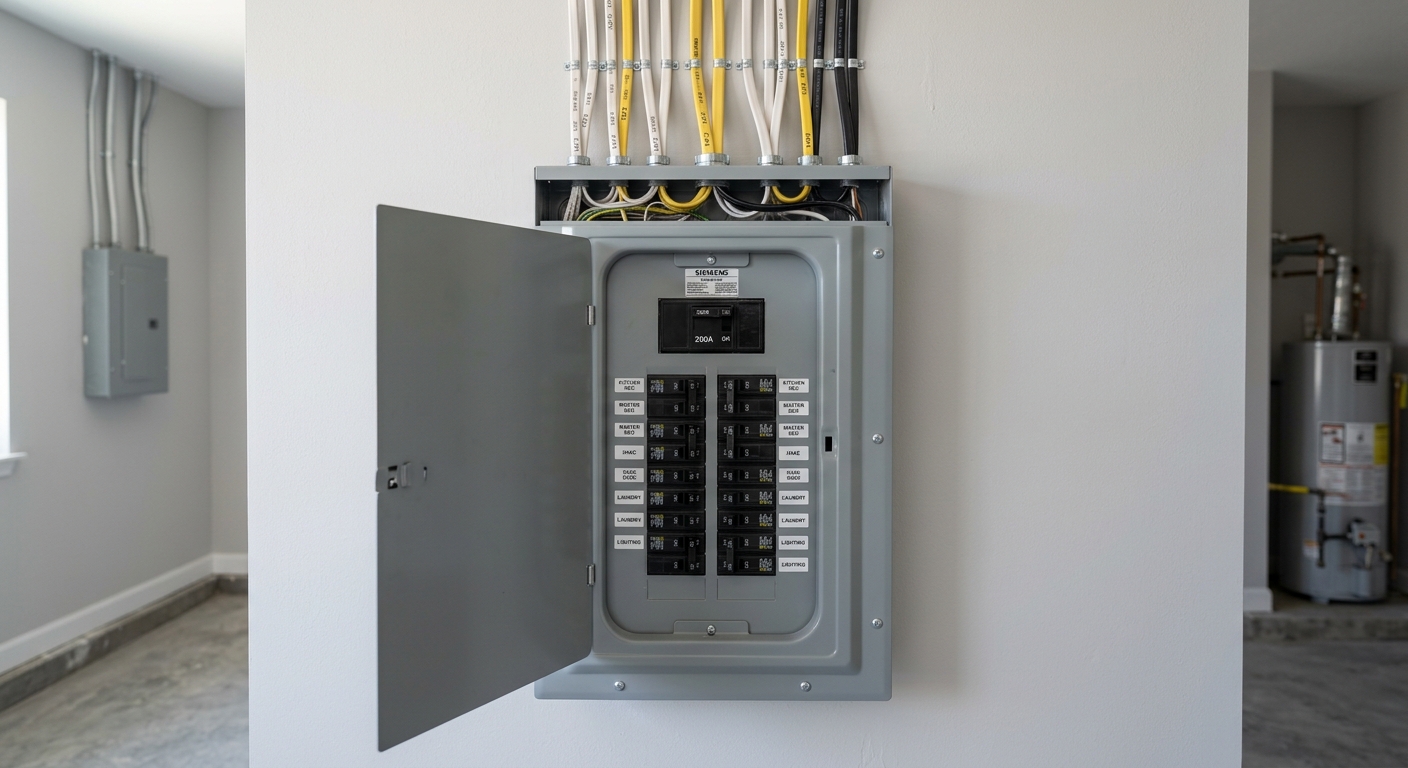
Electrical services and costs in Ottawa
In Ottawa, electrical upgrades are a steady part of homeownership, especially in areas with older housing stock. With 44.2% of local homes built before 1981, many owners are dealing with aged wiring and undersized capacity well before “routine” maintenance would normally be the driver. At the same time, homeowner households make up 260,220 in the Ottawa area (63.9% of households own) (Statistics Canada, 2021 Census), which supports an active market for licensed electricians and repeat upgrades.
Ottawa’s winter conditions also matter. Cold snaps don’t “create” electrical problems, but they increase the chance that your load becomes truly continuous—think space heating (even with heat pumps), basement finishes, dehumidifiers, and the laundry/oven use patterns that cluster indoors. That’s one reason panel and service upgrades often become urgent when EV adoption ramps up in the neighbourhoods where commuting is common. In places like Riverside South, Barrhaven, and parts of Orléans, contractors see more full-capacity jobs because homeowners add central air, larger kitchens, and Level 2 charging as their household needs grow.
For many clients, the project starts as one issue—tripping breakers, an EV plan, or a failing receptacle—then expands into a capacity review. Once we factor in Hydro/utility coordination, ESA permit requirements, and the materials for a modern breaker panel, the cost ranges below help you compare options realistically before you book a site visit.
| Service |
Why It's Needed |
Permit Required |
Price Range |
| Panel upgrade — 100A to 200A service |
Modern loads (EV chargers, heat pumps, induction/range, larger basement electrical) often require more breaker space and higher service capacity. |
Yes (permit + ESA inspection) |
$2,500–$6,000 |
| EV charger installation (Level 2, 40–50A) |
Adds dedicated charging circuit with proper breaker, cable sizing, and load/permit review for safe continuous operation. |
Yes (permit + ESA inspection) |
$900–$2,500 |
| Knob-and-tube wiring removal and replacement |
Replace aging wiring methods that can have damaged insulation and connection failures; improves safety and insurability outcomes. |
Yes (rewiring + ESA inspection) |
$8,000–$25,000 |
| Aluminum wiring remediation (CO/ALR connectors) |
Pre-1976 aluminum branch circuits may need approved remediation or partial replacement to address connection overheating risk. |
Yes (permit + ESA inspection) |
$3,500–$10,000 |
| New dedicated circuit (HVAC, appliance, hot tub) |
Reduces nuisance trips and supports higher-demand loads with correct breaker type and conductor sizing. |
Yes (new circuits require permit + ESA inspection) |
$1,200–$5,000 |
| Whole-home rewire (older home, full replacement) |
When multiple rooms, circuits, and devices are beyond safe repair, a full replacement restores modern safety and code compliance. |
Yes (permit + ESA inspection) |
$12,000–$35,000 |
Prices are estimates only and vary by project scope, site access and material selection.
What affects the price of electrical work in Ottawa
In Ottawa and across Ontario, quotes for the “same” electrical job can swing by 30–50% because the real scope often reveals itself only after a site visit. The dominant driver is the age and type of wiring and service equipment. Many Ottawa homes have older electrical systems, and if a property built in the 1960s–70s has a 60A or 100A service, it may be inadequate once you add today’s continuous loads—especially EV charging and electric cooking. Homes built before 1950 can also have knob-and-tube wiring, where risks are tied to the condition of insulation and connections, not just how long it has existed. Some insurers are more cautious about these systems, which can push projects from “later” to “now.”
Aluminum branch circuits (commonly associated with builds in the 1965–1976 window) add another cost layer because remediation must be done with approved approaches such as CO/ALR connectors—or with replacement where conditions are poor. Meanwhile, EV adoption in the Ottawa area is increasing Level 2 permit applications, which means more time spent on load review, circuit design, and coordination. Even within a fixed “band,” those details change cable runs, breaker type, and labour hours.
Concrete local examples: a service upgrade in a detached home with easy access to the meter base and panel usually lands closer to the lower end of the $2,500–$6,000 range, while a job with hard-to-reach routing behind finishes can push toward the top. If an EV charger install can tap an existing panel location efficiently, it may stay near the $900–$2,500 band; if it requires a new feeder, panel work, or panel capacity upgrades first, the budget needs to reflect that staged approach.
| Price Factor |
Why It Matters |
Cost Impact |
| Panel size upgrade — 100A to 200A is the standard minimum today |
Higher service capacity and more breaker space for modern appliances and charging. |
Often +$2,500–$6,000 depending on utility coordination and materials |
| Wiring type — copper vs. aluminum remediation vs. K&T removal |
Aluminum and knob-and-tube require specialized remediation or replacement and careful inspection. |
Can add thousands; K&T and full rewires commonly exceed $8,000 |
| Number of new circuits — each adds material and labour time |
Each circuit means added conductors, breakers, devices, and wiring labour. |
Multi-circuit projects can escalate quickly within $1,200–$25,000+ bands |
| Permit + ESA/TSBC inspection fee — mandatory for all major work |
ESA inspections ensure the installation meets Ontario Electrical Safety requirements. |
Non-optional cost component on upgrades and new circuits |
| Labour rate for licensed electricians — journeyman rates in Ottawa region |
Ottawa labour costs include on-site time for diagnostics, wiring, and documentation. |
Typically a significant portion of the total, especially for rewiring |
| EV charger amperage — 40A vs. 50A circuit affects cable and breaker cost |
Higher amperage can require larger conductors and breaker selection; impacts continuous-duty design. |
May shift EV charger installs upward within the $900–$2,500 band |
| Emergency or after-hours premium |
Scheduling urgency increases overtime or call-out labour. |
Can add a noticeable percentage to labour |
| Load calculation required for service upgrade |
Determines correct service size and ensures the panel configuration is code-compliant. |
May add diagnostic time; prevents under-sizing and rework |
Permits & regulations in Ontario
In Ontario, electrical work beyond changing a light bulb must be completed by a licensed electrician. For Ottawa homeowners, that means permitting and inspections aren’t optional when you’re doing anything that affects circuits, panels, wiring methods, or service equipment. In practice, the following work typically does require a permit in Ontario: panel upgrades and breaker changes that involve new equipment, new dedicated circuits (including EV charger circuits), rewiring that replaces conductors and devices, and any service upgrade (for example, 100A to 200A). You generally also need a permit when you’re adding or moving outlet circuits, replacing concealed wiring, or making changes that could affect load or overcurrent protection.
What usually does not require a permit: swapping a fixture or receptacle faceplate when the wiring connection method remains unchanged and the device is compatible with the existing circuit. Even then, if you discover a safety issue (damaged wiring, improper grounding, or unsafe splicing), the correct path is to stop and have the electrician address it under the proper permit.
How to verify before you hire: (1) confirm the contractor is licensed with the Ontario registry for the applicable licence class; (2) request a certificate of liability insurance and verify it’s current; (3) ask for WSIB clearance (or applicable WCB coverage) documentation; and (4) look for a letter of clearance/coverage status and match the name of the licensed company on the documentation. If they can’t provide these up front, that’s a red flag—especially for ESA-inspected work like a panel change or EV installation.
When your Ottawa home needs an electrical upgrade
Ottawa homes often show electrical “warning signs” that are less about aesthetics and more about safety and code compliance. First, breakers that trip regularly can indicate an overloaded circuit, failing components, or an undersized panel layout for today’s load profile. Second, if you have knob-and-tube wiring, the key concern is the condition of insulation and connections; it’s not just “old,” it can be a problem for both safety and insurability. Third, a 60A or 100A panel may be inadequate when you combine modern appliances—especially if you plan for an EV charger, run a heat pump system during winter, and cook with a high-demand electric range. In Ottawa, it’s common for homeowners to move to a 200A upgrade as the standard long-term solution.
Fourth, aluminum wiring (often seen in pre-1976 construction) isn’t always immediately dangerous if connections were maintained, but it does require licensed remediation with approved methods. Fifth, insufficient outlets and extension cords everywhere usually points to circuit capacity limits and unsafe usage patterns. Sixth, missing AFCI/GFCI protection where required can surface at home sales or inspections, and it’s often cheaper to address before finishes are fully redeveloped.
Which signs need immediate action? Frequent tripping, burning smells, discoloration at receptacles, and evidence of overheating should be treated as urgent. Knob-and-tube and aluminum typically warrant a planned upgrade soon—because remediation is best scheduled before major renovations or sale timelines. As a simple pricing example, if a 200A upgrade is necessary for safe EV charging, planning that alongside the charger can avoid duplicative labour; choosing “just an extra outlet” without a load review often costs more later because panel capacity still limits what you can add.
| Warning Sign |
What It Means |
Recommended Action |
Urgency |
Price Band |
| Breakers trip frequently |
Possible overload, faulty breaker, or undersized/incorrectly protected circuits. |
Diagnostic load test and circuit inspection; add dedicated circuits or upgrade panel as needed. |
Urgent (schedule promptly) |
$1,200–$6,000 |
| Knob-and-tube wiring present |
Older wiring method with insulation/connection concerns; often affects insurability and safety. |
Plan K&T removal and replacement in affected areas (or full rewire if widespread). |
Urgent to planned |
$8,000–$25,000 |
| 60A or 100A panel (inadequate load capacity) |
May not support EV charging, heat pumps, and modern kitchen loads without excessive limits. |
Electrical load calculation and service upgrade to 200A with updated panel layout. |
Planned (but sooner if adding EV) |
$2,500–$6,000 |
| Aluminum wiring (pre-1976 construction) |
Connection overheating risk if not remediated correctly; needs approved methods. |
Remediate using approved CO/ALR connectors and/or replace sections in poor condition. |
Planned |
$3,500–$10,000 |
| Insufficient outlets — extension cords everywhere |
Unsafe temporary wiring practices and a likely overload risk on a limited number of circuits. |
Add new receptacle circuits; correct spacing and GFCI/AFCI compliance where required. |
Planned (stop using extension cords for permanent needs) |
$1,200–$5,000 |
| No AFCI or GFCI protection where required |
Higher risk of arc faults and shock; can block sale/inspection outcomes. |
Upgrade to code-compliant protection (new breakers or receptacles as appropriate). |
Planned |
$150–$800 |
How to choose a electrical work contractor in Ottawa
Choosing the right electrician in Ottawa starts with verification. First, confirm they’re licensed in Ontario for the type of work being quoted (panel changes, rewiring, and EV circuits are not homeowner DIY territory). Ask for a certificate of liability insurance and read the expiry date—coverage should match the company doing the work on site. Second, request WSIB/WCB documentation and a clearance letter (or the applicable proof of coverage). This protects you if a worker is injured while working on your property. If they can’t provide these items, don’t proceed.
Next, get 2–3 itemised written quotes. A good quote breaks down labour and materials separately, identifies the specific devices (panel, breakers, connectors, charger model), and states what’s included. Watch for exclusions: permit pulling, disposal of old materials, drywall patching, and any Hydro coordination are common “scope surprises.” For major work, you should see ESA permit/inspection referenced explicitly. Also ask about warranty—typically a workmanship warranty period plus the manufacturer warranty for products. Clarify whether the warranty is transferable if you sell the home.
For payment, never pay more than 10–15% upfront. Use a payment schedule tied to milestones, with a holdback until the job is complete and inspected (where required). Finally, request a start date and completion timeline in writing, and make sure the contractor explains what conditions could affect schedule, such as access limitations or utility timelines.
- Licence verification number shown on the quote and invoice
- Current certificate of liability insurance provided before work starts
- WSIB/WCB coverage proof and clearance documentation
- Itemised quote with labour vs. materials line items
- Permit pulling explicitly included or clearly excluded
- Disposal and recycling of removed panel/wiring materials clarified
- Scope includes load calculation when upgrading service size
- A circuit map or panel schedule included for panel work
- Workmanship warranty length stated in writing
- Manufacturer warranty terms and whether they’re transferable
- Payment schedule with 10–15% maximum upfront and a holdback
- Written start and completion dates with allowances for delays
In Ottawa, red flags include: quoting a panel or EV job as a “fixed price” without an on-site inspection, refusing to mention ESA permits/inspections, giving vague answers about aluminium/knob-and-tube remediation standards, asking for most payment up front, or providing no written scope and no warranty terms.
Frequently asked questions — electrical work in Ottawa
Do I need to upgrade to a 200A panel?
Not every home needs 200A, but many Ottawa houses do once you’re adding modern loads. The deciding factor is a load calculation plus what you already have: EV charging plans, electric ranges, heat pumps, hot tubs, finished basements, and central A/C can push a 60A or 100A system past its practical limits. If your home is in the older housing stock category (Ottawa has a large share of pre-1981 homes), it’s also common to discover outdated wiring or limited breaker space when the electrician opens the panel. In those cases, a 200A upgrade often becomes the safer long-term solution rather than trying to “work around” capacity. Pricing commonly sits in the $2,500–$6,000 range for panel/service upgrades, depending on access and utility coordination in your neighbourhood.
How much does an EV charger installation cost in Ottawa?
For Ottawa homeowners, a typical Level 2 EV charger installation (often a 40A or 50A circuit) commonly falls within the $900–$2,500 band. Your actual cost depends on whether the charger can use nearby panel capacity, the distance to the routing path, and whether you need additional panel work first. If the panel is undersized (for example, no realistic capacity for another high-load circuit) you may need a service/panel upgrade, which can add to the total. Permit and ESA inspection are part of the normal process for new EV circuits in Ontario, and that paperwork time is reflected in the quote. If you’re planning an EV and your home is older, it’s smart to budget for a capacity review early so you don’t pay for a charger install and then have to redo panel work later.
What is knob-and-tube wiring and should I replace it?
Knob-and-tube wiring is an older wiring method where conductors are supported on ceramic knobs and routed through building cavities. The main concern isn’t simply that it’s old; it’s the condition of insulation and connections over time, which can become unsafe. In Ottawa and across Ontario, insurers and home buyers often view knob-and-tube negatively, and from a safety standpoint it’s difficult to “spot-fix” when multiple sections age differently. In many cases, electricians recommend targeted replacement where wiring is accessible and faulty, or a larger scope replacement if it’s widespread. Cost varies widely depending on how many circuits are involved; when it’s a true removal and replacement job, budgets often align with the $8,000–$25,000 range. Because this is permit work in Ontario, get a licensed contractor to assess and document the condition before you plan renovations or list the home.
Is aluminum wiring safe in older Ottawa homes?
Aluminum wiring isn’t automatically “dangerous,” but it does require the right type of remediation and properly made connections. In older Ottawa homes—especially those built in the era when aluminum branch circuits were common—connection issues can contribute to overheating if the original devices weren’t installed using approved methods. That’s why the modern approach usually involves a licensed electrician assessing terminations and then performing remediation with approved CO/ALR connectors or replacing portions where connections are in poor condition. The goal is to restore safe contact quality and ensure Ontario code compliance at the points where current is transferred. If you suspect aluminum wiring, don’t just change a receptacle; have the contractor identify the wiring type and evaluate the condition. Remediation projects often fall in the $3,500–$10,000 range depending on how extensive the work is.
Do I need a permit for electrical work in Ontario?
In Ontario, most electrical work beyond basic like-for-like fixture swaps requires a permit and inspection by the Electrical Safety Authority (ESA). Panel upgrades, new circuits (including EV charger circuits), rewiring, and service upgrades all require permits in the normal course. Even if the work seems “small,” adding a circuit, changing breaker equipment, or modifying concealed wiring typically pushes you into permit territory. DIY electrical is prohibited for most work, and homeowners generally don’t have the same authority to pull permits as licensed electrical contractors. Before work begins in Ottawa, ask the contractor whether the permit is included and confirm that the ESA inspection is scheduled. A reputable licensed contractor can provide licence verification and the documentation you need. This is one reason electrical quotes include not just labour and materials, but also mandatory administrative and inspection steps.
What are signs of an overloaded electrical panel?
Signs of an overloaded panel usually show up as nuisance breaker trips, lights dimming during appliance start-up, warm or discoloured outlets/switches, and the need to rely on extension cords because you can’t add outlets safely. In Ottawa, overload symptoms can be more noticeable in winter because more heating and basement equipment run continuously, while kitchen and laundry cycles stack at home. If you’re seeing frequent tripping, it can indicate either overloaded circuits or an installation that doesn’t match today’s load profile. Another common trigger is planning for an EV charger or adding an electric range or heat pump; if the panel is already limited, adding more load can make trips more likely. When load calculations show insufficient capacity, a service/panel upgrade to 200A is often recommended, with typical costs landing in the $2,500–$6,000 range depending on your site and scope.