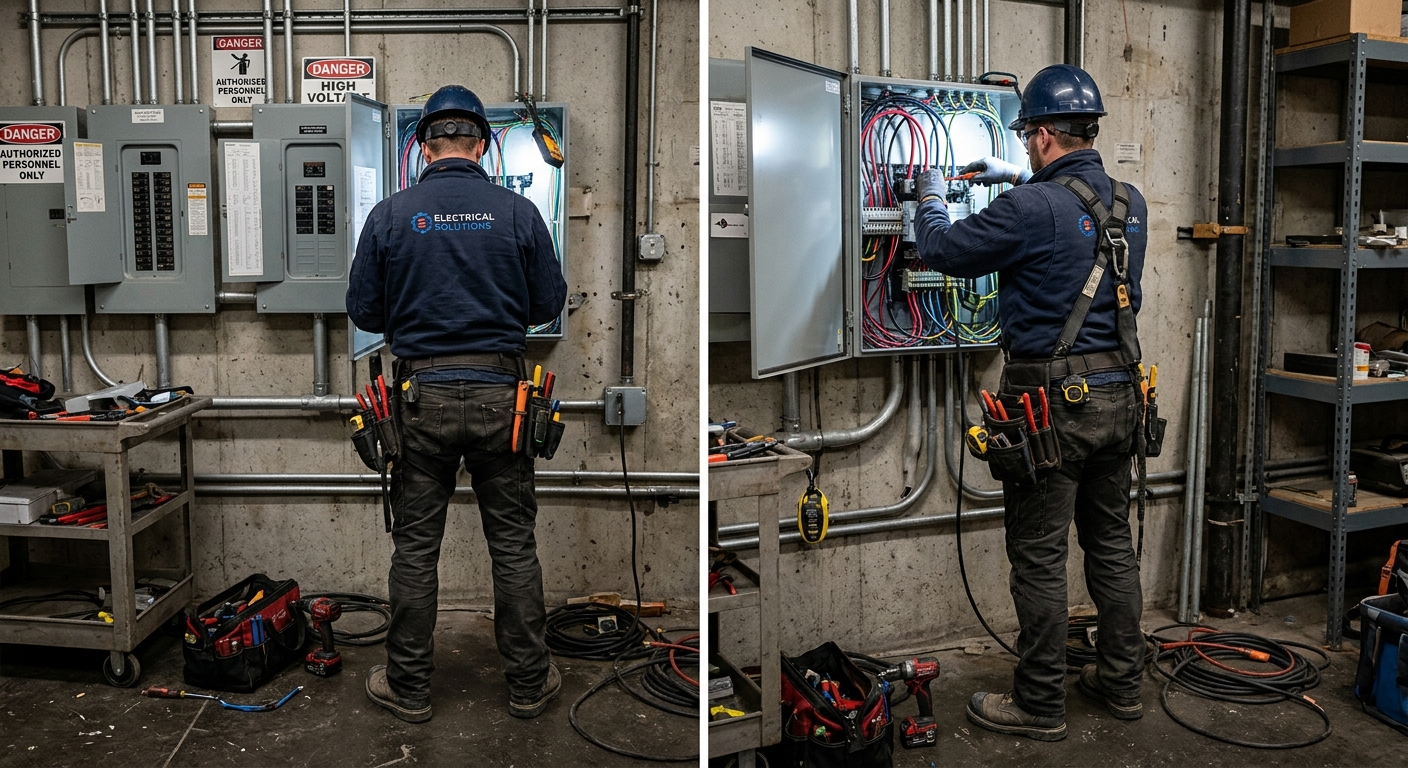
Electrical services and costs in Pickering
Electrical service work in Pickering is in high demand because Toronto’s housing mix blends older, service-limited neighbourhoods with fast-paced infill and renovation activity. With 31.2% of homes in the area built before 1981 (Statistics Canada, 2021 Census), it’s common to find wiring systems and panels that were never designed for today’s loads—heat pumps, EV chargers, induction cooking, finished basements, and home-office electronics. That older stock is often paired with knob-and-tube or aluminum branch wiring, which can’t reliably handle modern continuous loads without remediation or partial/whole-house replacement.
Pricing also reflects the GTA’s labour market and job complexity. Contractors in the Toronto economic region routinely see higher call volumes and short lead times, and electricians are often booked around permit inspection windows through the Electrical Safety Authority (ESA). Toronto-area weather contributes indirectly: cold snaps increase HVAC and supplemental heating demand, and in homes with older panels, that extra draw can push an already-full electrical system into nuisance tripping. The result is a higher frequency of panel/service upgrades, load calculations, and additional circuit work.
In Pickering’s older pockets—especially around Bay Ridges and the established sections near Highway 2—many homeowners are upgrading from 60A or 100A services toward 200A when they add an EV charger or complete a basement. If you’re comparing quotes, the price differences usually come down to how much wiring remediation is needed and whether a service upgrade and load study are included. Use the ranges below as a practical starting point for budgeting.
| Service |
Why It's Needed |
Permit Required |
Price Range |
| Panel upgrade — 100A to 200A service |
Modern homes often need more capacity for A/C, heat pumps, EV charging, and added circuits; older 60A/100A services can be overloaded. |
Yes |
$2,500–$6,000 |
| EV charger installation (Level 2, 40–50A) |
Provides safe, code-compliant charging with the correct breaker, cable size, and back-of-panel capacity. |
Yes |
$900–$2,500 |
| Knob-and-tube wiring removal and replacement |
Knob-and-tube insulation ages poorly; replacement reduces fire risk and improves insurability and code compliance. |
Yes |
$3,000–$15,000 |
| Aluminum wiring remediation (CO/ALR connectors) |
Aluminum branch wiring may require approved connectors and inspection because terminations and device connections can overheat over time. |
Yes |
$3,000–$10,000 |
| New dedicated circuit (HVAC, appliance, hot tub) |
Dedicated wiring prevents nuisance tripping and supports manufacturer requirements for high draw equipment. |
Typically yes (new circuit/breaker) |
$300–$2,500 |
| Whole-home rewire (older home, full replacement) |
When wiring throughout is aging, unsafe, or incompatible with modern loads, a full replacement is the most durable solution. |
Yes |
$8,000–$20,000 |
Prices are estimates only and vary by project scope, site access and material selection.
What affects the price of electrical work in Pickering
In Pickering and the wider Toronto economic region, you can easily see quote differences of 30–50% for what sounds like the same electrical job. The biggest reason is that “the same task” often uncovers different hidden conditions: existing wiring condition, panel condition, cable routing, and whether a load calculation or service upgrade is required. Toronto-area market demand also affects scheduling and overhead; when contractors are booked solid around inspection dates, labour time and project logistics become more expensive.
Housing age is the dominant cost driver. In homes built before 1950, knob-and-tube (and older open splices) may be present, and insurance requirements can push remediation earlier than expected. In many homes from the 1960s–70s, older panels (often 60A or 100A) and aluminum branch wiring (frequent in homes built in that era) limit how much equipment you can add safely. Aluminum remediation usually requires licensed workmanship and approved CO/ALR connectors; in more extensive cases, full replacement may be the safer path. EV adoption is another cost accelerant in the region: Level 2 charger permit applications have risen, and many installs require additional amperage headroom plus correct circuit protection.
Concrete local examples: a 200A panel upgrade in a straightforward basement-finish scenario can land in the $2,500–$6,000 band, but if the service conductors need major remediation or service relocation/trenching is required, budgets often stretch toward higher-end outcomes in the $6,000+ range. Similarly, a connector-based aluminum fix may stay near lower wiring ranges when only terminations are involved, but when large sections require replacement, wiring budgets commonly move toward the $3,000–$15,000 band.
Seasonality matters, too: during cold snaps, A/C and supplemental heating loads reveal whether a panel and feeder are truly sized for today’s use—sometimes forcing a service upgrade sooner rather than later.
| Price Factor |
Why It Matters |
Cost Impact |
| Panel size upgrade — 100A to 200A is the standard minimum today |
Newer loads (heat pumps, EV, kitchen appliances) require capacity and proper load distribution. |
Often the largest single line item (commonly tied to the $2,500–$6,000 band) |
| Wiring type — copper vs. aluminum remediation vs. K&T removal |
Aluminum terminations need approved connectors; knob-and-tube removal is more labour-intensive. |
Can shift from manageable fixes to $3,000–$15,000 wiring outcomes |
| Number of new circuits — each adds material and labour time |
Each circuit needs breaker, cable, routing time, and often wall/finishing patching. |
Typically adds hundreds to a few thousand per circuit |
| Permit + ESA/TSBC inspection fee — mandatory for all major work |
Major electrical work must be permitted and inspected before energization. |
Often $200–$500 depending on scope |
| Labour rate for licensed electricians — journeyman rates in {region} |
Complex routing and troubleshooting increase hours; GTA demand influences availability. |
Commonly around $90–$120/hour in this region |
| EV charger amperage — 40A vs. 50A circuit affects cable and breaker cost |
Higher amperage may require larger conductors, breaker selection, and more capacity planning. |
Can move EV installs within the $900–$2,500 band |
| Emergency or after-hours premium |
After-hours callouts cost more and often reduce scheduling flexibility. |
Can add a noticeable premium (often several hundred dollars) |
| Load calculation required for service upgrade |
Ensures the upgraded service can safely supply present and future loads. |
May add assessment time; avoids rework and future overload risk |
Permits & regulations in Ontario
In Ontario, ALL electrical work beyond changing a light bulb must be completed by a licensed electrician. That includes panel upgrades (100A to 200A), new circuits, rewiring, and service-related changes—plus EV charger installations, because they require a new breaker/circuit and must be inspected. In Pickering, you should plan on permits for major work, and the permitted work must pass inspection through the Electrical Safety Authority (ESA) before it’s safe to energize and close out. DIY electrical is prohibited for most work; homeowner “exceptions” are narrow and still generally depend on permits/inspection for anything more than limited, predefined tasks.
What typically DOES require a permit: adding or replacing a breaker and circuit, running new cable for a dedicated appliance circuit, rewiring any part of a wall circuit, replacing a panel, upgrading service conductors, and installing a Level 2 EV charger. What typically does NOT require a permit: changing a receptacle or switch that does not involve rewiring (only in very limited scenarios and still subject to electrical rules), and replacing fixtures where connections remain within the existing approved wiring arrangement. Because the line can be blurry, the safest approach is to ask your electrician what is “permit-required” in your exact scope.
To verify a contractor for Pickering projects: (1) check their Ontario licence number in the provincial online registry; (2) request a current certificate of insurance (liability coverage) and confirm it matches the project scope; and (3) confirm WSIB/WCB coverage where applicable. A reputable electrician can also provide evidence of clearance and documentation related to ESA permit submissions.
When your Pickering home needs an electrical upgrade
Pickering homeowners typically notice electrical issues in ways that are safety-critical—not just inconvenient. Frequent breaker trips are the first warning sign: they often indicate an overloaded panel, undersized circuits, or a problem with a breaker or connection. If tripping happens when running the kitchen, laundry, heat, and a charger all around the same time, it’s a strong signal your service and branch circuits are under strain.
Knob-and-tube wiring is another major concern. The issue isn’t simply that it’s old; it’s the risk from deteriorating insulation and junctions that may not meet modern code expectations. If knob-and-tube is present, treat it as an upgrade priority because it can affect insurance and safety compliance.
Service size matters in the Toronto climate, where winter heating loads can raise demand. A 60A or 100A panel may not be adequate once you add an EV charger, heat pump equipment, and modern kitchen appliances. For many families, a 200A upgrade is the standard solution when planned additions are involved.
Aluminum wiring in pre-1976 construction often isn’t an automatic “immediate emergency” if it has been properly terminated and monitored, but it does require licensed remediation—especially at devices and junctions—using approved methods like CO/ALR connectors. Also watch for insufficient outlets (extension cords everywhere) and missing AFCI/GFCI protection where required; those issues often surface during home sales and can create safety and compliance gaps.
As a dollar example: if a dedicated circuit plus EV work can stay near the $900–$2,500 band, but your panel is only 100A and you need additional capacity, the added scope quickly moves into the $2,500–$6,000 panel upgrade band. The goal is to avoid paying for “temporary fixes” that can’t support future load.
| Warning Sign |
What It Means |
Recommended Action |
Urgency |
| Breakers trip frequently |
Often indicates overload, failing breaker, or unsafe/undersized circuit behaviour. |
Electrical diagnostic + load assessment; consider panel/circuit upgrades |
Immediate to urgent (stop repeated reset attempts) |
| Knob-and-tube wiring present |
Older insulation and junction methods can increase overheating and connection risk. |
Plan K&T removal/replacement and bring circuits to modern standards |
High priority (plan as soon as feasible) |
| 60A or 100A panel (inadequate load capacity) |
Likely insufficient headroom for today’s loads during peak seasons. |
100A to 200A service upgrade with load calculation |
Urgent before major new loads (EV/heat pump) |
| Aluminum wiring (pre-1976 construction) |
Device terminations and splices may be prone to overheating without proper methods. |
Licensed aluminum remediation (CO/ALR connectors) or targeted replacement |
Planned upgrade (sooner if issues are overheating or damaged) |
| Insufficient outlets — extension cords everywhere |
Overuse of temporary power can overload circuits and create trip hazards. |
Add dedicated circuits/receptacles; remove reliance on extension cords |
Moderate urgency (address before summer/winter load spikes) |
| No AFCI or GFCI protection where required |
Older installations may not include modern protection for arc-fault and shock hazards. |
Upgrade affected circuits with code-compliant protection |
Planned upgrade (becomes urgent before selling/renovating) |
How to choose a electrical work contractor in Pickering
Choosing an electrician in Pickering is mostly about verification and clarity. Start with Ontario licensing: ask for their licence number and verify it in the provincial licensing registry before work begins. Next, request a current certificate of liability insurance—this protects you if there’s property damage or an accident on site. Confirm WSIB/WCB coverage where required so you’re not left holding the risk if a worker is injured. A contractor who can’t provide documentation promptly usually isn’t the right choice for panel or rewiring jobs.
Then get 2–3 itemised written quotes. You want line items that separate labour hours, materials (panel components, breakers, cable type, connectors), permit/inspection handling, and any testing/diagnostics. Avoid “lump sum only” quotes for major work; pick one scope and one site assumption, and ensure each quote includes the same tasks. Carefully read the exclusions: ask whether permit pulling is included, whether disposal/dust protection is included, and whether patching and finishing coordination is separate.
Warranty matters. Confirm workmanship warranty length (and what it covers), product/manufacturer warranties, and whether warranties transfer if you sell your home. For payment scheduling, keep it conservative: never pay more than 10–15% upfront, and use a holdback until the job is complete and inspected. Finally, insist on a written start date and completion estimate—electrical projects often depend on ESA scheduling, so timelines should be realistic.
- Confirm Ontario licence number before signing
- Request proof of liability insurance (and confirm policy expiry)
- Verify WSIB/WCB coverage
- Get itemised quotes with labour + materials breakdown
- Ask if ESA permit pulling and inspection booking are included
- Clarify scope: what’s excluded (trenching, drywall patching, disposal)
- Require load calculation when upgrading service capacity
- Ask what wiring remediation method they’ll use for aluminum (approved CO/ALR vs replacement)
- Confirm AFCI/GFCI strategy for the circuits being upgraded
- Check warranty terms for workmanship and equipment
- Set a payment schedule with a 10–15% max deposit
- Get the permit/inspection responsibility and document handoff in writing
Red flags in Pickering: (1) they refuse to provide a licence number or insurance certificate; (2) they quote without a site visit for panel/service or knob-and-tube work; (3) they offer “no permit needed” for a new breaker/circuit or EV charger; (4) they won’t detail how they’ll handle aluminum termination methods; and (5) they ask for large deposits before any materials are ordered or paperwork is submitted.
Frequently asked questions — electrical work in Pickering
Is aluminum wiring safe in older Pickering homes?
Aluminum wiring can be safe when it’s installed and terminated correctly, but it requires a licensed electrician to assess the condition and make proper repairs. In Pickering (with a substantial share of older homes), aluminum branch wiring is most commonly associated with homes from the mid-1960s through the 1970s, and the main concern is overheating at devices and connections if improper materials or methods were used. A common remediation approach is to use approved CO/ALR connectors at splices and device terminations, then document the work for inspection. If you’re seeing discoloration, frequent nuisance issues, or damaged outlets, prioritize remediation rather than leaving it. If your electrician determines it’s beyond safe correction, targeted replacement or full rewire may be necessary. Budget varies widely, but remediation projects often land within the $3,000–$10,000 range depending on how much cable/termination work is involved.
Do I need a permit for electrical work in Ontario?
In Ontario, most electrical work beyond basic fixture changes requires a permit and inspection. Panel upgrades (for example, upgrading from 100A to 200A), new circuits, rewiring, service upgrades, and EV charger installations all require a permit in Pickering through ESA processes, and the completed work must be inspected. The rule isn’t just paperwork—it helps confirm the work meets the Ontario Electrical Code and that the contractor properly tests and labels circuits. If someone tells you a permit is “not needed” for new wiring, a new breaker, or a service change, that’s a serious concern. Ask your electrician to explain what permit is being pulled for your scope and to confirm inspection responsibility. For major work, it’s common to see permit/inspection fees in the $200–$500 range depending on the scope.
What are signs of an overloaded electrical panel?
Overload signs show up as recurring nuisance tripping (especially with simultaneous loads like kitchen + laundry + heating), dimming lights when appliances start, or a feeling that “everything trips when we use multiple things at once.” You may also notice that certain circuits are always near failure or that breakers feel unusually hot after a trip. In Pickering’s real-life winter usage, the extra heating and HVAC demand can expose a panel that has no safe capacity headroom for new additions. Another clue is the panel age: many older homes have 60A or 100A services that were fine decades ago but become limiting once you add EV charging, heat pumps, or induction cooking. When the solution includes capacity, homeowners often budget for a 100A to 200A upgrade, commonly within the $2,500–$6,000 band, plus any required wiring/circuit additions.
Can I do my own electrical work in Ontario?
In Ontario, DIY electrical is very limited. In general, electrical work must be performed by a licensed electrician, and permits/inspections apply to most work that involves new wiring, panels, circuits, or anything related to service capacity. While there are narrow exceptions, they do not usually cover EV charger installs, panel upgrades, rewiring, or adding dedicated circuits for major appliances—those are permit-required and must be inspected. Practically, even if you’re confident, you still have to meet the Ontario Electrical Code and ESA inspection requirements. If you’re tempted to DIY, ask a licensed electrician first what parts, if any, are safe and permitted for homeowner involvement. You’ll also want to confirm how your work would affect liability and insurance. For larger projects, DIY can turn into costly rework and delays once the inspector requires correction.
How long does a rewiring job take?
Whole-home rewiring timelines vary based on the number of rooms, whether the home has open walls (e.g., unfinished basement), accessibility, and whether older hazards like knob-and-tube are being removed. For many Pickering homes built in earlier eras—where older wiring may run through multiple locations—full replacement often takes several weeks including rough-in, finishing coordination, testing, and inspection lead times. Partial rewires (for example, replacing only specific branch circuits) can be faster, but wall access and panel/service coordination still matter. Also remember that permit and ESA inspection scheduling can affect the start/finish dates even if labour hours are steady. If you’re planning work around EV charging or heat pump installation, plan your electrical scope early so the service capacity is ready before mechanical equipment arrives.
Why do my breakers keep tripping?
Breakers that keep tripping typically point to overload, a failing breaker, a connection issue, or a problem appliance/circuit behavior. A common pattern is that the system trips when you use multiple high-draw items at once—like a dryer, kettle, microwave, HVAC, and then an additional load during peak winter. In older Pickering homes, nuisance tripping can also be triggered by worn components or unsafe wiring terminations, including issues in aluminum wiring sections or old device connections. Another cause is inadequate protection: sometimes circuits lack proper AFCI/GFCI coordination, which can lead to repeated trips when modern loads behave differently than older equipment. Start with professional troubleshooting: turn off the affected load(s), note when tripping happens, and have an electrician check the panel capacity and circuit connections. If you need a capacity fix, a panel upgrade (often $2,500–$6,000 for many 100A-to-200A projects) may be the most cost-effective long-term solution.