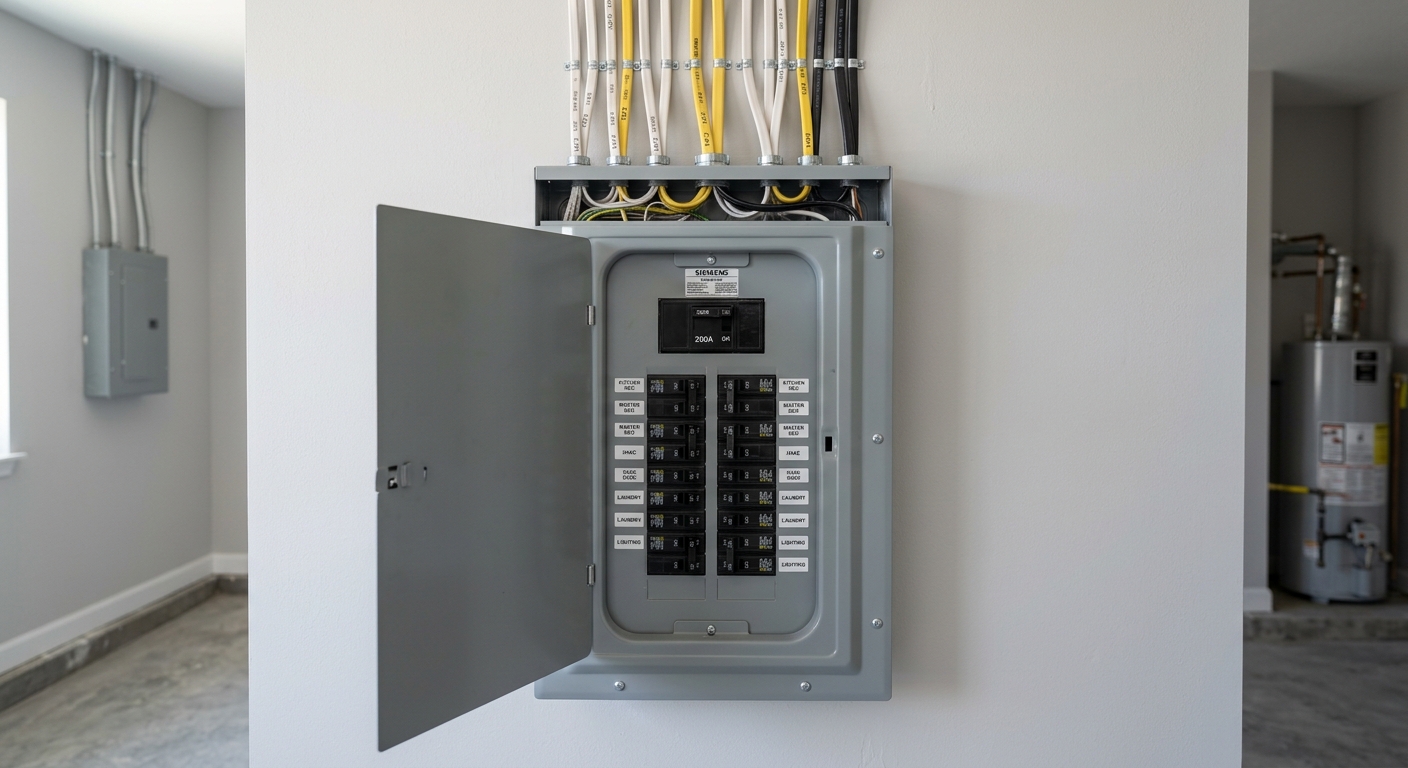
Electrical services and costs in Tecumseh
Tecumseh homeowners often find that electrical service upgrades are less about “new gadgets” and more about keeping older wiring safe with today’s power demands. In Tecumseh, about 40.2% of homes were built before 1981, which means many properties were designed around mid-century loads—not EV charging, modern heat pumps, and larger kitchen/utility appliances. With the population around 23,300, you also get steady contractor availability, but the trades still get busy when multiple neighbours are doing service work at the same time.
Southwestern Ontario’s Windsor–Sarnia corridor has a large stock of mid-century housing, so electrical contractors in Tecumseh commonly deal with knob-and-tube remnants and aluminum branch circuits. Cost is shaped by how much access is needed (finished basements, plaster, or tight service bays), and by coordination with utilities for shut-offs and service changes. In most Tecumseh neighbourhoods—especially where homes were built in earlier eras—panel and service upgrades can be the prerequisite step before adding EV chargers or finished-basement electrical. Weather can also indirectly affect timing: winter cold increases time for outdoor work and temp-sensitive excavation, while spring/fall scheduling often concentrates larger installations.
Below is a practical cost comparison for common electrical upgrades homeowners request in Tecumseh, Ontario, including what typically triggers permits through the ESA and inspections after completion.
| Service |
Why It's Needed |
Permit Required |
Price Range |
| Panel upgrade — 100A to 200A service |
Improves capacity for modern loads (EV charging, heat pumps, electric range) and supports code-compliant breaker spacing and protection. |
Yes (service change/panel replacement) |
$2,500–$6,000 |
| EV charger installation (Level 2, 40–50A) |
Adds a dedicated circuit and breaker for safe, continuous charging; often requires verifying service capacity first. |
Yes (new circuit/permit for charger wiring) |
$1,000–$2,500 |
| Knob-and-tube wiring removal and replacement |
Knob-and-tube wiring is deteriorated and not compatible with modern safety requirements; removing it reduces fire risk and insurance issues. |
Yes (extensive wiring replacement) |
$8,000–$20,000 |
| Aluminum wiring remediation (CO/ALR connectors) |
Improves connection integrity where aluminum branch wiring exists; remediation is typically done with approved connectors and verified terminations. |
Yes (major wiring work) |
$3,000–$9,000 |
| New dedicated circuit (HVAC, appliance, hot tub) |
Adds proper protection and wiring for high-demand equipment, reducing nuisance trips and improving safety. |
Yes (new branch circuit) |
$1,500–$4,500 |
| Whole-home rewire (older home, full replacement) |
Replaces outdated wiring, redesigns circuits for current loads, and can improve safety and resale readiness for homes built before 1981. |
Yes (full rewire) |
$12,000–$30,000 |
Prices are estimates only and vary by project scope, site access and material selection.
What affects the price of electrical work in Tecumseh
In Tecumseh and the wider Windsor–Sarnia area, the same “type” of electrical project can land 30–50% apart because the job isn’t just parts—it’s labour hours, access, and how much work is required to bring the system up to Ontario Electrical Code expectations. For example, a panel upgrade might start as a straightforward 100A-to-200A change, but the quote can rise if the service mast, grounding, wiring routing, or breaker compatibility needs correction before ESA inspection. Conversely, if your home already has modern feeder wiring and clean access to the panel location, costs can stay closer to the lower end of the panel band.
Age of housing stock is the dominant driver. In Tecumseh, 40.2% of homes were built before 1981, so it’s common to encounter older installation practices, including knob-and-tube and mixed wiring generations. Homes built in the mid-century era also show up with 60A or 100A services that can struggle with today’s load profile—EV chargers, heat pumps, heat tracing, induction stoves, and expanded receptacle needs. If your home has aluminum branch circuits (often common in homes from the mid-1960s through the 1970s), remediation with approved CO/ALR connectors requires meticulous workmanship and verified terminations, otherwise the work may shift toward replacement. EV adoption is also increasing permit applications for Level 2 chargers, and those added circuits can push load calculation and service capacity work earlier in the project.
Two local examples: (1) A Tecumseh basement panel move can cost more when walls are finished with drywall and tight joist spacing—labour rises even if the parts are similar. (2) If your EV charger run is short from the panel to the garage, the project may stay nearer the $1,500–$3,500 range for straightforward panel-adjacent work; long conduit runs or a capacity-driven service upgrade can move it toward the upper bands.
| Price Factor |
Why It Matters |
Cost Impact |
| Panel size upgrade — 100A to 200A is the standard minimum today |
More capacity for EVs and modern appliances; often triggers wider code compliance checks. |
Typically adds a major portion of the budget; commonly $2,000–$6,000 |
| Wiring type — copper vs. aluminum remediation vs. K&T removal |
Aluminum needs approved connection methods; knob-and-tube may require targeted removal and rewiring. |
Can shift projects by thousands (remediation vs. replacement) |
| Number of new circuits — each adds material and labour time |
More breakers, cable runs, boxes, and terminations increase time and inspection complexity. |
Often increases cost in a step pattern; each circuit may add $1,500–$4,500 depending on routing |
| Permit + ESA/TSBC inspection fee — mandatory for all major work |
ESA permits and inspections are required for service changes, rewiring, and new circuits. |
Adds fixed administrative and inspection-related costs to the estimate |
| Labour rate for licensed electricians — journeyman rates in Tecumseh/Essex–Windsor corridor |
Labour hours depend on access, troubleshooting, and code correction work. |
Hours-driven; the difference between 6 hours and 12 hours is often a large price gap |
| EV charger amperage — 40A vs. 50A circuit affects cable and breaker cost |
Higher amperage can require heavier cable/breakers and sometimes different load impacts. |
Usually modest for parts, but can influence overall capacity decisions |
| Emergency or after-hours premium |
Scheduling urgency and limited availability increase cost. |
May add a noticeable surcharge compared with standard scheduling |
| Load calculation required for service upgrade |
Proper sizing depends on actual connected loads (and planned loads like EV charging). |
Can keep the project efficient or expand it to corrective work if capacity is tight |
Permits & regulations in Ontario
In Ontario, electrical work beyond changing a light bulb must be completed by a licensed electrician. That includes panel upgrades, new circuits (such as a dedicated EV charger circuit), knob-and-tube replacement, aluminum wiring remediation, and service changes. For these permitted jobs, the work must be inspected by the Ontario Electrical Safety Authority (ESA). In Tecumseh, an electrician typically coordinates with ESA and, for service changes, with the local utility for shut-offs and service work sequencing.
Homeowners sometimes ask about “DIY exceptions.” In practice, DIY is limited for minor tasks and still needs to stay within the narrow boundaries allowed by Ontario rules. Anything that involves opening energized equipment, modifying the service, adding wiring/circuits, or touching the panel is not something to treat as a homeowner project. If your plan involves outlets, breakers, adding a charger, or rewiring sections of your home, assume it requires a permit and inspection.
Step-by-step verification for Tecumseh contractors:
- Confirm the electrician’s licence/registration using the Ontario online licence registry referenced by the province/ESA.
- Request a current certificate of insurance (liability) showing coverage limits and that the contractor is an insured party for electrical work.
- Ask for WSIB coverage proof (or a clearance letter if applicable to your contractor arrangement) and verify it matches the legal name on the quote.
- Confirm the scope is permit-ready: service upgrades and new circuits should be explicitly stated as “permit/ESA inspection included.”
- Get the permit number/ESA documentation referenced in the paperwork after submission (your electrician should supply it).
When your Tecumseh home needs an electrical upgrade
Electrical upgrades in Tecumseh are often safety-critical rather than “nice to have.” A good starting point is watching for warning signs. Breakers that trip frequently—especially when multiple loads run (microwave + kettle + hair dryer, or a heat pump + dryer)—often indicate an overloaded circuit, a failing breaker, or mis-sized wiring. That’s usually an “urgent diagnosis” situation because continued nuisance tripping can point to overheating or loose connections.
Knob-and-tube wiring is a major concern. The issue isn’t just that it’s old; it can have damaged insulation contact and degraded materials that don’t behave like modern insulation under load. If knob-and-tube is present, plan for removal/replacement, and treat it as more than cosmetic—especially if you’re refinancing or shopping insurance.
Next, consider your service size. If your home has a 60A or 100A panel, it may be inadequate for a modern Tecumseh load profile—EV charger charging plus heat pump operation plus an electric stove can push the system beyond what the service was meant to handle. In most cases, a 200A upgrade is the standard solution, particularly when you want to add Level 2 charging without constant load management.
Aluminum wiring (often in pre-1976 construction) is not automatically an immediate catastrophe if it has been maintained, but it requires licensed remediation and verified terminations. Finally, insufficient outlets and missing AFCI/GFCI protection can show up at sale time or during inspection; in Ontario, these protection gaps can become a compliance and safety issue.
Where prices make sense: paying for a load calculation and addressing service capacity early can prevent rework. For example, adding an EV charger on a marginal service may cost less at first but can lead to an additional service upgrade later, pushing you from an EV band (around $900–$2,500) toward the panel-service band (commonly $2,000–$6,000) once capacity is confirmed.
| Warning Sign |
What It Means |
Recommended Action |
Urgency |
Price Band |
| Breakers trip frequently |
Possible overload, failing breaker, or loose/overheated connections. |
Licensed troubleshooting; check load, breakers, and wiring terminations. |
Immediate diagnosis |
$250–$1,500 |
| Knob-and-tube wiring present |
Older wiring with insulation/connection concerns under modern load. |
Remove and replace affected circuits; redesign loads to code. |
Plan promptly |
$5,000–$20,000 |
| 60A or 100A panel (inadequate load capacity) |
Likely can’t support combined modern loads safely. |
Service upgrade to 200A with load calculation and ESA permit. |
Plan before adding major loads |
$2,500–$6,000 |
| Aluminum wiring (pre-1976 construction) |
Connections may oxidize/loosen over time without proper remediation. |
Remediate with approved CO/ALR connectors or targeted replacement. |
Plan promptly |
$3,000–$9,000 |
| Insufficient outlets — extension cords everywhere |
Improper temporary wiring and overload risk from power strips and cords. |
Add receptacles and dedicated circuits as needed. |
Planned upgrade (safety first) |
$1,500–$4,500 |
| No AFCI or GFCI protection where required |
Code and shock/fire protection gaps in certain areas/circuits. |
Add/upgrade receptacles and breakers to compliant protection levels. |
Important (especially before sale) |
$600–$3,000 |
How to choose a electrical work contractor in Tecumseh
Choosing the right electrical contractor in Tecumseh starts with licensing and proof of coverage—not just a friendly quote. First, verify the electrician’s Ontario licence using the provincial registry guidance provided by ESA. Next, request a certificate of insurance showing liability coverage and that the contractor is insured for the type of work you’re hiring them for. Then ask for WSIB/WCB documentation (and, where applicable, a clearance letter) so you’re not left responsible if something goes wrong on site.
Get 2–3 itemised written quotes. Ideally, each quote lists labour and materials separately (for example: breaker and cable sizes, outlet/receptacle types, panel components, connectors for aluminum, permit-related line items). Avoid lump sums that don’t explain what’s included. Read exclusions carefully: confirm whether a permit pull, ESA inspection fees, disposal/clearance of old materials, and any necessary panel access work are included.
Warranty matters for both workmanship and equipment. Ask for the workmanship warranty period and whether product warranties are manufacturer-backed (and if they remain valid if you transfer the property later). For payment, never agree to pay more than about 10–15% upfront; hold back the remainder until the job is complete and inspected/approved. Finally, insist on a written start date and a completion estimate—winter schedules can shift outdoor/service work, so timelines should be realistic and documented.
- Licence verification completed before booking (not after).
- Certificate of insurance current and includes your address listed or job description noted.
- WSIB/WCB proof (or clearance letter) provided before work begins.
- Itemised quote: labour, materials, breakers, cable, labour hours, and expected permits/inspections.
- Explicit scope: panel work, grounding checks, load calculation, and any required upgrades.
- Permit/ESA inspection line item stated as included (or clearly excluded).
- Disposal/trash handling for old breakers/wiring and any panel debris noted.
- Clear allowance for fixtures/receptacles if you haven’t selected them yet.
- Written warranty on workmanship and confirmation of manufacturer warranty terms.
- Payment schedule capped at 10–15% deposit; remaining balance tied to completion.
- Site-access realism: confirm how they’ll manage finished walls, basement ceilings, and service bay space.
- Job communication: who you call for changes, and how change orders are priced.
Red flags to watch for in Tecumseh: they won’t provide licence/insurance/WSIB proof, their quote is not itemised, they’re vague about permits/ESA inspection responsibility, they want most payment upfront, or they dismiss capacity/load calculations when you’re planning an EV charger or other high-demand loads.
Frequently asked questions — electrical work in Tecumseh
What are signs of an overloaded electrical panel?
In Tecumseh, a common sign of an overloaded panel is breakers that trip when you run several appliances at once (for example: electric stove and kettle, or clothes dryer plus a heat pump). You might also notice dimming lights, buzzing from the panel area, or a pattern where specific combinations reliably cause issues. While nuisance tripping can also point to a failing breaker or a loose connection, overload becomes more likely when you’re adding new loads—EV chargers, hot tubs, induction cooking, or finished-basement renovations.
If you’re seeing these patterns, don’t “reset and wait.” Have a licensed electrician do a load check and review panel capacity. In many Windsor–Sarnia homes, moving from 100A to 200A is the standard fix when capacity is tight, typically in the $2,500–$6,000 band depending on service conditions and required corrections.
Can I do my own electrical work in Ontario?
In Ontario, most electrical work must be done by a licensed electrician. While people sometimes think small jobs are allowed, the boundary is narrow—DIY is not a safe approach for anything involving the panel, wiring changes, adding circuits, or modifications that require permits. For Tecumseh homeowners, this matters because common upgrades like EV charger circuits, new receptacles in a remodel, and any service/panel change are typically permit-required and must pass inspection by the ESA.
If you want to reduce cost, the safer option is to let your electrician handle the permitted electrical portion while you can manage non-electrical tasks like clearing the workspace, arranging access, or selecting fixtures. If you’re planning a Level 2 charger, expect a permit and installation by a licensed contractor, and budgeting roughly $900–$2,250 for EV charger installations depending on cable routing and whether you’re also addressing service capacity.
How long does a rewiring job take?
A whole-home rewiring timeline varies mainly due to access (finished basements, plaster walls, and how many rooms need rework) and the condition of existing wiring paths. In older Tecumseh homes—especially those built before 1981, where legacy wiring is more likely—rewiring can take significantly longer than a “same-day” circuit addition. A targeted circuit replacement may be a couple of days, while a whole-home rewire often stretches over weeks because it involves careful circuit redesign, safe cable routing, outlet relocation, and multiple inspections.
Plan for interruptions: your electrician may need wall openings, and you’ll likely coordinate plaster/drywall repairs with other trades. Weather can also affect scheduling around the service bay and outdoor routing. The best way to estimate timing is an on-site assessment with a scope that defines exactly what is being replaced and inspected.
Why do my breakers keep tripping?
Breakers that keep tripping in Tecumseh can come from several causes: an overloaded circuit, a failing breaker, damaged wiring, or connections that have loosened or overheated. If tripping is tied to one area (like a bathroom receptacle, kitchen small appliances, or a basement circuit), it may point to a specific wiring run or device issue. If it happens when you run multiple high-demand loads, panel/service capacity can also be a factor—particularly in homes with older 60A or 100A services.
What’s important is pattern recognition and troubleshooting. Resetting repeatedly can make the problem worse, especially if the cause is heat or a loose termination. A licensed electrician can test and isolate the circuit, and if you’re near capacity, a service upgrade (commonly $2,000–$6,000 for panel/service upgrades) may be the longer-term fix that prevents repeated trips.
How do I compare electrical quotes?
To compare electrical quotes in Tecumseh, focus on scope, not just the total number. Ask for itemised pricing—labour and materials—and confirm whether the quote includes permit pull and ESA/inspection coordination for the work type. For example, two “EV charger” quotes can differ drastically if one includes service capacity checks and the other assumes the existing panel has enough spare capacity. Similarly, aluminum remediation estimates should specify whether approved CO/ALR connectors are being used and how many connections are being remediated (or whether replacement is planned).
Also compare exclusions: disposal of old materials, drywall/plaster repair responsibilities, and any additional travel/time if access is difficult. A reliable estimate should align with typical bands in this region—EV installs often land around $900–$2,500, while panel/service changes commonly fall in the $2,000–$6,000 range depending on service and grounding conditions.
How long does a panel upgrade take in Tecumseh?
Panel upgrades in Tecumseh can take anywhere from one day to several days depending on how complicated the service work is and how much correction is needed before inspection. A straightforward 100A to 200A change with good access to the panel and clear routing often completes faster; more time is needed when grounding, wiring verification, or component compatibility issues require additional labour. Because permits and ESA inspection are part of the process, you should also factor in scheduling—inspection timing can affect the “end date” even after the electrical work is physically complete.
In homes built before 1981 (about 40.2% in Tecumseh), you may also encounter older installation methods that add time for safe rewiring within the panel area. Get a written timeline based on your home’s setup, and budget for the typical panel-service band (often $2,500–$6,000) when planning around both labour and required verification.