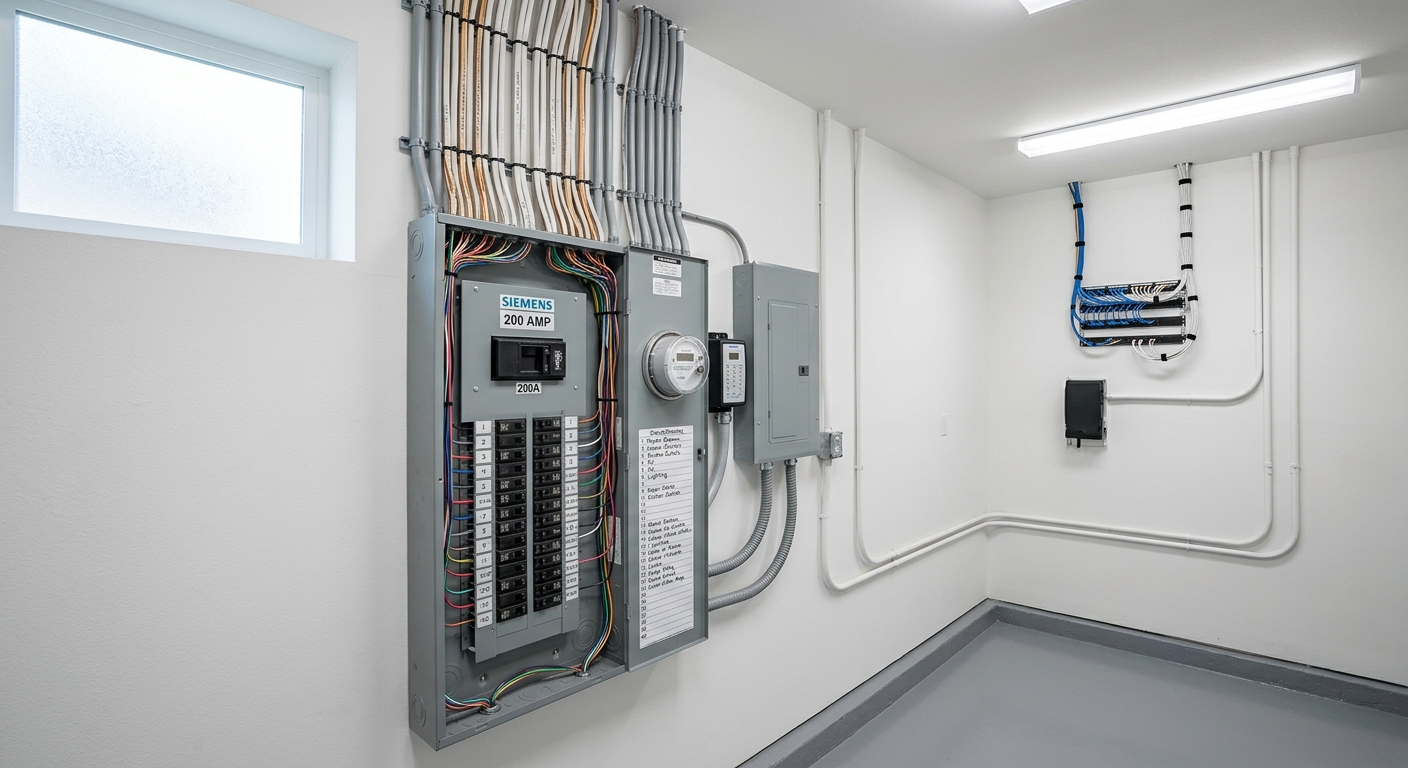
Electrical services and costs in South Huron
Electrical services in South Huron are shaped by a simple reality: a large portion of local housing is older. In fact, 66.4% of dwellings were built before 1981, which means many homes were originally wired for much lower demand than today’s lifestyle. With that age mix, South Huron commonly sees panel upgrades, knob-and-tube (K&T) removal, and aluminum wiring remediation—often paired together—so electricians can bring the home up to current code and improve insurance eligibility. Region-wide, Stratford–Bruce Peninsula also includes a lot of rural lots and longer drive times, so contractor availability and travel can affect scheduling and labour. Winters in Southwestern Ontario can further slow access to basements, crawlspaces, and meter areas when waterlines, grading, or utility locations are harder to reach.
Homes in areas like Exeter and the wider Central Huron corridor tend to bring similar themes: older panels feeding limited circuits, finished-wall fishing that increases labour time, and electrification upgrades such as EV charging. EV adoption is a major driver in Stratford–Bruce Peninsula, especially when homeowners add Level 2 chargers (typically 40–50A) alongside heat pumps, induction stoves, or electric vehicle “ready” panels. That combination can push a home from an undersized service into a 100A-to-200A service upgrade—one reason quotes can swing depending on the existing panel condition and wiring layout.
Below is a practical comparison of the most common electrical services we see in South Huron and what homeowners typically budget after permits and inspections under ESA.
| Service |
Why It's Needed |
Permit Required |
Price Range |
| Panel upgrade — 100A to 200A service |
Supports modern loads (EV chargers, heat pumps, electric cooking) and corrects undersized/aging equipment. |
Yes (permit and ESA inspection) |
$2,500–$5,000 |
| EV charger installation (Level 2, 40–50A) |
Adds safe dedicated circuit capacity and proper protection for charging. |
Yes (permit and ESA inspection) |
$1,200–$2,800 |
| Knob-and-tube wiring removal and replacement |
Modern safety and insurance concerns; K&T generally can’t be left in place for full code compliance. |
Yes (permit and ESA inspection) |
$8,000–$20,000 |
| Aluminum wiring remediation (CO/ALR connectors) |
Improves long-term connection performance using approved connectors where replacement isn’t practical. |
Yes (permit often required depending on scope) |
$2,900–$7,500 |
| New dedicated circuit (HVAC, appliance, hot tub) |
Prevents overloads and improves safety by adding correct circuit capacity and protection. |
Yes (new circuit generally requires a permit) |
$900–$2,400 |
| Whole-home rewire (older home, full replacement) |
Ensures consistent, code-compliant wiring throughout for safety, resale readiness, and future flexibility. |
Yes (permit and ESA inspection) |
$12,000–$28,000 |
Prices are estimates only and vary by project scope, site access and material selection.
What affects the price of electrical work in South Huron
In Stratford–Bruce Peninsula, the same “simple” electrical upgrade can end up costing 30–50% more or less depending on what’s behind the wall and at the service entrance. The dominant driver is housing age. South Huron has a high share of older homes, and 66.4% of dwellings built before 1981 often means earlier wiring standards, older panels, and equipment that’s undersized for current demand. If you’re dealing with knob-and-tube, or aluminum wiring from the mid-20th century, contractors typically spend more time on diagnostics, careful removal, and approved remediation methods (such as CO/ALR connectors) to get the installation accepted by the inspection process and insurance requirements.
Between the 1960s and 1970s, aluminum wiring appears often in homes built for lower electrical loads; many households now add induction stoves, heat pumps, and EV chargers. That creates another cost pressure point: modern EV adoption is increasing Level 2 charger permit applications, usually at 40–50A, which can trigger a service upgrade if the panel and feeder capacity aren’t adequate. In practical terms, a 100A-to-200A service upgrade is commonly budgeted in the $2,500 to $5,000 band, while wiring and rewiring work can fall into the $8,000 to $20,000 band depending on how much fishing, wall access, and replacement is required.
Local conditions can also raise or lower costs. For example, finished basements and drywall throughout Exeter can increase labour because wiring routes aren’t “open concept,” while unfinished basements or accessible crawlspaces generally reduce time. Conversely, rural callouts outside the main corridor can add travel time, and winter access to meter enclosures or exterior service equipment can make work slower. Availability of specialized crews for larger service upgrades can also influence pricing during peak seasons.
| Price Factor |
Why It Matters |
Cost Impact |
| Panel size upgrade — 100A to 200A is the standard minimum today |
More capacity, correct bus/feeder sizing, and room for new breakers for modern loads. |
Often adds $2,500–$5,000 depending on panel condition and cable work |
| Wiring type — copper vs. aluminum remediation vs. K&T removal |
Aluminum connections require approved corrective work; K&T generally requires significant replacement. |
Can shift the project by several thousand dollars (remediation vs full rewiring) |
| Number of new circuits — each adds material and labour time |
New breakers, cable runs, junction boxes, and termination time scale with circuit count. |
Often adds $300–$800 per new circuit before large access costs |
| Permit + ESA/TSBC inspection fee — mandatory for all major work |
Permits are required for panel/service upgrades, rewiring, and new circuits; inspections are part of compliance. |
Typically adds a few hundred dollars, depending on scope |
| Labour rate for licensed electricians — journeyman rates in {region} |
Skilled labour and time-in-wall fishing are major drivers; rural travel can increase effective rates. |
Commonly the largest swing factor across comparable jobs |
| EV charger amperage — 40A vs. 50A circuit affects cable and breaker cost |
Higher amperage generally uses heavier cable and correctly rated breakers/parts. |
Typically changes charger install pricing within the $1,200–$2,800 band |
| Emergency or after-hours premium |
Urgent scheduling increases labour costs and may require priority crew dispatch. |
Often adds a service call/priority premium |
| Load calculation required for service upgrade |
Verifies capacity for present and planned loads; impacts what the ESA inspection expects. |
Usually adds consultant/administrative time, but prevents costly rework |
Permits & regulations in Ontario
In Ontario, ALL electrical work beyond changing a light bulb must be completed by a licensed electrician. That includes panel and service upgrades, adding or altering circuits, rewiring, troubleshooting that involves opening junctions, and installing Level 2 EV chargers. For South Huron homeowners, the key point is that you should plan around permits and inspections: major work requires an ESA (Electrical Safety Authority) permit and must pass inspection before it’s considered compliant.
What typically DOES require a permit in Ontario: panel upgrades (100A to 200A), new dedicated circuits (including for HVAC equipment, hot tubs, and EV chargers), any rewiring or removal/replacement of unsafe wiring types, and any service changes. What typically does NOT require a permit: replacing a fixture with an identical unit, swapping a receptacle or switch that’s in the same configuration without altering wiring routes (confirm this with your electrician), or basic lamp changes.
How to verify your contractor before work starts: (1) confirm the electrician’s Ontario licence/registration using the ESA online registry; (2) ask for a certificate of insurance showing general liability coverage and ensure dates are current; and (3) request confirmation of WSIB coverage if applicable for the contractor’s staff and subcontractors. If you’re paying a reputable South Huron firm, they can usually provide documentation quickly. Also ask whether the permit will be pulled under their licence and whether they’ll book the inspection—if the quote is “permit included,” it should be clearly stated.
When your South Huron home needs an electrical upgrade
South Huron homes don’t always need an upgrade, but certain warning signs are safety-critical—not cosmetic. First, breakers that trip regularly usually point to overloads or failing connections. If you’re constantly resetting breakers when you run a dryer, microwave, space heater, or EV charging, you may be dealing with undersized circuits or a panel that no longer matches your household’s load profile.
Second, knob-and-tube wiring is a major concern. The risk isn’t just “age”; it’s the condition of insulation, heat/connection behaviour, and ongoing insurability. If K&T is present, treat it as a planned major upgrade (and often a more urgent one if you’re selling or adding heavy loads).
Third, 60A or 100A service is often inadequate for modern electrification in the Stratford–Bruce Peninsula region. With EV charging, heat pumps (common in Ontario upgrades), electric cooking, and everyday loads running together, the home can exceed capacity. The standard solution is frequently a 200A upgrade. For example, if your panel upgrade budget starts around the $2,500–$5,000 band, that’s often justified because it avoids the risk of repeated nuisance trips and supports future installs. If you skip the service upgrade, you may still pay for repeated “add-a-circuit” labour—and you can still run out of safe capacity.
Fourth, aluminum wiring (common in pre-1976 construction) may not be instantly dangerous if well maintained, but it requires licensed remediation. Finally, insufficient outlets and missing AFCI/GFCI protection can become a code-compliance issue that surfaces at home sale or inspection.
In this climate, where homeowners use more indoor heating and appliances during winter, overload problems can show up sooner. Signs of K&T, repeated breaker trips, or confirmed aluminum issues should be handled promptly; outlet shortages without safety protection are usually “planned,” but they still deserve attention.
| Warning Sign |
What It Means |
Recommended Action |
Urgency |
Price Band |
| Breakers trip frequently |
Overload, failing connections, or undersized/incorrect circuit protection. |
Inspection, load assessment, and circuit correction; may require service/panel changes. |
Immediate to planned (depends on cause) |
$900–$5,000 |
| Knob-and-tube wiring present |
Older insulation and connection behaviour that can create safety and insurance risk. |
Plan for removal and full replacement of affected runs; update circuits to code. |
Planned (often required before major additions) |
$8,000–$20,000 |
| 60A or 100A panel (inadequate load capacity) |
Modern loads exceed what the service can safely support. |
Load calculation and likely 100A-to-200A service upgrade. |
Planned (becomes urgent when adding EV/heat) |
$2,500–$5,000 |
| Aluminum wiring (pre-1976 construction) |
Connections may degrade over time without approved remediation. |
Licensed remediation with CO/ALR connectors or targeted replacement. |
Planned (time it with insurance/sale needs) |
$2,900–$7,500 |
| Insufficient outlets — extension cords everywhere |
Overreliance on temporary power; higher risk of overheating and nuisance issues. |
Add receptacles and, when needed, install new dedicated circuits. |
Planned (safety upgrade before winter) |
$900–$2,400 |
| No AFCI or GFCI protection where required |
Higher risk of arc-fault or shock hazards; may fail code at sale. |
Add AFCI/GFCI protection as required by the applicable code scope. |
Planned (often before listing) |
$200–$800 |
How to choose a electrical work contractor in South Huron
Choosing a contractor in South Huron is mostly about verifying professionalism and avoiding “surprise scope” later. Start by confirming Ontario licensing. The electrician should be able to show their valid registration details, and you can verify licensing through the Ontario ESA-related registry resources. Next, ask for a certificate of insurance and confirm coverage is active and appropriate for electrical contracting. Also confirm WSIB/WCB coverage where applicable—don’t assume; ask. If the contractor can’t provide documentation, move on.
Get 2–3 itemised written quotes rather than a single lump sum. A good quote breaks out labour vs materials, identifies exactly what’s being replaced, and lists allowance line items like wall access, disposal, and patching (if included). Ask whether the permit and ESA inspection are included in the quoted price or billed separately. Clarify what’s excluded: for example, drywall repair, ceiling restoration, conduit runs in finished spaces, or any changes required after opening walls.
Warranty matters. Ask for the workmanship warranty length, whether it’s in writing, and whether manufacturer warranties for breakers/chargers transfer to the homeowner. For payment, avoid paying more than 10–15% upfront; hold back the balance until completion and final cleanup. Finally, insist on a written start date and a realistic completion window—rural scheduling and inspection bookings can affect timelines, but a reliable contractor will plan around them.
- Verify Ontario licence before signing anything
- Ask for an insurance certificate (and confirm it’s current)
- Confirm WSIB/WCB coverage where applicable
- Use itemised quotes: labour, materials, and permit/inspection line items
- Ensure the scope includes fishing/patching assumptions for finished walls
- Ask if disposal of old panel parts or removed wiring is included
- Confirm whether a load calculation is included for service upgrades
- Request a permit plan: who pulls it and when
- Ask what happens if the electrician finds additional wiring issues after opening walls
- Get warranty details in writing (workmanship and product warranties)
- Use a payment schedule with a 10–15% deposit cap and holdback at substantial completion
- Require a written timeline including inspection scheduling
Red flags I see too often in South Huron: a quote that refuses to itemise labour/materials, no clear permit/inspection responsibility, “we’ll just connect it” language without a load calculation for panel/service work, promises of same-day installs for service upgrades without ESA permit booking, and pushing for large deposits upfront.
Frequently asked questions — electrical work in South Huron
How do I know if my South Huron home has aluminum wiring?
In South Huron and across Ontario, aluminum wiring is most commonly associated with older homes built around the mid-1960s through 1970s, but age alone isn’t enough. The most reliable method is an electrician inspection: they can check the conductor markings on the cable (often stamped or printed along the insulation) and confirm whether terminations show CO/ALR-compatible connectors or older “direct-to-device” connections. You may also notice specific device discoloration or the presence of markings on the wire jacket and breaker/panel terminations. If you’re seeing warm receptacles, frequent loose/poor connections, or nuisance breaker issues, have it assessed promptly. Once confirmed, remediation is typically budgeted within common regional bands—small CO/ALR connector work can be a few thousand dollars, while larger replacement can move into broader rewiring costs.
What is the cost of rewiring a house in South Huron?
Whole-home rewiring in South Huron typically lands in the $12,000 to $28,000 range depending on the number of rooms, accessibility (finished walls vs open basement), whether you’re replacing K&T, and how much new receptacle/outlet and lighting work you want. South Huron’s older stock—66.4% built before 1981—means many homes have wiring routes that weren’t designed for today’s load and circuiting, increasing labour for fishing through finished spaces. A partial rewiring (for example, targeted replacement of K&T sections or dedicated circuit corrections) can be less, but the scope should be defined after the electrician removes a few test access points. If your home is also headed toward electrification (EV charger, heat pumps, induction), it may make sense to coordinate with a panel/service plan so you’re not paying twice for access.
What electrical upgrades are required when selling a home in Ontario?
Ontario doesn’t require you to retroactively upgrade every feature of an older home just because it’s being listed, but inspections and buyer due diligence often uncover issues that must be corrected. The big triggers are code safety protections (like GFCI/AFCI where required for the relevant work), unsafe or non-compliant wiring, and electrical hazards such as knob-and-tube that can affect insurability and compliance expectations. If your panel is undersized for the connected load, or if you’re missing modern protection for circuits, buyers may require updates before closing. In South Huron, many homes are older and 72.9% of households own (Statistics Canada, 2021 Census), which means many owners are upgrading ahead of sale to avoid negotiation. A practical approach is to hire an electrician for a pre-list electrical assessment, then budget for the minimum required fixes—often starting with panel/service readiness (commonly $2,500–$5,000 for a 100A-to-200A upgrade when warranted) and targeted protective device upgrades.
What is a load calculation and why does my electrician need one?
A load calculation is the formal method electricians use to determine whether your service and panel have enough capacity for the connected electrical loads—right now and, importantly, for the changes you’re planning (like an EV charger or a heat pump system). In Ontario, when a service upgrade is being considered, inspectors expect the work to be sized correctly for the anticipated demand, and electricians use the calculation to justify the required service rating and breaker arrangements. Without it, you can end up with an install that technically “fits,” but doesn’t safely meet the required capacity for breakers and conductors. In South Huron, where winter heating habits and electrification tend to increase usage, load planning helps prevent repeated nuisance trips. If you’re in the market for a 100A-to-200A service upgrade, the load calculation is a key part of why costs can vary and why quotes are sometimes higher when the existing panel can’t support the new circuits.
How do I find a licensed electrician in South Huron?
The safest approach is to start with licensing verification and then match the company to your job size. In Ontario, electricians must be licensed, and you can verify licensing details through ESA-related resources and the Ontario registry tools. Then ask for proof of insurance (certificate of liability) and confirmation of WSIB/WCB coverage where applicable. After that, request 2–3 itemised quotes so you can compare labour vs materials, permit responsibility, and scope inclusions like disposal and wall access/patching. For South Huron, many homeowners also prefer contractors familiar with older wiring issues common in the Stratford–Bruce Peninsula region (like K&T and aluminum remediation). If a contractor can’t clearly explain the permit/inspection process or won’t provide documentation when you ask, that’s a strong sign to keep looking. For common projects, you should also expect pricing to reflect local rates—journeyman labour is often in the $90 to $140 per hour range in the region depending on urgency and site conditions.
Can I add a subpanel to my South Huron home?
Yes, a subpanel can be added in many South Huron homes, but it depends on the existing main panel/service capacity, the wiring type in the home, and the routing feasibility. A subpanel is often used when you want to expand circuit count, separate loads (for example, an EV charger area), or reduce overheating risk by distributing circuits more appropriately. In Ontario, adding a subpanel is typically not “DIY” work: it usually requires a permit and ESA inspection, especially because it involves modifying the service distribution and adding new branch circuit protections. Your electrician will often start with a load calculation to confirm the main service (commonly 100A vs 200A) can support the added circuits. Pricing varies widely based on cable runs and wall access; many subpanel projects end up falling within or near the panel/service upgrade band if they require upstream changes. If your electrician suggests a full 200A upgrade to support the subpanel and EV-ready circuits, that’s usually the safer long-term plan.