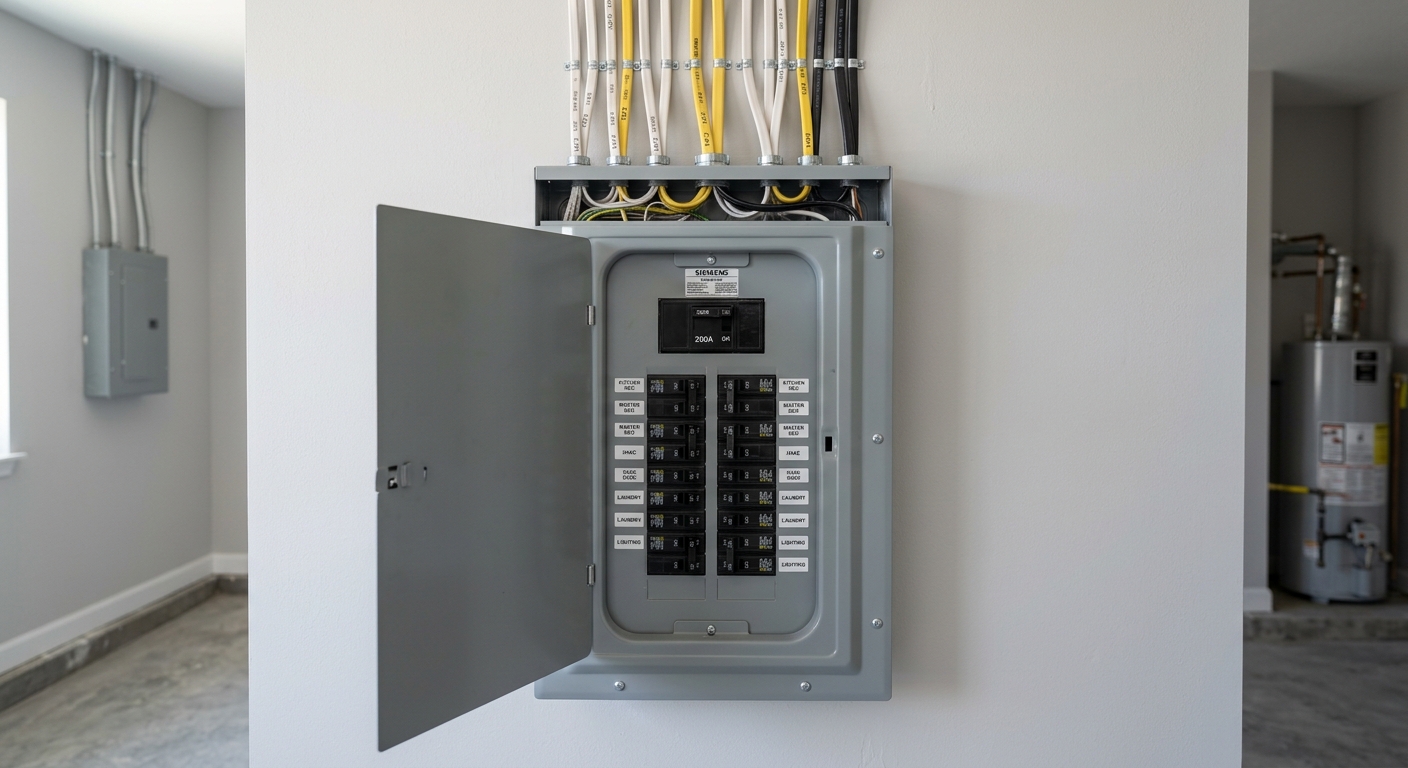
Electrical services and costs in Vaughan
Electrical services in Vaughan run the gamut from straightforward fixture swaps to full service and wiring upgrades, and pricing reflects both the local housing mix and today’s higher electrical demand. In Vaughan, about 7.6% of homes were built before 1981 (Statistics Canada, 2021 Census), which is a common starting point for homeowners who discover older wiring materials, limited panel capacity, or insulation concerns. Another reason upgrades are frequent here is that Vaughan’s steady growth has layered in new infill while many long-established neighbourhoods still rely on dated distribution.
In the Toronto economic region, demand is also shaped by weather and load patterns. Winters drive longer heating run-times, and many homeowners now pair older electrical infrastructure with heat pumps, electric ranges, finished basements, and Level 2 EV charging. That combination is why contractors in areas such as Maple (Vaughan)—where you’ll find both mature housing and active renovations—often see panel work and circuit additions bundled together.
Labour availability affects turnaround and cost too. Because licensed electricians in the GTA commonly bill roughly $90–$120 per hour, jobs that require extra troubleshooting, panel/service access work, or drywall patching tend to land at the top end of typical bands. If your home needs both an electrical service upgrade and new circuits, you should expect coordination time for permits and inspections. Use the comparison table below as a reality check when you’re reviewing estimates for Vaughan.
| Service |
Why It's Needed |
Permit Required |
Price Range |
| Panel upgrade — 100A to 200A service |
More capacity for today’s loads (EV chargers, heat pumps, electric heating and major appliances) and improved breaker space |
Yes (permit + ESA inspection) |
$2,500–$6,000 |
| EV charger installation (Level 2, 40–50A) |
Supports home charging; often requires load/permit review and an appropriately sized breaker/cable run |
Yes (permit + ESA inspection) |
$900–$2,500 |
| Knob-and-tube wiring removal and replacement |
Eliminates an ageing wiring method that can pose insulation/contact risks and is often a barrier for insurance and financing |
Yes (permit + ESA inspection) |
$3,000–$15,000 |
| Aluminum wiring remediation (CO/ALR connectors) |
Improves long-term connection reliability where copper is not used throughout; may include connector-only remediation or targeted replacement |
Yes (permit + ESA inspection) for major remediation |
$3,000–$10,000 |
| New dedicated circuit (HVAC, appliance, hot tub) |
Prevents overloads and nuisance trips; adds proper protection and code-compliant routing |
Often yes (permit depends on scope; new circuits typically require it) |
$500–$3,500 |
| Whole-home rewire (older home, full replacement) |
When safe distribution can’t be rebuilt with partial fixes; supports modern safety devices and reliable load handling |
Yes (permit + ESA inspection) |
$8,000–$20,000 |
Prices are estimates only and vary by project scope, site access and material selection.
What affects the price of electrical work in Vaughan
In Vaughan (and across the Toronto economic region), two quotes that look similar on paper can still differ by 30–50% because the hidden drivers—labour complexity, wiring material realities, and inspection scope—vary lot to lot and job to job. The dominant cost driver is usually the age and condition of the housing stock. While Vaughan has a large share of established single-detached dwellings (Statistics Canada, 2021 Census), it’s the pre-1950 and mid-century wiring patterns that most often push costs upward. Homes built before 1950 may still show knob-and-tube wiring, which many insurers scrutinize, and can require more invasive removal than homeowners expect. Meanwhile, homes from the 1960s–1970s often have small panel services (commonly 60A or 100A) that don’t match today’s load profile—EV chargers, heat pumps, induction/electric stoves, basement renovations, and added receptacles.
Aluminum branch wiring, seen in many houses from that mid-period, is another key driver: it typically needs licensed remediation using approved CO/ALR connectors (and sometimes targeted replacement), which affects both time and parts. EV adoption is also a major workload factor; Level 2 charger permit applications have increased, and many require a load check before a new 40–60A circuit can be safely added. In practical terms, a panel upgrade band of roughly $2,500–$6,000 can become a higher total when combined with wiring remediation and new circuit runs (often pushing total rewiring projects well into the $3,000–$15,000 range depending on extent).
Local conditions that raise cost include long cable paths through finished basements, service entry constraints, and the need for trenching or partial exterior work. Cost can be lower when your panel location is accessible, wiring paths are open (unfinished areas), and the job scopes are separated cleanly into “add circuits” versus “full service upgrade.” Toronto-area contractor schedules also matter: after-hours callouts and urgent safety corrections typically carry premiums.
| Price Factor |
Why It Matters |
Cost Impact |
| Panel size upgrade — 100A to 200A is the standard minimum today |
More breaker space and capacity for modern appliances and charging |
Often shifts the job into the $2,500–$6,000 panel/service band |
| Wiring type — copper vs. aluminum remediation vs. K&T removal |
Aluminum and knob-and-tube require specific remediation or replacement approaches |
Can add several thousand dollars or more depending on extent ($3,000–$15,000) |
| Number of new circuits — each adds material and labour time |
Breakers, cable, boxes, and time for routing/termination increase with every circuit |
Multiplicative effect on labour + materials |
| Permit + ESA/TSBC inspection fee — mandatory for all major work |
Inspections and administrative steps are non-optional and vary by scope |
Typically adds roughly $200–$500 depending on project size |
| Labour rate for licensed electricians — journeyman rates in {region} |
GTA labour commonly runs about $90–$120/hour, depending on urgency and complexity |
Higher when troubleshooting and access work are needed |
| EV charger amperage — 40A vs. 50A circuit affects cable and breaker cost |
Higher amperage may require heavier conductors and breaker components |
Can move charger installs toward the upper end of $900–$2,500 |
| Emergency or after-hours premium |
Scheduling and safety-response overhead increases costs |
Can add a noticeable premium to labour |
| Load calculation required for service upgrade |
Ensures the upgraded service matches actual connected loads |
May add technician time and delays if additional design notes are needed |
Permits & regulations in Ontario
In Ontario, ALL electrical work beyond changing a light bulb must be done by a licensed electrician. That includes panel upgrades (100A to 200A), rewiring, installing new circuits (including EV Level 2 chargers), and anything that alters the electrical distribution system. These jobs require permits and must be inspected for compliance—work is inspected through the Electrical Safety Authority (ESA) for Ontario (with inspection sign-off required before energizing or before the work is considered complete).
What typically does require a permit in Vaughan: new branch circuits, new breakers, panel/service changes, EV charger installations, rewiring, and knob-and-tube or aluminum remediation that affects connections and terminations. What typically does not require a permit (and still must be done safely and in compliance): replacing an existing receptacle with an identical one, swapping fixtures with the same wiring method, and replacing a like-for-like breaker in certain situations—however, if you’re unsure whether the scope changes wiring or breaker ratings, assume a permit is required and confirm with your electrician.
How to verify a contractor step-by-step in Vaughan: (1) Confirm the electrician’s Ontario licence on the ESA/contractor registry using the company or licence number; (2) Request a certificate of insurance (liability) showing adequate coverage and confirm the electrician is named or authorized to work under that policy; (3) Ask for WSIB/WCB documentation (or the applicable clearance evidence) before work starts. Finally, insist that the permit is pulled under the proper party and that inspection dates are scheduled in writing.
When your Vaughan home needs an electrical upgrade
If your Vaughan home shows warning signs, the goal is to separate “inconvenient” from “safety-critical.” Frequent breaker trips are a top clue: they often indicate an overloaded panel or circuits sized incorrectly for modern appliance use. A second big red flag is knob-and-tube wiring—don’t treat it as just an age issue. The key concern is that insulation condition and contact quality can degrade, and insurance/real-estate transactions may fail until it’s addressed.
Service size is another practical factor. Many older homes still have 60A or 100A panels that struggle with a modern load profile—especially when you add an EV charger, run a heat pump, and use electric cooking and basement loads at the same time. In Vaughan’s climate, winter heating and extended compressor/backup operation can increase peak demand, which is one reason a 200A upgrade is commonly the standard solution when the panel can’t accommodate today’s connected loads.
Aluminum wiring (often found in pre-1976 homes) is not always an immediate “sparking” emergency, but it does require licensed remediation using approved connectors or replacement of problem sections to reduce long-term connection issues. Finally, insufficient outlets and missing AFCI/GFCI protection can become more than a nuisance—when they surface during home sale or insurance underwriting, correction can turn into an expensive scramble.
For cost context: if you’re adding an EV charger and discover you also need a panel upgrade, you’re frequently looking at a combined project rather than just the charger. A standalone Level 2 charger install can be around the $900–$2,500 band, but when paired with a service upgrade, the total often moves into the $2,500–$6,000 panel/service range plus new circuit work.
| Warning Sign |
What It Means |
Recommended Action |
Urgency |
Price Band |
| Breakers trip frequently |
Likely overload, incorrect circuit sizing, or failing/undersized components |
Schedule inspection for load review and breaker/circuit testing; add circuits or upgrade panel if needed |
Immediate (safety + troubleshooting) |
$500–$6,000 |
| Knob-and-tube wiring present |
Potential insulation/contact risks; often blocked by insurance and inspection expectations |
Plan K&T removal and replacement, starting with highest-risk runs |
High (plan promptly) |
$3,000–$15,000 |
| 60A or 100A panel (inadequate load capacity) |
Modern loads exceed what the service/panel was designed to support safely |
Request a load calculation and discuss 200A upgrade |
High (especially before major additions) |
$2,500–$6,000 |
| Aluminum wiring (pre-1976 construction) |
Connections may need remediation; improper terminations can degrade over time |
Licensed assessment, connector remediation (CO/ALR) or targeted replacement |
Planned (not usually “emergency”) |
$3,000–$10,000 |
| Insufficient outlets — extension cords everywhere |
Code and safety concern; higher likelihood of overload and damaged cabling |
Add receptacles and dedicated circuits where required; improve GFCI/AFCI coverage |
Medium (plan before winter and heavy load seasons) |
$500–$3,500 |
| No AFCI or GFCI protection where required |
Increased risk of arc faults and shock; often flagged during sale/inspection |
Add/properly replace devices and correct affected circuits to code |
Medium to High (depends on location) |
$200–$2,500 |
How to choose a electrical work contractor in Vaughan
Choosing the right contractor in Vaughan is mostly about verification and clarity. First, confirm licensing: ask for the electrician’s Ontario licence information and verify it through the Ontario electrical authority/registry resources, then make sure the person doing the work matches the paperwork. Second, request liability insurance—get the certificate of insurance and confirm effective dates and coverage limits. Third, verify WSIB/WCB coverage (or applicable clearance evidence) so you’re not left holding the risk if a worker is injured on your property.
Next, get 2–3 itemised written quotes instead of a single lump sum. You want a breakdown of labour hours, materials (cable type, breakers, panel components, charger hardware), and allowances for access/demolition. Read exclusions carefully: is the permit pull included, are inspections included, and is disposal/cleanup covered? For wiring or panel/service work, confirm whether drywall patching is included or if it’s excluded.
Warranty matters. Ask for a workmanship warranty length (often framed around months/years), and separate that from manufacturer warranties on parts. If you’re planning to sell soon, ask whether the warranty documentation is transferable. Payment should be staged: never pay more than about 10–15% upfront; use a holdback until the job is complete and verified. Finally, insist on a written start date and completion estimate—Toronto-area scheduling can affect timelines, especially when ESA inspections are needed.
- Verify Ontario electrician/company licence information before scheduling.
- Confirm liability insurance via certificate (and check expiry dates).
- Provide WSIB/WCB clearance or coverage documentation.
- Require an itemised quote with labour + materials—not just one total.
- Ask whether ESA permit fees are included and who pulls the permit.
- Confirm inspection scheduling responsibility and timing assumptions.
- Get an explicit scope for disposal/cleanup (debris removal, packaging).
- Ask whether panel upgrades include all required components (breakers, labels, bonding/grounding checks).
- Clarify if old wiring is removed fully or capped in place (and why).
- Request AFCI/GFCI selections and where they’ll be installed.
- Review warranty terms in writing and whether they’re transferable.
- Use a payment schedule with a holdback until final testing and sign-off.
Red flags seen in Vaughan include: (1) contractors who won’t provide written, itemised scopes; (2) refusing to pull the ESA permit or discussing inspection “later”; (3) asking for large upfront payments beyond 10–15%; (4) vague warranty language (no duration, no workmanship terms); and (5) pressure tactics when you ask to verify licensing/insurance and WSIB/WCB coverage.
Frequently asked questions — electrical work in Vaughan
How do I compare electrical quotes?
In Vaughan and across Ontario, the fairest way to compare quotes is to line up the scope and not just the totals. Ask each contractor for an itemised breakdown: labour time, materials (panel components, cable type, breakers), disposal/cleanup, and whether the ESA permit + inspection fees are included. Confirm what’s excluded—common gaps include drywall patching, trenching for exterior runs, or whether troubleshooting time is capped. If you’re adding an EV charger, check whether the quote includes a load calculation and the exact circuit amperage (40A vs 50A). A quote that lands near the $900–$2,500 Level 2 band may become much higher if it doesn’t address a needed service upgrade that could move you toward the $2,500–$6,000 panel/service range.
How long does a panel upgrade take in Vaughan?
Typical panel upgrades in Vaughan often take one to two working days on site, but the calendar timeline depends on permitting and inspection scheduling. For many homes, the actual electrical work (panel/service disconnect, new equipment install, wiring terminations, testing, and labelling) is manageable within that window. The broader project can extend longer if you need additional remediation like aluminum connection fixes, more extensive re-routing, or if service location changes require extra work. In winter, site access and working conditions can add time, especially for homes with outdoor service components. Expect the permit and ESA inspection steps to add days, so get start date and inspection plan in writing. If the quote includes remediation or more than a simple swap to a 200A standard, build extra time for troubleshooting and materials delivery.
What is a GFCI outlet and where is it required in Ontario?
A GFCI (Ground Fault Circuit Interrupter) outlet is a safety device designed to quickly shut off power when it detects leakage current, reducing shock risk. In Ontario, GFCI protection requirements are addressed through the Ontario Electrical Code, and what’s “required” depends on the location and type of circuit. Common areas include kitchens, bathrooms, garages, basements (where applicable), outdoor receptacles, and near sinks—especially where moisture is present. Many Vaughan homeowners also run into GFCI/AFCI compliance issues when selling, because older wiring may not have modern protection devices where the Code expects them. If your contractor proposes adding new circuits, ask whether they’re selecting the correct GFCI devices for the affected locations. Costs vary widely, but small corrections are sometimes within the $200–$5,000 lighting/fixture-to-protection-related range depending on how many circuits are involved.
How do I know if my Vaughan home has aluminum wiring?
In Vaughan, aluminum wiring is most common in homes built around the mid-century period. A quick way to narrow it down is to check your home’s wiring and panel labels: aluminum branch-circuit conductors often have markings or the panel may include notes from prior upgrades. The safest approach is to have a licensed electrician verify by inspecting conductors at accessible junction points—such as at receptacles, switches, or the panel—because visuals alone can be misleading. If aluminum is present, the next step is an assessment of connections and terminations, since aluminum wiring typically requires approved remediation (for example, CO/ALR connectors) or replacement where connections are unsuitable. If you’re planning an EV charger or other new high-load equipment, confirming wiring type early helps prevent delays later. Remediation projects commonly fall into the $3,000–$10,000 range depending on extent.
What is the cost of rewiring a house in Vaughan?
Whole-home rewiring costs in Vaughan depend heavily on the home size, the wiring method needed (full replacement versus selective replacement), accessibility (finished vs unfinished spaces), and how much remediation is required for the existing system. If you’re dealing with knob-and-tube removal and replacement, projects can land within the broader $3,000–$15,000 band, but full replacement across an entire home often goes higher depending on complexity. For older homes that also need a service upgrade to support today’s loads (EV charging, heat pumps, electric ranges), you may see the total shift because a 200A panel/service upgrade typically ranges around $2,500–$6,000. The best quotes will explain the pathway: how much gets removed, how new cable is routed, what’s included in labour, and how many new circuits and safety devices are installed to meet modern requirements.
What electrical upgrades are required when selling a home in Ontario?
Ontario doesn’t impose one universal “must upgrade everything” checklist for every sale, but there are practical electrical expectations that come up during inspections, appraisals, and insurance underwriting—especially for older housing stock. In Vaughan, the most frequent items are safety and compliance updates: adding or upgrading GFCI/AFCI protection where required, correcting unsafe or non-compliant wiring, and addressing outdated wiring types such as knob-and-tube. Aluminum branch wiring often triggers requests for licensed remediation, particularly where connections are questionable. If the home has a small service (like 60A or 100A) and the electrical system can’t safely support modern loads, buyers may request an upgrade before closing. If you’re planning an EV charger sale-proofing step, note that Level 2 installs commonly fall in the $900–$2,500 range, but service capacity and wiring condition can change the overall budget. Work must be permitted and inspected per Ontario requirements through the ESA.