Electrical services and costs in Camrose
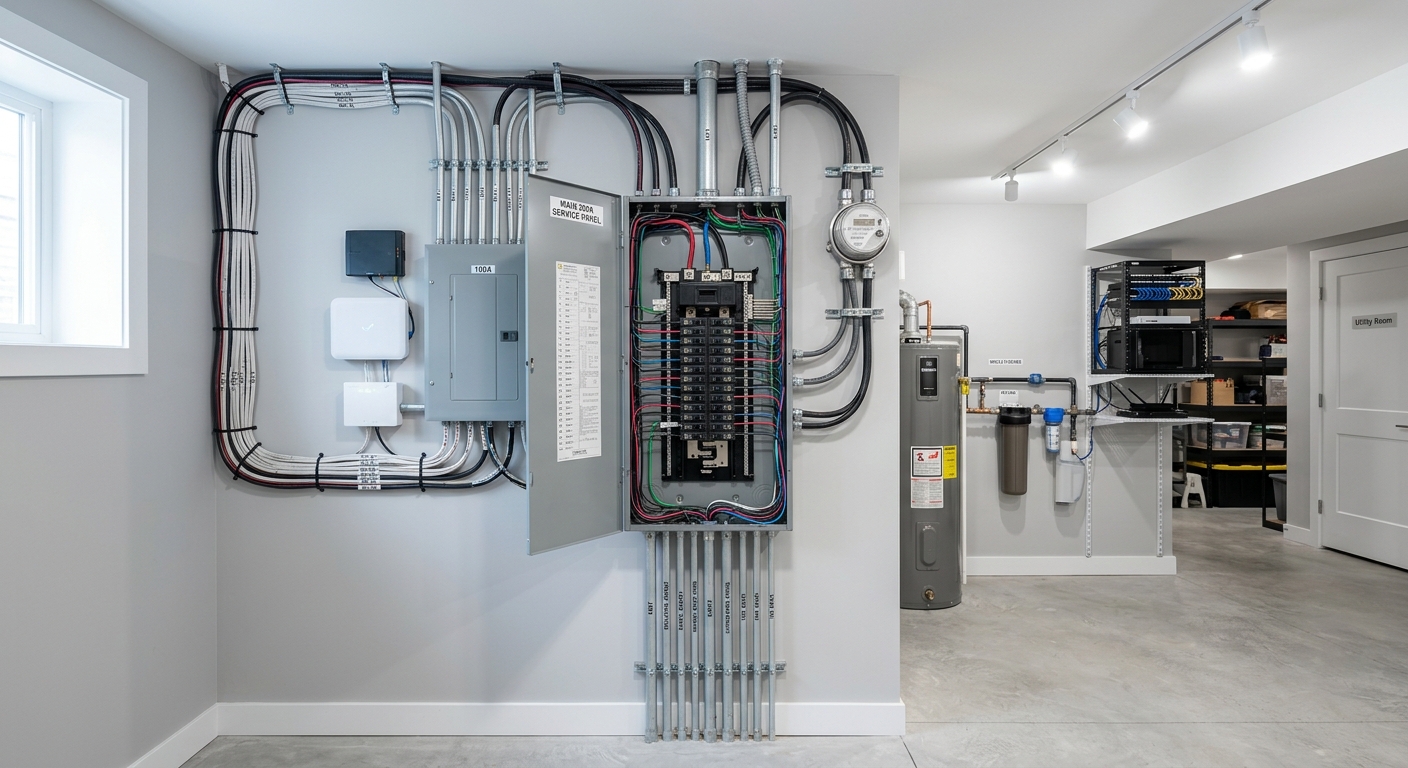
Camrose homeowners often notice that electrical costs aren’t “one-size-fits-all.” In a community where many houses are older—Statistics Canada reports that 47.7% of homes in the area were built before 1981—electrical updates are commonly tied to safety and modernization, such as removing knob-and-tube wiring and correcting aluminum wiring issues. Another local factor is homeownership: 65.9% of households own their home (Statistics Canada, 2021 Census), and that stable ownership base drives ongoing upgrades like garage builds, hot tubs, and EV charging.
In the Camrose–Drumheller region, winters are long and demanding on household loads. That matters for pricing because baseboard and resistance heating can already push a service near its comfort limits, and any add-ons (heat pumps, induction stoves, workshops) increase the workload for load calculations, panel capacity checks, and sometimes a full service upgrade. You’ll also see higher coordination time when work involves utility service connections or service distance on rural lots—both common outside the core.
Trade availability is also a local reality. During busy periods, electricians are booked ahead for permit-ready jobs, and that can affect scheduling (and therefore mobilization and travel time). In Camrose, areas like the mature residential pockets near downtown and along 50 Avenue often have older wiring types that are especially in demand for rewires and service upgrades.
Below is a practical comparison of the most common electrical service work you’re likely to plan for in Camrose, Alberta.
| Service |
Why It's Needed |
Permit Required |
Price Range |
| Panel upgrade — 100A to 200A service |
Modern loads often outgrow older panels, especially with EV charging, larger kitchens, and electric heat. |
Yes (service change) |
$4,000–$9,000 |
| EV charger installation (Level 2, 40–50A) |
Adds a safe, code-compliant charging circuit with correct breaker sizing and circuit protection. |
Yes (new circuit) |
$900–$2,500 |
| Knob-and-tube wiring removal and replacement |
Modern safety standards and insurance requirements often won’t accept aging knob-and-tube; it can be brittle and difficult to maintain. |
Yes (rewire/removal) |
$3,500–$12,000 |
| Aluminum wiring remediation (CO/ALR connectors) |
Licensed remediation helps address connection heating risk with approved connectors or component replacement. |
Yes (alterations to branch circuits/connections) |
$3,500–$10,500 |
| New dedicated circuit (HVAC, appliance, hot tub) |
Reduces nuisance trips and improves safety by giving high-demand equipment proper wiring and protection. |
Yes (new circuit) |
$1,200–$4,200 |
| Whole-home rewire (older home, full replacement) |
Best option when multiple wiring systems exist (e.g., mixed-era wiring) and panels/outlets aren’t meeting today’s needs. |
Yes (full rewiring) |
$10,000–$22,000 |
Prices are estimates only and vary by project scope, site access and material selection.
What affects the price of electrical work in Camrose
In Camrose–Drumheller, it’s common to see quotes for the “same” job come in 30–50% apart, even before you compare materials. The dominant reason is the starting condition of the home: many houses were built before modern electrical standards, and the electrical system often needs more than one fix. In homes built before 1950, knob-and-tube can be present and difficult to isolate, and insurance coverage may become harder to maintain. In homes built from the 1960s–70s, it’s also more typical to find panels and branch circuits that were sized for earlier lifestyles—sometimes 60A or 100A services—plus aluminum wiring in that era that needs licensed remediation using approved CO/ALR components or replacement of affected wiring runs.
Another growing driver is EV adoption across Alberta. In practice, a 40–60A Level 2 charger request often triggers a load calculation and a service/panel review. If the home needs an upgrade, you’re not just buying a panel—you’re coordinating permits, inspection schedules, and often utility or service connection steps. A service upgrade is commonly within the $4,000–$9,000 band, while wiring/remediation jobs often land in the $3,500–$12,000 range depending on how extensive the wiring correction is.
Local conditions can raise or lower your total. For example: (1) Rural service distances and trenching or long cable routes increase materials and labour time; (2) Homes with clear access (basement below finished areas not packed with insulation) usually cost less than homes requiring careful fishing through finished walls; and (3) If you already have an updated panel with spare breaker spaces, a dedicated EV or appliance circuit is closer to the lower end of the EV band.
| Price Factor |
Why It Matters |
Cost Impact |
| Panel size upgrade — 100A to 200A is the standard minimum today |
Determines available capacity for EVs, modern kitchens, and heating loads. |
Often the single largest line item; commonly $4,000–$9,000 |
| Wiring type — copper vs. aluminum remediation vs. K&T removal |
Aluminum (CO/ALR) and knob-and-tube (removal/replacement) add skilled labour and materials. |
Can shift a job from “circuit-only” into $3,500–$12,000 territory |
| Number of new circuits — each adds material and labour time |
Every added circuit means breaker, cable, boxes, terminations, and labour time. |
Small projects can grow quickly in cost |
| Permit + ESA/TSBC inspection fee — mandatory for all major work |
Major electrical alterations must be permitted and inspected before energizing. |
Typically adds a fixed overhead to most service/panel/circuit jobs |
| Labour rate for licensed electricians — journeyman rates in Camrose |
Licensed work is charged by time plus complexity (troubleshooting, fishing, rework). |
Local rates commonly fall around $80–$150/hour in this region |
| EV charger amperage — 40A vs. 50A circuit affects cable and breaker cost |
Higher amperage can require larger conductors and breaker adjustments. |
Can nudge a Level 2 install toward the top half of $900–$2,500 |
| Emergency or after-hours premium |
Scheduling urgency increases mobilization and labour premium. |
Often increases total by a noticeable margin |
| Load calculation required for service upgrade |
Older homes with electric heat and multiple major appliances need careful calculation for safe capacity. |
Adds professional time; prevents under-sizing |
Permits & regulations in Alberta
In Alberta, electrical work beyond changing a light bulb must be done by a licensed electrician. That includes panel upgrades, rewiring, new circuits, and service upgrades—so if you’re adding an EV charger, upgrading from 60A/100A to 200A, or correcting knob-and-tube/aluminum wiring, expect permits and inspections. Permits are typically required for major work because it must meet electrical safety requirements under the Alberta Safety Codes Act and the provincial electrical code.
What usually does require a permit includes: replacing or adding breakers and circuits; installing a new outlet circuit; moving or replacing panel equipment; upgrading service size; and any EV Level 2 charger circuit (new wiring and breaker work). What typically does not require a permit includes simple fixture swaps where no wiring changes are made (for example, replacing a hardwired light fixture with another that uses the existing wiring and box), or replacing a receptacle cover—though practices can vary when there’s uncertainty about wiring condition. If you’re unsure, the electrician should clarify before starting.
To verify your contractor in Camrose, do it in this order: (1) Check their Alberta licence through the provincial licensing registry for the appropriate electrical trade; (2) Request a certificate of insurance (liability coverage) showing active coverage for residential work; (3) Confirm WSIB/WCB coverage—ask for the clearance letter or proof document; and (4) Only then book the site visit and insist the electrician pull the permit for any work that requires it. This protects you during inspection and if something goes wrong.
When your Camrose home needs an electrical upgrade
Camrose winters can expose electrical weaknesses quickly, and not every issue is just “inconvenient.” If you’re seeing safety-critical warning signs, treat them seriously rather than waiting for a full failure. Here are the most common red flags I see in older Camrose housing stock and rural properties.
First, breakers that trip regularly. That often means an overloaded panel, undersized circuits, or damaged connections—especially when resistance heat, kettles, microwaves, and garage tools are running at the same time. Second, knob-and-tube wiring: the concern isn’t only age; insulation contact and deterioration can create leakage and overheating risks, and many insurers push back when it remains in place. Third, a 60A or 100A service can be inadequate for modern loads. If you’re planning an EV charger, heat pump, and upgrading major appliances, a 200A upgrade is the standard solution in many cases because you need capacity and proper distribution. Fourth, aluminum wiring in pre-1976 homes may not be “immediately dangerous” if connections are maintained, but it does require licensed remediation—typically CO/ALR connectors and inspection of terminations—because connection heating is the key issue. Fifth, insufficient outlets and lots of extension cords are a functional hazard that often points to circuit loading problems. Sixth, missing AFCI/GFCI where required can become an inspection and compliance issue, especially when selling or renovating.
What’s urgent vs. planned? If you smell burning, see heat discoloration, or have repeated breaker trips with worsening symptoms, treat it as urgent. If you only notice outlet scarcity or older protection on circuits, that’s usually planned work—though it’s smart to address it before you add higher loads. A good example of justified spend: if an EV charger request alone is pushing you toward a full service correction, you’ll often compare a charger-only install versus a $4,000–$9,000 service upgrade; the upgrade can cost more up front, but it avoids repeated overloading and expensive rework later.
| Warning Sign |
What It Means |
Recommended Action |
Urgency |
Price Band |
| Breakers trip frequently |
Overload, failing breaker, undersized wiring, or problematic connections under load. |
Troubleshoot circuits, verify load, and correct with dedicated circuits or panel updates. |
Immediate to short-term |
$900–$4,200 |
| Knob-and-tube wiring present |
Older wiring with higher risk of insulation breakdown; often an insurance concern. |
Plan staged removal/replacement and verify safe isolation or full replacement where needed. |
Short-term to planned |
$3,500–$12,000 |
| 60A or 100A panel (inadequate load capacity) |
May not handle modern loads like EV charging and updated kitchens/heating. |
Do a load calculation and plan a 200A service/panel upgrade if required. |
Planned but prompt |
$4,000–$9,000 |
| Aluminum wiring (pre-1976 construction) |
Connection heating risk if not properly remediated and inspected. |
Licensed remediation with approved CO/ALR connectors or circuit replacement where necessary. |
Planned |
$3,500–$10,500 |
| Insufficient outlets — extension cords everywhere |
High load on limited circuits and poor protection management. |
Add properly protected outlets/circuits and reduce extension-cord use. |
Planned, but address before adding loads |
$1,200–$4,200 |
| No AFCI or GFCI protection where required |
Code-compliance and safety gap that can appear during renovations and home sales. |
Upgrade devices/breakers to meet requirements for affected rooms/circuit types. |
Planned |
$200–$3,500 |
How to choose a electrical work contractor in Camrose
Choosing the right electrician in Camrose is mostly about verification, clarity, and paperwork. Start by confirming Alberta licensing: ask for their licence number and verify it through the Alberta licensing registry. Next, request proof of liability insurance (certificate of insurance) showing coverage for residential service work. Then confirm WSIB/WCB coverage by requesting the clearance letter or acceptable proof—this matters for worker safety and protects you as the homeowner.
For pricing, don’t accept vague estimates. Get 2–3 itemised written quotes that separate labour, materials, and any specialty components (for example, CO/ALR devices or a specific breaker/panel model). Make sure the quote states whether the electrician will pull the required permit and whether the cost includes the inspection fees and any required documentation. Also ask about disposal/cleanup and whether patching (drywall repair access areas) is included or excluded—those details can swing the final cost after the fact.
Warranty should be in writing: confirm workmanship warranty length, plus manufacturer warranties for panels/breakers/chargers. Ask whether the product warranty is transferable to you as the owner. For payment, a safe approach is to keep upfront deposits around 10–15% and hold back until the job is complete and inspected. Finally, insist on a written start date and estimated completion timeline—especially important when insulation, panel lead times, or rural travel can affect scheduling.
- Confirm Alberta licence number and trade scope before work starts
- Request a certificate of insurance and verify the coverage is active
- Ask for WSIB/WCB clearance proof or equivalent
- Get a permit included (for service changes, new circuits, EV chargers, rewires)
- Use an itemised quote: labour hours, materials, and parts line items
- Clarify what’s excluded (drywall access, disposal, landscape restoration)
- Ask how they handle knob-and-tube/aluminum risk (scope and sequencing)
- Confirm exact equipment model numbers (panel, breakers, EV charger)
- Verify warranty coverage and transferability in writing
- Keep deposits to 10–15% and schedule payments tied to milestones
- Get inspection/approval responsibility stated clearly
- Require start date and completion estimate in writing
In Camrose, 4–5 practical red flags include: a contractor who won’t provide licence/insurance/WSIB documents; a “lump-sum” quote without listing materials and labour; promises of “no permit needed” for panel, service, or EV charger work; refusal to put warranty terms in writing; and pressure to pay a large upfront deposit before any permit is pulled or work begins.
Frequently asked questions — electrical work in Camrose
Do I need a permit for electrical work in Alberta?
In Alberta, most electrical work beyond simple light bulb or minor fixture swaps requires a permit and inspection by the provincial electrical safety authority framework. In Camrose, if you’re upgrading a service (like moving from 60A/100A to 200A), adding a new circuit, rewiring, or installing an EV Level 2 charger, you should expect the permit process. It’s not optional for major work, and it’s part of why licensed contractors cost more than “handymen.” Before you approve a quote, confirm the scope explicitly states that the electrician will pull the permit, schedule inspection, and ensure the work is compliant. Also verify the contractor’s Alberta licence and request proof of liability insurance and WSIB/WCB coverage so you’re protected if something goes wrong during inspection or commissioning.
What are signs of an overloaded electrical panel?
Overload signs in Camrose homes commonly include breakers that trip frequently, lights that dim when appliances start, and warm or discoloured breaker/terminal areas. Another strong clue is what you’ve added recently: EV chargers, garage circuits, or high-demand heating equipment can overwhelm older capacity. In homes built before 1981 (Statistics Canada, 2021 Census), wiring and panel arrangements may not match today’s load patterns. If you’re currently on a 60A or 100A panel and planning a charger or major appliance, the cost comparison often becomes urgent: a panel/service update is commonly in the $4,000–$9,000 band, while trying to “patch” it with a few new circuits can lead to repeated nuisance trips and higher rework risk.
Can I do my own electrical work in Alberta?
In Alberta, DIY electrical is restricted. For most electrical tasks that involve wiring changes, new circuits, panel work, or anything requiring permitting and inspection, homeowners can’t legally perform the work themselves. Light bulb changes are fine, and some very minor fixture replacements may be acceptable if no wiring modifications are involved, but in practice many “small” changes can become code issues once a technician looks closer. For example, installing a new receptacle or running cable for an EV charger circuit isn’t just a basic DIY job—it’s tied to permits and inspections. In Camrose, if the goal is safety and compliance for insurance and resale, the best approach is to hire a licensed electrician, then coordinate decisions (like charger location) with them so permits and inspection flow smoothly.
How long does a rewiring job take?
Rewiring timelines in Camrose depend heavily on how much is being replaced and how accessible the home is. A partial fix (for example, targeted replacement of knob-and-tube runs in a couple of rooms) can be quicker, while a whole-home rewire takes longer due to circuit mapping, wall access, and a full inspection-ready end state. Typical residential schedules often span from several days to a few weeks: labour time, materials lead times, and whether drywall access is required can shift the timeline. Weather can indirectly affect scheduling—if work is staged outside in winter (service components or outdoor conduit), crews plan carefully to protect materials and keep the site safe. Always ask your electrician to provide a start date and completion estimate in writing and confirm how inspection steps fit into the timeline.
Why do my breakers keep tripping?
Repeated breaker trips usually mean the circuit is being overloaded, the breaker is aging, or there’s a connection issue causing high resistance or fault conditions. In Camrose, the issue can be amplified when multiple loads run together—especially during cold snaps when baseboard/resistance heating is active. It can also happen if you’ve added equipment without matching circuit capacity, such as a workshop circuit or an EV charging setup. Another important possibility in older homes is wiring condition: aluminum connections or problematic terminations can lead to trip events or overheating risks. The right next step is troubleshooting: an electrician should check loads, inspect terminations, and confirm there’s no short or ground fault. The fix could be as simple as a dedicated circuit, but if your panel/service is undersized, it may point toward a $4,000–$9,000 type service upgrade.
How do I compare electrical quotes?
Start by comparing apples to apples. In Alberta (and specifically for Camrose jobs), insist on itemised written quotes that separate labour, materials, permits/inspection-related fees, and any special components. Confirm the quote includes the permit pull where required—service upgrades, new EV circuits, and rewires should not be “optional.” Check scope exclusions: drywall patching, disposal, outdoor conduit/landscape restoration, and whether an electrician is responsible for inspection sign-off. Warranty terms matter too: workmanship warranty length and product/manufacturer warranty details should be written and clear. Finally, evaluate the electrical reasoning: a good quote will reference load calculation needs and whether the existing wiring type (knob-and-tube, aluminum remediation, or mixed circuits) affects the scope. If one quote lands near the $3,500–$12,000 wiring band but another looks far cheaper without explaining the wiring situation, ask what’s being left out.