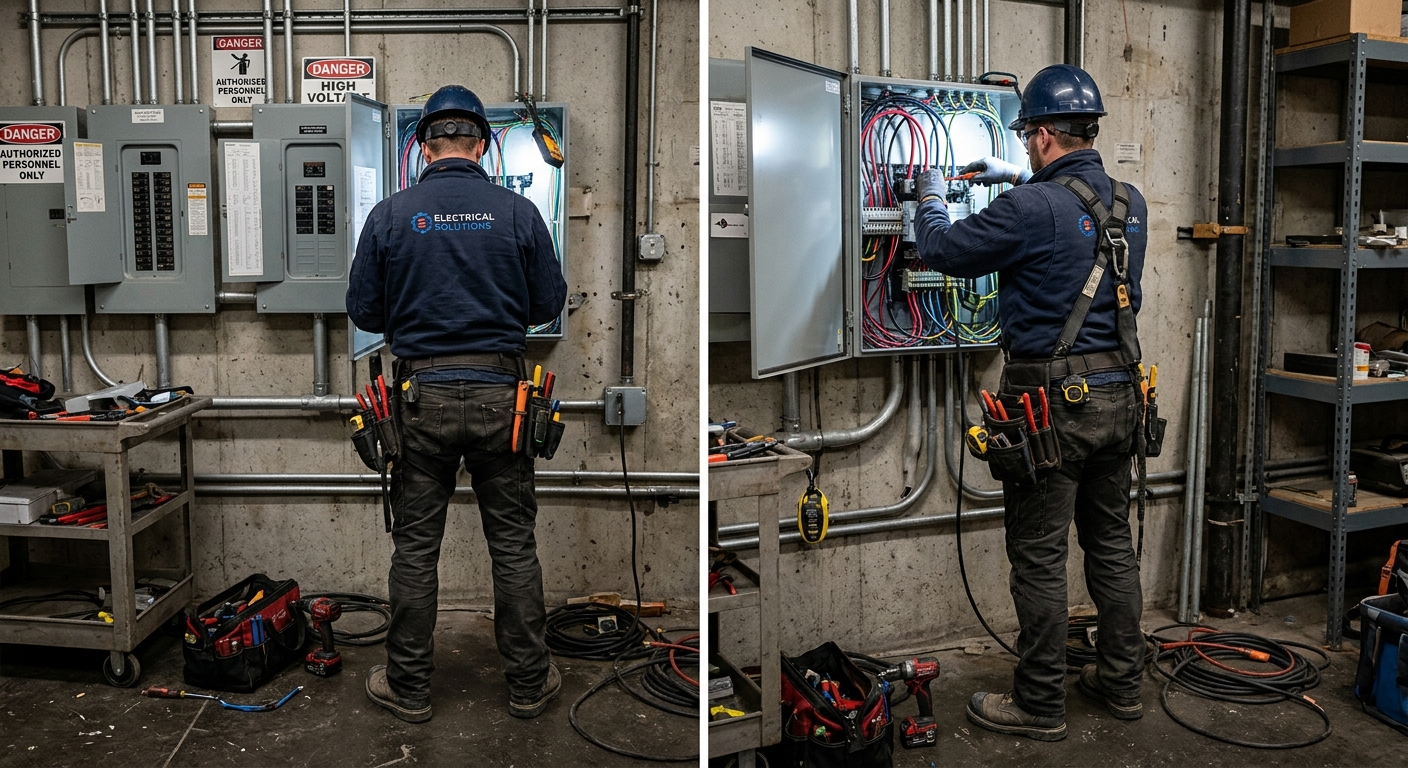
Electrical services and costs in Fort McMurray
In Fort McMurray, electrical work costs are shaped by the city’s mix of established neighbourhoods and ongoing growth—while winters push homes harder on power demand. With a population of 66,573 (Statistics Canada, 2021 Census), the Wood Buffalo–Cold Lake region has enough consistent demand that licensed contractors can be available, but peak season still affects scheduling. Many older properties remain in service with dated wiring and panels, and that’s where most homeowners feel the biggest budget impact: pre-modern electrical systems are common candidates for knob-and-tube removal or other remediation, and load growth now happens faster than many panels were built to handle.
Cost is also heavily influenced by the climate and how people heat their homes. Cold snaps encourage electric resistance heat, heat pumps operating at high demand, and the use of large space heaters in garages and outbuildings. Add in a modern “plug-in lifestyle” (EV charging, induction stoves, additional kitchen circuits) and you start seeing why 60–100A services often become a bottleneck. In areas like Timberlea, where many older homes sit alongside newer builds and renovations, electricians are frequently called for safety-driven upgrades: panel capacity improvements, circuit additions, and service changes to support EV-ready electrical and future-proofing.
Below is a practical cost comparison for the most common service calls and upgrade paths in Fort McMurray, so you can benchmark your quote and understand what’s typically driving the range.
| Service |
Why It's Needed |
Permit Required |
Price Range |
| Panel upgrade — 100A to 200A service |
Increases available capacity for today’s loads (EV charging, heat pumps, kitchen and laundry, garages/shop circuits). |
Yes (service/panel upgrade) |
$3,500–$6,000 |
| EV charger installation (Level 2, 40–50A) |
Supports reliable home charging; often requires dedicated breaker/cable and sometimes a service or panel capacity check. |
Yes (new circuit/charger connection) |
$1,100–$2,500 |
| Knob-and-tube wiring removal and replacement |
Knob-and-tube is typically unsafe for modern use and can trigger insurance non-acceptance; replacement reduces risk and improves code compliance. |
Yes (rewiring/major alterations) |
$6,000–$15,000 |
| Aluminum wiring remediation (CO/ALR connectors) |
Aluminum branch wiring often requires approved connector work or full replacement to reduce loose-connection risk and meet expectations for modern terminations. |
Yes (major wiring alterations) |
$3,000–$8,500 |
| New dedicated circuit (HVAC, appliance, hot tub) |
Reduces nuisance tripping and allows high-demand equipment to run safely within its intended circuit capacity. |
Yes (new circuit) |
$1,200–$3,000 |
| Whole-home rewire (older home, full replacement) |
Needed when wiring is extensive and unsafe/damaged, or when the home must support modern load requirements and full safety upgrades. |
Yes (full rewiring) |
$8,000–$20,000 |
Prices are estimates only and vary by project scope, site access and material selection.
What affects the price of electrical work in Fort McMurray
In Wood Buffalo–Cold Lake, the same “type” of electrical job can come in 30–50% apart across Alberta because the drivers aren’t just labour—they’re access, wiring condition, permit complexity, and how much a contractor must upgrade to make the finished system safe and compliant. For example, a straightforward panel swap is usually cheaper than a full panel upgrade with load calculations, service conductors replacement, and extra breakers/circuits needed for modern heating and EV readiness. That’s why you’ll often see pricing in the panel upgrade/service band of $2,500–$6,000 widen depending on whether the electrician is working with older wiring, a crowded service area, or a service that needs corrective work before inspection.
Housing-stock age is the dominant cost driver here. Homes built before 1950 are more likely to have older wiring types that insurance companies may not readily accept; that can force larger remediation or replacement rather than “patching.” Homes from the 1960s–70s often have 60A or 100A panels that are inadequate for today’s combined loads—EV chargers, heat pumps, and electric stoves used together. Aluminum wiring is also a common theme for homes built roughly between 1965 and 1976; remediation typically requires licensed, approved connector work (CO/ALR) or full replacement, not DIY “fixes.”
Local winters raise the stakes for load planning. When electric resistance backup or supplemental heaters run alongside other loads, the contractor may need to update the service and rebalance circuits instead of simply adding a breaker. On the other hand, a lower-cost job can happen when wiring is accessible (no drywall removal) and the panel location is straightforward. EV adoption is adding a surge in Level 2 charger permit applications, and a 40A versus 50A circuit choice can affect conductor size and breaker cost, nudging some quotes toward the $2,500–$6,000 panel band or keeping them closer to the lower end of the EV charger band.
| Price Factor |
Why It Matters |
Cost Impact |
| Panel size upgrade — 100A to 200A is the standard minimum today |
More capacity means bigger equipment and often service/feeder conductor work to meet modern load requirements. |
Typically increases project cost by moving into the $2,500–$6,000 service upgrade band |
| Wiring type — copper vs. aluminum remediation vs. K&T removal |
Aluminum remediation requires approved terminations; knob-and-tube often requires removal and replacement for safety and code acceptance. |
Can shift jobs from “add a circuit” pricing toward wiring/rewire pricing (often $3,000–$15,000) |
| Number of new circuits — each adds material and labour time |
Every circuit requires breaker, wiring, routing, labour for terminations, and testing. |
Higher circuit count moves cost upward even if panel size is unchanged |
| Permit + ESA/TSBC inspection fee — mandatory for all major work |
Major electrical changes require a permit and inspection to be lawful and to protect insurance coverage. |
Adds fixed administrative/inspection costs on top of labour and materials |
| Labour rate for licensed electricians — journeyman rates in Wood Buffalo–Cold Lake |
Skilled labour is priced for travel, safety practices, and inspection readiness in a northern climate. |
Labour differences can contribute materially to the 30–50% quote spread |
| EV charger amperage — 40A vs. 50A circuit affects cable and breaker cost |
A 50A circuit may require different conductor and breaker sizing; routing and termination work still applies. |
Usually modest, but can push the EV install toward the upper part of the $900–$2,500 band |
| Emergency or after-hours premium |
Urgent callouts often require overtime, truck rolls, and scheduling priority. |
Commonly adds a noticeable premium versus standard hours |
| Load calculation required for service upgrade |
Modern heating, EV, and kitchen loads can exceed assumptions; proper load calcs protect the homeowner and keep inspection smoother. |
May add hours of labour and documentation, especially if panel updates are multi-step |
Permits & regulations in Alberta
In Alberta, the rule is straightforward: beyond changing a light bulb, electrical work must be done by a licensed electrical contractor. Permits are required for panel upgrades, new circuits (including most EV charger installs), rewiring, and service upgrades. Those permitted jobs must pass inspection by the province’s electrical safety authority—handled through accredited processes in Alberta (often referenced through STANDATA in the province). DIY electrical is restricted because safety risk isn’t just about “it works,” it’s about termination integrity, grounding/bonding, wire sizing, and protection coordination that must comply with the Canadian Electrical Code and Alberta requirements.
What typically DOES require a permit: any new breaker/circuit, panel or meter base work, service conductor changes, rewiring portions of a home, adding outlets/fixtures that involve new circuit wiring, and any EV charger connection. What typically does NOT require a permit: swapping a like-for-like fixture (same wiring type and mounting method), replacing a light switch cover, and many “no-contact” bulb swaps—though if you’re unsure, ask the contractor before proceeding.
To verify an Alberta contractor in Fort McMurray, start with the Alberta licensing registry (look up the electrical contractor licence number and ensure it’s active). Next, request a certificate of insurance showing liability coverage; confirm WSIB/WCB coverage for workers (or ask for their clearance documentation). Finally, after the job, ensure you receive permit/inspection documentation and that the contractor can provide a clearance letter or proof of passed inspection where applicable.
When your Fort McMurray home needs an electrical upgrade
Your Fort McMurray electrical system may need attention when you see safety-critical warning signs—especially given how much electricity cold weather can drive. First, breakers that trip regularly are often a sign of overload, failing breakers, or circuits feeding loads they weren’t meant to handle. Second, knob-and-tube wiring is a key concern: the issue isn’t only that it’s old, it’s that insulation and connection reliability are not aligned with modern expectations, and insurance can become a problem. Third, a 60A or 100A service may be inadequate for today’s combination of loads. With EV charging, heat pumps (and sometimes electric backup), and an electric range or major appliances, many homes land beyond what an undersized service can support—this is where a 200A upgrade is commonly the standard solution.
Fourth, aluminum wiring (often found in pre-1976 construction) isn’t always immediately dangerous, but it does require licensed remediation to ensure terminations are correct and stable over time. Fifth, insufficient outlets or relying on extension cords is both a convenience issue and a fire-risk symptom of poor circuit planning. Sixth, missing AFCI/GFCI protection where required is a code compliance and resale issue that can surface during inspections and home sales.
In a northern climate like ours, planned upgrades are usually smarter than repeated “quick fixes.” For example, choosing a proper panel/service plan that keeps you within the $2,500–$6,000 panel upgrade band may prevent repeated tripping—and it can be cheaper than piecemeal added circuits that still don’t solve the underlying capacity problem. If you’re considering EV charging, the earlier you address load capacity, the more likely you’ll keep the EV install closer to the $900–$2,500 EV charger range.
| Warning Sign |
What It Means |
Recommended Action |
Urgency |
Price Band |
| Breakers trip frequently |
Overload, failing components, or improper circuit sizing/protection. |
Electrician diagnosis + load assessment; add circuits or upgrade protection as needed. |
Immediate |
$1,200–$3,000 |
| Knob-and-tube wiring present |
Older wiring type with poor suitability for modern safety expectations; often insurance-sensitive. |
Plan for removal and replacement/rewire sections; ensure correct termination and grounding. |
High priority |
$6,000–$15,000 |
| 60A or 100A panel (inadequate load capacity) |
Not enough headroom for EV charging, heat equipment, and modern kitchen/laundry loads. |
Service/panel upgrade to 200A with proper load calculation. |
High priority |
$2,500–$6,000 |
| Aluminum wiring (pre-1976 construction) |
Requires approved remediation to address connection reliability and meet modern expectations. |
Aluminum remediation (CO/ALR connectors) or selective/full replacement. |
Planned upgrade |
$3,000–$8,500 |
| Insufficient outlets — extension cords everywhere |
People are compensating for circuit planning gaps; extension cords increase risk. |
Add outlets and circuits; consider GFCI protection where required. |
Planned upgrade |
$1,200–$3,000 |
| No AFCI or GFCI protection where required |
Older protection scheme; potential code non-compliance at sale and increased shock/fire risk. |
Add AFCI/GFCI protection or modernize receptacle types as required. |
High priority |
$200–$2,500 |
How to choose a electrical work contractor in Fort McMurray
Choosing the right licensed electrician matters in Fort McMurray because the job isn’t just “wiring”—it’s permits, correct terminations, and inspection readiness in a cold climate where components and routing decisions can affect reliability. Start by confirming the contractor’s Alberta electrical licence using the provincial registry and ask for the licence number before work begins. Then verify liability insurance (request a certificate of insurance) and confirm WSIB/WCB coverage for the crew. If they can’t provide proof, that’s a stop sign.
Next, ask for 2–3 itemised written quotes. The best quotes break out labour hours, materials (panel/chargers/breakers/cable), permit/inspection handling, and any allowance for drywall access or conductor re-routing. Be clear about exclusions: what’s not included (e.g., trenching, specialty equipment, disposal of old panels/wiring)? Ask whether permit pulling is included and whether they’ll take care of any required inspection scheduling.
Warranty is another differentiator. Confirm the workmanship warranty length (often 1–2 years is common, but ask for the exact term), whether there’s a separate product/manufacturer warranty, and whether warranties are transferable if you sell your home. For payment, avoid large upfront payments: never go beyond 10–15% before work starts, and hold a portion until final testing and completion. Finally, insist on a written start date and completion estimate, and make sure they document the final test/commissioning results.
- Licence number and active status from the Alberta registry
- Certificate of insurance for liability coverage
- WSIB/WCB clearance or coverage confirmation
- Itemised quote (labour, materials, permits/inspection handling, testing)
- Clear scope: what circuits are added/changed and where the wiring routes
- Permit pull included (or confirmed responsibility)
- Disposal and cleanup plan for old materials
- Manufacture/model listed for panels, breakers, and EV chargers
- Workmanship warranty term in writing
- Start date and completion window documented
- Payment schedule with a holdback until final acceptance
- Photos/documentation of key stages (panel work, terminations, testing)
Red flags I commonly see in Fort McMurray include: contractors who won’t provide their licence/insurance information, quotes that are “lump sum” with vague scope, unclear permit responsibility, requests for large upfront payments with no schedule, and installers who won’t discuss load calculations or testing before calling the job finished.
Frequently asked questions — electrical work in Fort McMurray
How long does a rewiring job take?
In Fort McMurray, rewiring timelines depend heavily on how much of the home can stay closed-up (access behind walls/basement areas) and how extensive the wiring is. A small “targeted” replacement (for example, a few rooms or a specific portion of the branch circuit network) might take several days, but whole-home rewire is more like weeks because crews must remove old wiring, run new cable, install protection devices, and then test thoroughly for continuity/insulation and functional performance. If the existing wiring includes knob-and-tube, the removal and replacement scope can expand once the contractor opens walls and confirms how far it goes. Budget-wise, whole-home rewires in this region can fall around the $8,000–$20,000 band, and the schedule typically reflects that broader safety work and permit/inspection steps in Alberta.
Why do my breakers keep tripping?
Breaker trips usually point to one of three issues in Alberta homes: overload (too much load on one circuit), a circuit that’s miswired/undersized for the current use, or a failing breaker/connection. In Fort McMurray, winter loads can make this worse—space heaters, heat equipment, laundry, and kitchen appliances may be running at the same time, pushing the circuit beyond its intended capacity. It can also happen after adding new devices if someone added loads without adding circuits. A licensed contractor should identify which breaker is tripping, what loads are on that circuit, and whether there’s a wiring or termination problem. The fix might be as simple as balancing loads, but if you’re seeing repeated nuisance trips, it’s often a sign you need added dedicated circuits or—if you’re consistently near capacity—service/panel upgrade planning in the $2,500–$6,000 range.
How do I compare electrical quotes?
To compare quotes in Fort McMurray, insist on itemisation rather than a single lump sum number. You want the breakdown: labour hours, materials (panel model, breaker amperage, EV charger model if applicable, conductor type), permitting and inspection handling, and any testing/commissioning. Check what’s excluded—common exclusions include drywall patching, trenching/sidework, disposal fees, and any upgrades required after the electrician opens the walls (especially in older homes). Also compare scope clarity: one quote might include load calculation and an electrical upgrade to support EV/heat loads, while another might only replace a breaker. That’s how two “panel upgrades” can end up in different parts of the $2,500–$6,000 band. Finally, verify the contractor’s Alberta licence and insurance and ask about workmanship warranty length so you’re comparing risk and quality, not just price.
How long does a panel upgrade take in Fort McMurray?
A panel upgrade in Fort McMurray often takes one workday to a couple of days, depending on how complex the service change is and whether wiring access is straightforward. Typical factors that add time include: needing to update feeder/service conductors, adjusting grounding/bonding, replacing or repositioning the panel for code requirements, and completing load calculations and circuit planning. If the existing panel area has accessibility problems (tight clearances, old wiring issues, or corrosion), the schedule can stretch—especially when the contractor must make the system inspection-ready in Alberta. Timing also matters seasonally because cold weather can affect working conditions and material handling. Even if labour time is short, the permitting and inspection steps are still required, and inspection timing can affect when the system can be put back fully into service. For many homeowners, that’s why a panel upgrade sits in the $2,500–$6,000 band—equipment and compliance work both drive cost and time.
What is a GFCI outlet and where is it required in Alberta?
A GFCI (ground-fault circuit interrupter) outlet is a protective device that quickly shuts off power when it detects an unsafe ground fault—reducing shock risk. In Alberta, GFCI protection is required in specific locations based on the Canadian Electrical Code and Alberta inspection expectations. Common examples include areas with water exposure and damp locations, such as bathrooms, kitchens near sinks (depending on configuration), garages, outdoors, unfinished basements where required, and within certain receptacle locations near sinks. In older Fort McMurray homes, it’s not unusual to find receptacles that were installed before modern protection requirements; those may require upgrades during renos, new circuit additions, or when you open walls for rewiring. If your quote includes bringing protection up to current expectations, even a smaller job can sit in the $200–$2,500 band depending on how many devices and circuits are affected, labour access, and whether you’re adding new wiring.
How do I know if my Fort McMurray home has aluminum wiring?
The quickest ways to identify aluminum wiring are visual and by documentation. Many panels and device boxes have conductors with markings that indicate aluminum (or sometimes “AL” or specific insulation markings on the wire). Another clue is the installation era and building style: aluminum branch wiring is commonly associated with homes built roughly between 1965 and 1976. If you’re unsure, a licensed electrician can confirm by checking the wire type in accessible junctions and verifying terminations at receptacles/switch boxes and at the panel. They’ll also look for whether the proper approved termination methods are already in place. Aluminum wiring isn’t automatically “immediate danger,” but it does require licensed remediation when connections are not correct for modern requirements. Depending on condition and extent, remediation using CO/ALR connectors or selective replacement can land around the $3,000–$8,500 band, while more extensive rewiring can move toward higher wiring/rewire ranges.